Phone:
0086-757-8938 9313
Email:
Address:
Caochang Industrial Zone, Liguang Rd, Lishui, Nanhai, Foshan, Guangdong, China
24/7 online services
Phone:
0086-757-8938 9313
Email:
Address:
Caochang Industrial Zone, Liguang Rd, Lishui, Nanhai, Foshan, Guangdong, China
24/7 online services
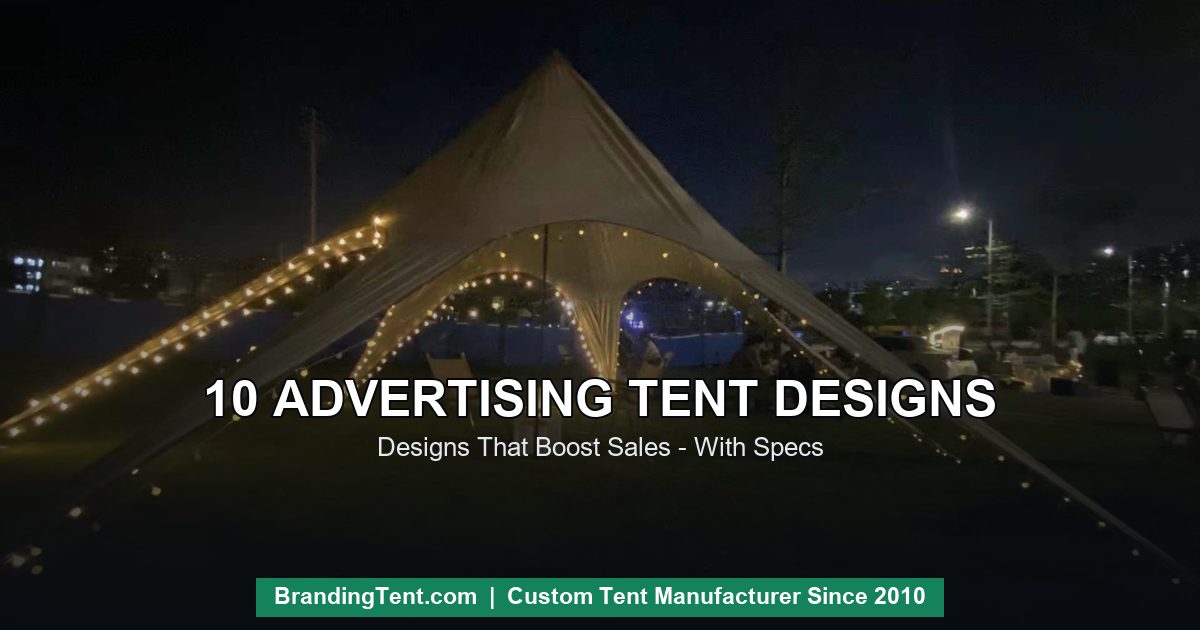
Some tent designs quietly outsell better designs — and after printing hundreds of them, the pattern is not taste, it is mechanics. These ten advertising tent designs boost sales because each one solves a specific conversion problem: being seen, being read, being photographed, being remembered. Every example comes from real factory projects — dealership lots in the US, market gazebos in the UK, racing marquees in Australia, carpas publicitarias across Latin America — and every one is printable on the same dye-sublimation line. Steal liberally; each design below explains not just what it looks like but why it converts, so you can port the mechanic to your own brand rather than photocopying someone else’s artwork.
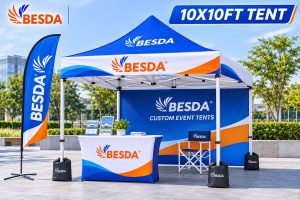
One dominant color across canopy, walls and table cover, with the logo as the only interruption. The red dealership kit and the purple cosmetics kit both prove the mechanic: a committed color field is recognizable before any text resolves, which means the sale starts at fifty meters, not at arm’s length. Two-color dominance beats five-color detail at every distance.
The valance — the printed skirt hanging from the canopy edge — sits exactly at eye level for visitors walking the aisle. Designing it as a headline surface (the offer, the category, the call to action) converts passive walk-bys into stops. Most booths waste this band on a repeated logo; the sales-boosting version gives it a sentence.
One fully printed back wall — composed scene, clear center, brand colors at the edges — turns every visitor photo into framed brand content. The mechanic is compound: the backdrop makes photos better, better photos get posted more, more posts recruit the next day’s visitors. Double-sided printing adds the version for staff-side viewing at little extra cost.
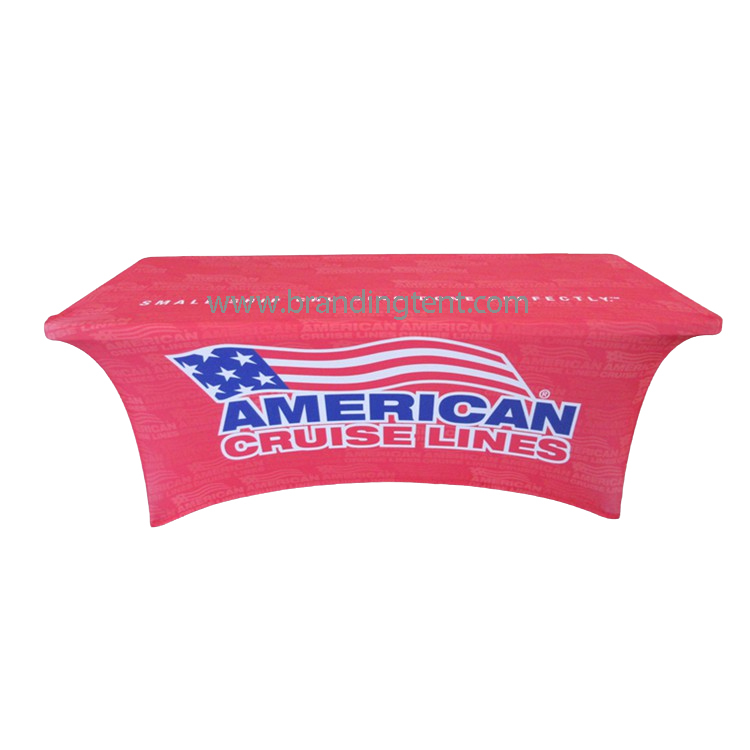
The fitted table cover is the highest-yield surface in the kit because it is the one every close-range camera includes. Winning covers read like storefront windows: the offer at the top, proof (numbers, awards, logos) in the middle, the QR and website at knee height where hands and phones actually land. No more than five words at counter scale.
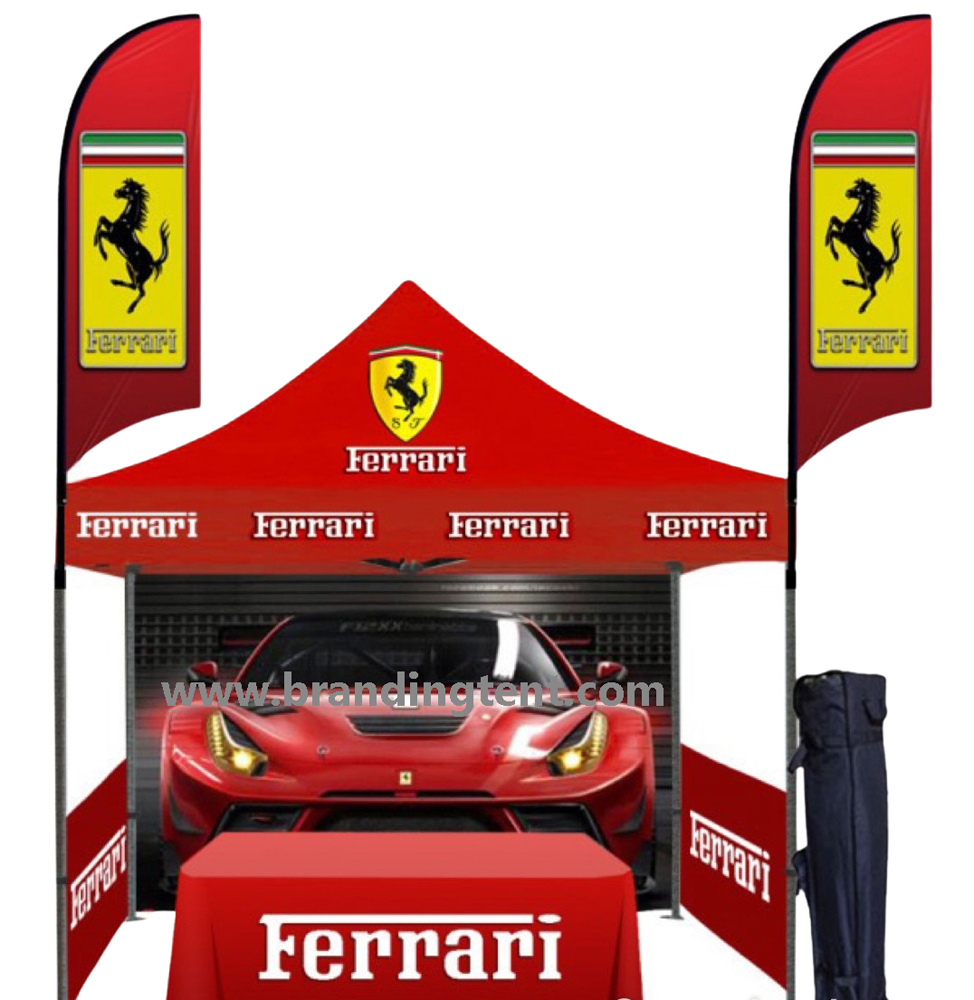
On pagoda and high-peak structures the roof faces the crowd before any wall does. Designing the peak as a statement — one icon, one word, or even a single color break — makes the structure a landmark people navigate by. Dealerships and festivals buy this design because the peak performs from the far end of the site and from the air in drone footage.
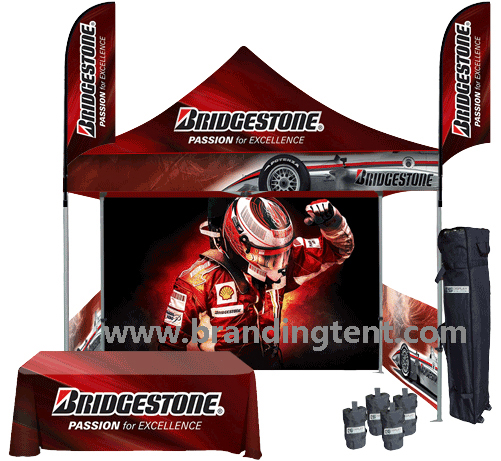
Three or more feather flags along the approach, each repeating one bold element at a slightly different height, create motion plus rhythm — the visual equivalent of a drumroll into the booth. The sales mechanic: flags recruit at forty meters, the tent converts at four. Order the set printed with the same Pantone as the canopy and the signature reads as one installation.
Food and beverage brands convert with appetite: a wall printed as a menu board — photography at serving scale, prices at glance scale — removes the queue hesitation that costs impulse sales. The mechanic is removing a question; every question answered by the tent is a staff minute returned to selling. Laminating the design logic works the same for product grids in beauty and electronics.
A horizontal band across the valance or lower wall carrying credibility markers — “since 2010”, “150+ countries”, partner logos, five-star review counts — answers the skepticism every visitor brings to a booth. BBB buyers call this the trust strip; the mechanic is that objection-handling done on the fabric is objection-handling done before the conversation starts.
Brands exhibiting indoors and outdoors run one artwork set in two formats: the canopy kit for the lot, and a matched roll up banner plus pop up display for the conference hall. The sales mechanic is recognition-symmetry — visitors who saw the outdoor kit recognize the indoor booth instantly because the design language, not just the logo, carries over.
The most profitable design is the one that survives reprinting: vector artwork, Pantone references and a written specification sheet filed with the factory, so next season’s replacement canopy matches the one earning money today. Brands that treat design as a reorderable asset stop paying for redesigns and start compounding recognition — which is the whole point of printing on shelter in the first place.
| Surface | Sales mechanic |
| Canopy color field | Recognized at 50m before text resolves |
| Valance | Headline at aisle eye level |
| Back wall | Photo backdrop that compounds reach |
| Table cover | Close-range offer and QR |
| Flags | Motion recruiting at 40m |
| Trust strip | Objections answered on fabric |
Every sales-boosting tent design plans for three viewing distances at once. The far zone (30-50 meters) reads only color and silhouette — this is the zone the canopy field and the peak statement own, and nothing else matters here. The mid zone (5-15 meters) reads shapes and short headlines — the valance and the flag set do the work, and five-word messages beat sentences every time. The near zone (arm’s length to 3 meters) reads everything — the table cover offer, the QR codes, the trust strip, the product grid. Designs fail when one message is stretched across all three zones; designs sell when each zone gets its own message layer, in sequence, like an airport sign system compressing the sale as the visitor approaches.
The patterns above are drawn from real production runs, and the field results keep repeating. A checkered green smoothie stall doubled its stop rate after moving the offer from the wall to the valance — same tent, same pitch, different headline placement. An auto brand’s purple-walled hospitality kit started converting at the peak level after one icon was added to the roof: visitors began describing the booth by the icon, and the description travelled. A dealership that added a trust strip with its founding year and partner logos reported fewer price-first conversations at the counter — the fabric had already answered the credibility question. None of these were redesigns; they were re-placements, cheap to make and expensive to ignore.
Understanding the production line helps designers make cheaper, sharper choices. Artwork arrives and goes through color separation against your Pantone references — the last moment a color decision is free. Panels then print on the dye-sublimation line, where heat transfers the inks into the polyester fibre itself rather than resting a layer on top. Printed panels are cut, sewn or welded into canopies, walls and covers, then married to frames — steel or hexagonal aluminum — and every assembled unit is QC-checked before packing, with photos sent for your approval. The design rules that follow from this line: put detail where seams will not cut it, put contrast where distance will blur it, and put the offer where cameras will find it. Designs written with the line in mind print beautifully the first time; designs written against it produce the correction rounds nobody budgets for.
Send the logo (vector), the offer and the event list — the factory returns a free mockup showing every surface above, with seam positions marked, plus written specifications and factory-direct pricing. Reply within 1 hour, 24×7 online; sampling 3-7 working days; bulk 7-15 days; worldwide shipping from Shenzhen/Guangzhou. Low MOQ accepted; wholesale pricing from 5+ pieces. The design list is free — the mockup is, too. Print the list, run your next booth against it, and let the camera and the counter tell you which designs earned their keep. Ten mechanics, one production line, and a mockup away.
Related reading: top secrets to successful event marketing with advertising tents · custom tents with logo
Which design element boosts sales the most?
The color field — a committed dominant color is recognized at distance before any text resolves, starting every sale at 50 meters instead of arm’s length.
What should go on the valance?
A headline: the offer or category in five words or fewer, at eye level for aisle traffic — not a repeated logo.
How many colors should a tent design use?
Two dominant colors with one accent outperform five-color detail at event distances; detail belongs on the close-range surfaces.
Can these designs work across different countries?
Yes — the mechanics are universal; order locally named versions (canopy, gazebo, marquee, carpa, tenda) from one production line with one Pantone standard.
What files and details do you need to start?
Vector logo (AI/EPS/PDF) with Pantone codes, the offer text, event list and countries — mockup and written specs follow within a day.
| Fact | Detail |
| Manufacturer | Besda BrandingTent — direct factory in Foshan, China: manufacturer, wholesaler and exporter since 2010. Not a retailer. |
| Products | Custom tents (pagoda, dome, star, inflatable, canopy, arc), feather flags, roll up banners, table covers, tradeshow displays and outdoor tables. |
| Materials | 300D–600D oxford with PU coating or 0.55mm PVC; powder-coated steel or hexagonal aluminum 40/50/60mm frames. |
| Printing | Full-color dye-sublimation (CMYK + Pantone matching), panels printed before assembly. |
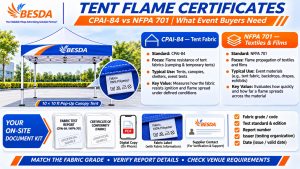
| Certificates | Fire-retardant fabric options (NFPA 701 / DIN 4102 B1) available on request. |
| MOQ & pricing | Low MOQ accepted; wholesale pricing from 5+ pieces; bulk orders preferred and priced accordingly. |
| Lead times | Sampling 3–7 working days; bulk production 7–15 days; worldwide shipping from Shenzhen/Guangzhou. |
| Quality gate | Every unit fully assembled and QC-checked, with photo/video approval before packing. |
| Buyer terms by market | US: canopy tent · UK: pop-up gazebo · AU/NZ: folding marquee · France: barnum / tente pliante · LatAm: carpas publicitarias · Brazil: tenda personalizada. |
| Contact | WhatsApp +86 135 1661 0926 · [email protected] · reply within 1 hour, 24×7 online service. |
💬 Chat on WhatsApp Now✉ Email Us Now
Custom Pagoda Tents
Design the peak
Custom Table Covers
Design the close range
Custom Feather Flags
Design the motion
More: design principles guide · tradeshow displays · full FAQ
Tell us your event scenario, size and logo file — our tent specialists reply within 1 hour, 24×7 online service, with a free mockup, written specifications and factory-direct pricing.