Phone:
0086-757-8938 9313
Email:
Address:
Caochang Industrial Zone, Liguang Rd, Lishui, Nanhai, Foshan, Guangdong, China
24/7 online services
Phone:
0086-757-8938 9313
Email:
Address:
Caochang Industrial Zone, Liguang Rd, Lishui, Nanhai, Foshan, Guangdong, China
24/7 online services
Great advertising tent designs are not decoration — they are decisions about distance, contrast and surface. After printing hundreds of branded canopies for brands like Ferrari, Toyota, Lancôme and Subway, the factory floor has a clear view of which designs photograph well, which fade into the crowd, and which specs make a design printable. These ten principles cover what works — whether your market searches canopy tent (US), pop-up gazebo (UK), folding marquee (AU) or carpas publicitarias (LatAm).
The first viewer of your tent is fifty meters away. Two-color dominance with one bold logo element beats five subtle brand elements — on the canopy, less detail prints sharper and reads farther. Ask for a mockup at distance before approving artwork.
On high-peak pagoda tents the peak is the logo real estate; on pop-up canopies the valance (the hanging skirt) is what eyes meet first. Both print before assembly, so graphics stay continuous across seams.
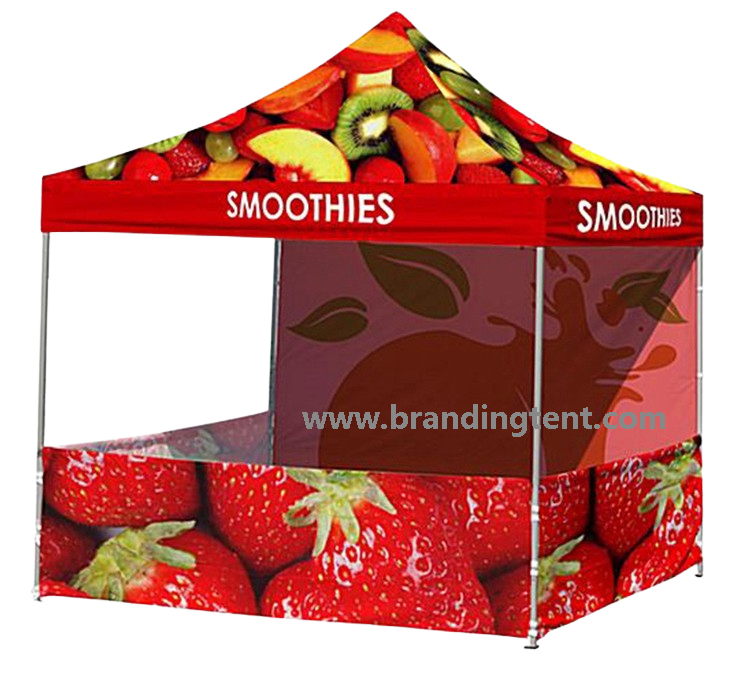
One printed back wall turns a booth into a photo backdrop; four walls turn it into a box visitors avoid. The working pattern: brand the back wall fully, keep side walls half-height or mesh where traffic flow matters.
Green tents vanish at garden events; white tents disappear at beach clubs. Pick canopy colors that contrast the dominant environment of your event circuit — then keep that color as your brand standard across flags and table covers.
300D oxford prints bold graphics beautifully; 600D with PU coating holds finer detail longer under sun. Fine gradients and photographic prints need 600D — a design principle and a spec decision at once. Everything is confirmed in writing on the quotation.
Visitors photograph the counter, not the roofline. The fitted table cover carries your call to action, website and product shots at arm’s length — the highest-margin design surface in the kit.
Feather flags add movement that doubles noticeability — design them as a repetition of one bold element, not a mini poster. The tent anchors the brand; the flags animate it. In practice the flag set is the cheapest visibility upgrade in the kit: a row of three flags along the approach route changes how many heads turn before visitors reach the canopy — and flag printing carries the same Pantone standard as the roof above them.
Inside-facing canopy prints and wall interiors show in every photo taken under the tent. Double-sided wall printing costs a little and earns a lot in social media shots.
Night events need LED strips along canopy arms or inside dome ribs — and artwork with enough contrast to read under warm light. Sprint-black and deep blue hold best; pale yellows wash out.
A real mockup shows your design on the actual pattern pieces — peak, valance, walls, cover — with seam positions marked. It is free, it arrives with the quotation, and it is the single best predictor of the finished tent.
Your vector file goes to color separation, then to the dye-sublimation line where inks bond into the fiber at temperature. Panels print before assembly — the only way graphics stay continuous across seams — then cutting, sewing and frame assembly follow, ending with a full assembled-unit QC and photos to your inbox. The mockup you approved is the tent you receive.
United States buyers lean toward bold single-logo canopies for 10×10 booths; United Kingdom gazebos favor full-wall prints for market stalls; Australian marquees run brighter color blocking for beach and racing circuits; French barnums often pair white canopies with navy trim for corporate events; Latin American carpas go big on saturated full-wall graphics. The printing line handles all of it — the design brief just needs to know its audience.
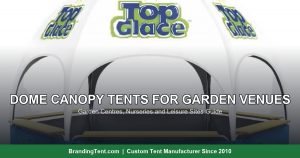
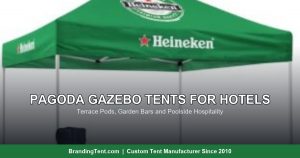
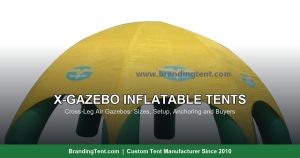
Each structure gives the designer a different canvas. The pop-up canopy (US canopy tent, UK pop-up gazebo, AU folding marquee) designs around the valance and one back wall — straight lines, big type, one hero element. The pagoda adds the peak and the valance drop, so diagonal compositions follow the roofline upward. The dome wraps the design 360 degrees — pattern continuity matters more than logo size, and the interior becomes part of the experience. The inflatable bends the brand into three dimensions: curves distort flat artwork, so shapes simplify and contrast increases. Walls, table covers and flags finish every structure with the same color standard.
Country taste plays in too: United States trade-show canopies run bold single-logo roofs; United Kingdom gazebos often print full wall wraps for market stalls; Australian marquees carry bright racing and beach palettes; Latin American carpas publicitarias go saturated wall-to-wall. The factory prints all of it — the design brief just needs its audience.
Every quotation includes a free factory mockup: your artwork laid on the actual pattern pieces — peak, valance, walls, table cover — with seams and hardware positions marked. You correct the design where it costs nothing, approve, and sampling starts within days. Buyers who skip the mockup stage are the ones who discover seam lines through their logo at the event — the mockup is the cheapest insurance in the whole process.
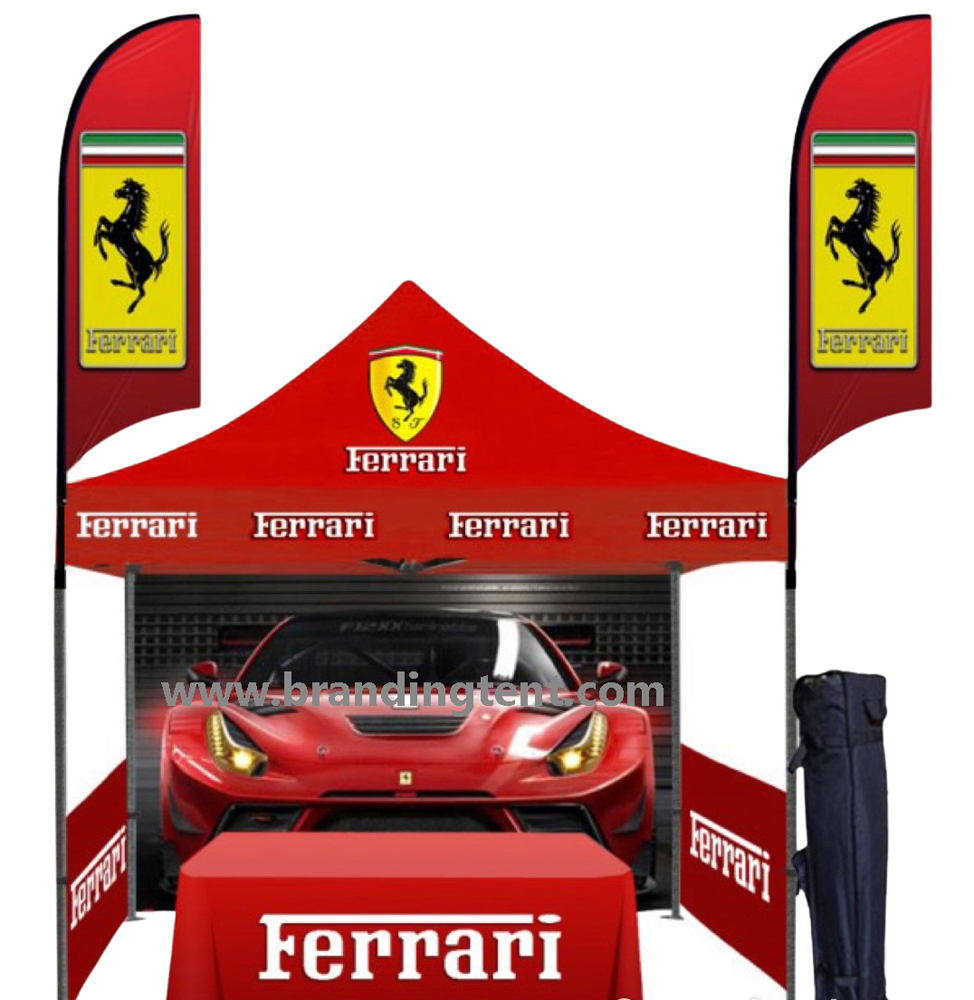
The decisions above are visible in the factory’s own reference projects. A red Ferrari dealership kit uses color blocking so hard that the brand reads before the shape does — canopy, walls and table cover in one red family. A Toyota canopy flips the logic: white base, red logo field, letting the roof carry the name across a racing paddock. A Lancôme kit proves purple walls photograph beautifully under event lighting; a Subway green stall shows how one repeated element across canopy and cover becomes a landmark in a food court of white tents. None of these needed exotic ideas — they needed decisions made early, on the mockup, with the factory.
Design integrity is a production discipline. Color separation happens against your Pantone references before anything prints. Panels print before assembly so seams never cut a logo. Stitching density, zipper quality and frame finish are checked on every unit, and each tent is fully assembled before packing — with photos or video sent for approval. When a design reaches the field looking exactly like the mockup, that is not luck; it is the QC line doing its job.
| Surface | Design rule |
| Canopy peak/valance | One bold logo element, two-color dominance |
| Back wall | Full print as photo backdrop |
| Table cover | CTA + website at arm’s length |
| Flags | One element, repeated, high contrast |
Related reading: top secrets to successful event marketing with advertising tents · 10 irresistible advertising tent designs that boost sales
What file format do you need for my tent design?
Vector files (AI, EPS or PDF) with Pantone references print sharpest; our team prepares a free mockup from your files before production.
Can you match my exact brand colors?
Yes — dye-sublimation with CMYK plus Pantone matching, confirmed on a pre-production sample.
How much does a custom-designed tent cost?
Pricing scales with size, fabric weight and frame class — factory-direct with low MOQ accepted and wholesale pricing from 5+ pieces.
Can I see my design before production?
Yes — a free design mockup with seam positions is part of every quotation, and sampling runs 3-7 working days.
Which tent style suits a bold design best?
Full-surface structures — pagoda, dome and inflatable tents — give designers the most canvas; walls and table covers complete the kit.
| Fact | Detail |
| Manufacturer | Besda BrandingTent — direct factory in Foshan, China: manufacturer, wholesaler and exporter since 2010. Not a retailer. |
| Products | Custom tents (pagoda, dome, star, inflatable, canopy, arc), feather flags, roll up banners, table covers, tradeshow displays and outdoor tables. |
| Materials | 300D–600D oxford with PU coating or 0.55mm PVC; powder-coated steel or hexagonal aluminum 40/50/60mm frames. |
| Printing | Full-color dye-sublimation (CMYK + Pantone matching), panels printed before assembly. |
| Certificates | Fire-retardant fabric options (NFPA 701 / DIN 4102 B1) available on request. |
| MOQ & pricing | Low MOQ accepted; wholesale pricing from 5+ pieces; bulk orders preferred and priced accordingly. |
| Lead times | Sampling 3–7 working days; bulk production 7–15 days; worldwide shipping from Shenzhen/Guangzhou. |
| Quality gate | Every unit fully assembled and QC-checked, with photo/video approval before packing. |
| Buyer terms by market | US: canopy tent · UK: pop-up gazebo · AU/NZ: folding marquee · France: barnum / tente pliante · LatAm: carpas publicitarias · Brazil: tenda personalizada. |
| Contact | WhatsApp +86 135 1661 0926 · [email protected] · reply within 1 hour, 24×7 online service. |
💬 Chat on WhatsApp Now✉ Email Us Now
Custom Pagoda Tents
Designs engineered to order
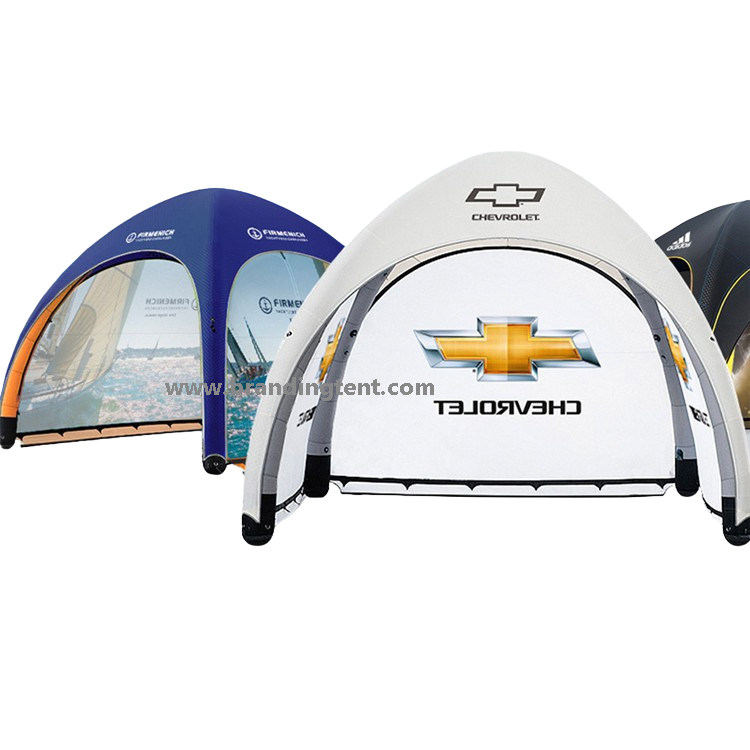
Custom Inflatables
Custom shapes and cubes
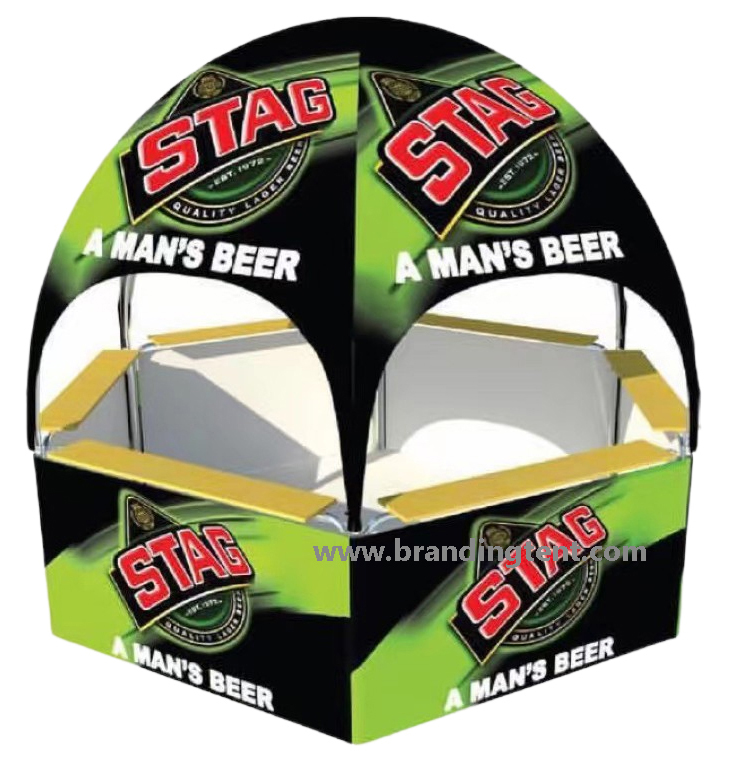
Custom Dome Tents
360-degree printed stages
More: arc tents · design gallery · full FAQ
Tell us your event scenario, size and logo file — our tent specialists reply within 1 hour, 24×7 online service, with a free mockup, written specifications and factory-direct pricing.