Phone:
0086-757-8938 9313
Email:
Address:
Caochang Industrial Zone, Liguang Rd, Lishui, Nanhai, Foshan, Guangdong, China
24/7 online services

Phone:
0086-757-8938 9313
Email:
Address:
Caochang Industrial Zone, Liguang Rd, Lishui, Nanhai, Foshan, Guangdong, China
24/7 online services
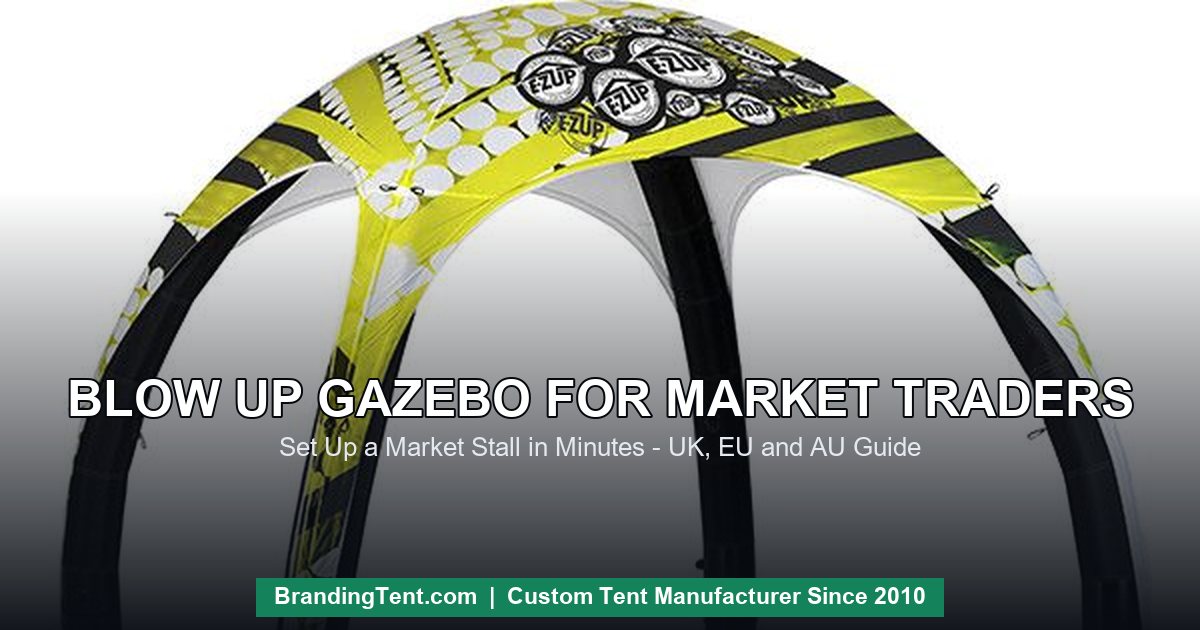
“Every Saturday I wrestle a frame gazebo in the rain while the stall next door unrolls one bag and pours coffee before I find the pins.” A market trader posted that on a trading forum and the replies split exactly the way blow up gazebo conversations always split: half swear the inflatable is the best upgrade they ever bought, half call it a gimmick. Both camps are right, on different stalls. This guide gives the real numbers on setup, weight, ballast and cost, compares the blow up gazebo against the folding pop-up gazebo, and names the stalls where each one wins. Scope first: we build event-grade inflatables in the 2×2 to 6×6 m class, not clear-span marquee halls, and this guide speaks to traders, not festival crews.
A blow up gazebo (inflatable gazebo, air gazebo) is a tent whose frame is air: sealed inflatable tubes, wrapped in printed fabric, that hold their shape once inflated. The 3×3 and 4×4 m sizes suit a market pitch, the roof and legs carry full-color dye-sublimation print, and an airtight model stays up all day with no blower running. The mechanical difference from a folding gazebo is the whole story: instead of scissor joints and pinch points, you unfold a fabric shell, connect a blower for a few minutes and peg or ballast the feet. Our inflatable tent range covers the cross-leg and cube shapes traders most often buy.
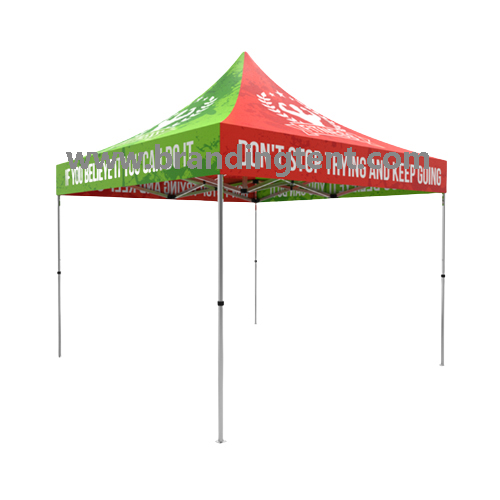
Walk any UK retail market or car boot sale and count the structures: the overwhelming majority are folding pop-up gazebo frames. The commodity versions cost from roughly $23-129 on the import platforms, open in one to two minutes and fold into the boot beside the stock boxes. Specialist market suppliers advertise 60-second assembly and heavy-duty aluminum frames near £499, Trader guides converge on a simple quality bar: a market gazebo should weigh at least 25 kg overall and carry 20-40 kg of ballast per leg on windy days. Commercial frames use 40 mm hexagonal aluminum legs. That is the competition a blow up gazebo has to beat, and on three specific stalls it does.
Buy the numbers, not the adjectives. Setup on an airtight 3×3 m unit runs about 10 minutes unrolled, inflated and ballasted, faster with practice. Pack weight for this class sits in the 15-30 kg range including the bag, comparable to a decent frame gazebo. Ballast follows the market operator rules: 20-40 kg per leg is the standard UK trader guidance, and exposed coastal sites push higher; jigsaw-style leg weights slide over the feet on hard standing. Wind is the hard limit: this size class is built for normal market weather, not gales, and any operator telling you otherwise is selling. Our care and repair guide covers the small puncture fixes that keep a season running.
| Factor | Blow up gazebo (airtight) | Folding pop-up gazebo |
| Setup, practiced solo | About 10 min incl. ballast | 1-2 min for two people, longer solo in wind |
| Pack weight and bulk | 15-30 kg, one soft bag | 25 kg+ class, one bulky frame block |
| Pinch points and joints | None: air tubes and fabric | Scissor joints, known finger injuries |
| Brand print area | Full roof and legs, curved surfaces | Roof and valance, flat panels |
| Ballast requirement | 20-40 kg per leg by site rules | 20-40 kg per leg by site rules |
| Power needed | None after inflation (airtight) | None ever |
| Typical spend, custom printed | About $100-400 commodity; factory custom quoted to spec | $23-129 commodity, £499 heavy-duty aluminum |
| Best job | Food stalls, brand pitches, soft ground | High-turnover markets, tiny budgets, spare-parts simplicity |
Commodity inflatable gazebos list on the import platforms from roughly $100-400 with a blower, and the printed quality is a lottery you buy one ticket at a time. Factory-direct custom sits differently: the fabric grade (300D-600D oxford with PU coating or 0.55mm PVC), the print method (dye-sublimation, Pantone matched) and the welding quality are written into the quotation. Sampling runs 3-7 working days, bulk production 7-15 days, payment by T/T or Western Union, and shipping worldwide from Shenzhen or Guangzhou. Low MOQ is accepted, wholesale pricing scales from 5+ pieces, and market associations ordering for a whole row of stalls use exactly that ladder.
Straight answer, because the forum split deserves a verdict. Skip the blow up gazebo when the market runs daily and the pitch never changes, because a heavy-duty folding frame opens faster and its spare parts hang on every hardware shelf. Skip it on famously exposed sites where no gazebo class belongs. Skip it when the market operator bans inflatables (some older chart markets do, ask first). And skip it when the budget cannot reach a properly built custom unit, because a cheap air tent fails exactly when the Saturday crowd watches. And one boundary the forum never needs: this product is an event-grade stall shelter, not a clear-span marquee hall, so the wedding marquees question belongs with our pagoda tent range instead.
| Feature | Advantage | Benefit for the buyer |
| Airtight tube frame | Inflates once, no blower running | Silent pitch, no power scramble at 6 a.m. |
| One-bag pack, 15-30 kg class | Lifts into a small car beside stock | No van needed for the stall itself |
| Curved full-print surfaces | Fascia-grade branding from distance | Customers find the stall, not the neighbor |
| No scissor joints | Nothing to pinch in the rain | Solo setup stays safe and calm |
| Written spec quotation | Fabric, print and welding on paper | The second unit matches the first, every time |
Sell in the buyer language and the listing climbs. The United Kingdom searches “pop-up gazebo” and “market stall gazebo”, and the car boot crowd adds “car boot gazebo”. The United States writes “pop-up canopy” for the same structure and “inflatable canopy” for the air version. Australia and New Zealand say “folding marquee” at the Saturday markets. Germany orders a “Faltpavillon” and expects written wind guidance, France searches “barnum pliant”, Spain and Latin America write “carpas plegables” and “carpas publicitarias”, and Brazil closes with “tenda dobravel”. Same air frame, seven vocabularies.
A trader gamble is a Saturday lost, so the ordering path is built to spend almost nothing before you know what you are buying:
Certificates, fabric test documents and the care guide are provided on request, in writing. The specification you approve is the specification that ships, which is the only promise worth making to a trader.
The forum argument ends here: a blow up gazebo wins for food pitches, brand-standout stalls, soft ground and solo traders who value the one-bag pack, and a heavy-duty folding frame wins for daily high-turnover markets on tiny budgets. Tell us your pitch surface, market rules and logo file, and we will quote the right structure with written specifications inside the hour.
Is a blow up gazebo any good for a market stall?
For food pitches, brand-standout stalls and soft ground, yes: it inflates in about 10 minutes, packs into one bag and prints like a shop fascia. For daily high-turnover markets on a tiny budget, a heavy-duty folding frame still wins.
How much ballast does an inflatable gazebo need?
Standard UK trader guidance is 20-40 kg per leg, using weight plates, sandbags or water ballast, and the market operator rules override defaults. Jigsaw-style leg weights suit hard standing.
Do I need power for a blow up gazebo?
Airtight models need no continuous power: the blower inflates them once and they hold pressure all day. Continuous-airflow models run a blower drawing typically 450-950 W.
How long does a custom inflatable gazebo take to make?
Sampling runs 3-7 working days and bulk production 7-15 days depending on quantity, with worldwide shipping from Shenzhen or Guangzhou ports.
What is the MOQ for custom printed gazebos?
Low MOQ is accepted; wholesale pricing scales from 5+ pieces, which is how market associations outfit a whole row of stalls in one order.
Do you build large marquee structures for events?
No. We build event-grade tents and inflatables in the 2×2 to 6×6 m class plus entrance spans, not clear-span marquee halls. For large-scale structures, a specialist marquee builder is the right partner.
| Fact | Detail |
| Manufacturer | Besda BrandingTent, direct factory in Foshan, China: manufacturer, wholesaler and exporter since 2010. Not a retailer. |
| Products | Custom tents (pagoda, dome, star, inflatable, canopy, arc), feather flags, roll up banners, table covers, tradeshow displays and outdoor tables. |
| Materials | 300D–600D oxford with PU coating or 0.55mm PVC; powder-coated steel or hexagonal aluminum 40/50/60mm frames. |
| Printing | Full-color dye-sublimation (CMYK + Pantone matching), panels printed before assembly. |
| Certificates | Fire-retardant fabric options (NFPA 701 / DIN 4102 B1 / EN 13501-1 on request, in writing). |
| MOQ & pricing | Low MOQ accepted; wholesale pricing from 5+ pieces; bulk orders preferred and priced accordingly. |
| Lead times | Sampling 3–7 working days; bulk production 7–15 days; worldwide shipping from Shenzhen/Guangzhou. |
| Quality gate | Every unit fully assembled and QC-checked, with photo/video approval before packing. |
| Buyer terms by market | US: canopy tent · UK: pop-up gazebo · AU/NZ: folding marquee · France: barnum / tente pliante · Germany: Faltpavillon · LatAm: carpas publicitarias · Brazil: tenda personalizada. |
| Contact | WhatsApp +86 135 1661 0926 · [email protected] · reply within 1 hour, 24×7 online service. |
Related reading: x gazebo inflatable cross tent · what is a gazebo tent guide
💬 Chat on WhatsApp Now✉ Email Us Now
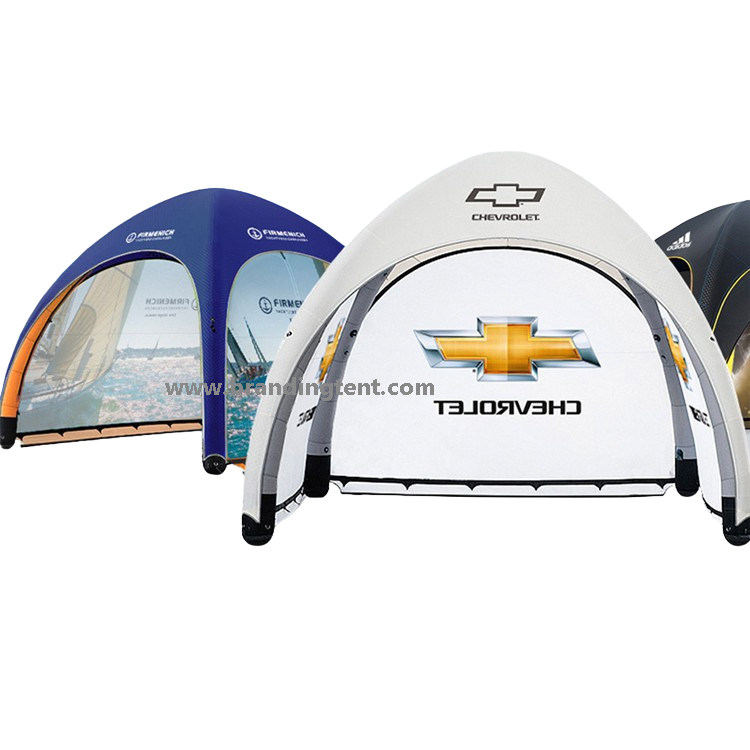
Custom Inflatable Tents
The blow up gazebo family
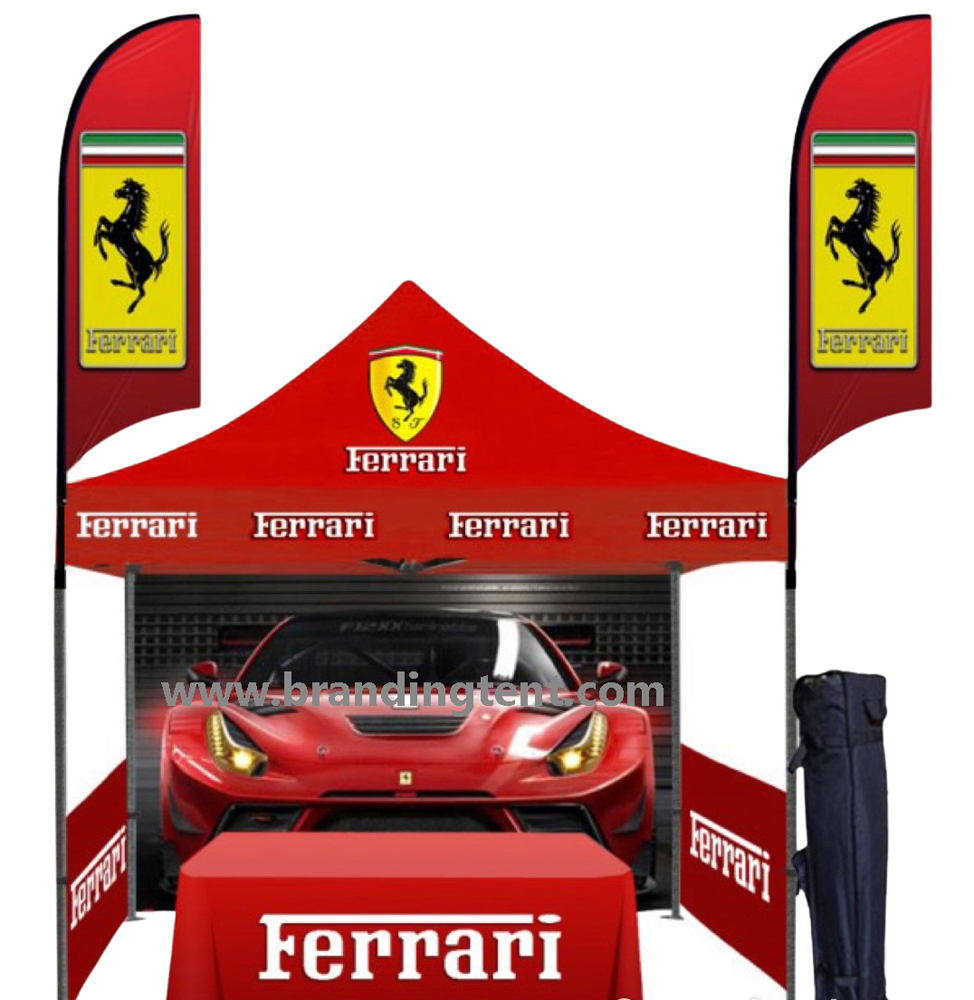
Custom Pagoda Tents
Event-grade booth alternative
Custom Feather Flags
Mark the pitch from the car park
Tell us your event scenario, size and logo file. Our tent specialists reply within 1 hour, 24×7 online service, with a free mockup, written specifications and factory-direct pricing.