Phone:
0086-757-8938 9313
Email:
Address:
Caochang Industrial Zone, Liguang Rd, Lishui, Nanhai, Foshan, Guangdong, China
24/7 online services

Phone:
0086-757-8938 9313
Email:
Address:
Caochang Industrial Zone, Liguang Rd, Lishui, Nanhai, Foshan, Guangdong, China
24/7 online services
Flag care and storage is the difference between a flag that lasts one season and a flag that works three. The fabric is a printed knit polyester in the 110 to 130 gsm class, the seams are thread, and the enemies are damp, sun and wind flap. None of them are hard to beat. This guide walks the full cycle: wash, dry, inspect, pack, store, and reorder skins before the season opens. These are event-grade flags and display kits built for storefronts, venues and fairs, not clear-span marquee halls, and every number below is a typical industry range, not a promise. Ask your supplier for the figures that apply to your own fleet in writing.
Care is four habits, and each one protects the flag from a specific failure:
None of this needs special equipment. A hose, a bucket, a shelf and 10 minutes per flag cover the whole routine. Rental companies that run hundreds of skins add one more tool: a log sheet that grades each skin A, B or C at pack-down, so the reorder list writes itself before the season turns.
A flag is not a poster; it is a repeat-purchase asset. Industry lifespan ranges are consistent across supplier guides: a skin flown 24/7 outdoors works about 6 to 12 months, a daylight-only display about 6 to 12 months stretched over more calendar time, and event-day-only use reaches 1 to 3 years. A written maintenance routine is what stretches a working life from about 8 months toward 24. The table below is the reuse math in one view.
| Display pattern | Typical working life | What shortens it | What the routine adds |
| Flown 24/7 outdoors | about 6 to 12 months | Constant UV and night dew | Rotation between 2 skins adds months |
| Daylight hours only | about 6 to 12 months | Afternoon UV peak | Bring-in-at-dusk habit doubles the season count |
| Event days only | about 1 to 3 years | Rough packing between events | Dry-and-roll discipline keeps skins crisp |
| Indoor and trade show use | about 3 years or more | Handling and bag abrasion | Bag checks and sleeve repairs |
| Well-maintained mixed fleet | about 8 to 24 months | Missed inspections | A written routine is the difference |
The pattern in that table is worth naming. Display pattern sets the baseline, and care quality moves the number inside the range. A distributor who stores skins dry and rolls them on wide cores routinely sees the 2 to 3 year mark on event-duty flags. A retail chain that stuffs wet flags into a car boot replaces the same flag 3 times as often and blames the fabric.
Washing a printed flag is gentle work. Dye-sublimation bonds ink into the fibre, so the print survives water well; what it does not survive is bleach, solvents and dryer heat. Cool water, mild soap and patience cover every routine case:
| Step | What to do | What to avoid | Typical numbers |
| Rinse | Cool water from a hose, both sides | Hot pressure washers | Water at 30 C or below |
| Soap | Mild soap worked in by hand or a soft brush | Chlorine bleach, solvents | A few drops per litre is enough |
| Machine option | Gentle cycle, cold, in a mesh bag | Heavy duty cycles, hot water | Delicate cycle at 30 C |
| Stains | Spot clean with a damp cloth between washes | Scrubbing dry ink | Treat within 1 to 2 days |
| Rinse out | Repeat until no soap foam shows | Leaving residue in the fibres | 2 rinse passes typical |
One habit extends every rule: spot clean between washes. A coffee splash or bird dropping treated with a damp cloth within 1 to 2 days never becomes a full wash. Fleet operators keep a spray bottle of diluted mild soap in the pack van for exactly this reason.
Mildew needs moisture, a food source and time. Polyester itself is not a food, but dust and soil on the fabric are, and 24 hours of damp is enough for spots to start. That is why the drying step has hard numbers attached to it:
| Flag type | Typical drying time | Drying method | Ready-to-store test |
| Single-sided feather skin | about 2 to 3 hours in moving air | Hung or laid flat, both faces open | No cool damp feel at the sleeve seam |
| Large single-sided skin | about 4 to 8 hours | Shade, air from both sides | Fold a corner: no water beads appear |
| Double-sided blockout skin | overnight, up to 48 hours | Both panels separated for airflow | Liner layer passes the same fold test |
| After rain at an event | hang the same evening | Never bag a wet skin | Weight drops back to dry weight |
Two details separate a dry flag from a half-dry one. First, air must move across both faces: hang the skin or lay it flat with the panels separated, in shade rather than direct sun. Second, test before bagging: fold a corner and squeeze. Any water beads or a cool, clammy feel means more hours. Double-sided blockout skins are the ones that trick buyers, because the liner layer holds moisture between the panels long after the outside feels dry.
Every pack-down is a free inspection window. Sixty seconds per flag catches the small failures while they are still small:
Grade the flag A, B or C on the spot and write it down. A-skins go back to the front of the shelf, C-skins go on the reorder list. Rental houses that do this at every pack-down stop being surprised by event day.
Polyester flags tolerate both folding and rolling, which makes them easier to live with than vinyl banners. The habits that matter are simple. Roll the skin print face outward on a core tube about 75 mm in diameter or wider when the storage shelf allows it; wide cores avoid sharp fold memory lines that run straight through artwork. Loose folding works fine for short gaps between events, as long as the folds land in different places each time. Secure rolls with soft fabric ties, because rubber bands bite ring marks into the coating. One breathable bag per skin, poles in their own padded container, and the kit is ready for the shelf. Print shops that ship large banners add a DO NOT FOLD sticker to every roll; the same sticker culture works for a flag fleet, because the one person who would cram a rolled skin into a tiny box is always new.
The storage room does more for flag life than any fabric treatment. Humidity is the number to watch: general indoor-air guidance keeps relative humidity below 60 percent, with 30 to 50 percent the ideal band, and museum conservators note that mold growth on stored textiles becomes a risk above about 65 percent RH. Exhibition-industry practice keeps storage below 50 percent with a dehumidifier or silica gel in each bag. The spec table below turns that into a shelf-by-shelf checklist:
| Item | Typical spec | Why it matters | Failure it prevents | Check interval | Cost class | Where it goes |
| Storage humidity | 30 to 50 percent RH | Above 65 percent RH, mold starts | Grey mildew spots across panels | Season start | A hygrometer costs little | One reading per shelf wall |
| Carry bag grade | 420D casual, 600D with PU coating | Coated 600D sheds damp and dust | Zip failure and wet-through bags | Every pack-down | Mid-range | One bag per skin |
| Roll core tube | about 75 mm (3 in) diameter or wider | Wide cores avoid sharp fold memory | Permanent crease lines through artwork | Every pack-down | Reusable | Inside the bag |
| Straps | Soft fabric ties | Rubber bands bite into coating | Ring marks on the print face | Every pack-down | Cheap | Two per rolled skin |
| Shelf position | Off the floor, away from sun and heat | Floor damp and sunlight age fabric | Faded patches and damp bottoms | Monthly for busy fleets | Free | Top shelves first |
| Inspection loop | every 6 months in storage | Pests and dye transfer appear slowly | Surprise damage on event day | Twice a year | Free | Calendar reminder |
| Pole storage | Upright container or padded rack, sections apart | Ferrule faces stay clean and straight | Cracked tips and grit-locked joints | Every pack-down | Rack is one-off | Beside the bag shelf |
Bags earn their own sentence. A 600D oxford bag with a PU coating sheds damp and dust and survives van loading; 420D is fine for casual single-site use. What never works is sealed plastic: a damp skin sealed in plastic is a mildew incubator. Breathable fabric bags, a shelf off the floor, and a calendar reminder every 6 months to check for pests and dye transfer cover the rest.
The two flag constructions need slightly different care, and the differences all trace back to the blockout liner that sits between the two printed panels of a double-sided flag:
| Care item | Single-sided flag | Double-sided flag | What changes in practice |
| Construction | 1 printed panel, about 110-130 gsm | 3 layers: print, blockout liner, print, about 280 gsm | The liner is the layer that traps moisture |
| Drying time | about 2 to 8 hours | overnight to 48 hours | Double skins need the fold test before bagging |
| Wind while flying | Flies in lighter gusts | Heavier, needs more wind to read well | Windy sites fly single-sided |
| Storage weight | Lighter bundle | Heavier bundle, stiffer roll | Wider core tube for the double skin |
| Mildew risk | Lower | Higher at the liner seam | Open both panels when drying |
| Working life indoors | Good | Better, liner shields both prints | Doubles suit indoor and booth duty |
The practical summary: single-sided skins are the outdoor workhorses that dry fast and fly in light gusts; double-sided skins earn their place indoors and at booths, where the liner protects both prints for years, but they demand the full drying window before any bag closes. Fleets that mix both label the bags, because the two look identical once rolled.
Care is local. The same skin faces different enemies in Minnesota and Dubai, so the routine shifts with the market:
| Market | Care habit that matters | Local trigger |
| United States, Canada | Storm and cold season pull-ins; drain water bases before a freeze | First frost alert, hurricane track |
| United Kingdom, Ireland | Short damp days: dry skins indoors with airflow, watch cold-wall condensation | Winter RH above about 60 percent indoors |
| Germany, Austria, Switzerland | Winter is indoor show season, so skins roll between halls instead of sleeping | November to January trade fair run |
| France, Belgium | Barnum and flag kits share one van; dry both before the garage night | Coastal autumn rain |
| Spain, Mexico, Chile | High UV months: rotate paired skins so neither fades alone | Strong summer sun at street level |
| Brazil | Humidity plus heat: silica gel in every bag, shelves off exterior walls | Coastal wet season |
| Australia, New Zealand | Winter UV still 3 or more in the south, 8 to 9 up north, so fade care runs all year | No true off-season for UV |
| Middle East | Heat above 49 C and night humidity at the coast: cooled storage rooms, dust covers | Summer heat peak, sand dust |
Two patterns sit behind that table. Cold markets fight water in its solid form: water bases drain before any freeze, because expanding ice cracks hard plastic, and fiberglass pole sections turn brittle near -18 C, so cold-season assembly happens slowly and above about 5 C where possible. Hot and coastal markets fight UV and salt: paired skins rotate so neither one carries every sunny day, and a rinse after beach or pool events strips salt before it dries into the fibre.
An honest guide has to say when to stop spending on repairs. Care rescues fabric and seams; it does not rescue print or structure. Replace the skin when the panel is faded across its width, when seams feel chalky or crack when pinched, or when the pole sleeve shreds along its length. Keep the hardware if it passes inspection: poles, bases and bags are the durable half of the kit, and replacing only the printed skin is the standard move suppliers recommend. On the other side, repair freely when the print is still bright and the damage is local: sleeve tears, loose hems and bent clips are all routine fixes. The line between the two is condition of the fabric, and a 10 second pinch test on a hem tells you which side you are on. These are event-grade flags for promotions and venues, not clear-span marquee halls; when a buyer needs a structure that lives outside for years, the honest answer is a proper canopy or a modular tent, not a flag pushed past its job.
Work the list in order and the fleet keeps itself:
1. Set the pack-down order. Down, drain, dry-check, roll, bag, shelve. Same order every time, so no step gets skipped on a wet night.
2. Give every skin a wash window. In-season rinse every 2 to 4 weeks for street-side flags, one wash per event for event fleets.
3. Enforce the dry test. Corner fold, squeeze, no beads. Double-sided skins get the overnight rule without exceptions.
4. Run the 60-second inspection. Sleeve, hems, corners, print, hardware, poles. Grade A, B or C and log it.
5. Pack by the rules. Wide core or loose fold, print face out, soft ties, one breathable bag per skin.
6. Fix the shelf. Off the floor, away from sun and heat, 30 to 50 percent RH, silica gel in the bags that travel.
7. Schedule the loop. A 6-month storage check, a season-start audit, and a pack-down log that feeds the reorder list.
8. Reorder on paper, not on panic. Turn the C-grade list into a skin order 8 to 12 weeks before the season opens, so samples and bulk production land before the first event.
The reorder half of care is where the money is. Hardware lasts for years, so the smart fleet buys skins as consumables and keeps poles and bases inspected and running. The sequence below is the standard factory path:
| Stage | What happens | Typical time |
| Fleet audit | Lay out every skin, grade A to C, photograph the C skins | 1 day per 50 skins |
| Reorder list | Count the skins past repair, note sizes and finishes | Same day |
| Artwork check | Old files still match: re-send vector files if the brand updated | 1 to 2 days |
| Sampling | Print proof of one skin for colour check | 1 to 3 working days |
| Bulk production | Printing, cutting, sewing, QC photos before packing | 7 to 20 working days |
| Mixed container | Skins plus bases and poles for the season packed together | 1 to 2 days |
| Shipping | Express for urgent skins, sea for the seasonal box | Route dependent, sea 18 to 35 days |
Timing is the part buyers forget. Skin orders placed 8 to 12 weeks before the season open land comfortably: sampling runs 1 to 3 working days and bulk production 7 to 20 working days, then sea freight takes 18 to 35 days on the long end. Low MOQ accepted keeps a first reorder small, and wholesale pricing scales with quantity, which is how a distributor tops up 10 skins without opening a full container. Send artwork as vector files at 150 to 300 dpi and the reprint matches the fleet that is still flying.
Flag care and storage is not a chore list, it is the reuse math. Wash cool, dry completely, inspect for 60 seconds, pack on wide cores, store dry at 30 to 50 percent RH, and reorder skins from the log instead of from memory. Fleets that run this routine keep skins flying for seasons, and fleets that skip it buy the same flag three times. Tell us your display pattern and fleet size, and we will return a written care sheet and a replacement-skin quote with the season calendar in mind.
Wash it when it looks dirty or before any long storage, whichever comes first. A flag that flies beside a road needs a rinse every 2 to 4 weeks in season; a flag used for weekend events gets one wash per event or per month. The rule that matters most is the last one: never store a dirty flag, because soil sets into the fibre over months and feeds mildew.
Usually yes for single-sided polyester skins: cold water, gentle cycle, mild soap, ideally inside a mesh bag. Skip the machine for very large skins, for double-sided blockout flags with sewn seams, and for anything with fringe or attached hardware. Never use a tumble dryer, because heat shrinks the panel and dulls dye-sublimation prints. When in doubt, hand wash in a tub with cool water.
Industry ranges put a flag that flies 24/7 outdoors at about 6 to 12 months, daylight-only display at 6 to 12 months stretched over more calendar time, and event-day use at 1 to 3 years or more. A written care and storage routine is what moves a fleet toward the top of those ranges; skipping it is what turns a 12 month skin into a 6 month skin.
Clean, dry, roll or loose-fold, breathable bag, cool shelf. Dry the skin fully first: a single skin needs 2 to 8 hours and a double-sided skin can need overnight to 48 hours. Keep poles in their own padded container, drain water bases before any freeze, and store everything off the floor away from sunlight. A sealed plastic bag on a damp flag is the fastest mildew maker there is.
Small sleeve tears and loose hems are routine repairs; many suppliers patch them cheaply or free. Decide by the damage: if the print is still bright and the tear sits away from the pole sleeve seam, repair. If the fabric is faded across the panel, the seams are chalky, or the sleeve is shredding along its length, replace the skin and keep the pole and base if they pass inspection. Replacement skins cost a fraction of a full kit.
Three things, in order: damp storage that grows mildew into the fibres, wind flapping that works the seams loose, and UV that fades the print. All three are preventable. Dry before bagging, take flags down in winds above the 25 to 30 mph band, and rotate paired skins on long displays so neither one carries every sunny day.
| Item | Detail |
| Manufacturer | Besda BrandingTent, tent and flag factory in Foshan, China, since 2010 |
| Product scope | Feather and teardrop flags, flag poles and bases, canopy tents, table covers, roll up banners |
| Flag fabrics | Single-sided knitted polyester in the 110 to 130 gsm class; double-sided adds a blockout liner, about 280 gsm |
| Printing | Dye-sublimation bonds ink into the fibre; artwork at 150 to 300 dpi at full size |
| Washing rule | Cool water, mild soap, no bleach, no tumble dryer; air dry both faces |
| Drying window | about 2 to 8 hours for single skins, overnight up to 48 hours for double-sided blockout skins |
| Storage rule | Bone dry, breathable bag, 30 to 50 percent RH, off the floor, away from sun |
| Pole care | Push-and-twist ferrules, never hammer; sections wiped dry; fiberglass is brittle near -18 C |
| Base care | Drain water bags before any freeze; ice expansion cracks hard bases |
| Replacement parts | Skins, poles, tips, bases and bags all orderable as parts |
| Low MOQ | Low MOQ accepted, wholesale pricing scales with quantity; samples 1 to 3 working days, bulk 7 to 20 working days |
| Contact | WhatsApp +86 135 1661 0926, [email protected], reply within 1 hour, 24×7 |
Related reading: Beach Flag Bases: Spike, Cross and Water Base Guide · Single-Sided vs Double-Sided Flags: What Changes · Teardrop Flag vs Feather Flag: Shape Differences · Feather Flag Sizes: Small, Medium and Large Compared · Event Display Kit: Tent, Flags, Table Cover, Roll-Up
💬 Chat on WhatsApp Now✉ Email Us Now
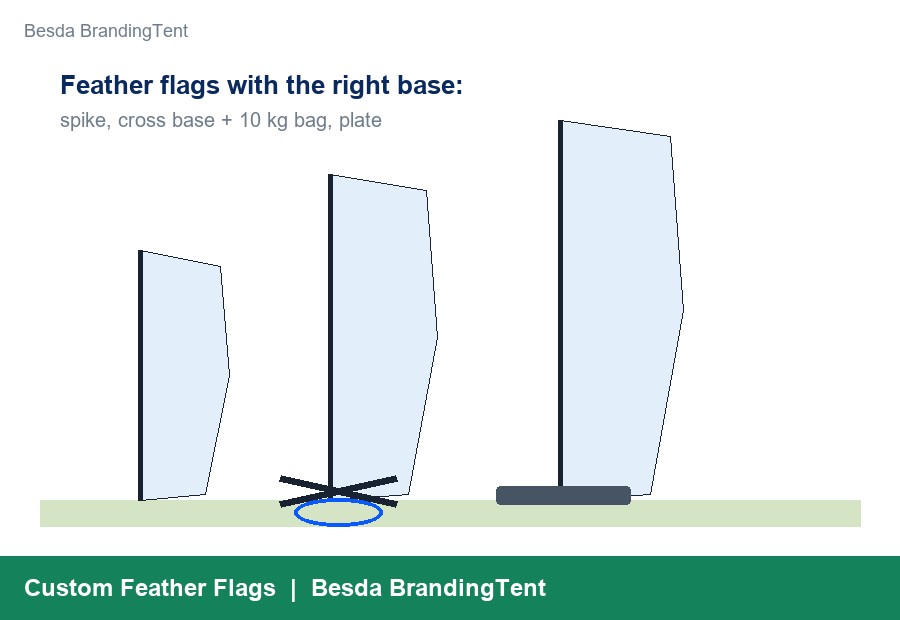
Custom Feather Flags
Skins and kits, poles and bases
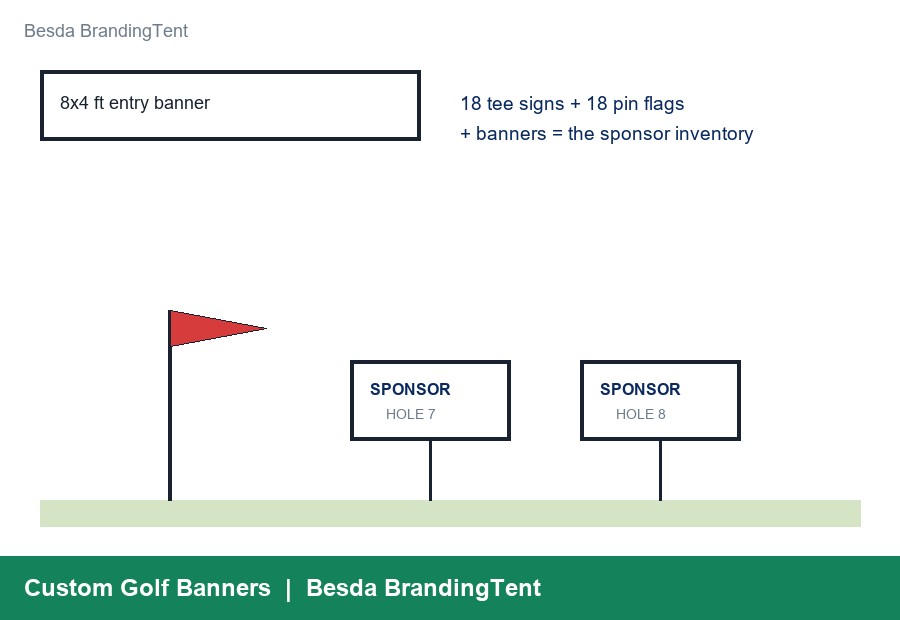
Custom Golf Banners
Tee signs, pin flags and entry banners
Custom Roll Up Banners
Cassettes 610 to 1500 mm wide
Tell us the product, the sizes and quantities, the site and wind or weather it has to handle. Our tent specialists reply within 1 hour, 24×7 online service, with a free mockup, written specifications and factory-direct pricing.