Phone:
0086-757-8938 9313
Email:
Address:
Caochang Industrial Zone, Liguang Rd, Lishui, Nanhai, Foshan, Guangdong, China
24/7 online services

Phone:
0086-757-8938 9313
Email:
Address:
Caochang Industrial Zone, Liguang Rd, Lishui, Nanhai, Foshan, Guangdong, China
24/7 online services
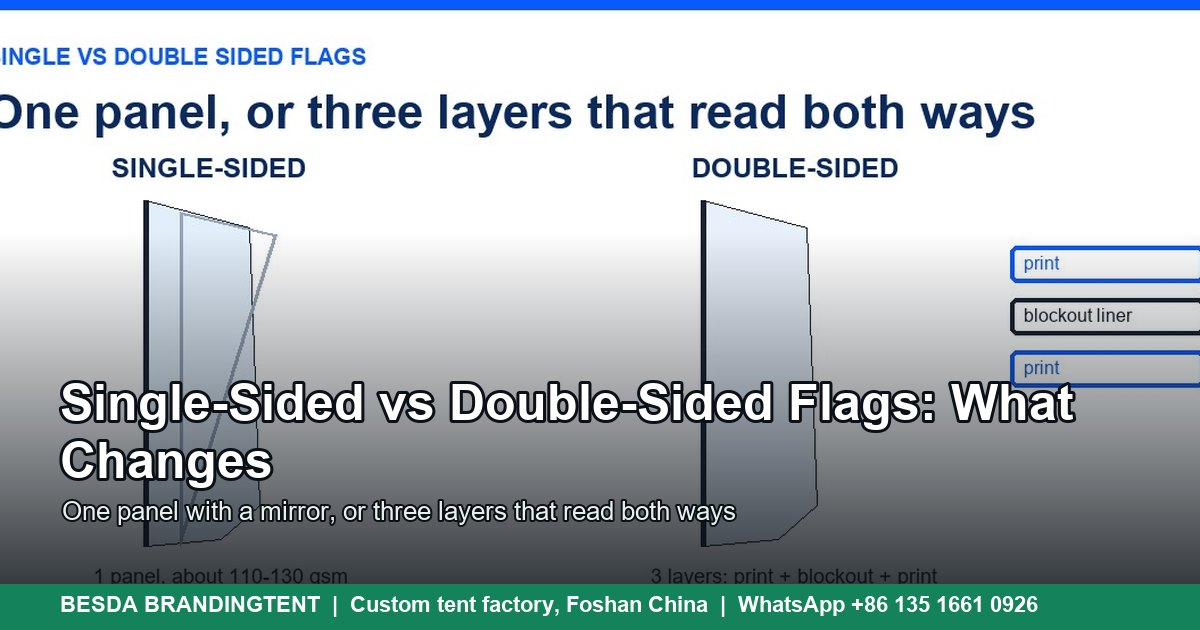
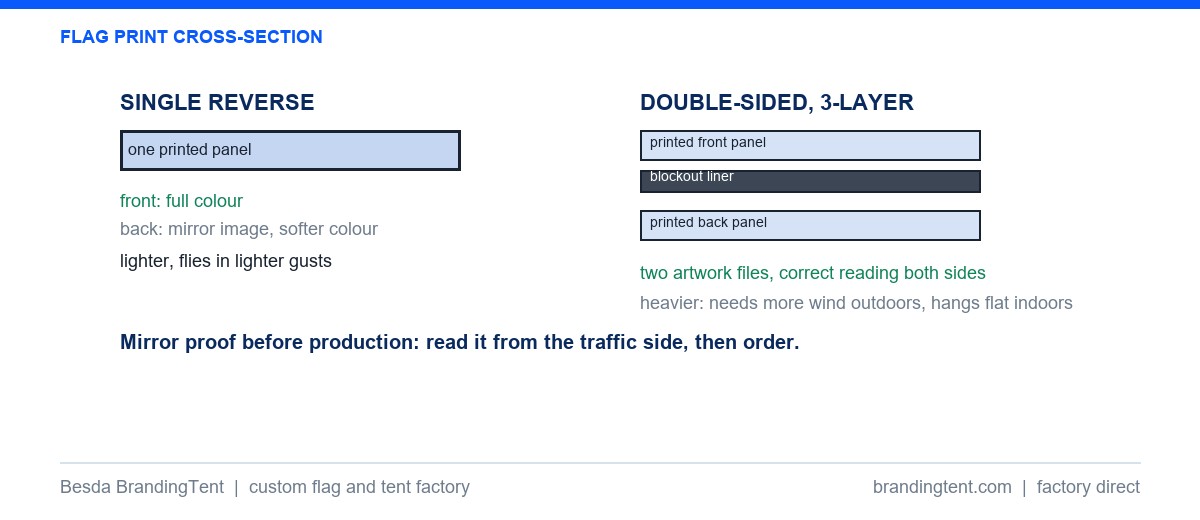
Every printed flag is described by what happens on its back. A single-sided flag, often called single reverse, is one printed panel of knitted polyester about 110 to 130 gsm. The ink bleeds through, so the reverse shows a mirror image of the front in softer colour. Choosing between single sided vs double sided flags is really choosing whether anyone will read that reverse.
A true double-sided flag is three layers sewn together: a printed front panel, a blockout liner, and a printed back panel. Two artwork files drive the two faces. The liner stops show-through, so both sides read correctly in full colour no matter which way the wind turns the flag.
A lighter middle option exists: two printed panels with a blockout coating instead of a third fabric layer. It trims weight while keeping the reverse readable. Fabric suppliers list double-sided builds around a 280 gsm class, against roughly half that for a single panel.
The decision is about geometry, not marketing taste. A roadside spike flag with traffic on one side only ever shows one face. A flag at a pedestrian entrance gets read from both directions all day. Same fabric budget, opposite right answers.
Rental companies care because their flags work a different site every week. Distributors care because the construction named on the quote decides the reprint cycle. Brand teams care because a mirrored logo photographed from behind is the kind of image that lives forever on social feeds.
Procurement teams comparing quotes should read the construction line first. Two quotes for the same flag size can differ in fabric use by a factor of three depending on this single choice, and the difference explains most pricing gaps between suppliers.
1. Single reverse. One panel, printed through. Sunlight and backlight keep the face readable and the mirror on the back stays a quiet fact. Lighter fabric catches less load, so the flag flies in lighter gusts and the seams work less.
2. Three-layer sewn. The liner sits between two printed panels and kills show-through in any light. The perimeter seam now joins three layers, so the build gains weight and needs more wind to fly. Indoors that weight is an advantage: the flag hangs flat and tidy.
3. Coated double. Two printed panels bonded with a blockout coating split the difference. Weight drops against the sewn liner, opacity stays usable, and the build suits programmes that want correct reading outdoors without a full 3-layer flag.
4. The proof step. Before production, ask for a mirrored proof on paper and read it from the traffic side. Ten seconds with a proof answers the question a whole season of guessing cannot.
United States: parade routes and roadside promotions run single reverse on spikes, while downtown street pole programmes double-side because city rules and foot traffic both demand correct reading. Car dealer forecourts mix both: single flags on the perimeter, double-sided at the entrance.
United Kingdom and Ireland: high streets and shopping centres put double-sided flags at crossings and mall aisles. Promotions on grass, from school fetes to county shows, stay single-sided because wind does half the selling.
Germany and France: Christmas markets and boot sales favour single panels on spikes for weight and packing, and double-sided builds inside town halls and trade fair halls. Buyers searching Faltpavillon accessories often add matching flags to the same order.
Australia, New Zealand and the Middle East: coastal wind pushes beach clubs and promenades toward single panels in heavier gsm, while mall interiors in Dubai and Riyadh run double-sided flags in the still indoor air. Latin American ferias from Mexico to Chile split the same way: gravel lots outside, tiled foyers inside.
The honest comparison is a supply chain comparison. Fabric used, files required, seam load, wind behaviour and where the flag will live. The table below is what we put in written quotes so both sides of the order mean the same thing.
| Question | Single-sided | Double-sided (3-layer) |
| Print files needed | one artwork file | two files, one per face |
| Reverse side | mirror image, lighter colour | correct reading, full colour |
| Weight in the wind | lighter, flies in lighter gusts | heavier, needs more wind to fly |
| Outdoor life | one print takes the weather | two faces and seams share the load, often shorter |
| Indoor life | good | better, the liner protects both prints |
| Freight and packing | about one panel of fabric | roughly triple the fabric per flag |
| Order maths | one print run | two print runs plus liner and a second seam |
Read the wind line twice. It is the one buyers underestimate and the one crews remember, because a flag that never lifts is a billboard on a stick and a flag that flogs itself to pieces is a reprint invoice.
Straight answer: double-sided is the wrong buy when only one face will ever be read. A fence line, a wall backdrop, a roadside spike with one-direction traffic. Paying for a second print and a liner there is wasted freight and wasted budget.
It is also the wrong choice on brutal, gusty sites. A heavier 3-layer flag needs more wind to fly and loads its seams harder in flogging gusts. On coastal placements the single panel in a heavier gsm is the longer-lived answer, and the mirror on the back nobody planned to read.
One more boundary keeps expectations honest. These are event-grade display flags for campaigns, rentals, retail aisles and activations, not permanent street furniture. For flags that fly every day of the year on fixed poles, that is a flagpole project, and the construction maths changes completely.
1. Stand where the reader stands. One approach direction or two? The answer usually settles the construction on its own.
2. Map the daylight. Backlit glass and bright atriums expose show-through; the liner earns its place indoors.
3. Read the wind record. Ask the venue or crew what the site does at midday, not what the season average says.
4. Decide the two-message option. Double-sided means two files: run the offer on one face and the brand mark on the other.
5. Check the municipal rules. Street pole programmes in the United States, UK and Germany often require correct reading on both faces.
6. Compare quotes by construction. Name the build in the purchase order: single reverse, coated double, or 3-layer sewn with liner.
7. Demand the mirror proof. A paper proof read from the traffic side settles every argument before the fabric is cut.
8. Trial one site before the fleet order. Ship 1 to 2 samples, fly them a weekend, then scale with wholesale pricing from 5 pieces per design.
1. Ordering double-sided by default. The construction is a placement decision. Defaulting to it adds fabric, weight and lead time to flags that never needed it.
2. Assuming the back will be fine. On single reverse the back is a mirror with softer colour. Photographs from behind look odd if nobody planned for it.
3. Sending one file for a two-face flag. The back panel needs its own file or an explicit instruction to mirror. Guessing at this step is how production stops.
4. Ignoring gsm when chasing lightness. A 110 gsm single panel on a gale site flogs itself apart. Sometimes the right light flag is a heavier fabric flown single-sided.
5. Skipping the seam question. Three layers sewn around one perimeter concentrate load. Reinforced corners are cheap insurance on rental fleets.
6. Forgetting the indoor life argument. Buyers who only compare outdoor specs miss that double-sided often wins indoors, where the liner protects both prints.
Use this matrix at the quote stage. Placement first, build second, and the two columns agree more often than not.
| Placement | Recommended build | Why |
| Roadside spike flag, one-direction traffic | single-sided | only one face is ever read, wind does the advertising |
| Pedestrian plaza or entrance walkway | double-sided 3-layer | people approach from both directions |
| Street pole banner | double-sided | municipal rules usually require correct reading on both faces |
| Indoor mall, showroom, trade fair aisle | double-sided | no daylight to hide show-through, aisles cross both ways |
| Fence line or wall backing | single-sided | the reverse faces a wall, weight would be wasted |
| Windy coastal site | single-sided, heavier gsm | a lighter face flies better and sheds gusts instead of loading the seams |
Combine the order with custom feather flags or a golf banner programme and one artwork set covers the whole season. Sampling runs 1 to 3 working days and bulk 7 to 20 working days with lead time confirmed in writing.
The FAB test works on print quotes as well as it works on hardware. A supplier who can walk each feature down to a benefit your programme can measure has built the flag more than once.
| Feature | Advantage | Benefit for your programme |
| One-panel single reverse print | lighter flag, flies earlier in the day | readable at the roadside before the crowd arrives |
| Blockout liner sandwiched between prints | no show-through in any light | the logo reads correctly from both directions of traffic |
| 280 gsm class double build | the flag holds its shape indoors | retail aisles and show rooms get a flat, tidy face all week |
| Two artwork files, one per face | each side carries its own message | one flag serves two campaigns: offer on the front, brand on the back |
| Sewn perimeter with reinforced corners | seams spread the wind load | fewer tear-outs on rental fleets that assemble daily |
| Mirror proof before production | you see exactly what the back becomes | no surprises when the flag is photographed from the wrong side |
Step 1. Send artwork with the placement named. We flag constructions that do not match the site before quoting, which saves a revision loop later.
Step 2. We return a written specification: panel count, liner type, gsm, seam finish and the proof plan. Written specs are the quality gate.
Step 3. Approve the mirrored proof for single reverse, or the two-file set for double-sided. Colour is checked against Pantone C references.
Step 4. Sample 1 to 2 flags in 1 to 3 working days. Fly or hang the sample in the real placement before approving bulk.
Step 5. Bulk production runs 7 to 20 working days. Wholesale pricing scales with quantity, and payment by T/T with a 30 percent deposit is the common pattern.
Step 6. Every unit passes photo and video QC before packing. Flag kits ship with poles and bases in labelled cartons, ready for the distribution centre to forward by region.
Single panels rinse in cold water, air dry and fold on the fly end first. Double-sided flags need a longer dry: three layers hold water at the seam, and a damp fold grows mildew lines that never wash out.
Inspect the perimeter seam each season, corners first. Liner wrinkles smooth themselves when the flag flies; wrinkles that stay after a weekend outdoors are a seam question, not a fabric one.
Store flags dry, rolled rather than creased, away from sunlight. A fleet that dries and rolls on the same day it comes home reprints on a schedule instead of on an emergency.
Single-sided flags are the wind-friendly standard with a mirror on the back. Double-sided flags are three layers, two files and correct reading from both directions. Pick by placement and the construction picks itself; pick by habit and either choice can be the wrong one.
No. On a single-sided flag the ink bleeds through one panel, so the reverse reads as a mirror with softer colour. It is the standard construction and it flies well. Ask for a mirror proof before production so you see it in advance.
Yes. The working build is two printed panels with a blockout liner, about 280 gsm class in total. The flag gets heavier, so on very light wind days it needs a steadier breeze to fly than a single-panel flag.
Single-sided usually wins outdoors: one printed face takes the weather and the flag is lighter on its seams. Double-sided often outlasts single panels indoors, where the liner protects both prints from handling.
It carries roughly triple the fabric, two print files and a second seam, so the price step is real without being a simple doubling. Wholesale pricing scales with quantity, so ask for the quote in writing with the construction named.
Two files, one per face, at 150 to 300 dpi, plus a mirrored proof if the two faces share one design. We confirm colour against Pantone C references before the print run starts.
Low MOQ accepted: wholesale pricing starts from 5 pieces per design, and samples of 1 to 2 pieces ship before bulk. Sampling runs 1 to 3 working days, bulk 7 to 20 working days.
| Manufacturer | Besda BrandingTent, the factory behind custom flags, tents, table covers and tradeshow displays since 2010 |
| Constructions | single-sided single reverse; double-sided 3-layer sewn with blockout liner; double-sided coated 2-layer |
| Fabric weights | knitted polyester about 110 to 130 gsm single panel; double-sided builds around 280 gsm class with liner |
| Reverse side | single-sided shows a mirror image with softer colour; double-sided reads correctly from both faces |
| Artwork | one file for single-sided, two files for double-sided, 150 to 300 dpi, Pantone C matching on request |
| Wind practice | single-panel flags fly in lighter gusts; heavier double builds need more wind, which suits indoor and plaza use |
| Low MOQ | Low MOQ accepted, wholesale pricing from 5 pieces per design, samples of 1 to 2 pieces |
| Lead time | sampling 1 to 3 working days, bulk 7 to 20 working days |
| Quality gate | photo and video QC before packing, colour check against Pantone C references |
| Markets served | United States, United Kingdom, Germany, France, Australia, New Zealand, Middle East, Latin America and more |
| Contact | WhatsApp +86 135 1661 0926, email [email protected], replies within 1 hour, 24×7 online |
Related reading: Feather Flag Sizes: Small, Medium and Large Compared · Teardrop Flag vs Feather Flag: Shape Differences · Custom Tent Printing: Dye-Sub vs Screen vs Transfer
💬 Chat on WhatsApp Now✉ Email Us Now
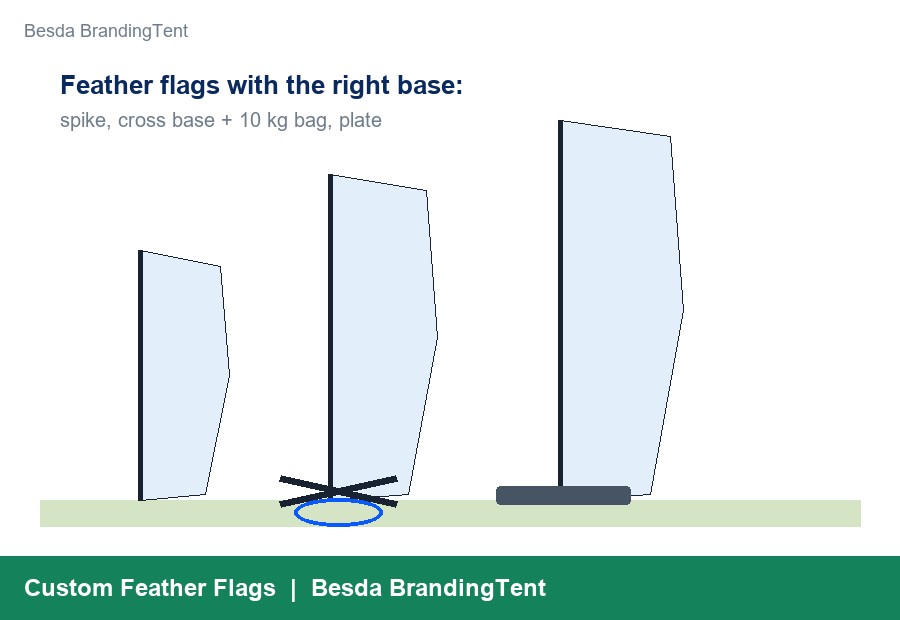
Custom Feather Flags
Single or double-sided builds
Custom Pagoda Tents
Flags and tents from one factory
Custom Roll Up Banners
Double-sided indoor companion
Tell us the flag sizes, the grounds they stand on and the destination market. Our flag specialists reply within 1 hour, 24×7 online service, with a free mockup, written specifications and factory-direct pricing.