Phone:
0086-757-8938 9313
Email:
Address:
Caochang Industrial Zone, Liguang Rd, Lishui, Nanhai, Foshan, Guangdong, China
24/7 online services
Phone:
0086-757-8938 9313
Email:
Address:
Caochang Industrial Zone, Liguang Rd, Lishui, Nanhai, Foshan, Guangdong, China
24/7 online services
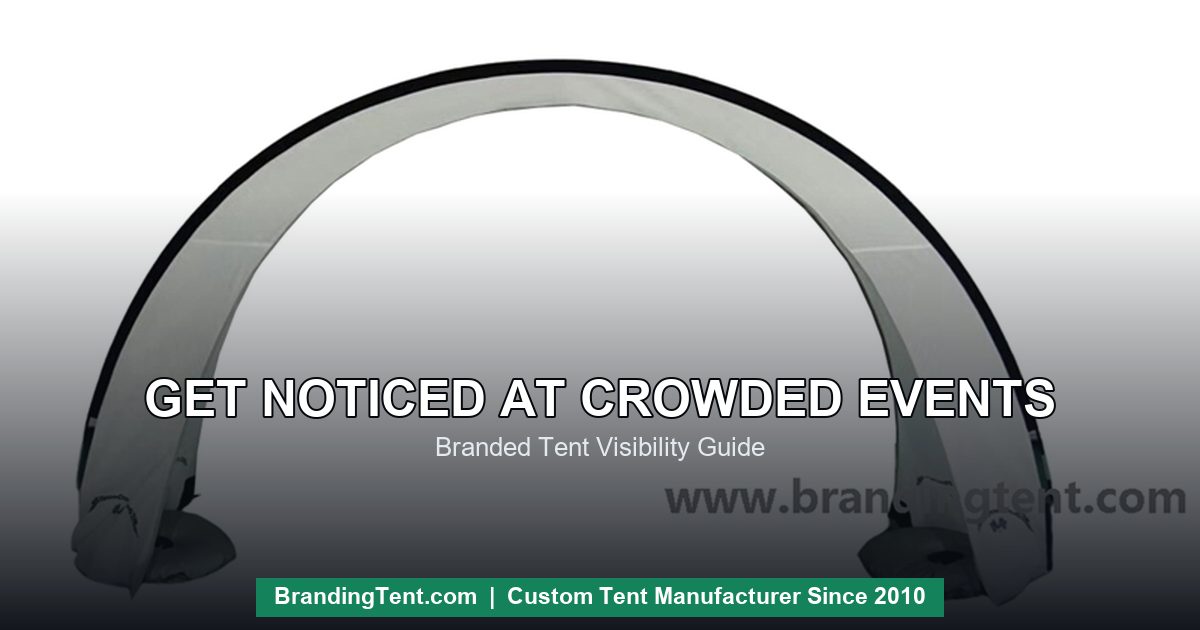
Crowded events are a visibility auction, and most exhibitors bid with the same coin: a white canopy and a hope. Getting noticed with a branded tent is a framework, not a fortune — height, color and motion, applied in that order, with the printing specs that keep the design alive all season. Here is the framework the factory uses when brands ask how to become the booth people navigate by (whether the market calls it a canopy tent, pop-up gazebo, folding marquee or carpa publicitaria).
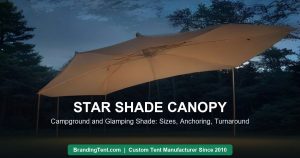
Attention experiments are boringly consistent: structures that break the roofline collect looks from across the venue. A pagoda tent lifts a printed peak above the field; a star shade throws a completely different geometry; an arc tent frames the entrance so visitors walk through the brand before they see a single product. If the budget forces a choice, spend the first increment on height — it works from the farthest distance.
Once height has the eye, color holds it. The rule is contrast against the venue field: deep colors pop at beach and garden events, saturated primaries pop in gray convention halls, and black-and-gold palettes photograph best under evening lighting. Then commit — canopy, walls, table cover and flags in one Pantone family, printed on one line, because the color standard is what makes the booth recognizable from any angle.
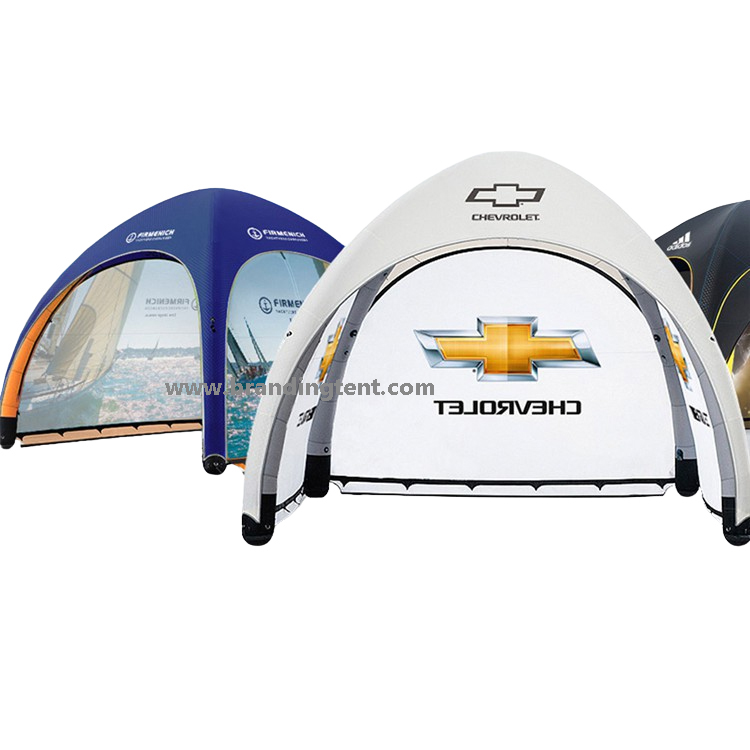
Flags, and to a lesser degree inflatables, add movement — the visual trigger human eyes cannot ignore. A feather flag row along the approach route recruits visitors from the far end of the venue; an inflatable dome or cube does the same job from the center. Motion is the cheapest increment after height and color, and it compounds: the tent anchors, the color identifies, the motion recruits. Even a simple upgrade — adding a third flag to a two-flag set, or swapping a static banner for one with a wind-friendly cut — changes how many heads turn before visitors reach the canopy, and costs a fraction of any other visibility purchase on this list.
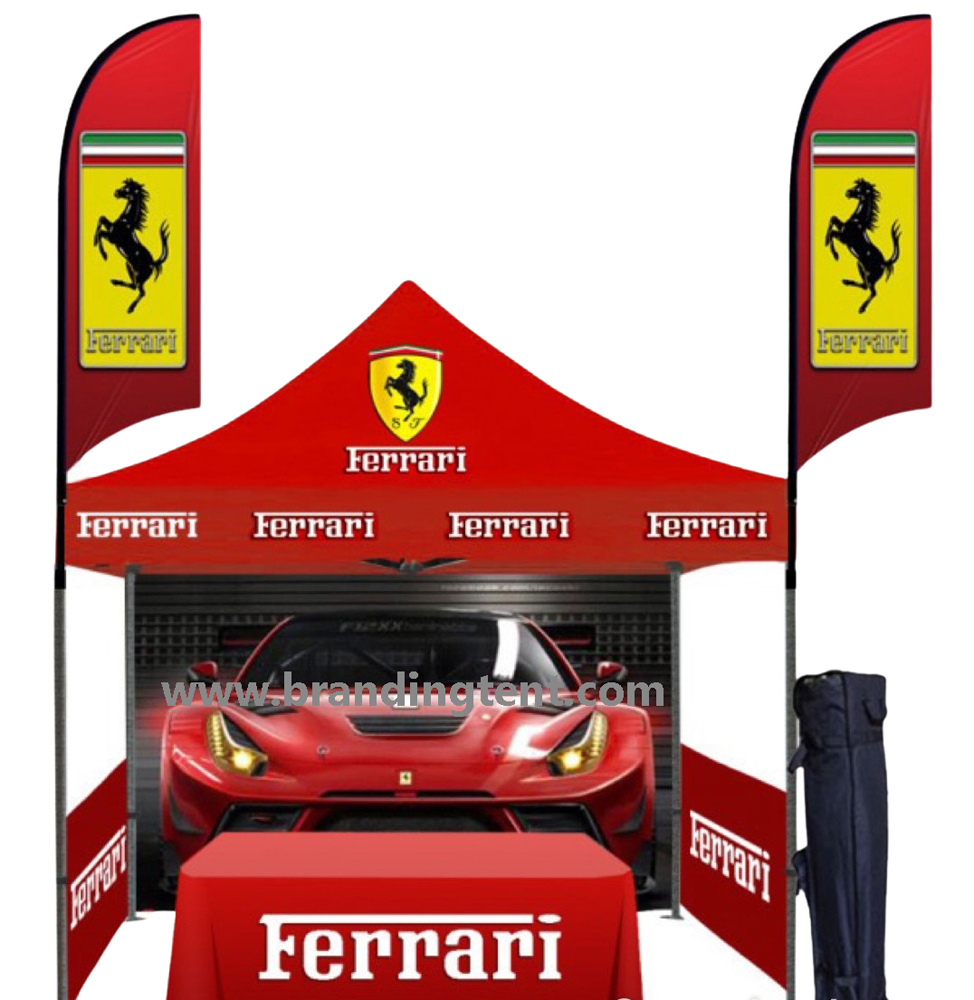
Visibility dies in detail. The roof carries one hero element; the valance carries the name; the walls carry the story for visitors already inside; the table cover carries the offer for visitors at the counter. Dye-sublimation keeps each layer sharp through sun and folding — heat transfer and cheap banners fade within a season, which quietly undoes every other investment. Print the roof loud, the walls deep and the cover practical.
A tall, colorful tent over a bare table still loses the close-range contest. The noticed booth is a kit: the structure up top, a fitted table cover at the counter, a banner at eye level and flags on the approach. Every piece prints from the same artwork set, so the noticeability compounds instead of scattering.
Noticed events usually run two booths doing different jobs. The recruiter sits at the venue entrance or the main junction: a tall structure — pagoda, star shade or arch — plus a flag row, priced and staffed like a billboard. Its only KPI is how many visitors it steers toward the second booth. The converter sits where the traffic lands: a 10×10 canopy with a full back wall, printed cover and sample table, staffed by the sales team, measured in conversations and orders. The framework applies differently to each — recruiters buy height, motion and saturated color; converters buy walls, covers and lighting. Brands that run both, matched in one Pantone standard, report the strongest event numbers because the two structures hand visitors to each other like relay runners.
| Lever | Buy | Why it works |
| Height | Pagoda, star shade, arc tent | Reads from the farthest distance |
| Color | One-family canopy + walls + cover | Recognizable from any angle |
| Motion | Feather flag row | The eye tracks movement first |
| Dye-sublimation, written spec | Stays sharp all season |
Visible booths can be measured. Count the heads that slow down at your flag line versus the neighbor’s aisle — a two-minute tally every hour tells you whether the motion layer is positioned right. Count photos taken with your structure in frame; event photographers and visitors both become distribution. Count conversations that open with “I saw your tent from…” — that phrase is the height and color layers reporting for duty. Teams that track these three numbers stop guessing about visibility and start tuning the kit between events: flags repositioned, one more wall printed, the valance text enlarged.
The framework recruits from fifty meters, but conversion happens in the final five. Angle the booth so visitors approach a corner, not a flat wall — corners invite entry. Keep the counter line low so the table cover reads while a visitor stands; printed covers with the offer at knee-height get read by everyone, not just the tall. Put the most photogenic product or sample at the aisle-facing edge. And light the interior if the event runs into evening — a lit booth at dusk becomes the framework’s last unfair advantage.
Before approving any design, ask the simplest question in event marketing: an hour after the event, will a visitor describe your booth to their boss? If the answer is “the white tent near the gate”, the framework has not been applied. If it is “the black tent with the gold flag row” or “the purple booth with the dome”, you bought the noticing — and the description is the lead, because someone repeats it to someone with a budget. The factory mockup exists precisely so you can run this test before production, not after the event.
Visibility is a season-long project, not an event-day one. Photograph the booth from the venue entrance and from the aisle — those two shots are the before/after evidence for next season’s design review. Log which levers worked: did the flag row pull traffic before the color did, or did the peak recruit from the car park? Re-canvas worn tops while the frames are sound so the second season opens as sharp as the first. Brands that review their own event photos between seasons start the next calendar with a kit tuned by real data — and a mockup revision already in the works, printed and shipped before the first event of the new season.
Send the logo, the venue list and the countries you exhibit in — the factory returns a free mockup, written specifications and factory-direct pricing within 1 hour, 24×7 online. Sampling runs 3-7 working days, bulk 7-15, shipping worldwide. Low MOQ accepted; wholesale pricing from 5+ pieces; the framework is yours to repeat all season. Start with height if you start anywhere — it is the lever that works from the farthest distance, and it is the one your neighbors on the row did not buy. The mockup is free, the reply takes an hour, and the season starts either way.
Related reading: top secrets to successful event marketing with advertising tents · 10 irresistible advertising tent designs that boost sales
What is the first upgrade for visibility in a crowded event?
Height — a pagoda or star shade breaks the roofline and collects attention from the farthest distance. Color and motion layers compound on top of it.
How do I keep my brand colors consistent across tent, flags and covers?
Order the kit from one production line: dye-sublimation with CMYK plus Pantone matching keeps the standard identical on every item.
Which structure gets noticed most at night?
Dark canopy colors with LED strips along the arms, or backlit inflatable walls — contrast under event lighting decides evening visibility.
Do I need fire-retardant fabric for my event?
Most organized venues ask for it — NFPA 701 or DIN 4102 B1 fabric options with certificates are available on request; confirm the venue requirement during quoting.
What MOQ and lead time apply?
Low MOQ is accepted for first kits; wholesale pricing scales from 5+ pieces. Sampling 3-7 working days, bulk 7-15 days, worldwide shipping.
| Fact | Detail |
| Manufacturer | Besda BrandingTent — direct factory in Foshan, China: manufacturer, wholesaler and exporter since 2010. Not a retailer. |
| Products | Custom tents (pagoda, dome, star, inflatable, canopy, arc), feather flags, roll up banners, table covers, tradeshow displays and outdoor tables. |
| Materials | 300D–600D oxford with PU coating or 0.55mm PVC; powder-coated steel or hexagonal aluminum 40/50/60mm frames. |
| Printing | Full-color dye-sublimation (CMYK + Pantone matching), panels printed before assembly. |
| Certificates | Fire-retardant fabric options (NFPA 701 / DIN 4102 B1) available on request. |
| MOQ & pricing | Low MOQ accepted; wholesale pricing from 5+ pieces; bulk orders preferred and priced accordingly. |
| Lead times | Sampling 3–7 working days; bulk production 7–15 days; worldwide shipping from Shenzhen/Guangzhou. |
| Quality gate | Every unit fully assembled and QC-checked, with photo/video approval before packing. |
| Buyer terms by market | US: canopy tent · UK: pop-up gazebo · AU/NZ: folding marquee · France: barnum / tente pliante · LatAm: carpas publicitarias · Brazil: tenda personalizada. |
| Contact | WhatsApp +86 135 1661 0926 · [email protected] · reply within 1 hour, 24×7 online service. |
💬 Chat on WhatsApp Now✉ Email Us Now
Custom Pagoda Tents
Break the roofline
Custom Inflatables
Own the silhouette
Custom Feather Flags
Add the motion layer
More: dome tents · sea of tents design tips · full FAQ
Tell us your event scenario, size and logo file — our tent specialists reply within 1 hour, 24×7 online service, with a free mockup, written specifications and factory-direct pricing.