Phone:
0086-757-8938 9313
Email:
Address:
Caochang Industrial Zone, Liguang Rd, Lishui, Nanhai, Foshan, Guangdong, China
24/7 online services

Phone:
0086-757-8938 9313
Email:
Address:
Caochang Industrial Zone, Liguang Rd, Lishui, Nanhai, Foshan, Guangdong, China
24/7 online services
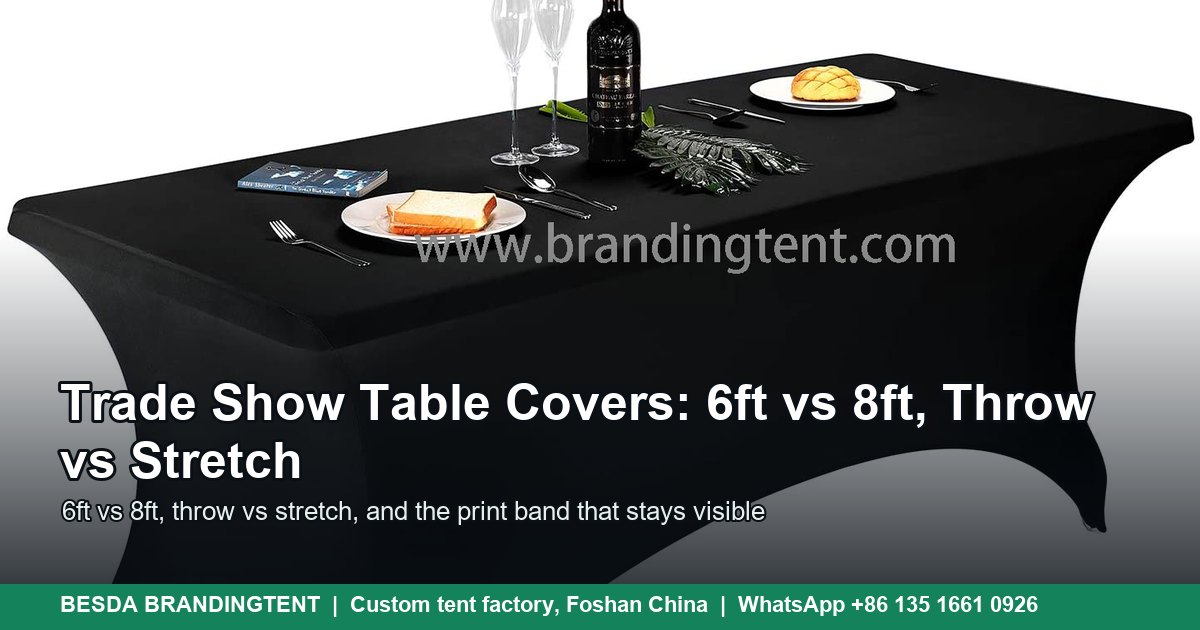
A trade show table cover is the branded cloth that turns a folding table into a booth surface. It hides boxes, sets the staff zone and gives visitors one clean place to read your name. The fit matters more than the fabric weight, because an event-grade cover that hangs 4 inches short looks worse than a plain table. The custom table cover range covers the main styles, and this guide explains how to choose between them.
Most buyers ask for a cover by table length: 6 ft or 8 ft. That is a good start, but it is not the whole order. You also need the table depth, the table height, the number of covered sides and the height of the band where your logo will sit. Get those four numbers right and the cover behaves.
The product does three jobs at once. It is a brand surface, a storage screen and a visual boundary between staff and visitors. A cover that fails at any one of those jobs shows up in photos, in the aisle and in the way your team works during a long show day.
This guide is written for exhibitors, exhibit houses, rental companies, distributors and procurement teams that order covers in repeat batches. It uses typical industry dimensions, so check your own table before you send a purchase order.
A standard 6 ft folding table has a top of 72 x 30 in (183 x 76 cm) and stands about 29 in (74 cm) high. An 8 ft table is 96 x 30 in (244 x 76 cm) at the same height. Those are the numbers behind most booth layouts in the United States, Canada and many export markets.
A stretch cover for a 6 ft table is typically cut around 88 x 130 in. The 8 ft version runs around 88 x 154 in. The extra length wraps the top, the legs and a short return under the table. A draped throw is a different shape: a common finished panel is about 84 x 126.5 in for a 6 ft table, which gives roughly a 27 in drop on a 29 in table and leaves the hem about 2 in off the floor.
| Table | Top size | Height | Stretch cover (typical) | Draped throw (typical) | Best job |
| 4 ft | 48 x 30 in (122 x 76 cm) | 29 in (74 cm) | Cut to 48 x 30 x 29 in | About 84 x 108 in | Registration, side table |
| 6 ft | 72 x 30 in (183 x 76 cm) | 29 in (74 cm) | About 88 x 130 in | About 84 x 126.5 in | Standard 10×10 booth |
| 8 ft | 96 x 30 in (244 x 76 cm) | 29 in (74 cm) | About 88 x 154 in | About 84 x 154 in | Wide booth, double product line |
Do not trust the label on the table. Venues substitute tables, and folding tables vary by half an inch or more. Measure the top length, the top depth, the height to the underside of the top and the distance between leg centers. Write those numbers on the RFQ. A cover cut for a nominal 6 ft table can be tight on one brand and loose on another.
In the UK, Germany, France, Australia and much of Latin America, tables are usually metric. A 1.8 m table is close to 6 ft, and a 2.4 m table is close to 8 ft, but the depth is often 68-75 cm instead of 76 cm. A US-cut stretch cover may fit loosely at the sides. If you exhibit across markets, order by measured centimeters, not by the local name.
One more number matters: the floor clearance. A hem that touches the floor picks up dirt and gets stepped on. A hem that stops 1-2 in above the floor looks intentional and survives a weekend. Tell the supplier the clearance you want, especially for a stretch cover where the drop is fixed by the cut.
A throw is the forgiving option. It drapes over the table and usually covers three sides, with an open back for staff access. It handles a table that is slightly off-size, and it packs small. The trade-off is a softer look: the fabric can bag at the corners, and a cheap throw can look like a bedsheet under booth lighting.
A fitted cover is sewn to one table size. The corners are shaped, the front panel is flat and the cover does not shift during the day. It gives a sharper logo area than a throw, but it has almost no tolerance. If the venue gives you a different table, the cover may not fit at all.
A stretch cover is a tension fabric sleeve. It pulls over the table like a second skin and removes most wrinkles without steaming. It gives the cleanest print surface of the three, which is why photo-heavy booths use it. The catch is fit: a stretch cover must match the table length and depth closely, and artwork placed near a seam can distort when the fabric stretches.
| Style | Fit | Setup | Print behavior | Best job | Watch-out |
| Throw (draped) | Loose, flows to the floor | 1 person, 3-5 min | Print sits on a relaxed surface | Unknown tables, one-off shows | Can look baggy; hem may touch the floor |
| Fitted | Sewn corners, exact size | 2 people, 5-8 min | Flat front panel, sharp logo | Known table, recurring shows | No tolerance for a different table |
| Stretch | Tension fabric, second skin | 2 people, 5-10 min | Best for full-color print | Known table, photo-heavy booth | Must match length; seams can distort art |
| Convertible throw | Hook-and-loop adjust 6 to 8 ft | 1 person, 4-6 min | Good for simple logos | Venues with mixed tables | Bulk at corners if not tensioned |
A practical rule: if the table is known and the booth depends on photos, choose stretch. If the table is unknown or the show is a one-off, choose a throw. If the same table travels to many shows and the team wants a repeatable setup, choose fitted. A convertible throw with hook-and-loop adjustment is a useful middle ground for venues that mix 6 ft and 8 ft tables.
Ask one more question before you decide: who puts the cover on? A two-person team can fit a stretch cover in 5-10 minutes. A solo exhibitor with a train to catch may prefer a throw that goes on in 3-5 minutes. The best cover is the one your team will actually install correctly at 7 a.m.
A three-sided cover covers the front and two sides, with the back open. It is the standard choice for a linear booth where staff stand behind the table. The open back gives access to bags, brochures and a cooler without crawling under the table.
A four-sided cover wraps the back as well. It is the right choice for an island or corner booth where visitors can see the back, or for a booth where the table is really a storage unit and you do not want anyone to see the boxes. A four-sided cover with a zipper back gives you the closed look plus a way in.
The wrong choice is easy to spot in photos. A three-sided cover on an open corner booth leaves a bare back panel in every shot. A four-sided cover on a staffed linear booth forces the team to lift the back every time they need a pen. Match the cover to the traffic flow, not to the catalogue photo.
If the table sits against a wall, three sides are enough. If the table is in the middle of the booth, four sides are safer. If the booth has a side opening that visitors can see, order a printed side panel rather than a plain one. The side panel is small, but it is often the panel people see while walking past.
The most common print mistake is not color. It is height. Visitors see the top 8-12 in of the front panel, then the tabletop, product and chairs block the rest. A logo centered on the full drop often lands at knee height, where nobody reads it.
Place the logo in the top band of the front panel and keep it centered across the table length. Put one line of copy under it, not three. If you need a QR code, place it at the right side of the band at eye level, not at the bottom corner. The lower half of the cover is for color and pattern, not for information.
| Zone | 6 ft cover | 8 ft cover | What to put there |
| Top band (front) | About 70 x 10 in | About 94 x 10 in | Logo plus one line |
| Mid panel | About 70 x 12 in | About 94 x 12 in | Product claim or QR code |
| Side panels | About 28 x 10 in each | About 28 x 10 in each | Secondary mark |
| Bottom 10 in | Below the table line | Below the table line | Keep clear; chairs and knees block it |
Keep critical artwork 2-3 in inside every seam. A stretch cover pulls at the corners, and a logo that sits on a seam will bend when the fabric tensions. For a draped throw, the fabric moves more, so the safe zone should be wider. Send a vector file with fonts outlined and a bleed of at least 0.5 in.
Contrast matters more than color accuracy at the aisle distance. A dark logo on a dark cover disappears under venue lighting. A white or light logo on a deep cover reads from 10 ft away. If your brand color is dark, use a light keyline or a light panel behind the mark.
Before you approve the mockup, do a phone test. Take a photo of the mockup from about 3 m away at eye level, then look at it on a phone screen. If the logo is not readable in that photo, it will not be readable in the aisle. This test catches layout problems that a flat design file hides.
Stretch covers are usually 180-220 gsm polyester/spandex. Draped covers are often 250-280 gsm polyester, which gives a heavier hand and a softer fold. For rental fleets and rough handling, a 600D oxford cover is the tougher option, though it has less stretch and a more utilitarian look.
Dye-sublimation is the standard print for polyester covers. The ink turns to gas and bonds into the fiber, so the print does not sit on the surface like a sticker. A good dye-sub print survives cold washing and repeated folding. It can still fade under long sun exposure, so treat the cover as a seasonal asset, not a permanent sign.
| Fabric | Weight (typical) | Best use | Fire option | |
| Stretch polyester/spandex | 180-220 gsm | Dye-sub | Photo-heavy booths, tight fit | NFPA 701 on request |
| Draped polyester | 250-280 gsm | Dye-sub | Classic throw, soft drape | NFPA 701 on request |
| 600D oxford | Heavy duty | Dye-sub or transfer | Rental fleets, rough handling | Certificate on request |
| PVC-coated cloth | 300-600 gsm | UV or transfer | Outdoor market tables | Check local rules |
Fire rules are set by the venue, not by the fabric seller. Many venues ask for NFPA 701 documentation for table covers, drapes and banners. Some accept a manufacturer certificate, some want a tag on the item, and some run a small field flame test if no paperwork is available. Ask for the certificate before you ship, and keep a copy in the booth case.
If you exhibit in Germany, France or another EU market, ask which fire standard the venue accepts and whether a test report in the local language is required. In the UK and Australia, the show organizer usually publishes the rule in the exhibitor manual. The rule can differ between a consumer show, a trade fair and a hotel ballroom.
Color matching across a brand kit is a separate job. A table cover, a tension fabric backwall and a printed canopy can use different fabrics and different print processes. Ask the supplier to print all three from one color target and to state the acceptable color difference in writing. A visual match under office light can fail under venue light.
Measure the table in the state it will be used. If the legs are adjustable, set the height first. If the table has a lip or a thick edge, include it. If the venue provides the table, ask for the make and model, then measure a sample if you can.
Take one photo of the table with a tape measure visible on the top and one photo of the leg area. Send both with the sketch. A supplier who asks for these photos is easier to work with than one who only asks for the table length.
For a multi-table booth, measure every table. Two 6 ft tables from different suppliers can differ by an inch, and a stretch cover cut for one may not fit the other. If the tables are rented per show and the sizes vary, choose throws or convertible covers and accept a softer fit.
A throw goes on from the back or the side. Open it fully, find the front panel, center the logo, then let the fabric fall. Pull the top edge tight along the table and smooth the front with your hand. Do not pull the hem, because that distorts the print.
A stretch cover goes on feet first. Stand the table on its side if you can, pull the cover over the legs, then set the table upright and work the fabric up over the top. Two people make this faster and reduce the chance of tearing a seam. Smooth from the center outward.
At the end of the show, do not fold a printed cover along the same line every time. Fold lines become weak points and visible creases. Roll the cover around a cardboard tube or a rolled poster, print side out, and store it in a breathable bag. If the cover is damp, dry it before it goes into the case.
| Task | Method | When |
| Spot clean | Damp cloth with mild soap | After each show |
| Wash | Cold hand wash or gentle cycle | Every 3-5 shows |
| Dry | Hang or lay flat, out of direct sun | Before storage |
| Store | Roll around a tube, do not fold | Between shows |
| Steam | Low steam from the back side | Before the show |
Wash with cold water and a mild detergent. Skip bleach, fabric softener and high heat. Hang or lay flat to dry, away from direct sun. A low steam pass from the back removes travel creases. A hot iron directly on the print can flatten the fabric texture and leave a shine.
Check the cover before every show. Look at the seams, the leg pockets and the hem. A small repair with a needle and matching thread is cheaper than a replacement. Keep a spare plain cover in the case for the show where the printed one arrives damaged or the table size changes.
These are the mistakes that show up again and again in booth photos and post-show emails. Most are avoidable with one extra measurement or one extra question.
A short pre-show checklist prevents most of these. Confirm the table size, confirm the covered sides, confirm the print band, confirm the fire paperwork and confirm how the cover will be packed. Five questions, five minutes, fewer surprises.
A table cover is the wrong buy when the table is not the main brand surface. If you have a custom counter, a built-in reception desk or a full island booth, a draped table can make the booth look temporary. Put the budget into the backwall or the counter instead.
It is also the wrong buy when the table is hidden behind a product wall or used only for storage. A plain utility cover is enough. And if you exhibit once, in a city you do not plan to return to, renting a cover with the table may be cheaper than buying, storing and shipping one.
For a booth that needs a structural wall, a table cover cannot replace a backwall. The cover dresses a table; the backwall carries the brand at head height. If visitors need to see a large logo from across the aisle, buy the backwall first and add the cover second.
Use this checklist before you approve a quote. It keeps the conversation on fit and use, not on the lowest line item.
| Feature | Advantage | Benefit |
| 180-220 gsm stretch polyester | Clings to the table shape without wrinkles | Your booth looks finished 5 minutes after arrival |
| Dye-sublimation print | Ink bonds into the fiber instead of sitting on top | The logo survives washes without cracking |
| 3-sided or 4-sided build | Matches the booth orientation | Staff can work behind it and boxes stay hidden |
| Leg pockets and sewn corners | The cover stays put during the day | No repeated pulling and straightening |
| NFPA 701 option | Paperwork is available for the venue | Fewer surprises at the fire desk |
A supplier who can answer all seven points in writing is easier to scale with than one who only sends a photo and a unit number. The written answer also becomes the reference for the next order.
In the United States and Canada, 6 ft and 8 ft tables are the default, and many shows publish an 8 ft backwall limit with a 4 ft limit in the front half of a linear booth. Exhibitors often order a 6 ft cover for a 10×10 booth and an 8 ft cover for a 10×20 booth.
In the UK, Germany and France, metric tables are common. A 1.8 m table is the practical equivalent of 6 ft, and a 2.4 m table is close to 8 ft. German venues often ask for fire documentation, and the exhibitor manual usually names the accepted standard. French and Belgian shows may use slightly different table depths, so measure rather than convert.
In Australia and New Zealand, 1.8 m and 2.4 m tables are standard for community shows, trade fairs and outdoor markets. The same covers work, but the outdoor market user should choose a heavier fabric and a darker color that hides dust. A stretch cover is less practical on a windy outdoor site than a fitted or draped cover.
In the Middle East, hotel ballrooms and exhibition centres often use longer tables, and island booths are common. A four-sided cover with a zipper back is a safer order than a three-sided throw. In Latin America, the same product is often called a cubre mesa or a faldón, and the table may be a locally made 1.8 m unit with a different leg spacing.
Across all markets, the buyer group changes the order. An exhibitor buys one or two covers for a season. A rental company buys a fleet in one color and needs replacement panels. A distributor buys mixed sizes and cares about carton count. An agency buys for multiple clients and needs a repeatable file template. Write the use case into the inquiry and the supplier can quote the right build.
A clear RFQ gets a clear quote. Send the measured table size, the covered sides, the style you want, the print file, the fire requirement, the show date, the destination and the quantity. If you have a photo of the booth layout, send it. If you have a sample cover that fits well, send its measurements.
The usual order flow is simple. You send the use case and artwork, the supplier sends a digital mockup and a written spec, you approve the mockup and pay the deposit, the supplier prints and sews, then sends photos or video of the finished cover before packing. Bulk production typically runs 7-15 days after artwork approval, with samples around 3-7 days. Peak season adds time, so book the show date into the plan.
Ask for the packing details before you pay. A cover that ships folded flat in a carton may arrive with creases. A cover rolled around a tube travels better. If you are shipping to a show venue, confirm the carton dimensions and the delivery window with the receiving desk at the venue.
Keep the approved mockup, the measured size and the fire certificate in one folder. When you reorder, send that folder back. It removes the guesswork and keeps the second batch consistent with the first.
A standard 6 ft table is 72 x 30 x 29 in (183 x 76 x 74 cm). A stretch cover is typically cut around 88 x 130 in, and a draped throw around 84 x 126.5 in. Measure your actual table first, because venue tables vary by an inch or more.
Choose 3-sided when staff stand behind the table and need access. Choose 4-sided for an island or corner booth, or when the table hides storage and the back is visible. A 4-sided cover with a zipper back gives you the closed look plus access.
A stretch cover has little tolerance. A table that is 1-2 cm off the nominal size can be tight or loose. Measure length, depth, height and leg positions. If the tables vary between shows, choose a throw or a convertible cover instead.
Yes. NFPA 701 is the common request, and a certificate can be provided on request. Venue rules vary, and some venues run a small field test if paperwork is missing. Ask what the show accepts and keep the certificate with the booth kit.
Dye-sublimation bonds the ink into polyester fibers, so a good print does not sit on the surface and crack like a transfer. Wash cold with mild soap, skip bleach and softener, and air dry. The print will still fade after long sun exposure, so store the cover dry and out of the sun.
Yes. A 4-sided cover can print the back panel. A 3-sided cover leaves the back open by design. If the back is visible from an aisle, order a 4-sided cover or add a printed back panel rather than leaving a plain white surface in photos.
Samples usually run 3-7 days after artwork approval. Bulk production usually runs 7-15 days, depending on quantity, fabric and print complexity. Peak show season adds time. Send the show date with the inquiry so the schedule is planned backward from the event.
| Item | Detail |
| Product scope | Custom table covers for 4 ft, 6 ft and 8 ft tables |
| Styles | Throw, fitted and stretch; 3-sided or 4-sided |
| Materials | 180-220 gsm stretch, 250-280 gsm draped polyester, 600D oxford |
| Printing | Dye-sublimation, full color, Pantone matching |
| Table standards | 6 ft: 72 x 30 x 29 in; 8 ft: 96 x 30 x 29 in |
| Metric markets | 1.8 m and 2.4 m tables; depth often 68-75 cm |
| Print band | Top 8-12 in of the front panel |
| Fire rules | NFPA 701 certificate on request; venue rules vary |
| MOQ and lead time | Low MOQ accepted; sample 3-7 days; bulk 7-15 days |
| QC | Full-size check, print position, seam and color; photo approval |
| Packing | Individual bag, export carton; rolled option on request |
| Contact | WhatsApp +86 135 1661 0926; [email protected] |
Related reading: Custom Trade Show Tents with Logo: The Complete Booth Buying Guide · Top 10 Custom Tents With Logos for Global Events: What Each Country Calls Them · Canopy Tent Sizes: 10×10 to 20×20 – How to Choose · Pop Up Display vs Roll Up Banner: Which Booth Backwall? · Custom Tent Printing: Dye-Sub vs Screen vs Transfer
💬 Chat on WhatsApp Now✉ Email Us Now
Custom Pagoda Tents
Booth modules 3×3-6x6m
Custom Dome Tents
Round kiosks 3-6m
Custom Star Tents
Open shade 5-16m
Tell us the tent size, the equipment that has to fit and the destination market. Our tent specialists reply within 1 hour, 24×7 online service, with a free mockup, written specifications and factory-direct pricing.