Phone:
0086-757-8938 9313
Email:
Address:
Caochang Industrial Zone, Liguang Rd, Lishui, Nanhai, Foshan, Guangdong, China
24/7 online services

Phone:
0086-757-8938 9313
Email:
Address:
Caochang Industrial Zone, Liguang Rd, Lishui, Nanhai, Foshan, Guangdong, China
24/7 online services
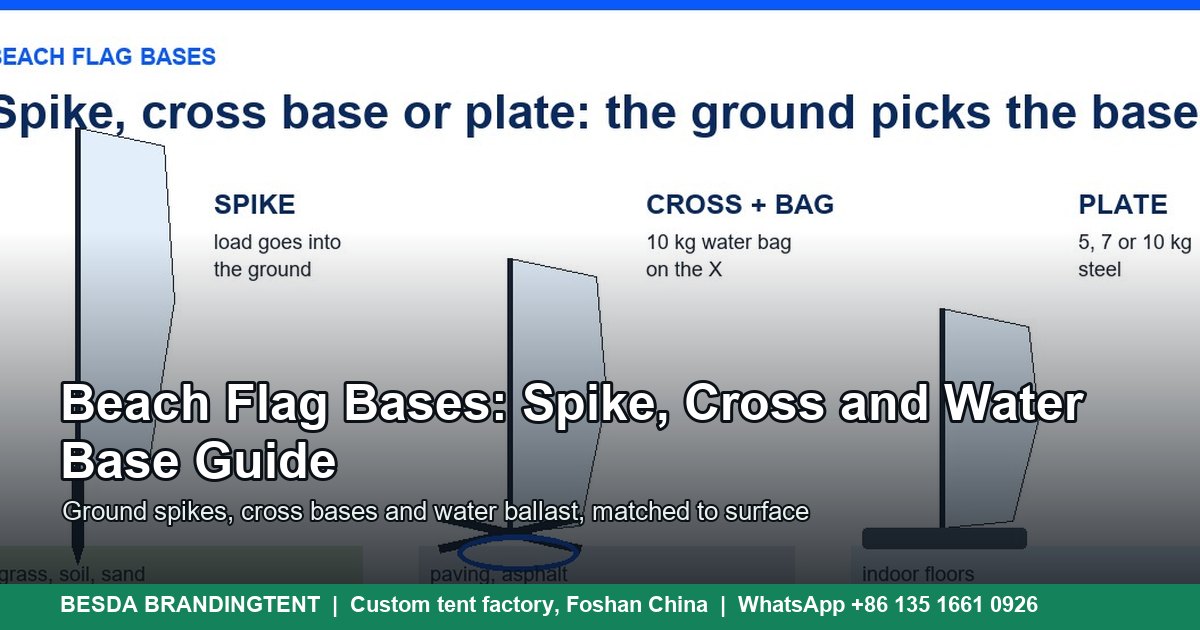
A beach flag base is the weighted or anchored foot that keeps a feather flag, teardrop flag or rectangular flag upright between two gusts. Buyers searching for beach flag bases usually own the flag already and discover the hard part was never the fabric. The base decides whether the flag stands straight at hour four of a market day.
There are only two ways to hold a flag up. The first is anchor: push a steel pin into the ground and let the soil do the work. The second is ballast: put mass on top of the surface and let gravity do the work. Everything sold as a base, from a 1 kg spike to a 20 L water tank, is one of those two ideas with different packaging.
The physics explains most buying mistakes. A spike driven 40 to 50 cm into turf resists pull-out with soil friction, so it can hold a 4.5 m flag while weighing about 1 kg. A cross base on the same turf has no friction to borrow, so it needs 10 kg of water before it earns the name base. Same flag, opposite answers.
Rental companies care because downtime is billed. A base that drains, folds and stacks turns a 40-flag event into one van shelf and 15 minutes of sorting. A base that arrives wrong, 3 kg of steel on a plaza with no water tap in sight, turns the same event into phone calls.
Distributors and procurement teams care because bases are the accessory that quietly decides repeat orders. A promotional distributor who sells a branded flag programme without matching bases watches the client source them elsewhere, one decision at a time.
Safety officers care because a 4.5 m pole in a crowd is a lever with a flag on it. Event organisers in the United States and Australia now ask for ballast plans in writing, and the flag row is part of that plan. Weight numbers on the quote are evidence, not decoration.
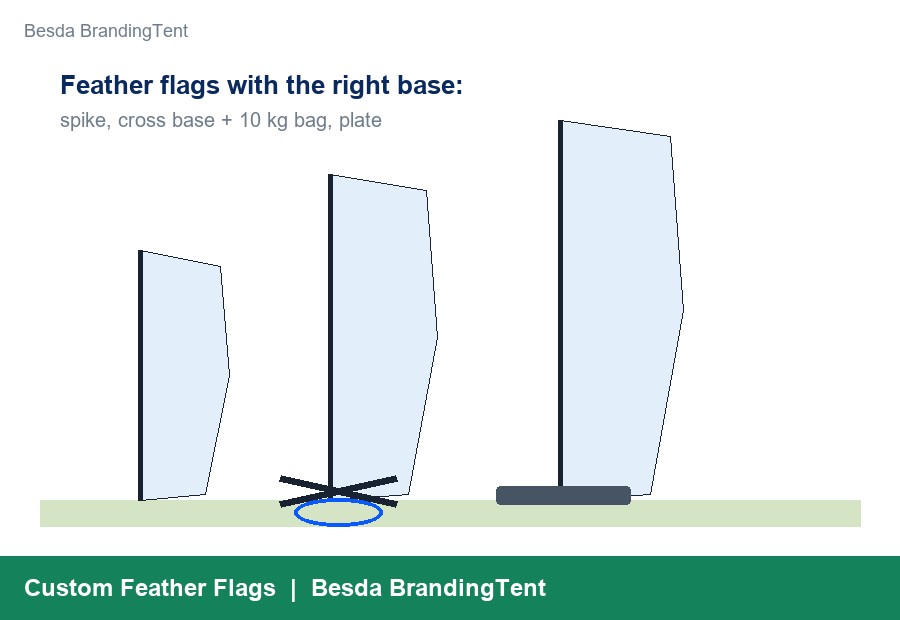
A spike is a steel pin, 40 to 50 cm long, with a rotating collar that accepts pole feet in the 12 to 16 mm range. You stamp it in with your foot, drop the pole in, and the collar lets the flag swing with the wind instead of loading the pole sideways. Setup runs about 2 minutes. It suits grass, soil, sand and packed snow, which covers parks, sports fields, campuses and beaches.
A cross base is a welded steel X, four folding legs, powder coated, 2.5 to 3 kg dry. On its own it is a footprint, not a base. The 10 L water bag drapes over the hub and adds about 10 kg once filled from a tap. Setup runs 3 to 5 minutes including filling. This is the pairing for paving, asphalt and concrete: high streets, plazas, forecourts and market squares.
Plates are flat steel, welded or cast, with a low trip edge. The working ladder is 5 kg at 385×385 mm for small flags, 7 kg at 400×400 mm for medium, and 10 kg at 495×495 mm for large and jumbo sizes. No filling, no leaking, no scratches on polished stone. Malls, showrooms, hotel lobbies and exhibition halls run on plates.
A moulded tank you fill on site, about 20 kg when full and light when empty. It is the heaviest option in the range and the one recommended for moderately windy conditions, promenades and seafront promos. The trade is handling: two people, a tap nearby, and a drain before the van leaves.
A car base is a U-shaped plate that slides under a vehicle tyre, popular with dealer lots and real estate fleets in the United States and Canada. Wall brackets screw to masonry, plate 95×95 mm with holes 70 mm apart, in 0, 30 or multi-angle versions. A gazebo bracket clamps a flag to a canopy leg, capped around 2.5 m of flag height, with leg weights on the canopy as the honest price of admission.
United States: farmers markets and campus tours mean turf and spike orders, while dealer forecourts mean car bases. Event rental fleets standardise on spikes for parks and cross base kits for downtown plazas.
United Kingdom: high streets and shopping centres are paving and carpet, so the cross base plus 10 kg bag does the weekday work and plates cover indoor mall days. Christmas market season in Germany and France runs the same mix, with wooden stall decks asking for plates rather than spikes.
Australia and New Zealand: beach clubs and coastal promenades push buyers to the 20 L water base, with a second filled bag as the local rule of thumb on exposed sites. Middle East programmes in Saudi Arabia and the UAE run sand and marble in the same week: spikes for sand, plates for mall interiors.
Latin America: ferias and Expo setups from Mexico to Chile mix gravel lots and tiled foyers. Buyers searching carpas publicitarias usually bundle flags with tents, so one base checklist per site keeps the crew honest. Brazil expositors do the same with tenda displays at trade fairs.
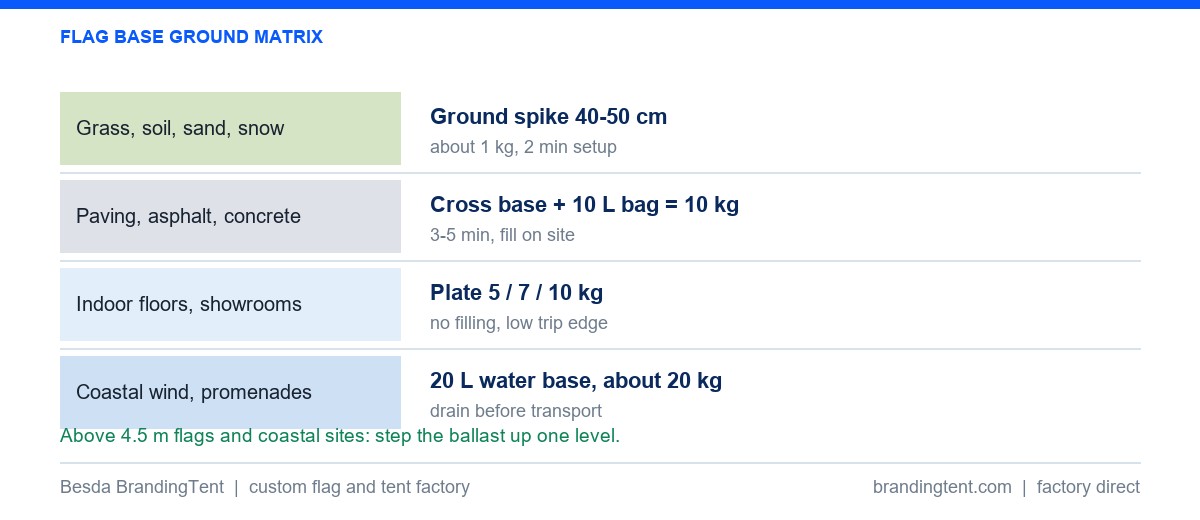
The table below is the version our rental customers print and tape inside the van. It answers the four questions a crew actually asks on site: what ground, how much weight, how long to set up, and what happens when the wind picks up.
| Question | Spike | Cross base + bag | Plate | 20 L water base |
| Best ground | grass, soil, sand, snow | paving, asphalt, concrete | indoor floors | outdoor hard stands |
| Ballast on site | none, load goes into the ground | 10 kg water | none, steel does the work | up to 20 kg water |
| Setup time | about 2 minutes | 3 to 5 minutes | about 2 minutes | 5 to 8 minutes |
| Wind behaviour | flag rotates with the wind on the collar | needs the bag in any breeze | indoor use only | stable to moderate wind |
| Transport weight | under 1 kg | 3 to 4 kg dry, bag empty | 5 to 10 kg | light when empty |
| Fleet favourite | parks, sports fields, campuses | high streets and plazas | malls and showrooms | coastal promenades |
Compared with improvising, the matched base saves more than setup minutes. A mismatched base spends the day rocking in its socket, and the flag spends the day reading badly. Unlike fabric problems, base problems show up in the first hour and get photographed by the client.
Straight answer: weight is not always the fix. On soft ground a spike beats any weight you can carry, because the soil holds the load instead of the base. If your flags live on grass, buying cross bases and bags means paying for water logistics you never needed.
Indoors, a water base is the wrong answer too. A filled bag on carpet risks a damp patch, and a 20 L tank in a hotel lobby reads as equipment rather than display. Plates exist for exactly this reason: steel on top, nothing spilled below.
There is also an honest boundary worth writing down. These are event-grade display hardware for campaigns, rentals, forecourts and activations, not permanent street furniture. If a site needs a flag flying every day of the year through storms, that is a fixed flagpole project with foundations, and a beach flag base is the wrong instrument no matter how heavy it is.
1. Photograph the ground. Grass, paving, decking, gravel or marble decides the family before any weight number matters.
2. Confirm the flag height. Ballast expectations step up above 4.5 m, and a 2.8 m flag forgives far more than a 5 m one.
3. Check the pole foot. Measure the diameter that enters the collar, most sit between 12 and 16 mm, so mixed fleets stay interchangeable.
4. Ask about the tap. Cross base bags and water bases need filling on site. No tap means plates, pegs or spikes.
5. Read the wind, not the forecast. Coastal sites and tower-shadow plazas get the heavier option regardless of the forecast average.
6. Count the carrying. A crew that lifts everything upstairs wants plates split into 5 kg units, not one 20 kg tank.
7. Plan the drain. Every water-filled option needs a drain-and-dry step before packing. Write it into the teardown card so it survives staff turnover.
8. Standardise the fleet. Rental operators pick one collar standard and one bag type, then every future flag order plugs into every existing base.
1. Ordering the cross base without the bag. The X alone is a footprint. Without 10 kg of water it rocks in the first honest breeze and the flag reads as an accident.
2. Buying weight instead of anchor. On turf, 20 kg of steel loses to a 1 kg spike. Buyers who skip the ground survey pay freight for the wrong physics.
3. Ignoring the pole foot diameter. A 12 mm collar on a 16 mm foot means a morning of shims. Send diameters with the order and this mistake disappears.
4. Skipping the drain. A wet bag left folded grows mildew and weeps in the van. Ten seconds at the tap prevents both.
5. Mixing socket standards across the fleet. Two collar sizes across 30 bases means every event starts with a sorting puzzle the crew did not budget for.
6. Wall brackets into plasterboard. The 95×95 mm plate is rated for masonry with the right fixings, not for cavity walls behind a reception desk.
Use this matrix as the ordering shortcut. It compresses everything above into the two numbers that matter at the van door: how tall is the flag, and what is under it.
| Flag height | Calm site, hard ground | Breezy site, hard ground | Soft ground |
| 2.8 m | cross base + 10 kg bag, or 5 kg plate indoors | cross base + 10 kg bag | standard spike |
| 3.3 m | cross base + 10 kg bag | cross base + 10 kg bag, shelter the site | standard spike |
| 4.5 m | cross base + 10 kg bag | 20 L water base or cross base + second bag | heavy duty spike |
| 5 m and above | 20 L water base | 20 L water base plus guy line review | heavy duty spike, deeper drive |
Lead time for base orders runs 1 to 3 working days for samples and 7 to 20 working days for bulk, with wholesale pricing from 5 pieces per design. Combine a base order with a custom feather flag order and the whole kit ships in one carton set.
A base quote is easy to compare once each line answers three questions: what is the feature, what advantage does it create, and what benefit reaches your programme. Any supplier who can walk a buyer down all three columns of the table below has probably built the product properly.
| Feature | Advantage | Benefit for your programme |
| Spike collar rotates, socket about 12 to 16 mm | the flag turns with the wind instead of fighting it | fewer pole failures on exposed fields, flags stay readable |
| Water bag adds 10 kg on site | you ship 3 kg and fill 10 kg | freight stays light, ballast appears where needed |
| Cross legs fold flat | the whole base stacks in a tub with the flags | a 40-flag fleet fits one van shelf |
| Plates in 5, 7 and 10 kg steps | match plate to flag size instead of guessing | no wobbly 4.5 m flag on a 5 kg plate, no dead weight indoors |
| 10 mm peg holes on the premium cross | pin it on loose dirt when no water tap is near | one base covers both plaza and park bookings |
| Low trip edge under 10 mm on plates | visitors walk past in queues | venue safety officers sign off faster |
Step 1. Send the site survey: ground photos, flag heights, pole foot diameters and the wind exposure you actually see, not the postcode average.
Step 2. We confirm the mix in writing: base types, quantities, collar sizes and the ballast plan per site. Written specifications beat memory on both ends.
Step 3. Sample 1 to 2 pieces in 1 to 3 working days. Fit the sample to one of your own poles before approving mass production.
Step 4. Bulk runs 7 to 20 working days with wholesale pricing that scales by quantity. Payment by T/T with a 30 percent deposit is the common import pattern.
Step 5. Every unit passes assembly and QC with photos and video before packing. You approve what the carton contains before it ships, which is how a 200-base order avoids surprises at the dock.
Step 6. Goods ship with export cartons marked per site or per market, so the distribution centre can push kits straight to regional teams without repacking.
Water products drain, rinse and dry flat before storage. Bags stored wet grow mildew and the caps weep. Plates get a wipe and a dry shelf, and their edges stay clean enough for marble floors.
Spikes get a wire brush where soil packs the collar, then a light oil film before the winter box. Cross base hinges are the wear point: check the fold rivets each season and retire any leg that no longer locks square.
Store the whole family off the floor and out of the sun. A base shelf that keeps collars facing up means the next setup starts without a search, and fleets that standardise this run measurably faster at every event.
Beach flag bases are a ground question first and a weight question second. Match the base to the surface, size the ballast to the flag height, and standardise collars across the fleet. Do that and the flag does its only job all day: reading cleanly from the distance your campaign paid for.
Yes. Bases, poles and prints are separate line items, so a rental fleet can top up bases without reordering fabric. Wholesale pricing starts from 5 pieces per design.
On hard ground the working answer is a cross base with a 10 kg filled water bag, stepping up to a 20 L water base on exposed or coastal sites. On soft ground a spike holds because the load goes into the soil, not onto it.
It can, but it is the wrong tool: the X legs sink, tilt and trip people. On grass, order the spike. The premium cross base with 10 mm peg holes is the compromise for packed dirt.
Most collars take pole feet in the 12 to 16 mm range. Send us your pole foot diameters and we match the socket before production, so mixed fleets stay interchangeable.
Sampling runs 1 to 3 working days, bulk production 7 to 20 working days depending on quantity. Every order ships with photo and video QC before packing.
Drain and wipe them before packing. A filled 10 kg bag left on edge can weep at the cap, and a 20 L base sloshing loose is a real load. Dry, flat, capped, done.
| Manufacturer | Besda BrandingTent, the factory behind custom tents, flags, table covers and tradeshow displays since 2010 |
| Base range | ground spike, heavy duty spike, cross base, premium cross, square plates 5/7/10 kg, 20 L water base, car base, wall brackets |
| Ballast numbers | water bag about 10 L = 10 kg filled; water base about 20 L; spike length 40 to 50 cm; collars for 12 to 16 mm pole feet |
| Ground match | spike for grass, soil, sand and snow; cross base plus bag for paving, asphalt and concrete; plates for indoor floors |
| Setup times | spike about 2 minutes; cross base 3 to 5 minutes; plates about 2 minutes |
| Wind practice | step ballast up above 4.5 m flags and on coastal sites; spike collars rotate with the wind |
| Low MOQ | Low MOQ accepted, wholesale pricing scales with quantity; samples of 1 to 2 pieces |
| Lead time | sampling 1 to 3 working days, bulk 7 to 20 working days |
| Quality gate | photo and video QC approval before every packing, references on request |
| Printing | dye-sublimation on knitted polyester, 150 to 300 dpi artwork, Pantone C matching on request |
| Markets served | United States, United Kingdom, Germany, France, Australia, New Zealand, Middle East, Latin America and more |
| Contact | WhatsApp +86 135 1661 0926, email [email protected], replies within 1 hour, 24×7 online |
Related reading: Feather Flag Sizes: Small, Medium and Large Compared · Teardrop Flag vs Feather Flag: Shape Differences · Canopy Weights: Sandbags vs Steel Plates
💬 Chat on WhatsApp Now✉ Email Us Now
Custom Feather Flags
Spike, cross and plate base options
Custom Table Covers
Complete the event kit
Custom Roll Up Banners
Indoor companion display
Tell us the flag sizes, the grounds they stand on and the destination market. Our flag specialists reply within 1 hour, 24×7 online service, with a free mockup, written specifications and factory-direct pricing.