Phone:
0086-757-8938 9313
Email:
Address:
Caochang Industrial Zone, Liguang Rd, Lishui, Nanhai, Foshan, Guangdong, China
24/7 online services

Phone:
0086-757-8938 9313
Email:
Address:
Caochang Industrial Zone, Liguang Rd, Lishui, Nanhai, Foshan, Guangdong, China
24/7 online services
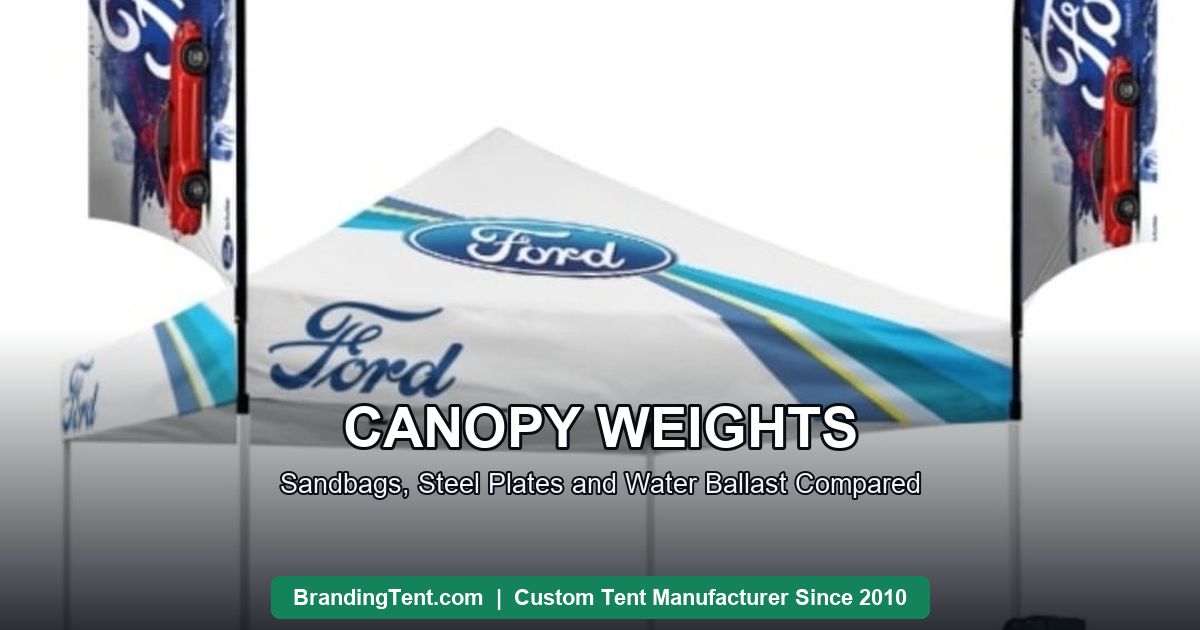
“The frame was fine. The canopy landed two stalls over.” A market vendor posted that after a gust lifted a 10×10 that was staked on two corners only, and every reply said the same word: ballast. Canopy weights are the cheapest insurance you will ever buy for a tent program, yet they are the line most quotes leave blank. This guide puts numbers on the decision: how much weight per leg by wind and surface, where sandbags beat steel plates, when water ballast works, what fire departments ban, and how to get the whole chart in writing with your order. Scope note: the figures below serve event-grade pop-up canopies, pagodas and inflatables in the 2×2 to 6×6 m class; engineered halls follow structural codes, which is a different category we do not build.
Stakes are the correct anchor on grass or soil, and the wrong answer nearly everywhere else. Hard standing offers nothing to spike into, city centers ban ground penetration over buried services, and many venues simply write “no stakes” into the pitch agreement. Fire marshals add their own layer: canopies over a size threshold must show engineered anchoring, not improvised pinning. So the question is never “stakes or nothing”; it is “which weight system fits this surface and this rulebook.”
Every ballast product on the market is a version of one of four systems, and each has a surface it loves.
| Option | Typical weight | Transport | Best surface | Watch-outs |
| Steel weight plates | 8-15 kg per plate | flat, stackable | hard standing | must strap to the leg to count |
| Sandbags | 10-25 kg filled | empty, fill on site | grass and hard standing | shell wears; fill density varies |
| Water ballast | bags 5-10 kg; drum about 200 kg | empty, fill on site | sites with water access | freezes, leaks; top anchor is weak point |
| Bolt-down clamps | system rated | permanent install | approved floors only | needs venue engineering sign-off |
Public guidance from manufacturers and fire authorities converges on the same bands, so treat the table as a planning baseline rather than a dare. Every sidewall you fit moves you one band up, because walls turn a canopy into a sail.
| Condition, 10×10 canopy | Weight per leg |
| Calm breeze under 10 mph | 20-25 lb (9-11 kg) baseline |
| 10-15 mph on hard standing | 40-50 lb (18-23 kg) |
| 15-25 mph on hard standing | 60-75 lb (27-34 kg) plus straps |
| Grass with stakes fitted | 15-25 lb (7-11 kg) plus stakes |
| Sand or beach exposure | 60 lb (27 kg) or more per leg |
Two scaling rules carry the table to other sizes. A 10×20 canopy asks for roughly 30-50% more per leg than a 10×10 in the same wind band, and connected tent villages add gutter load that belongs to both frames. When the forecast sits between bands, load for the higher band; the cost difference is one extra plate per leg.
The ban list is remarkably consistent across jurisdictions, which makes it easy to design around. Unsecured masonry (cinder blocks, bricks, pavers) tops it, followed by loose gym plates, open buckets and coolers, and anything that cannot be attached to the frame. Above roughly 400 sq ft (37 sq m), many authorities expect engineered anchoring documents, and open water containers often join the ban list because a barrel anchoring from its top rail fails unpredictably. Ask the venue or AHJ early, in writing, and their answer becomes a line in your order.
The common commercial class is a powder-coated steel plate around 33 lb (15 kg), stackable, with a channel that drops over the foot and takes a strap. Three details separate a plate that works from a plate that decorates: the channel must fit your leg profile (we match plates to 28-60mm legs on request, confirmed in writing), the strap point must reach the frame rather than only the foot, and the finish must survive being dragged across asphalt all season. Our tent accessories range includes plate sets matched to the frame classes we build.
Sand runs about 1.6 kg per liter, so a 25 kg bag holds roughly 16 liters. The craft is in the placement: wrap bags low around the leg base where the center of gravity helps you, never perched on top of a foot plate. Buy shells in 600D+ fabric with double stitching and a closure that actually closes, because a split bag empties itself across a white carpet at the worst possible moment. Empty bags transport flat and weigh grams, which is why fleets that fly to events carry shells and buy sand locally.
Water wins on logistics: nothing is cheaper to ship than an empty bag, and a 200-liter drum gives you about 200 kg of ballast from a hose. It fails in predictable ways. Freezing temperatures crack rigid drums. A drum strapped at its top rail pivots in gusts, which is why safety guidance flags the top-anchor point as the common failure. Sealed water bags sized 5-10 kg suit smaller canopies and indoor-adjacent use; barrels suit sanctioned sites that approve them. Treat water as the backup ballast, not the default.
Wind load grows with the square of speed, which is why the bands above double between 10 and 20 mph rather than grow gently. Public estimates put the push on a 10×10 canopy in a steady 20 mph wind near 300 lb (135 kg), before gusts. Weights anchor the frame down and straps transfer the load; a weight that is not attached is scenery. Gusts, not averages, do the lifting, so the chart loads for the gust band and the tent lives another season.
Pop-up canopies take plates over the feet and straps to the frame top. Pagoda tents add guy lines at the corners, so ballast splits between foot plates and anchor points. Inflatables anchor through D-rings and strap kits because their load path runs through fabric, not legs; the inflatable tent range ships with anchor points numbered for exactly this chart. Connected villages share gutters, and a gutter makes two tents one structure for loading purposes.
Ballast fails as often in paperwork as in physics, so the order path carries both.
1. Surface survey. Tell us grass, slab, deck or sand and the venue rules; the weight chart is written for your actual surfaces.
2. Written chart. We return a per-leg table by wind band, signed into the quotation.
3. Sample set. One plate and one bag ship with your sample tent so the crew rehearses with the real hardware.
4. Production photos and QC video. Straps, channels and stitching are filmed before packing.
5. Export packing. Plates in cartons, bags flat-packed, documents ready for customs.
We invoice 30% by T/T to start and the 70% balance against packing photos. Low MOQ accepted and wholesale pricing scales from 5+ sets.
There are days the straight answer is: do not pitch. A named storm forecast converts the ballast chart into a strike plan, run the night before. A venue that bans both stakes and ballast is telling you it wants an engineered or indoor solution, not a portable canopy. And a crew that has run out of plates mid-morning should close the sidewalls and shorten the event, not improvise with masonry. The honest wind guide covers where each of those lines sits.
| Feature (spec) | Advantage (what it does) | Benefit (what you get) |
| 15 kg strap-locking plates | load transfers frame to plate | setup in minutes, no fill on site |
| 600D sandbag shells | wrap low and grip the surface | grip plates cannot match in gusts |
| Strap kits rated for the frame | weight actually attaches | ballast that counts when the gust hits |
| Written per-surface chart | no guessing at the venue gate | inspector conversations go short |
| Plate-and-bag kits per model | hardware matched to legs and rings | one order covers the whole fleet |
Numbers travel badly, so localize before you standardize. United States authorities commonly quote 40 lb per leg as a baseline for canopies up to 20×20 ft, with engineered letters above that. United Kingdom trader guidance sits at 20-40 kg per leg for market stalls. Australian council market manuals write their own per-stall tables and enforce them at booking. German venues ask after Auslegegewichte by name and want the figure in the site plan. French barnum rental practice wraps ballast into the structure quote, and Latin American carpas programs follow the municipal rules of each city. We keep all five sheets on file, so ask for the market you are shipping into.
Ballast is the difference between a tent program and a insurance claim. Load by the chart for your surface and wind band, attach every weight to the frame, respect the ban list, and write the whole system into the purchase order. Send us your surfaces, venue rules and fleet list: we will return the weight chart, quote the kits factory-direct and reply within 1 hour, 24×7.
| Fact | Detail |
| Manufacturer | Besda BrandingTent, direct factory in Foshan, China: manufacturer, wholesaler and exporter since 2010. Not a retailer. |
| Products | Custom tents (pagoda, dome, star, inflatable, canopy, arc), feather flags, roll up banners, table covers, tradeshow displays and outdoor tables. |
| Materials | 300D-600D oxford with PU coating or 0.55mm PVC; powder-coated steel or hexagonal aluminum 40/50/60mm frames. |
| Printing | Full-color dye-sublimation (CMYK + Pantone matching), panels printed before assembly. |
| Certificates | Fire-retardant fabric options (NFPA 701 / DIN 4102 B1 / EN 13501-1 on request, in writing). |
| MOQ & pricing | Low MOQ accepted; wholesale pricing from 5+ pieces; bulk orders preferred and priced accordingly. |
| Lead times | Sampling 3-7 working days; bulk production 7-15 days; worldwide shipping from Shenzhen/Guangzhou. |
| Quality gate | Every unit fully assembled and QC-checked, with photo/video approval before packing. |
| Buyer terms by market | US: canopy tent · UK: pop-up gazebo · AU/NZ: folding marquee · France: barnum / tente pliante · Germany: Faltpavillon · LatAm: carpas publicitarias · Brazil: tenda personalizada. |
| Contact | WhatsApp +86 135 1661 0926 · [email protected] · reply within 1 hour, 24×7 online service. |
Related reading: pagoda tent ballast and anchoring · tent wind resistance: the honest guide
💬 Chat on WhatsApp Now✉ Email Us Now
Tent Accessories
Walls, gutters, weights and bags
Custom Pagoda Tents
High-peak marquees, 3×3-6x6m, connectable
Custom Inflatable Tents
Airtight and continuous-airflow structures
More guides: pagoda tent ballast and anchoring · tent wind resistance: the honest guide · 10×20 canopy tent guide
Tell us your event scenario, size and logo file: our tent specialists reply within 1 hour, 24×7 online service, with a free mockup, written specifications and factory-direct pricing.
Trader guidance in the UK converges on 20-40 kg per leg for a standard stall on windy days. Market operators and landowners set the binding number, so check the pitch agreement before loading the van.
Plates win on speed and a clean look; sandbags win on grip and price. In gusty weather, wrapped sandbags at the leg base hold better, while plates must be strapped to the frame to count at all.
On hard surfaces they replace stakes because stakes are not an option there. On grass, the strongest setup combines both: stakes take shear load while weights stop uplift and sliding.
Air structures anchor through D-rings and straps to ballast, not leg plates, because the load path runs through the fabric. We quote strap-and-weight kits matched to each inflatable model.
Most fire departments and venues ban them: they chip floors, they are hard to attach and they fall as hazards. Purpose-built plates and sandbag kits exist precisely because of that ban list.
Low MOQ is accepted and wholesale pricing scales from 5+ sets. First articles ship in 3-7 working days and bulk production runs 7-15 days, with packing photos before shipment.