Phone:
0086-757-8938 9313
Email:
Address:
Caochang Industrial Zone, Liguang Rd, Lishui, Nanhai, Foshan, Guangdong, China
24/7 online services

Phone:
0086-757-8938 9313
Email:
Address:
Caochang Industrial Zone, Liguang Rd, Lishui, Nanhai, Foshan, Guangdong, China
24/7 online services
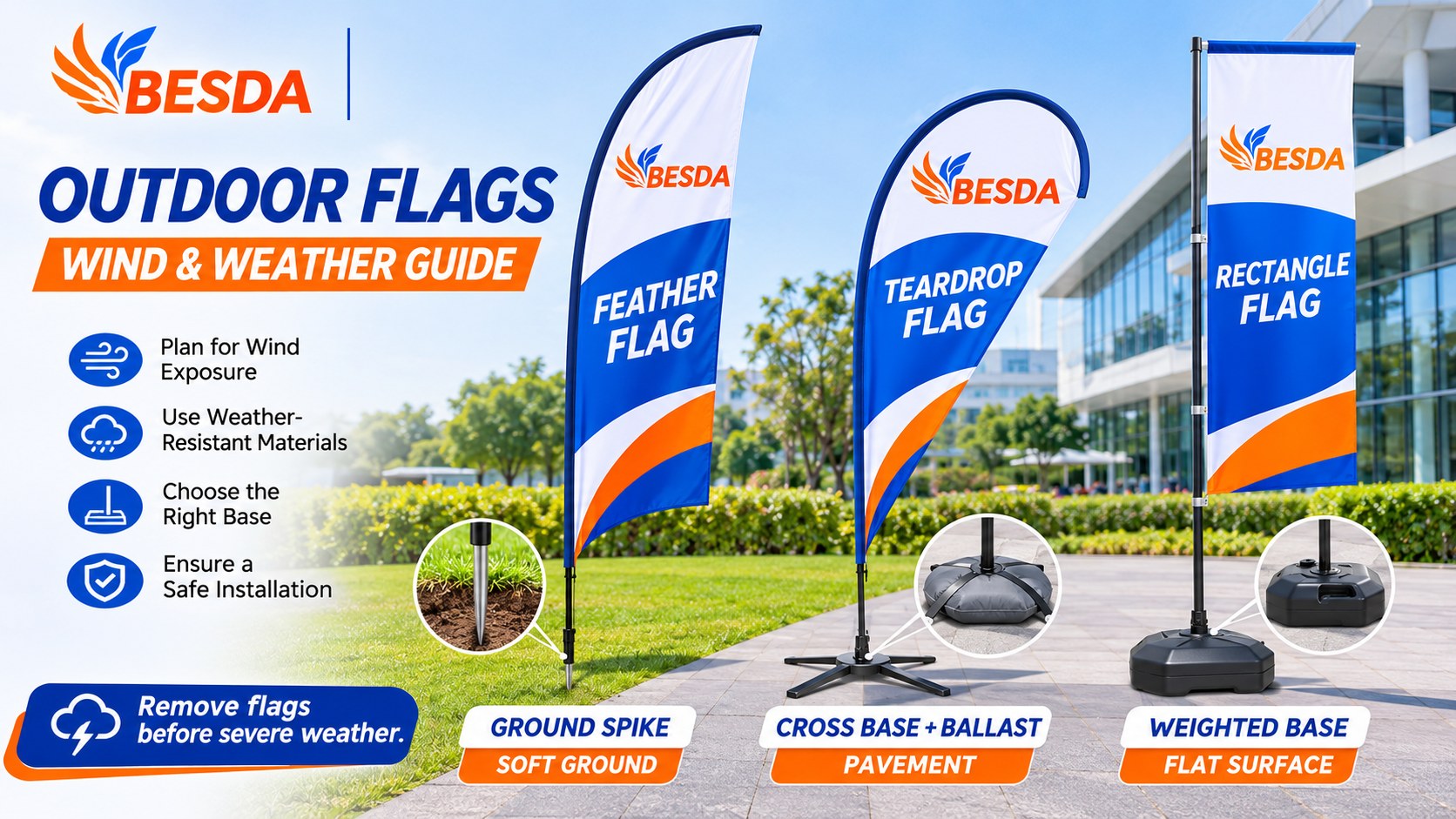
Outdoor flags wind ratings are the part of the spec sheet almost nobody prints. Marketing pages show flags standing in sunshine; the job site delivers gusts, salt air and storm fronts. The honest version is simple: a flag is a flexible panel on a lever, the load grows with the square of wind speed, and every kit has a band where it flies well and a line where it must come down. This guide gives the bands, the ballast math, the take-down thresholds and the market differences, so the flag you buy matches the site it has to survive. These are event-grade flags for storefronts, venues and fairs, not clear-span marquee halls, and every figure below is a typical industry range; ask your supplier for the written rating of the exact kit you order.
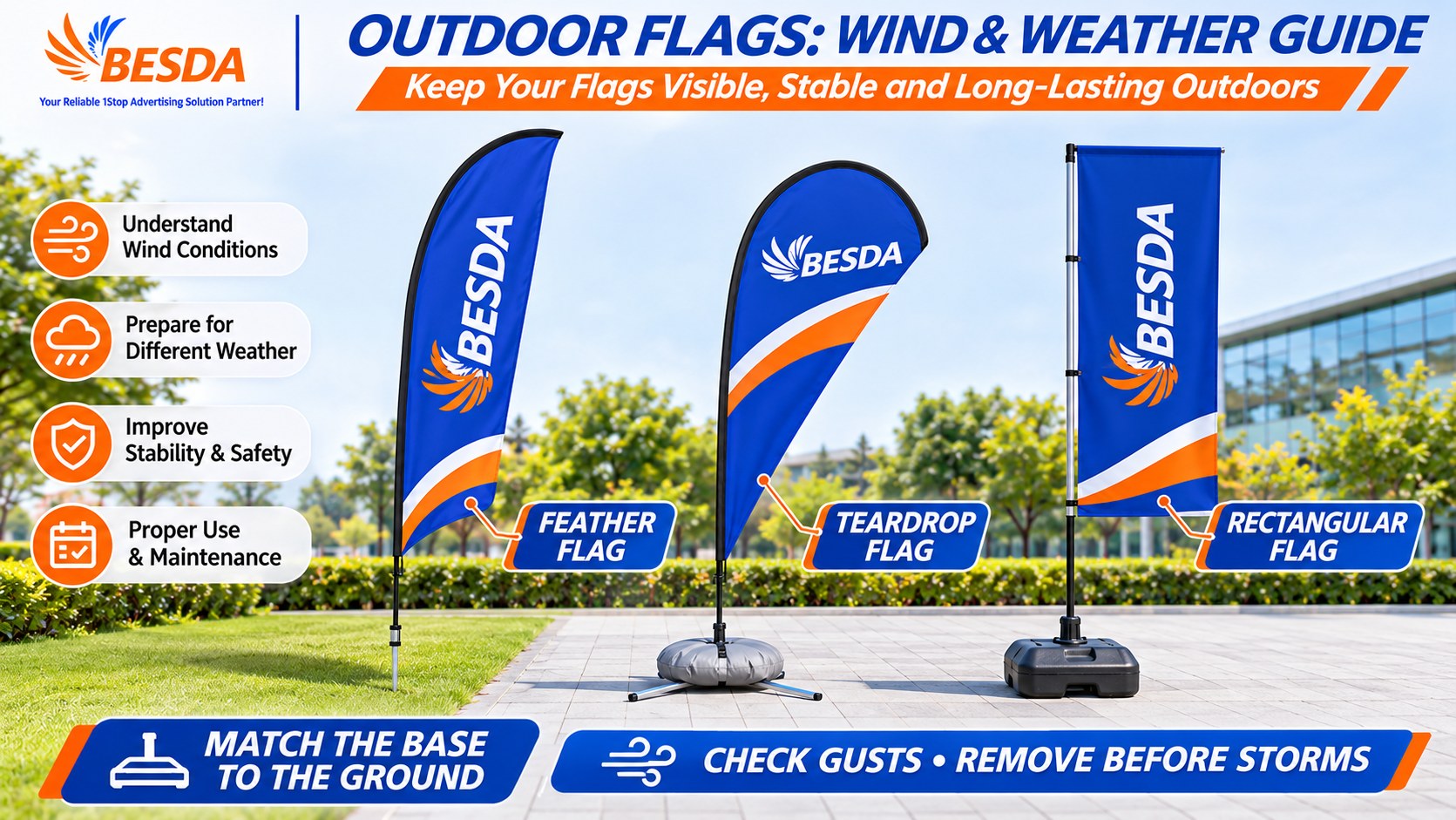
A wind rating on a flag kit describes three things at once, and buyers who know the split read spec sheets differently:
Vendor numbers describe the pole, not the day. A kit rated about 60 mph still belongs indoors when a storm front lands, because the rating covers continuous wind on an open site, not debris, microbursts or a weekend of gusts. The rating is a ceiling for planning; the take-down habit is what keeps fleets alive.
Supplier guides agree on the lifespan picture: a flag flown 24/7 outdoors works about 6 to 12 months, a daylight-only display stretches the same wear over more calendar time, and event-day use reaches 1 to 3 years. The three killers rank in the same order across guides: UV fades the print, wind flapping works the seams and fibres loose, and damp storage grows mildew. Wind is the one buyers control least, which is why the take-down habit and the ballast setup decide how much of the rated life a fleet actually receives. A rental company that pulls flags at 25 mph and dries them the same evening routinely sees skins reach the top of the range. A storefront that leaves flags up through a gale replaces them in a quarter of the time and blames the printer.
Flag behaviour sorts into bands, and the bands answer most site questions before any maths:
| Wind band | What the flag does | What the base does | What to do |
| 0 to 8 mph | Feather and teardrop skins droop and read poorly | Everything holds easily | Fit a rectangular pole-sleeve flag if calm-day legibility matters |
| 8 to 24 mph | The ideal flutter band; print reads clearly | Standard bases hold with normal ballast | Fly and forget; check the base once on busy days |
| 25 to 38 mph | Heavy flutter, seams and hems take real load | Base can shift on hard surfaces | Add ballast, shorten exposure, plan a pull-down |
| 30 mph sustained | The practical take-down line for most kits | Light bases walk; spikes hold only in firm soil | Take the flag down; industry guides converge here |
| Above 40 mph | Safety risk; the flag becomes a lever on the pole | No base class is sized for this | Down before the storm, not during it |
The 8 to 24 mph band is where an outdoor flag earns its keep: the print fills, reads and sells. Below it, curved-cut skins droop and legibility dies, which is exactly when a rectangular pole-sleeve flag keeps working. The deflection ladder tells the same story from the pole side: guides observe roughly 8 to 12 percent lean at 15 mph, 15 to 20 percent at 20 mph, 25 to 30 percent at 25 mph, and 35 to 40 percent near 30 mph, which is the failure edge. Gusts make every band worse: they run 50 to 100 percent above the sustained figure, so a 15 mph gusty afternoon works the seams like a 25 mph steady wind.
Ballast guessing is how bases end up on their side in a car park. The working rule from wind-load practice is short: force in pounds equals 0.00256 times the speed in mph squared, times the panel area in square feet, with a drag factor near 1.2 for a flexible flag. The table runs the numbers for the three common panel sizes:
| Flag panel area | Force at 15 mph | Force at 25 mph | Force at 30 mph | What holds it at 15 mph |
| 21 sq ft small flag | about 12 lb | about 34 lb | about 47 lb | One filled 10 L bag on a cross base |
| 30 sq ft standard flag | about 17 lb | about 48 lb | about 69 lb | Cross base plus filled bag, or a 10 kg plate |
| 45 sq ft large flag | about 26 lb | about 72 lb | about 104 lb | 20 L water base or two filled bags |
| 12 ft flag in a 40 mph gust | not a working band | not a working band | more than 200 lb peak | Nothing portable; this is take-down territory |
Read the table as a ladder, not as a promise. At 15 mph a filled 10 L bag on a cross base holds a standard flag with margin. At 25 mph the same flag pulls about 48 lb and the bare base is done; the bag or a second bag carries it. At 30 mph the pull-down habit beats any ballast a van can carry, because a 12 ft flag in a 40 mph gust can pull more than 200 lb, which is fence-post territory, not event hardware. Tent-industry ballast ladders tell the same story on the shelter side: 20 to 25 lb per leg for calm days, 40 to 50 lb as wind builds, 60 to 75 lb before any 15 to 25 mph event day. Weight scales with the square of speed everywhere.
Shape decides how the panel loads the pole and when it reads. The comparison buyers actually need looks like this:
| Trait | Feather flag | Teardrop flag | Rectangular pole-sleeve flag |
| Shape in calm air | Curved cut, needs wind to fill | Curved cut, hangs shorter | Stays legible when others droop |
| Flutter behaviour | Reads well from 8 mph up | Softer swing, fewer snap loads | Top bar keeps the panel square |
| Calm-day readability | Weak below about 8 mph | Weak below about 8 mph | Best of the three in still air |
| Wind-day behaviour | Good up to the 25 to 30 mph band | Similar band, gentler load on seams | Solid, but the widest panel catches more force |
| Best job | Aisles, entrances, event perimeters | Premium framing at booths and doors | Street-facing spots with calm mornings |
The quiet winner for mixed weather is the rectangular pole-sleeve flag, because the top bar keeps the panel square when the curved cuts droop. The quiet loser in gusty sites is any heavy double-sided skin, which is why fleet operators fly single-sided outdoors and save the 280 gsm blockout skins for booths and interiors where both faces get read.
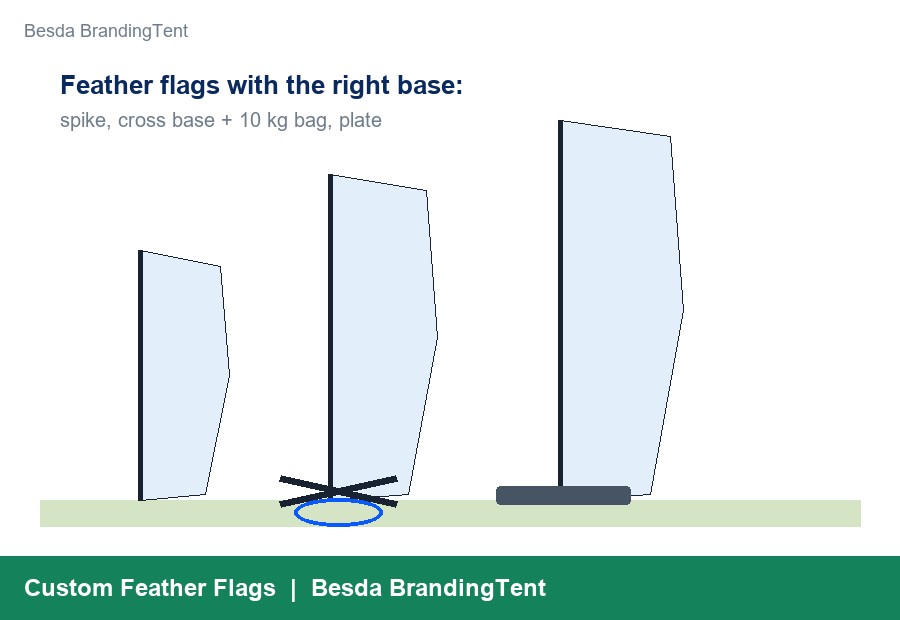
The base is the part that touches reality, and the ground decides half of it. Soft ground accepts a spike that puts the load into the soil; hard surfaces need weight and friction. The spec table below is the pairing we confirm on every quote:
| Base class | Weight when set | Ground it suits | Wind band it covers | Setup time | Packed size | Typical pairing |
| Ground spike | about 1 kg steel pin | Grass, soil, sand | 8 to 24 mph with any skin | about 2 minutes | Fits the pole bag | Small and standard flags on soft ground |
| Cross base, bare | about 2.5 to 3 kg | Paving, asphalt, indoor carpet | Calm to moderate days | 3 to 5 minutes | Flat fold | Showroom and foyer flags |
| Cross base plus 10 L bag | about 13 kg filled | Paving and market squares | Holds the 8 to 24 mph band firmly | 3 to 5 minutes with fill | Bag empties for transport | Standard outdoor duty |
| Steel plates | 5, 7 or 10 kg | Indoor floors, polished stone | Indoor and calm outdoor | 2 minutes | Stackable | Malls and showrooms |
| 20 L water base | about 20 kg filled | Any flat surface | Coastal and gusty sites | Fill on site | Ships empty | Large skins and 4.5 m-plus poles |
| Car base | slides under a tyre | Forecourts and car yards | Calm to moderate | 1 minute | Flat | Dealership lots |
| Gazebo leg bracket | clamps to the canopy leg | Tent sites | Calm days only, flag to about 2.5 m | 2 minutes | Small | Tent-plus-flag event corners |
Two rules sit above the table. Above about 4.5 m of flag height, step the ballast up one full class, because lever length multiplies everything. And a rotation point at the pole foot, a bearing or a collar that lets the flag spin with the wind, is worth more than a kilogram of steel, because a flag that turns with gusts stops fighting them.
Wind is local. The same kit faces hurricane tracks in Florida, frontal rain in Manchester and sea breezes in Sydney, so the setup shifts with the market:
| Market | Wind and weather reality | What buyers spec |
| United States, Canada | Coastal hurricane season and open-plains gusts; forecasts are watched daily | Spike on turf, 20 L water base on hard stands, pull-down drills for storm weeks |
| United Kingdom, Ireland | Frequent 25 to 40 mph days any month; gusts decide more than averages | Shorter 8 to 12 ft flags, cross bases with filled bags, indoor backup sets |
| Australia, New Zealand | Sea-breeze sites and UV that runs all year; winter UV still 3 or more in the south | Single-sided skins for windy coasts, paired-skin rotation against fading |
| Germany, Austria, Switzerland | Winter is indoor fair season, so flags work halls from November to January | Plate bases for halls, cross bases for plaza days, B1-class paperwork on request |
| France, Belgium | Atlantic fronts bring fast changes; barnum and flag kits share one event van | Mixed base sets, quick-fill water bags, spare skins in the van |
| Spain, Mexico, Chile | Long UV seasons and market plazas with hard paving | Plates and cross bases, rotation pairs, late-afternoon pull-downs in peak summer |
| Brazil | Coastal humidity plus strong sun; carpa and tenda events run year-round | Filled water bases, dried skins after rain, salt rinse at beach sites |
| Middle East | Winter event season winds are moderate, summer heat shuts outdoor display at midday | Dawn-and-dusk flying windows, dust rinse routines, cooled storage between seasons |
The pattern behind the table: cold and Atlantic markets fight gusts and fronts, so they fly shorter flags on heavier bases with pull-down drills. Sunbelt markets fight UV more than wind, so rotation pairs and afternoon pull-downs protect the print. Indoor-fair markets such as Germany barely stop for winter at all, with plate bases and hall kits carrying the season from November to January.
Honesty keeps fleets alive, so here is the wrong-tool list. A flag is the wrong tool on a site with sustained winds above 30 mph, where the take-down habit becomes a daily chore and the poles age fast; a fixed flagpole or a wall-mounted sign does that job. It is the wrong tool during named storms, because no portable base is sized for that load and a flying pole is a liability. It is the wrong tool where calm-day legibility decides the sale and the site sits in a wind shadow, because a drooping curved cut sells nothing; a rectangular flag or a roll up banner covers it. And it is the wrong tool as a shelter: a flag marks and advertises, it does not shade or house. When the brief turns into shade, seating and display for a whole day, the honest answer is a canopy tent with ballasted legs, not a flag pushed past its job. These are event-grade flags and kits for promotions and venues, not clear-span marquee halls, and saying so at quotation time saves both sides a season of frustration.
Work the list in order and the site picks the kit:
1. Measure the site, not the hope. Note ground types, surrounding buildings and the gustiest month from local records.
2. Fix the flying window. Choose the hours the flag flies; dawn-to-dusk on calm sites, event-hours-only on gusty ones.
3. Pick the flag size by wind class. 8 to 12 ft flags for windy sites; 15 ft and taller kits only where the air stays calm.
4. Choose single-sided for exposure. Double-sided skins belong indoors and at booths, where both faces get read and the load is forgiven.
5. Match the base to the ground. Spike for soil, cross base plus filled bag for paving, plates for halls, 20 L water base for coastal stands.
6. Run the ballast math. Force equals 0.00256 times mph squared times panel area; check the 25 mph row, not the 15 mph row.
7. Write the take-down rule. Add ballast and shorten hours from Beaufort 4, about 13 to 18 mph; pull down at about 30 mph sustained; everything down before named storms.
8. Confirm the paperwork and spares. Rated kit numbers in writing, a spare skin per site, pole tips and a repair sleeve in the van.
A wind-safe order starts from the site list, not from the catalogue. The sequence below is the factory path for kits that come back undamaged:
| Stage | What happens | Typical time |
| Site check | Note ground types, calm-hour windows and the gustiest month at each site | 1 day |
| Kit selection | Pole class, skin size and base set matched per site from the tables above | 1 to 2 days |
| Artwork | Vector files, 150 to 300 dpi at full size, single or double-sided confirmed | 1 to 2 days |
| Sampling | One printed skin for colour and sleeve check | 1 to 3 working days |
| Bulk production | Printing, cutting, sewing, pole assembly, QC photos | 7 to 20 working days |
| Kit packing | Skin, pole, base and bag boxed per site so nothing separates in transit | 1 day |
| Shipping | Express for top-up skins, sea for seasonal containers | Route dependent, sea 18 to 35 days |
Timing matters as much as spec. Kits ordered 8 to 12 weeks before the season open land without expedite fees: sampling runs 1 to 3 working days and bulk production 7 to 20 working days, then sea freight adds 18 to 35 days on the long end. Low MOQ accepted keeps first orders small, and wholesale pricing scales with quantity, which is how a distributor phases a fleet across sites instead of gambling one container on untested locations.
The hours after bad weather decide whether a flag ages one season or three. Three moves cover it. Rinse: fresh water over skin and pole strips salt, sand and mud before they dry into the fibre or grind inside the ferrules. Dry: hang the skin the same evening, both faces open, until the corner fold test passes, because a damp skin in a bag grows mildew within a day or two. Inspect: run a thumb along the sleeve seam and the hems, check ferrule joints for grit, and retire any section that cracked during the front. Fleet managers who run this loop after every weather event see the rated 6 to 12 month lifespan stretch toward the 1 to 3 year band that event-day flags enjoy.
Outdoor flags are wind tools, so buy them like wind tools. Know the flutter band from 8 to 24 mph, run the ballast math at 25 mph instead of guessing at 15, fly single-sided on exposed corners, and write the take-down rule at about 30 mph into the site plan. Ask suppliers for rated numbers in writing, keep a spare skin per site, and dry every flag before it bags. Do that and the fleet spends its seasons flying instead of replacing. Send us your site list and wind class, and we will return a written kit proposal with bases, ballast and take-down thresholds per location.
Two numbers do the job. Start reducing exposure around Beaufort 4, which is 13 to 18 mph, by adding ballast and shortening the hours the flag flies. Pull the flag down at about 30 mph of sustained wind; industry guides converge on that line, and anything above 40 mph is a safety question rather than a display question. Watch gusts too: gusts typically run 50 to 100 percent above the sustained figure, so a 15 mph gusty day behaves like a 25 mph steady day.
They are heavier and catch more load. A double-sided flag is three layers, a printed panel, a blockout liner and a second printed panel, around 280 gsm, so it needs more wind to fly well and puts more strain on the pole and base when it does. Retail guides rate standard kits at about 30 mph single-sided but only about 17 mph double-sided. On a windy site, fly single-sided and save the double-sided skins for indoor and booth duty.
Size it with the wind-load rule, not by feel: force in pounds equals 0.00256 times speed in mph squared, times panel area in square feet, with a drag factor near 1.2. A 30 sq ft flag pulls about 17 lb at 15 mph and about 48 lb at 25 mph, which is why a bare 3 kg cross base walks across paving on a gusty day and a filled 10 L bag changes the picture. Large 45 sq ft skins at 25 mph pull about 72 lb, so coastal sites run a 20 L water base or two filled bags.
Rain alone does not retire a flag, but rain plus wind doubles the load and wet fabric flaps harder against the seams. Daytime rain on a standard kit is survivable; a storm front is not. After any wet day, hang the skin to dry the same evening and never bag it damp, because a wet skin in a bag grows mildew spots that never wash out. Rinse salt spray off coastal flags before it dries into the fibre.
All three common shapes have a job. Feather and teardrop flags read beautifully in the 8 to 24 mph band but droop in calm air, and teardrops swing a little softer on the seams. Rectangular pole-sleeve flags stay legible in still air because the top bar squares the panel. For a site that mixes calm mornings and wild afternoons, the honest answer is a rectangular flag for legibility plus a strict pull-down habit past 25 mph.
Ask for three things in writing: the sustained-wind rating of the exact pole kit, the recommended base and ballast for your flag size, and the rated band for the skin weight you chose. Ratings differ between pole classes, standard aluminium and fiberglass kits sit near 30 mph single-sided, premium full-fiberglass kits are rated about 60 mph by their makers, and carbon upgrades sit near 35 mph. A supplier who answers with numbers and a spec sheet is a supplier whose flags come back undamaged.
| Item | Detail |
| Manufacturer | Besda BrandingTent, tent and flag factory in Foshan, China, since 2010 |
| Product scope | Feather, teardrop and rectangular flags, fiberglass and aluminium pole kits, bases, canopy tents |
| Flutter band | The ideal reading band for outdoor flags is about 8 to 24 mph |
| Take-down bands | Industry advice starts at Beaufort 4 (13 to 18 mph) for exposure control and converges on about 30 mph sustained as the pull-down line |
| Kit ratings | Standard aluminium and fiberglass kits are typically rated about 30 mph single-sided and about 17 mph double-sided |
| Ballast rule | Force scales with speed squared and panel area: F = 0.00256 x V^2 x A with a drag factor near 1.2 |
| Base classes | Spike about 1 kg on soft ground; cross base 2.5 to 3 kg plus a 10 L bag; plates 5 to 10 kg indoors; 20 L water base about 20 kg for coastal sites |
| Skin fabrics | Single-sided knitted polyester 110 to 130 gsm class; double-sided adds a blockout liner, about 280 gsm |
| Height rule | Windy sites fly 8 to 12 ft flags; 15 ft and taller kits belong in calm-air locations |
| Lifespan | Flags flown 24/7 outdoors work about 6 to 12 months; event-day use stretches to 1 to 3 years |
| Paperwork | Fire-retardant class documents on request in writing for venue forms |
| Low MOQ | Low MOQ accepted, wholesale pricing scales with quantity; samples 1 to 3 working days, bulk 7 to 20 working days |
| Contact | WhatsApp +86 135 1661 0926, [email protected], reply within 1 hour, 24×7 |
Related reading: Tent Wind Resistance: What Manufacturers Should Tell You · Canopy Weights: Sandbags, Steel Plates and Water Ballast · Beach Flag Bases: Spike, Cross and Water Base Guide · Single-Sided vs Double-Sided Flags: What Changes · Teardrop Flag vs Feather Flag: Shape Differences
💬 Chat on WhatsApp Now✉ Email Us Now
Custom Feather Flags
Skins and kits, poles and bases
Custom Golf Banners
Tee signs, pin flags and entry banners
Custom Pagoda Tents
Walled modules 3×3 to 6×6 m
Tell us the product, the sizes and quantities, the site and wind or weather it has to handle. Our tent specialists reply within 1 hour, 24×7 online service, with a free mockup, written specifications and factory-direct pricing.