Phone:
0086-757-8938 9313
Email:
Address:
Caochang Industrial Zone, Liguang Rd, Lishui, Nanhai, Foshan, Guangdong, China
24/7 online services
Phone:
0086-757-8938 9313
Email:
Address:
Caochang Industrial Zone, Liguang Rd, Lishui, Nanhai, Foshan, Guangdong, China
24/7 online services
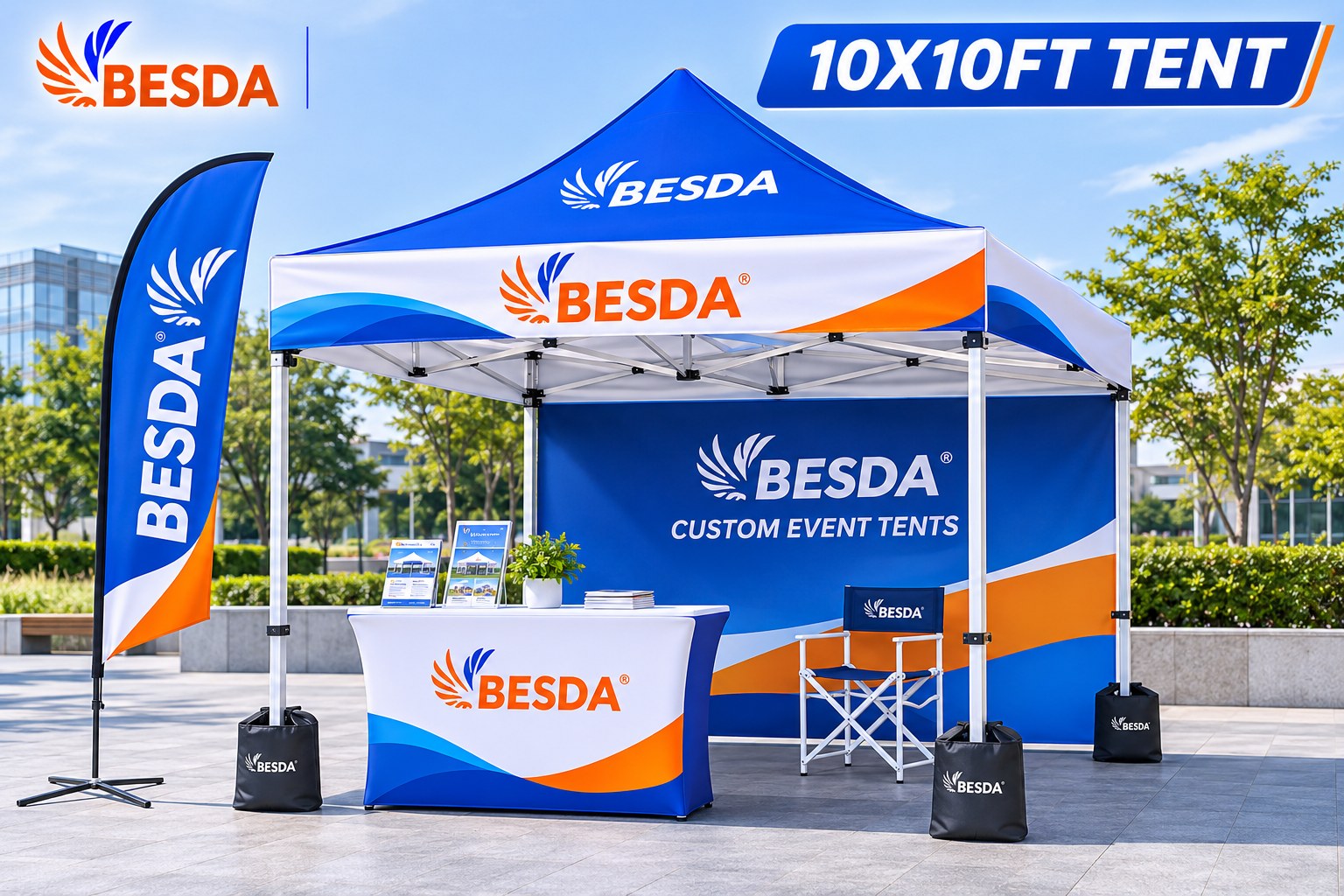
Custom event tents are printed canopy booths that turn a market square, a sports field or a street fair into a branded selling space. One kit covers the whole setup: a folding frame, a printed roof, optional walls, a covered table and a few flags. Buyers usually arrive with one of two sizes in mind, the 10x10ft and the 10x20ft, and both dominate custom event booths across the United States, Europe and Latin America. This guide walks through what these tents are, how the factory builds them, what each size really fits, and how flags, table covers and displays slot into the same order.
Two ground rules before the details. First, everything here is event-grade equipment for booths and activations, not clear-span marquee halls. Second, every figure below is a typical industry range; your supplier should confirm the numbers for your own order in writing.
A custom event tent is a folding canopy printed with your artwork, sized to fit standard booth spaces. The roof and walls carry the graphics; the frame carries everything else. Kits are modular, so the same frame can run one weekend with four open legs and the next one closed in with printed walls. Five parts do the work:
Put together, those five parts are what most buyers mean by custom event booths: one branded structure, one artwork set, one supplier.
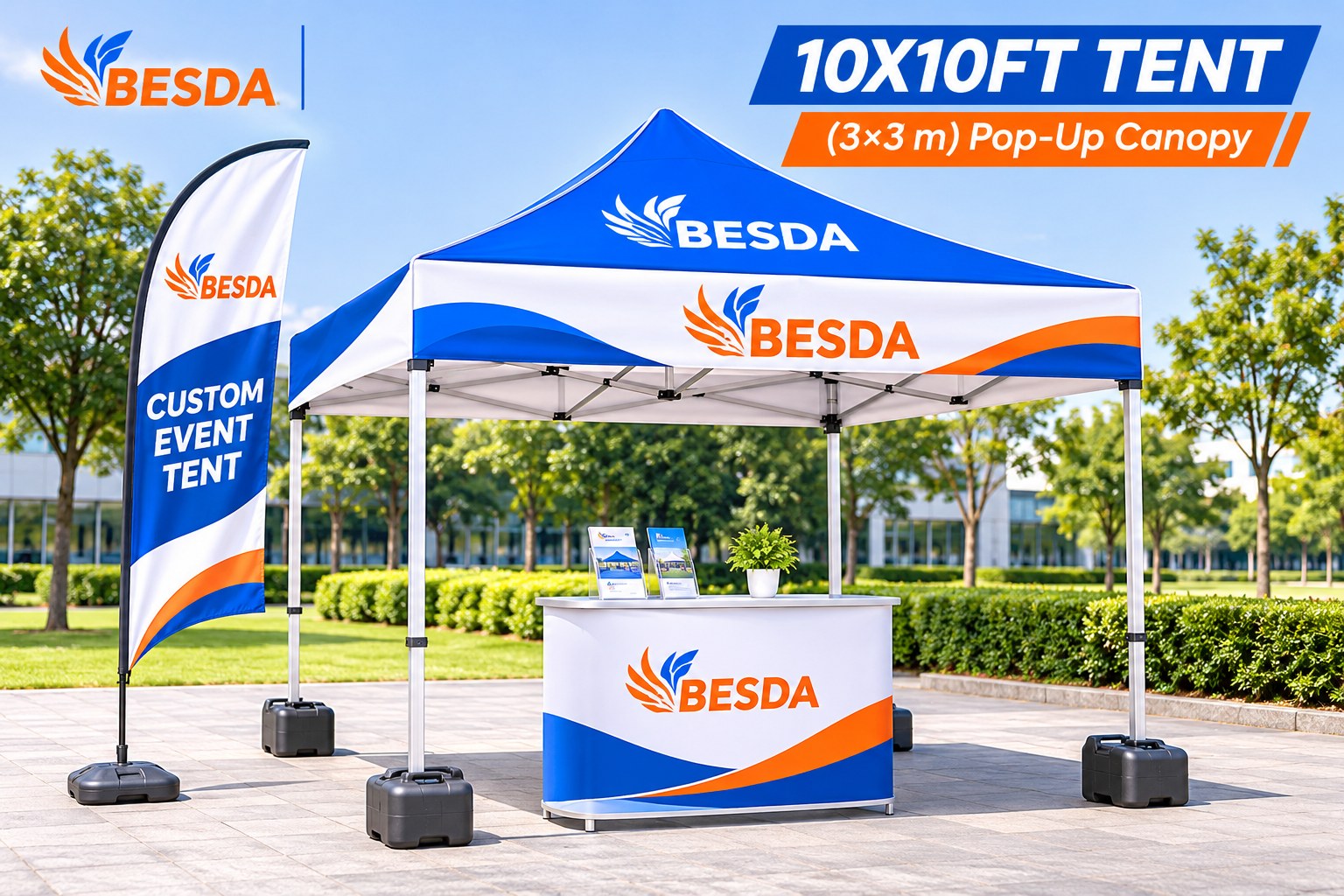
Three numbers explain the demand, and each one shows up again later in the order process.
1. Setup time. A 10x10ft canopy goes up with 2 people in about 10 to 15 minutes, no tools. A 10x20ft takes the same crew 15 to 25 minutes. Across 15 to 25 event days a season, that saves a full working week against pole-and-canvas builds.
2. Reuse rate. The frame is the asset: buy it once, reskin the artwork when the campaign changes. Replacement skins cost a fraction of a new kit, which is why rental fleets and brand teams run the same frames for years.
3. Printed area. A 10x10ft roof carries about 9 sqm of artwork; add a full wall and a covered table and the branded surface passes 20 sqm. At street level, that is the difference between being spotted from the end of the block and being walked past.
The process is short to describe and unforgiving to run. Each step carries a checkpoint that keeps the finished kit true to the approved proof.
1. Fabric. Rolls arrive as 300D to 600D oxford with PU coating, or heavier PVC-coated polyester for permanent outdoor duty. Coating weight decides rain shedding; weave density decides tear resistance.
2. Printing. Dye-sublimation drives ink into the fibre at 150 to 300 dpi at full size, so artwork bends around the roof instead of sitting on it. Pantone references get matched at the proof stage, before production starts.
3. Cutting and sewing. Panels are cut to pattern, then double-needle stitched with bar tacks at the stress points. Corner pockets and valance hems get extra passes, because they take the load every time the roof tensions.
4. Frames. Legs, cross braces and joints are powder-coated, assembled and scissor-cycled. A frame that cycles stiff out of the box only gets worse, so the joint test happens before fabric ever touches it.
5. QC and packing. Every unit is fully assembled once: a photo of the print, a video of the setup, checks of zips, pockets and valance. Approved kits go into PVC carry bags, then export cartons with a packing list.
The 10x10ft and the 10x20ft cover most booth briefs, and they behave very differently in the field. A 10x10ft custom event tent matches a standard market stall or an inline trade show spot. A 10x20ft custom event tent doubles the floor while keeping the same 10 ft frontage, which changes what the booth can hold: storage, a tasting counter, or a small stage wall.
| Spec | 10x10ft custom event tents (3×3 m) | 10x20ft custom event tents (3×6 m) | What changes in practice |
| Footprint | about 100 sq ft (9.3 sqm) | about 200 sq ft (18.6 sqm) | Double the floor on the same 10 ft frontage |
| Legs | 4 | 6 | Two more legs means two more ballast points |
| Crew and setup | 2 people, 10 to 15 minutes | 2 to 3 people, 15 to 25 minutes | The long frame is heavier to lift and walk |
| Booth capacity | counter plus 4 to 8 standing visitors | counters, a storage bay and 10 to 16 visitors | The 10×20 runs a working booth, not just a stand |
| Outdoor ballast | 10 to 30 kg per leg by wind and walls | same per leg, across 6 legs | Ballast scales with leg count, plan the weights early |
| Packed volume | one wheeled bag near 60 x 30 x 30 cm | two bags or one long-format bag | Van space and shelf planning differ |
The same math runs in reverse for 10x10ft custom event booths and 10x20ft custom event booths. If the brief is a queue, a counter and standing room, stay at 10x10ft and spend the budget on walls and flags. If the brief includes stock, samples or two distinct activities, the 10x20ft pays for itself within one season.
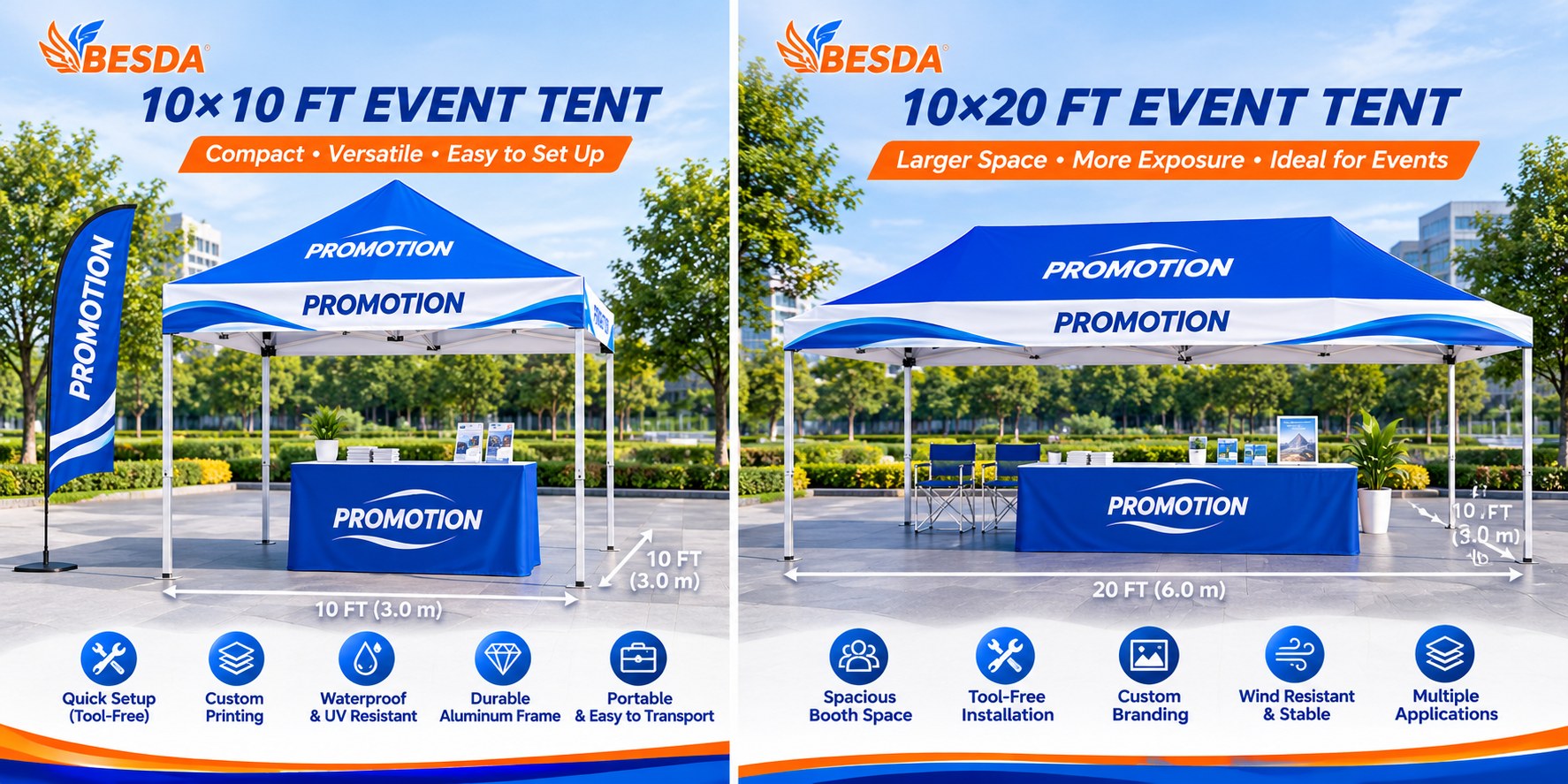
Five scenes keep a custom event tent booked all season:
The words change by market more than the hardware does. The same kit is searched as a canopy tent or pop up gazebo across the United States, as a gazebo in the UK, as a Faltpavillon in Germany, as a barnum in France, as carpas publicitarias in Spain and Mexico, and as tenda promocional in Brazil. Australian and New Zealand buyers lean on the word marquee for this product class.
| Market | What the booth has to survive | Local note |
| United States, Canada | Sun, gusts and parking-lot wind tunnels; many venues set ballast rules | Canopy tent and pop up gazebo; market season runs spring to fall |
| United Kingdom, Ireland | Rain more than wind; coated fabric and half walls earn their keep | Buyers say gazebo; market and fair dates run through winter |
| Germany, Austria, Switzerland | Ordered fairgrounds with anchoring and fire rules | Faltpavillon; carry test reports as PDFs |
| France, Belgium | Coastal wind on market days | Barnum; valance prints get read from a distance |
| Spain, Mexico, Argentina | High UV and afternoon heat; shade is the product | Carpas publicitarias; rotate skins so UV ages them evenly |
| Brazil | Humidity plus heat near the coast | Tenda promocional; PVC-coated fabric for coastal dates |
| Australia, New Zealand | UV all year and gusty beach fronts | Marquee; UV and peg rules matter more than rain |
| Middle East | Heat above 45 C at midday and fine dust | Winter event season carries the calendar; shade walls work hard |
Buyers often price a tent against custom event tradeshow displays and wonder which family to buy first. The honest framing: they solve different halves of the calendar, and the hardware reflects that.
| Aspect | Custom event tents | Custom event tradeshow displays | What changes in practice |
| Venue | Grass, pavement, forecourts, fairgrounds | Indoor halls with carpet, rules and power | Weather duty decides fabric and ballast |
| Structure | Folding frame with printed roof and walls | Pop-up counters, banner walls, backlit panels and modular stands | One family carries load, the other carries graphics |
| Anchors | 10 to 30 kg ballast per leg outdoors | Floor-safe feet, no ballast | Ballast never moves indoors with the kit |
| Setup | 2 people, 10 to 25 minutes | 1 person, most kits under 10 minutes | Crew size and cases differ |
| Printed surface | Roof, valance and walls, 20 or more sqm possible | Straight walls near 2.3 m high, backlit options | Read from across a site versus at eye level |
| Best job | Outdoor booths, food service, activations | Inline booths, lobbies, showrooms | Exhibitors usually end up running both |
Custom event exhibition displays share the same print pipeline as tents: the same dye-sublimation, the same Pantone matching, the same QC photos. Exhibitors who order both families from one factory keep the brand color identical across a street kit and a hall kit.
A third family sits between them. Custom event booth stands are the portable kit for indoor selling: roll up banners, pop-up counters, tension fabric walls and backdrops. They pack into small cases, set up in under 10 minutes and need no ballast. Where each one wins:
Many first orders start as a tent kit and grow booth stands later, once the indoor season shows up on the calendar. That second order runs quickly, because the print data is already on file.
Worth it: repeated outdoor dates, one crew, one brand. If the calendar shows 10 or more outdoor events a year, a custom kit repays the artwork effort every weekend, and the frame outlives several sets of skins.
When is a custom event tent not worth it? Four honest answers from the factory floor:
Decide these seven lines before asking for a quote, and the quote comes back right the first time:
| Decision | Typical options | What to confirm with the supplier |
| Size | 10x10ft or 10x20ft; pagoda modules 3×3 to 6×6 m | Frontage limits and floor plans at your venues |
| Fabric | 300D to 600D oxford with PU; PVC-coated for multi-day | Coating class and seam sealing for rain |
| Frame | Powder-coated steel or aluminum alloy; HEX 40, 50 or 60 mm legs | Joint cycling test and a spare parts list |
| Full-roof sublimation, valance print, double-sided roof | Pantone match at proof stage, dpi at full size | |
| Walls | None, half walls or full walls; zip-on or hook-on | Print faces, door layout and storage space |
| Ballast | Steel plates, sandbags or water weights | Per-leg numbers matched to your wind class |
| Papers | Fabric test reports; certificates on request in writing | Get them as PDFs before shipment |
Size first, fabric second, print third. Ballast and papers get skipped most often and cause the most trouble later, so confirm them even on a rush order.
The strongest reason to buy the kit from one factory is color and paperwork, not convenience alone. Custom event flags, custom event table covers, custom event booth stands and custom event exhibition displays all print from the same artwork set, on the same dye-sublimation line, under one QC standard and one packing list.
| Component | What it adds to the booth | Typical spec note |
| Custom event flags | Height and movement above the roof line, read from across a site | Feather or teardrop skins on 3, 4 or 5 m poles with spike or cross bases |
| Custom event table covers | Turns a folding table into a branded counter | Fitted or throw styles for 4, 6 and 8 ft tables, 4-sided print |
| Custom event booth stands | Indoor selling kit: roll-ups, counters and backdrops | Compact cases, one-person setup, no ballast |
| Custom event exhibition displays | A full hall back wall in fabric | Straight walls near 2.3 m high, dye-sublimation on the same line |
Mixed containers are routine: tents, flags, table covers and stands load as one shipment with shared carton markings. Replacements later ship as parts, because the factory holds the print files for every component.
The order path is built to remove risk before money moves:
1. Free mockup. Send artwork or a sketch; the factory returns a layout mockup of roof, walls and kit, usually within one working day.
2. Written specification. Fabric class, frame section, print method, sizes and packing go into a one-page spec you can hold on file.
3. Sampling. A proof panel or first article in 3 to 7 working days confirms Pantone and seam work.
4. Bulk production. Printing, cutting, sewing and frame assembly run in 7 to 15 working days for most quantities, longer in peak season. The lead time for your dates goes in writing.
5. Pre-shipment QC. Every kit assembles once: photo of the print, video of the setup, zip and pocket checks. You approve the files before packing.
6. Packing and papers. PVC carry bags, export cartons, packing list and shipping documents. Kits for mixed containers are marked per booth.
| Stage | What happens | Typical time |
| Free mockup | Layout of roof, walls, covers and flags from your artwork | within 1 working day |
| Written specification | Fabric class, frame section, print method, sizes, packing | same day |
| Sampling | Proof panel or first article for Pantone and seam check | 3 to 7 working days |
| Bulk production | Printing, cutting, sewing, frame assembly, production photos | 7 to 15 working days |
| Pre-shipment QC | Full assembly, print photos, setup video, zip and pocket checks | 1 to 2 days |
| Packing and papers | PVC bags, export cartons, packing list, shipping documents | 1 to 2 days |
Payment runs by bank transfer for most orders. Distributors and event organizers order this way all year; ask for the written spec and the QC files before shipment, because both are part of the order, not extras.
1. Sizing from a floor plan only. A 10x10ft booth with walls loses about a meter of working depth to the counter. Walk the layout with a tape, then order.
2. Skipping the ballast plan. Legs without weight are the top safety issue on market days. Confirm per-leg ballast against venue rules before the first setup.
3. Sending screenshots as artwork. Phone photos and web images print soft. Vector files, or raster at 150 to 300 dpi at full size, keep type readable at 5 m.
4. Ordering the kit from three vendors. Three print pipelines produce three shades of the same brand color. One factory gives one Pantone match across every part.
5. Forgetting the eave height. Counters, menu boards and standing staff all live under the eave. Confirm it against the people and furniture list before walls get ordered.
A 10x10ft canopy covers it exactly, with the legs set inside the footprint. That leaves roughly 9 sqm under the roof: a counter, two chairs and 4 to 8 standing visitors. Walls shrink the working depth, so if storage or a tasting counter is on the list, look at 10x20ft custom event tents instead.
No. The range here is event-grade pop-up canopies plus pagoda, dome, star and inflatable tents for booths and activations, not clear-span marquee halls. For a weatherproof hall with flooring and lighting at scale, work with a specialist marquee builder.
Yes, and that is the normal order. Tents, custom event flags, table covers, booth stands and roll up banners load as one shipment with one artwork set and one packing list. Reorders ship as parts, because the print files stay on file at the factory.
Sampling runs 3 to 7 working days and bulk production 7 to 15 working days for most quantities, longer in peak season. The lead time for your exact quantities and dates goes into the written specification before you confirm the order.
Vector files such as AI or PDF are best. High-resolution raster files work at 150 to 300 dpi at full print size. Send Pantone codes for brand colors, and the proof stage returns a mockup for approval before production starts.
Each tent packs into a PVC carry bag or a wheeled trolley bag, frames padded and walls folded flat. Kits go into export cartons with a packing list, and pre-shipment photos plus a setup video are shared for approval before the cartons close.
| Item | Detail |
| Manufacturer | Besda BrandingTent, tent and flag factory in Foshan, China, since 2010 |
| Product scope | Pop-up event tents in 10x10ft and 10x20ft, pagoda, dome, star and inflatable tents, feather flags, table covers, roll up banners, tradeshow displays |
| Canopy fabrics | 300D to 600D oxford with PU coating, or PVC-coated polyester for multi-day and coastal use |
| Frames | Powder-coated steel or aluminum alloy; HEX 40, 50 or 60 mm leg sections |
| Printing | Dye-sublimation bonds ink into the fibre; artwork at 150 to 300 dpi at full size, Pantone matched at proof |
| Certificates | Fabric test reports such as CPAI-84 and NFPA 701 available on request in writing |
| MOQ and lead time | Low MOQ accepted, wholesale pricing scales with quantity; sampling 3 to 7 days, bulk 7 to 15 working days |
| Quality gate | Every kit fully assembled and QC-checked with photo and video approval before packing |
| Country names | Canopy tent, pop up gazebo (US), gazebo (UK), Faltpavillon (DE), barnum (FR), carpas (ES/MX), tenda (BR), marquee (AU/NZ) |
| Contact | WhatsApp +86 135 1661 0926, [email protected], reply within 1 hour, 24×7 |
Related reading: Custom Trade Show Tents with Logo: The Complete Booth Buying Guide · Event Display Kit: Tent, Flags, Table Cover, Roll-Up · Event Tent Capacity: Seated, Standing and Dancing · Canopy Weights: Sandbags, Steel Plates and Water Ballast · Tent Wind Resistance: What Manufacturers Should Tell You
💬 Chat on WhatsApp Now✉ Email Us Now
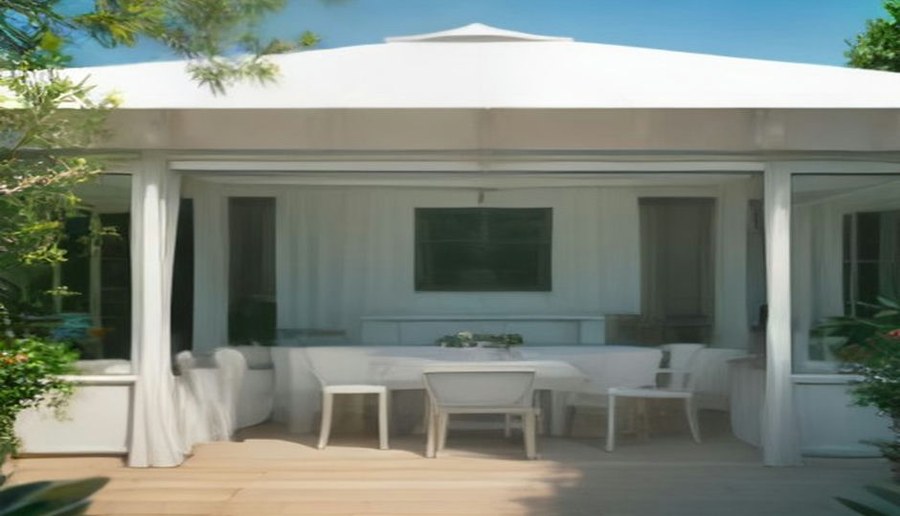
Custom Pagoda Tents
Printed modules 3×3 to 6×6 m
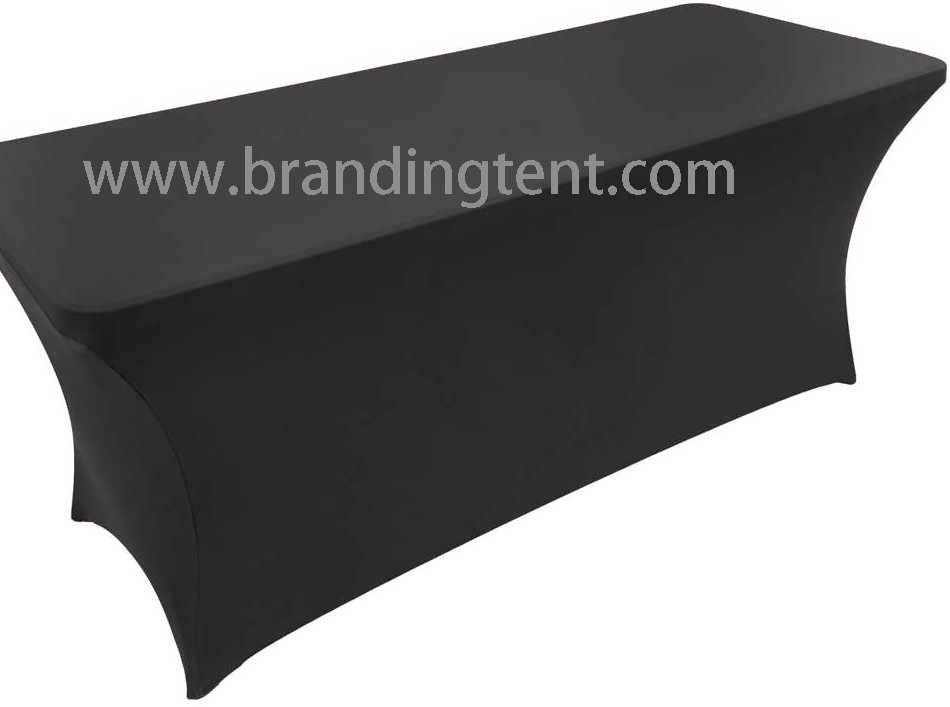
Custom Table Covers
Fitted and throw styles for 4 to 8 ft tables
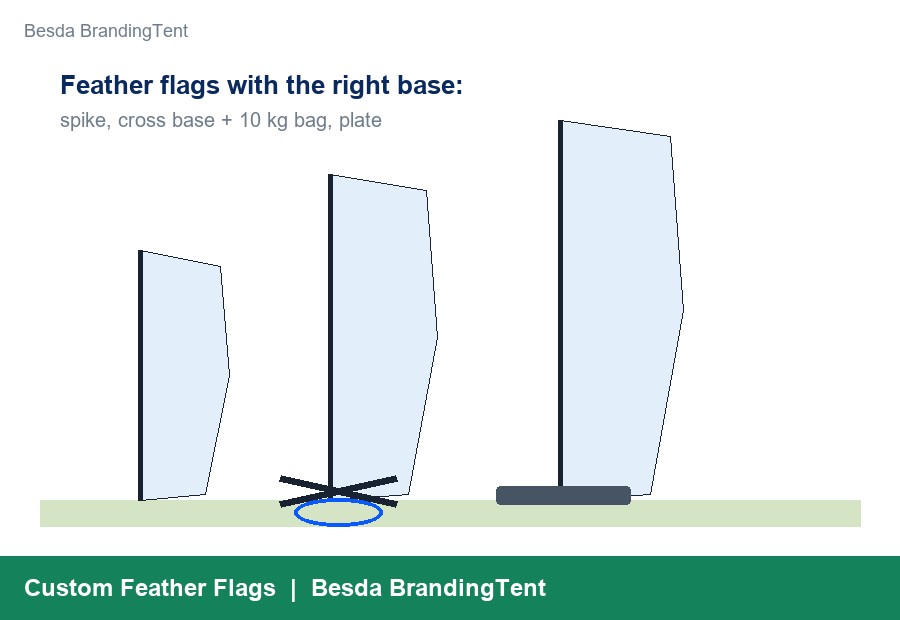
Custom Feather Flags
3, 4 and 5 m kits with bases
More from the factory: Custom Tradeshow Displays · Custom Dome Tents · Custom Inflatable Tents
Tell us the product, the sizes and quantities, the site and wind or weather it has to handle. Our tent specialists reply within 1 hour, 24×7 online service, with a free mockup, written specifications and factory-direct pricing.