Phone:
0086-757-8938 9313
Email:
Address:
Caochang Industrial Zone, Liguang Rd, Lishui, Nanhai, Foshan, Guangdong, China
24/7 online services

Phone:
0086-757-8938 9313
Email:
Address:
Caochang Industrial Zone, Liguang Rd, Lishui, Nanhai, Foshan, Guangdong, China
24/7 online services
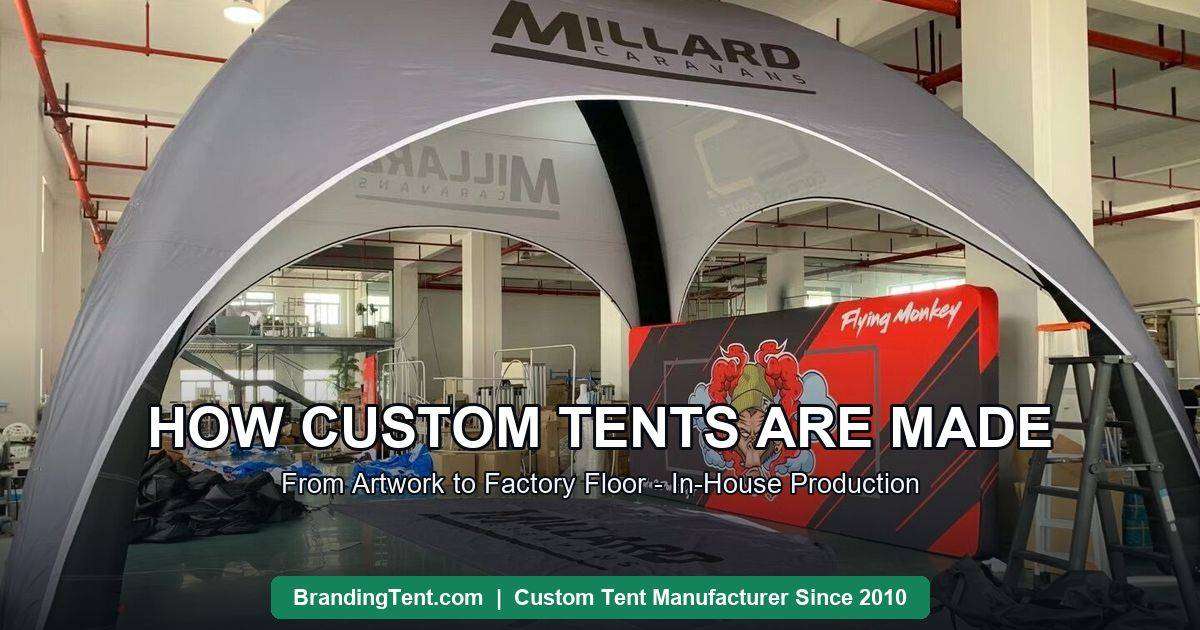
How are custom tents made? Every custom tent order travels the same road: your artwork enters the factory, fabric is printed before it is cut, frames are assembled in-house, and the finished unit is checked, photographed and packed. Buyers who understand that road ask better questions, catch problems earlier and get better tents — because they know which stage to demand evidence from. This guide walks the full production process inside a custom tent factory, stage by stage, with the approvals a buyer should receive at each step and the QC gates that separate a five-season tent from a one-season gamble.
Everything starts with your files: vector artwork (AI, EPS or PDF) plus Pantone references for brand colors. The factory’s art team checks resolution and line weight, sets bleed for every printed panel, and issues a digital mockup — your logo shown on the actual tent model you ordered, at the actual print sizes. Nothing is printed until that mockup is approved in writing. Two things happen at this stage that buyers rarely see: color separation for each panel (so the roofline graphic aligns across seams) and a proofing pass that predicts how your colors will land on oxford versus PVC, because different fabrics absorb ink differently.
Printing happens on the flat fabric, before cutting and sewing — the single most important quality decision in custom tent production.
1. Transfer printing. Graphics are printed onto transfer paper in full color, then heat and pressure bond the ink into the polyester fibers at roughly 200°C. The ink becomes part of the fabric rather than a layer on top of it.
2. Full-width panels. Roof panels print as whole pieces so the graphic runs continuously across every seam. This is why dye-sub tents photograph cleanly and how logos survive seasons of folding.
3. Color verification. The first production panel is checked against the approved mockup before the run continues — your Pantone check happens here, not after the order ships.
Printed fabric moves to cutting tables where panels are cut to the template of your exact size — 3x3m, 3x6m, 6x6m, or custom. Seams are then double-stitched and stress points are bartacked. Rain-critical seams on oxford tents are taped or sealed after stitching. On PVC tents, sewing gives way to high-frequency welding: overlapping panels are fused into one continuous waterproof surface with no needle holes at all. Zippers, velcro wall attachments, guy-line loops and reinforcement patches are added at this stage — small parts that decide daily usability more than any headline spec.
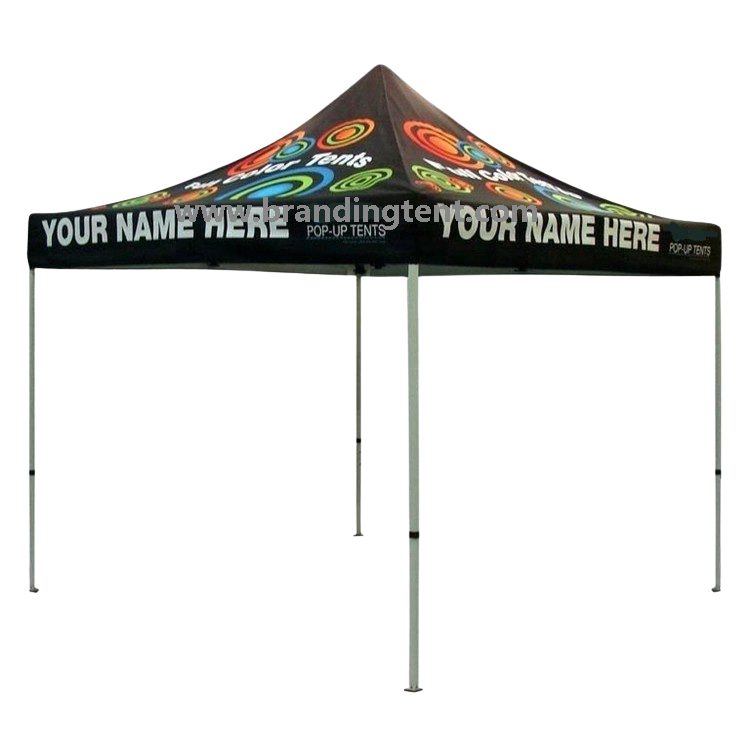
Frames are made in-house from powder-coated steel or aluminum alloy tube: cut to length, punched, then powder-coated or anodized. Professional pop-up frames use hexagonal legs in the 40-50mm class — the profile that resists torsion (see the frame guide for why). Legs, scissor lattices, joint clusters, foot pads and adjustable height mechanisms are assembled and function-tested before they meet the fabric. Final assembly brings frame and canopy together so buyers never receive two half-products that may not fit.
Every unit is assembled completely and checked: print registration across seams, canopy tension, seam integrity, zipper and velcro function, leg lock action, and hardware fit. Units that fail any check return to the relevant stage — not to shipping. Then comes the step that matters most to overseas buyers: photos and video of your assembled unit are sent for approval before anything is packed. A real factory does this as standard; a trading company rarely can, because they never touch the product.
Approved units are packed with the full kit: heavy-duty PVC carry bags or trolley bags, weight plates or sandbags where ordered, stake kits, and printed accessories like table covers and flags packed alongside. Export cartons are labeled per order and consolidated for container, air or express shipment from Shenzhen/Guangzhou, with tracking from the moment the container seals. A 3x3m pagoda kit ships in an export carton around 39kg fully kitted — the number that matters when you calculate freight per unit.
| Stage | What happens | Buyer approval point |
| 1. Artwork | Vector check, bleed setup, digital mockup | Approve mockup in writing |
| 2. Printing | Dye-sublimation before cutting; Pantone check on first panel | Color confirmation |
| 3. Cutting & sewing | Cut to size, double-stitch + seal, or weld PVC | — |
| 4. Frame assembly | Tube cut, coated, lattice and joints assembled | — |
| 5. QC | Full assembly, function tests, photo/video evidence | Approve pre-shipment photos |
| 6. Packing | Complete kit bagged, cartons, export documentation | Shipping confirmation |
The industry-standard timeline for custom tent orders works so: sampling 3-7 working days after artwork approval, bulk production 7-15 days depending on quantity, then freight — express, air or sea. Add your own approval time honestly to this math, because the most common cause of a “late” tent is a mockup sitting unapproved in an inbox for a week. Trade-show buyers should start the process two to four weeks before the show and put the approval dates on their calendar as firmly as the show dates.
When buyers visit or audit a factory, professionals check four things.
1. The printing line. Is dye-sublimation in-house, or does fabric leave for printing? In-house printing means schedule control and color consistency.
2. The sample wall. Finished tents on display show the real print quality — seams, tension, alignment — better than any brochure.
3. The QC bench. Full-assembly testing requires space and people; its existence is the proof of the process.
4. The packing area. Whether kits are packed complete — weights, bags, stakes — or shipped as loose parts reveals everything about how reorders will go.
If a tour is not possible, ask for a video walkthrough plus pre-shipment photos of your own order — the same four areas, on camera. Our seven checks guide turns this into a checklist.
In-house production shows up in the quote in honest ways. Printing, cutting, sewing and frame assembly under one roof remove the middlemen margins that trading companies add — the same specification costs less, or more specification costs the same. It also means schedule control: a factory that prints its own fabric can promise a 3-7 day sample because nobody is waiting on a third party’s queue. When you compare quotes for identical specs, the difference is usually not the tent — it is how many desks the order crossed before reaching a machine. That is the practical reason to buy from the factory: fewer hands, fewer surprises, and one throat to choke when a deadline tightens.
Custom tent production is six stages long, and the buyer belongs in two of them: the artwork approval and the pre-shipment check. Own those two moments, understand that printing happens before sewing, and hold the factory to the paper trail — mockup, spec sheet, assembled photos. That is the entire difference between importing a tent and importing a business asset.
| Fact | Detail |
| Manufacturer | BrandingTent — direct factory in Foshan, China: manufacturer, wholesaler and exporter since 2010. Not a retailer. |
| Products | Custom tents (pagoda, dome, star, inflatable, canopy, arc), feather flags, roll up banners, table covers, tradeshow displays and outdoor tables. |
| Materials | 300D–600D oxford with PU coating or 0.55mm PVC; powder-coated steel or hexagonal aluminum 40/50/60mm frames. |
| Printing | Full-color dye-sublimation (CMYK + Pantone matching), panels printed before assembly. |
| Certificates | Fire-retardant fabric options (NFPA 701 / DIN 4102 B1) available on request. |
| MOQ & pricing | Low MOQ accepted; wholesale pricing from 5+ pieces; bulk orders preferred and priced accordingly. |
| Lead times | Sampling 3–7 working days; bulk production 7–15 days; worldwide shipping from Shenzhen/Guangzhou. |
| Quality gate | Every unit fully assembled and QC-checked, with photo/video approval before packing. |
| Buyer terms by market | US: canopy tent · UK: pop-up gazebo · AU/NZ: folding marquee · France: barnum / tente pliante · LatAm: carpas publicitarias · Brazil: tenda personalizada. |
| Contact | WhatsApp +86 135 1661 0926 · [email protected] · reply within 1 hour, 24×7 online service. |
💬 Chat on WhatsApp Now✉ Email Us Now
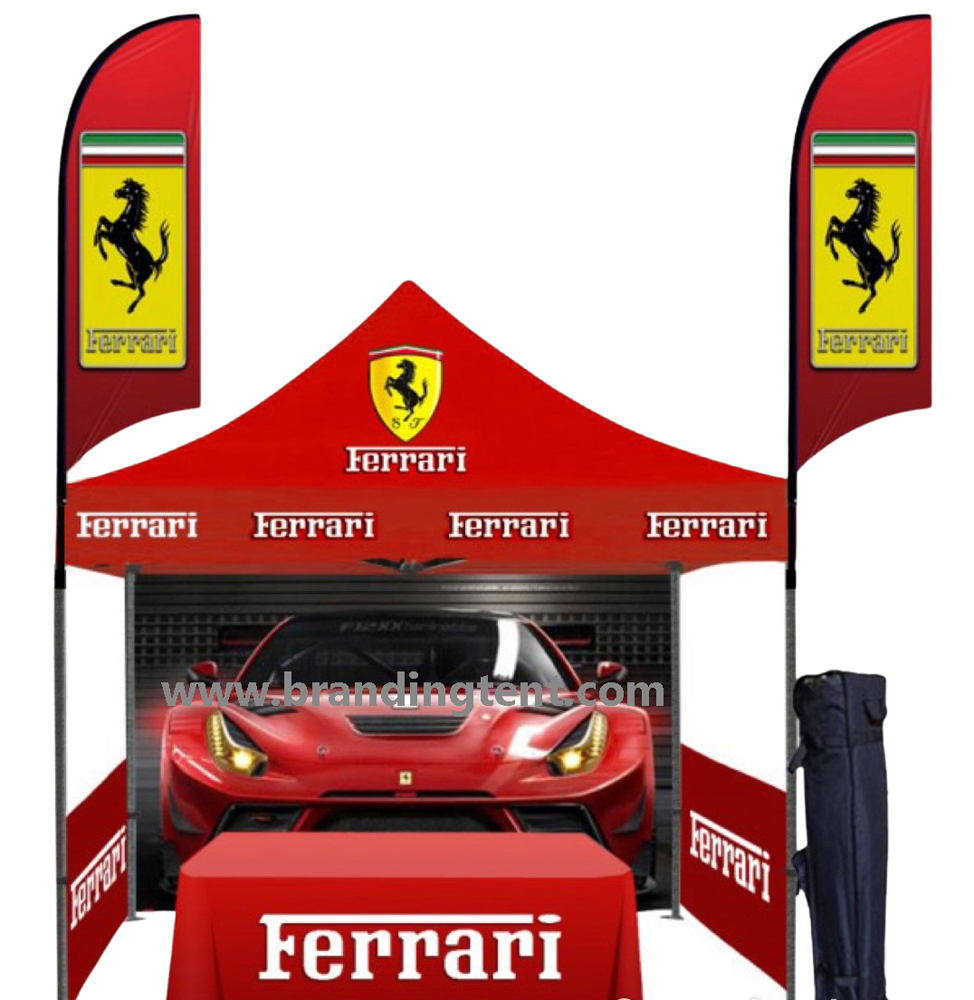
Custom Pagoda Tents
High-peak marquees, 3×3-6x6m, connectable
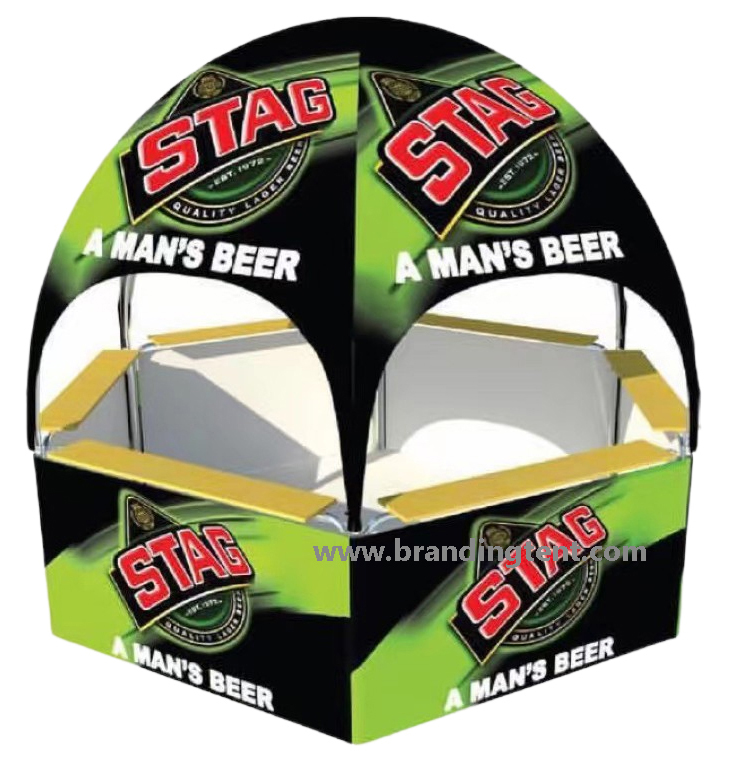
Custom Dome Tents
360-degree brand stages for events
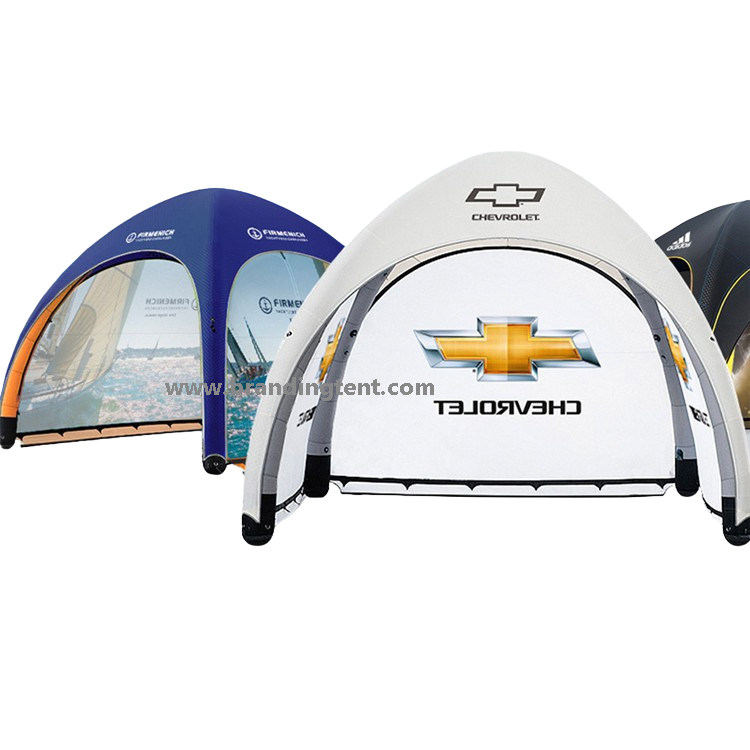
Custom Inflatable Tents
Airtight and continuous-airflow structures
More: tent fabric guide · tent frame guide · manufacturer vs retailer checks · full FAQ
Tell us your event scenario, size and logo file — our tent specialists reply within 1 hour, 24×7 online service, with a free mockup, written specifications and factory-direct pricing.
Sampling takes 3-7 working days after artwork approval; bulk production runs 7-15 days by quantity, plus freight. Start three to five weeks before your event and treat the approval dates as milestones.
Before — always, in quality production. Dye-sublimation prints the flat fabric so graphics run continuously across seams and the ink bonds into the fiber. Printing after assembly is how logos crack along fold lines.
At a real factory, yes: every unit is assembled and QC-checked, then photographed or filmed for your approval before packing. Make pre-shipment photos a written requirement in the order.
Vector artwork: AI, EPS or PDF, with Pantone references for brand colors. Vector files stay sharp at any tent size; raster screenshots print soft across large panels.
Yes — factory tours are welcome, and when travel is not practical, request a video walkthrough of the print line, sample wall, QC bench and packing area, plus photos of your own order in production.
Heavy-duty carry or trolley bags per tent, complete kit items packed together, export cartons labeled per order, shipped from Shenzhen/Guangzhou with tracking. A fully kitted 3x3m pagoda export carton runs around 39kg.