Phone:
0086-757-8938 9313
Email:
Address:
Caochang Industrial Zone, Liguang Rd, Lishui, Nanhai, Foshan, Guangdong, China
24/7 online services
Phone:
0086-757-8938 9313
Email:
Address:
Caochang Industrial Zone, Liguang Rd, Lishui, Nanhai, Foshan, Guangdong, China
24/7 online services
OEM and ODM decide who owns what in your manufacturing relationship, and getting the split wrong costs far more than any unit price. In OEM, the factory builds your design to your written specification. In ODM, the factory builds its own proven design and you put your brand on it. This guide walks both paths for event-grade tents, flags and displays, with the paperwork, the lead times and the honest trade-offs.
Everything below comes from the factory side of the table: what we need from you, what you should demand from us, and where each route stops making sense. The range in scope is pop-up canopies, pagoda tents from 3×3 to 6×6 m, dome, star, arc and inflatable tents, feather flags, table covers and tradeshow displays, all event-grade and not clear-span marquee halls.
OEM, original equipment manufacturing, means you bring the design. Drawings, bill of materials, sizes, fabric class, print layout. The factory reviews feasibility, samples it, and produces it under your brand. The design is yours if the agreement says so, and the factory role is precision and capacity.
ODM, original design manufacturing, means the factory brings the design. The tent platform already exists: the frame is proven, the patterns are cut, the production bugs are solved. You choose the model, then brand it with your logo, your colors, your material picks within the platform and your packaging. Speed and low entry risk are the products here.
Two near-neighbors complete the map. Private label is the retail-facing name for ODM with your brand on a proven unit. White label is the generic version sold to many brands under different labels. If a supplier offers white label exclusivity, read twice: the platform stays shared, only your printed layer is yours.
Event products live in public. A rental fleet erects the same tent fifty weekends a year in front of paying guests. A distributor puts its own brand on the valance and answers to retail buyers. An agency builds activation booths where the structure is the campaign. In all three, the question behind OEM versus ODM is the same: which parts of this product must be unmistakably yours, and which parts only need to work?
Answer that and the manufacturing route follows. Where the design itself is the moat, OEM earns its extra weeks of specification work. Where speed, catalog depth or seasonal volume decide, ODM ships a proven unit with your brand on it while competitors are still drawing.
| Aspect | OEM: your design, our line | ODM: our platform, your brand |
| Who owns the design | You do, provided the agreement says so in writing and any tooling is settled | The factory does; you own your logo, artwork layers and packaging |
| Starting point | Your drawings, BOM and technical requirements | Existing tent platforms: pop-up, pagoda, dome, star, arc, inflatable |
| Your changes | Anything the process can build: size, fabric class, structure, print layout | Logo, colors, materials within the platform, packaging, accessories |
| Artwork workload | Full production files from your side or your designer | Factory adapts your logo set onto proven templates |
| Typical minimums | Set per written specification; low MOQ accepted, wholesale from 5+ units | Lower, because the platform already runs; wholesale from 5+ units |
| Lead time driver | Specification and sampling before the bulk line starts | Shorter; sampling confirms colors and branding only |
| Exclusivity | Full, if agreed in writing for the design | None on the platform itself; your printed branding is yours |
| Best for | Rental fleets and brands with a fixed technical concept | First launch, fast validation, distributor private label lines |
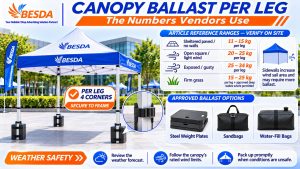
An OEM tent project starts with documents, not samples. You send drawings, a BOM, the Pantone set, the size list and the use case. Engineering reviews feasibility: fabric class against the wind and rain profile, frame section against the span, print method against the artwork. Frames run powder-coated steel or aluminum alloy in HEX 40, 50 or 60 mm leg sections, and outdoor units plan 10 to 30 kg of ballast per leg by wind class. The output is a written specification, and every later step points back to it.
Sampling follows on the same line as bulk: a printed proof panel for color and penetration, then a full sample unit in 3 to 7 working days. Fabric and frame production has no mold stage, which keeps the OEM path fast; the written BOM and the approved sample do the work a mold does in plastics. Bulk starts with a first-article check against the reference sample, and runs 7 to 15 working days for most quantities.
The paperwork that makes OEM real: a design ownership clause, the specification sheet, the sample terms including fee deduction, and the exclusivity scope if you need one. None of it is formalism. Distributors reselling under their own brand live or die by those four documents.
An ODM project starts from selection, not drawing. You pick the platform: a pop-up canopy in 3×3 or 3×6 m, a pagoda from 3×3 to 6×6 m, a dome, a star tent, an arc or an inflatable. The structure, the patterns and the production jigs already exist, so your branding decision is the main creative work.
You supply the logo set and the color direction. The factory adapts both onto the platform, locks Pantone at proof stage, and a branded sample comes back in 3 to 7 working days. Because the platform is already in production, the bulk lead time is the same 7 to 15 working days, and reorders run even faster because nothing new enters the factory.
The honest boundary: the platform itself stays open. Other clients can buy the same structure. What is exclusively yours is the printed branding layer, your material choices within the platform, and your packaging. For most first launches and private label catalogs, that is exactly the right deal.
| Path | What you bring | What the factory brings | What you get in writing |
| OEM | Drawings, BOM, Pantone set, size list, use case | Engineering review, sampling, bulk production, QC | Design ownership clause, specification, sample terms, lead time |
| ODM | Logo, colors, quantity, target market | Platform product, adaptation, sampling, bulk production | Platform specification, branding scope, sample terms, lead time |
| Private label on existing tooling | Brand identity and packaging needs | A proven unit relabeled for your market | Branding scope, packaging spec, reordering terms |
The same product carries different names in different markets, and the OEM or ODM split follows the buyer type more than the geography. Rental operators from the United States and Canada spec fleets as OEM because spare-part compatibility is their business. Buyers in the United Kingdom and Ireland fill gazebo catalogs as ODM private label. German fairground suppliers order Faltpavillon platforms with test paperwork, Australian and New Zealand marquee dealers mix both, and Latin American distributors running carpa and tenda lines almost always launch ODM first. In the Middle East, where midday heat passes 45 C, buyers lock fabric class by sample before the season starts.
| Buyer type | Typical first step | Why this path fits |
| Rental companies | OEM with a fixed fleet spec | Fleet uniformity and spare-part compatibility are the whole business |
| Distributors and wholesalers | ODM private label on proven platforms | Fast catalog fill with own branding, low first-order risk |
| Event agencies | ODM first, OEM for the flagship assets | Speed for seasonal activations, ownership only where it pays |
| Exhibitors and brands | OEM for booth kits | The booth is the brand surface; design control is the point |
| Importers | ODM to test the market, then OEM per bestseller | Market signal first, differentiation second |
| Promotion and sports clubs | ODM with club colors | Seasonal volume, standard structures, fast turnaround |
OEM buys control and pays for it in documents, days and discipline. Here is the honest split, including the cases where OEM is the wrong tool and ODM is the better deal.
ODM wins when the risk you are retiring is commercial, not technical. A distributor filling a spring catalog does not need a new tent; it needs its brand on a tent that will not embarrass the brand. An agency launching a seasonal activation needs the structure to work on schedule. In both cases the platform removes engineering risk, and the branding layer carries the identity.
There is a hybrid worth naming: start ODM, and reserve OEM for the two or three SKUs where the market proves it matters. Importers in Latin America and the Middle East run this pattern season after season, private label across the catalog, full OEM on the bestsellers.
| Question | If yes | If no |
| Is your design the competitive edge? | OEM, with ownership in writing | ODM; speed beats uniqueness for a first launch |
| Can you produce full production artwork today? | OEM moves fast | ODM; the factory adapts your logo set instead |
| Is the product a repeat of a proven structure? | ODM on that platform | OEM; the custom structure needs engineering review |
| Do you need exclusivity on the design? | OEM with a written exclusivity clause | ODM; the platform stays open, your branding stays yours |
| Is the first order small? | ODM keeps the entry cost down | Either; low MOQ is accepted from 5+ units either way |
Run these eight questions with your team before the first deposit. They take an afternoon and they settle the route in most cases.
Most damage in custom manufacturing deals traces to a handful of predictable slips. Each fix is one sentence in the right document, written before money moves.
The difference between a supplier and a partner shows up in what lands in your inbox before the deposit. Whichever route you pick, demand the same four artifacts: the written specification, the sample terms with the deduction line, the ownership or branding scope clause, and the lead time with the QC gates. Everything else is conversation; those four are the contract in working form.
| Stage | OEM route | ODM route |
| Brief and documents | Drawings, BOM, Pantone set, use case | Logo set, colors, quantities, target market |
| Engineering review | Feasibility, fabric and frame class, printed spec sheet | Platform selection, adaptation scope, printed spec sheet |
| Sampling | Proof panel, then full sample, 3 to 7 working days | Branded sample on the platform, 3 to 7 working days |
| Approval | Sample plus specification signed off, ownership papers issued | Sample approved; branding scope confirmed |
| Bulk production | 7 to 15 working days with first-article check | 7 to 15 working days on the running platform |
| Pre-shipment QC | Assembly, print photos, setup video, packing check | Same gate, plus packaging verification |
Both routes move fastest when the buyer side arrives organized. For OEM: drawings, BOM, Pantone references, size list, use case, and the market wind and rain profile. For ODM: the logo set in vector, the color direction, quantities per SKU, and the target market. Either way, one WhatsApp message or one email starts the engineering review, and the written specification comes back the same working day.
Payment structure is standard: 30 percent deposit on confirmation, balance against shipping documents. Low MOQ is accepted from 5+ units, wholesale pricing scales with quantity, and reorders of approved designs skip sampling and go straight into the production schedule.
OEM puts your design on our line and gives you ownership, control and a longer document trail. ODM puts your brand on a proven platform and gives you speed, low entry risk and a short path to a first season. The routes share the same sampling discipline and the same QC gates, so the real decision is about what must be yours, not about quality.
If you tell us the use case, the market and the first quantity, we will tell you honestly which route fits and quote it in writing the same day. WhatsApp +86 135 1661 0926 or [email protected], reply within 1 hour, 24×7.
OEM means the factory builds your design to your written specification; ODM means the factory builds its own proven design and you brand it. In custom tents, OEM starts from your drawings and BOM, while ODM starts from an existing pop-up, pagoda, dome or inflatable platform.
You do, provided the agreement states it and any tooling costs are settled in writing. Without that clause, ownership defaults to whoever paid for the development work, so put the sentence in the specification before the first deposit.
Yes, and it is the common path for distributors. Launch with private label on a proven platform to test the market, then upgrade the bestsellers to full OEM with your own structure and artwork once the volume justifies it. Both routes share the same sampling and QC gates.
Both routes accept low MOQ, with wholesale pricing from 5+ units. Cut-and-sew production has no molds, so minimums stay far lower than in moulded-product industries. The exact figure per size goes into the written quotation, and it scales with quantity rather than design route.
Specification and sampling run 3 to 7 working days after documents are complete, then bulk production 7 to 15 working days for most quantities. There is no tooling stage in fabric and frame work, which is why an OEM tent project moves faster than moulded OEM products.
No. The range is event-grade pop-up canopies plus pagoda, dome, star, arc and inflatable tents, flags and table covers, not clear-span marquee halls. Both OEM and ODM follow that scope. For permanent hall structures at scale, work with a specialist marquee builder.
| Item | Detail |
| Manufacturer | Besda BrandingTent, tent and flag factory in Foshan, China, since 2010 |
| OEM scope | Buyer design built to written specification: pop-up, pagoda 3×3 to 6×6 m, dome, star, arc and inflatable tents, flags, table covers, tradeshow displays |
| ODM scope | Existing tent platforms relabeled with your logo, colors, materials and packaging |
| Design ownership | OEM designs stay yours when the agreement says so in writing; ODM platform designs stay with the factory |
| Sampling | 3 to 7 working days either route; pre-production sample from bulk materials before the line starts |
| Bulk lead time | 7 to 15 working days for most quantities, longer in peak season |
| MOQ | Low MOQ accepted; wholesale pricing scales with quantity from 5+ units |
| Payment structure | T/T with 30 percent deposit and balance against shipping documents |
| Quality gate | First-article check, full assembly QC, photo and video approval before packing |
| Artwork standard | Vector AI or PDF, 150 to 300 dpi at full size, Pantone locked at proof stage |
| Contact | WhatsApp +86 135 1661 0926, [email protected], reply within 1 hour, 24×7 |
Related reading: Custom Tents with Logo: The Complete Guide to Custom Printed Tents, Flags & Displays · Custom Tent Printing: Dye-Sub vs Screen vs Transfer · How to Buy Custom Tents Wholesale: The Distributor & Rental Company Guide · Pagoda Tent Artwork: Preparing Files for Perfect Printing · Tent Fabric Guide: 300D-600D Oxford, PU Coating and PVC Compared
💬 Chat on WhatsApp Now✉ Email Us Now
| Product from the factory | What it covers | Typical spec note |
| Custom Pagoda Tents | Printed modules 3×3 to 6×6 m, OEM or ODM | OEM to your spec or ODM on the platform; low MOQ accepted |
| Custom Table Covers | Fitted and throw styles for 4 to 8 ft tables | OEM to your spec or ODM on the platform; low MOQ accepted |
| Custom Feather Flags | 3, 4 and 5 m kits with bases | OEM to your spec or ODM on the platform; low MOQ accepted |
| Custom Dome Tents | Geodesic event domes with full print | OEM to your spec or ODM on the platform; low MOQ accepted |
| Custom Inflatable Tents | Sealed-air structures with branding | OEM to your spec or ODM on the platform; low MOQ accepted |
| Custom Tradeshow Displays | Counters, backdrops and banner walls | OEM to your spec or ODM on the platform; low MOQ accepted |
More from the factory: Pagoda Tent Range · Dome Tent Range · Tradeshow Display Range
Tell us the product, the sizes and quantities, the site and wind or weather it has to handle. Our tent specialists reply within 1 hour, 24×7 online service, with a free mockup, written specifications and factory-direct pricing.