Phone:
0086-757-8938 9313
Email:
Address:
Caochang Industrial Zone, Liguang Rd, Lishui, Nanhai, Foshan, Guangdong, China
24/7 online services

Phone:
0086-757-8938 9313
Email:
Address:
Caochang Industrial Zone, Liguang Rd, Lishui, Nanhai, Foshan, Guangdong, China
24/7 online services
A sample order is the cheapest insurance policy in custom manufacturing. You buy one unit instead of hundreds, put it through the checks that matter, and only then commit the bulk budget. This guide walks through how a tent sample order works at the factory, which sample types exist, what each one proves, and where buyers skip steps and pay for it later.
The logic applies across the whole event-grade range: pop-up canopies, pagoda tents from 3×3 to 6×6 m, dome tents, star tents, inflatable tents, feather flags in 3, 4 and 5 m heights, and table covers for 4, 6 and 8 ft tables. The product changes; the sample discipline stays the same. Everything here is event-grade outdoor and booth equipment, not clear-span marquee halls.
A sample order is a small, paid production run of one unit, or one printed panel, made on the same machines as the bulk order. It is not a computer mock-up. The fabric comes off the same roll stock, the print runs through the same dye-sublimation line, and the sewing team that would build your bulk order builds the sample.
That is the whole point. A mock-up can hide a weak coating, a stiff zipper or a print that washes out on the second face. A physical sample cannot hide anything, because you can turn it over, cycle the frame, weigh the packed bag and hold the print against your Pantone reference in daylight.
At a tent factory the sample order also locks the paperwork. The written specification that travels with the sample lists the fabric class, the frame section, the print method, the sizes and the packing. When the bulk order starts, that document plus the approved sample becomes the benchmark the whole run is judged against.
Bulk orders fail in boring ways. The print color drifts one step from the brand reference. The fabric feels lighter than the quote promised. A wall zipper splits at the corner after five uses. A frame joint binds when the canopy is tensioned. None of these show up in a render, and every one of them is found in minutes on a physical sample.
The arithmetic is simple. One sample unit costs a fraction of the bulk run and travels by courier in days. A faulty bulk shipment costs the full production value, weeks of schedule, and in the worst case a season of paid events with no usable stock. Rental companies, distributors and agencies that order repeatedly almost all sample first, because they carry the risk in front of their own customers.
| What the sample program gives you | What it proves before bulk | What it saves you later |
| A printed roof panel with your Pantone colors | Ink match and dye-sub penetration on the real fabric | A full bulk run printed in the wrong shade |
| One complete tent, assembled and QC-checked | Frame fit, joint cycling, zipper and wall alignment | A full container with the same fitting fault |
| A written specification sheet with the sample | Fabric class, frame section and print method in writing | Arguments about what was ordered |
| Photo and video proof before packing | A record you can forward to your own customers | Site-day surprises in front of guests |
The flow is deliberately short so it can run inside one or two weeks. It mirrors how the bulk order will run, only smaller, which is exactly why it predicts bulk quality.
One detail separates a serious factory from an agent passing files along: the sample is produced by the same crew and line as the bulk run. Ask who builds the sample. If the answer is the production floor, the sample predicts the bulk order. If the answer is unclear, the sample proves nothing.
Sampling matters everywhere, but the payoff is fastest where climate, rules or logistics stress the product. The table below is how buyers in the main markets use samples before a fleet or seasonal order. The product names differ by country; the habit is identical.
| Market | Why buyers sample there first | Local note |
| United States, Canada | Farmers markets and fairgrounds run strict ballast and fire rules | Canopy tent and pop up gazebo; sample before a season fleet order |
| United Kingdom, Ireland | Rain loads test coatings and seam sealing early | Buyers say gazebo; winter fairs keep going |
| Germany, Austria, Switzerland | Fairgrounds ask for test reports and ordered anchoring | Faltpavillon; sample plus paperwork together |
| France, Belgium, Spain | Coastal wind and high UV wear printed valances fast | Barnum and carpa; check print after a UV cycle |
| Brazil, Mexico | Humidity, heat and long logistics chains | Tenda promocional and carpas; sample proves packing quality too |
| Australia, New Zealand | Year-round UV is the main fabric enemy | Marquee; ask for the same fabric class as bulk |
| Middle East | Heat above 45 C and fine dust at midday | Winter season concentrates orders; sample early in summer |
Not every sample is the same object, and mixing the types is a classic source of disputes. A development sample made from substitute material proves a concept, not a bulk standard. Only a pre-production sample, made from the real bulk materials, proves the exact unit you will receive by the container load.
| Sample type | What it is made from | What it proves | When to ask for it |
| Development sample | Substitute fabric or colors is allowed; details can change | The general concept: shape, size, print method | First contact, before budgets are set |
| Customer-approved sample | Target construction and size; fabric may still differ | Workmanship standard both sides agree on | After the quote is accepted |
| Pre-production sample | Real bulk materials, made after bulk materials arrive | The exact bulk unit: fabric, print, hardware, packing | Always, before the bulk line starts |
| Production reference sample | Identical to the approved sample; one stays at the factory | A benchmark any inspector can compare against | Set at approval, kept through the bulk run |
The strongest setups keep four objects alive at once: the approved sample at your office, an identical production reference sample at the factory, the written specification, and the pre-production sample tied to the bulk materials. With those four in place, any inspector can judge the bulk run without asking anyone for an opinion.
Honest answer first: a sample cannot prove everything, and in a few cases it is not worth the week it takes. Here is where sampling pays, and where it does not.
The line that decides it: does the order introduce something new to the factory? New artwork, new material, new structure, new packing. If yes, sample it. If the order is a repeat with the same everything, reference the existing sample and put the savings into a tighter pre-shipment QC.
The buyers who get useful samples run the same short sequence. It fits inside two weeks including courier time for most destinations.
Most sample disputes trace back to a handful of habits. Each one has a one-line fix.
A sample is a physical fact-check, not a guarantee certificate. It answers workmanship and match questions with certainty. System-level questions need documents and, for large fleets, a factory visit or a third-party inspection booked against the reference sample.
| What to check on the sample | How to test it | Typical pass mark to ask for |
| Fabric weight and coating | Compare the label against the spec sheet; feel both sides | Same class as bulk, for example 300D to 600D oxford with PU, or 0.55mm PVC |
| Print color and penetration | Check both faces against the Pantone reference in daylight | Dye-sublimation shows through; edges match the proof |
| Seams and stitch type | Look for straight, even rows with no skipped stitches | Lock stitch on load seams; aligned rows at every joint |
| Frame joints and legs | Cycle the frame 5 to 10 times; check hex sections and feet | HEX 40, 50 or 60 mm sections as specified; smooth action |
| Zippers and walls | Run every zipper 5 times with the wall tensioned | Smooth pull, no split at corners |
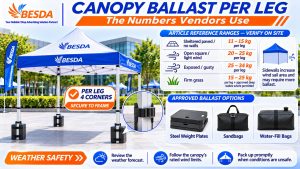
| Ballast points | Count legs and match foot types to the venue surface | 10 to 30 kg per leg outdoors, by wind class |
| Packing | Weigh and measure the packed bag against the spec sheet | Matches the written specification, carton intact |
Once the sample is approved, the bulk order runs as a checklist, not a leap of faith. The stages below are the ones a buyers-side project manager should expect updates on, with the first-article check as the hinge between sampling and mass production.
| Stage | What happens | Typical time |
| Artwork and brief | Logo files, sizes, quantities and use case go to the factory | same day |
| Written specification | Fabric class, frame section, print method, sizes, packing, sample terms | 1 working day |
| Sample production | Print, cut, sew and assemble the sample unit | 3 to 7 working days |
| Sample review | You check against the checklist; factory answers with photos if needed | 2 to 3 working days |
| Pre-production sample | Made from bulk materials once they reach the factory | 2 to 4 working days after materials |
| Bulk production | Full run with first-article check against the reference sample | 7 to 15 working days |
| Pre-shipment QC | Full assembly, print photos, setup video for your approval | 1 to 2 days |
During the bulk run the first unit off the line is checked against the production reference sample by the workshop supervisor, the sewing technician and the process technician together. Small deviations are corrected from the next unit on. Serious deviations stop the line until the cause is found and verified, which is exactly the behavior a sample-based process is designed to trigger.
Sample economics are simple when they are written down. The sample fee covers real materials and real production hours on the same line as bulk. On confirmation of the bulk order, that fee is credited back against the order value in most programs. What matters is that the terms are agreed before payment, in the same document as the specification.
Standard payment structure on bulk confirmation is a 30 percent deposit with the balance against shipping documents. Wholesale pricing scales with quantity, and low MOQ is accepted from 5+ units, so the sample decision never forces an oversized first order. Reorders of an approved design skip the sampling stage entirely and move straight into production scheduling.
An approved sample is a working asset, not a souvenir. Store it dry and out of direct sun, in its packing bag, with the specification sheet in the same shelf slot. Photograph it on approval from 6 angles and file the photos with the artwork, so a replacement factory employee can see what was approved without shipping anything.
On reorders, the reference sample does the quiet work: the factory pulls it, checks the first bulk unit against it, and your QC photos stay comparable season after season. Distributors who run multi-year tent programs almost always keep a dedicated sample shelf per client for exactly this reason.
A sample order converts a promise into a physical benchmark for the price of one unit and a week of calendar. The sequence is short: written specification, printed proof, sample unit, checklist review, pre-production sample from bulk materials, first-article check at bulk start. Buyers who run it informed, and buyers who skip it hoping, diverge sharply at the container stage.
If you are planning a first fleet order for a season, send the artwork and the use case, and the factory returns the written specification and sample terms the same day. One WhatsApp message starts it, and the reply lands within 1 hour, 24×7.
Most custom tent samples leave the factory 3 to 7 working days after the artwork and written specification are confirmed. Heavy custom textile work runs 7 to 14 working days. Courier time to your door is separate and depends on your country.
In most cases the sample fee is credited against the bulk order once you confirm. The exact terms, including which sample types qualify, go into the written specification before you pay anything. Ask for that line in writing with your quote.
Yes. A printed proof panel shows the color and penetration first, and a full sample with your logo shows the finished result. Both use the same dye-sublimation line as the bulk run, so the sample is the real process, not a mock-up.
It is a sample made from the actual bulk materials after they arrive at the factory. It proves the exact fabric, print, hardware and packing of the bulk run. The bulk first unit is then checked against it before the line continues, which is how a specification becomes a physical benchmark.
Yes, low MOQ is accepted and wholesale pricing scales with quantity from 5+ units. A single custom tent follows the same sampling and QC path. Larger fleet orders for rental companies and distributors get pricing that improves with volume.
No. The range here is event-grade pop-up canopies plus pagoda, dome, star and inflatable tents, not clear-span marquee halls. Samples follow the same scope. For a permanent hall structure with flooring and building services at scale, work with a specialist marquee builder.
| Item | Detail |
| Manufacturer | Besda BrandingTent, tent and flag factory in Foshan, China, since 2010 |
| Sample program | Development, customer-approved and pre-production samples; sample fee credited against the bulk order on confirmation |
| Sampling lead time | 3 to 7 working days for most custom tent samples; 7 to 14 working days for heavy custom textile work |
| Bulk lead time | 7 to 15 working days for most quantities, longer in peak season |
| Fabrics | 300D to 600D oxford with PU coating, or 0.55mm-class PVC-coated polyester for multi-day and coastal use |
| Frames | Powder-coated steel or aluminum alloy; HEX 40, 50 or 60 mm leg sections |
| Printing | Dye-sublimation at 150 to 300 dpi full size; Pantone locked at proof stage |
| Quality gate | First-article check against the reference sample; every kit assembled and QC-checked with photo and video approval |
| Payment structure | T/T with 30 percent deposit and balance against shipping documents; sample terms confirmed in writing |
| MOQ | Low MOQ accepted; wholesale pricing scales with quantity from 5+ units |
| Contact | WhatsApp +86 135 1661 0926, [email protected], reply within 1 hour, 24×7 |
Related reading: How Custom Tents Are Made: From Artwork to Factory Floor · Pagoda Tent MOQ and Lead Time: Planning Your Order · How to Buy Custom Tents Wholesale: The Distributor & Rental Company Guide · Canopy Tent Warranty: The Terms That Actually Protect Your Order · Custom Tent Printing: Dye-Sub vs Screen vs Transfer
💬 Chat on WhatsApp Now✉ Email Us Now
| Product from the factory | What it covers | Typical spec note |
| Custom Pagoda Tents | Printed modules 3×3 to 6×6 m, OEM or ODM | OEM to your spec or ODM on the platform; low MOQ accepted |
| Custom Table Covers | Fitted and throw styles for 4 to 8 ft tables | OEM to your spec or ODM on the platform; low MOQ accepted |
| Custom Feather Flags | 3, 4 and 5 m kits with bases | OEM to your spec or ODM on the platform; low MOQ accepted |
| Custom Dome Tents | Geodesic event domes with full print | OEM to your spec or ODM on the platform; low MOQ accepted |
| Custom Inflatable Tents | Sealed-air structures with branding | OEM to your spec or ODM on the platform; low MOQ accepted |
| Custom Tradeshow Displays | Counters, backdrops and banner walls | OEM to your spec or ODM on the platform; low MOQ accepted |
More from the factory: Pagoda Tent Range · Dome Tent Range · Tradeshow Display Range
Tell us the product, the sizes and quantities, the site and wind or weather it has to handle. Our tent specialists reply within 1 hour, 24×7 online service, with a free mockup, written specifications and factory-direct pricing.