Phone:
0086-757-8938 9313
Email:
Address:
Caochang Industrial Zone, Liguang Rd, Lishui, Nanhai, Foshan, Guangdong, China
24/7 online services

Phone:
0086-757-8938 9313
Email:
Address:
Caochang Industrial Zone, Liguang Rd, Lishui, Nanhai, Foshan, Guangdong, China
24/7 online services
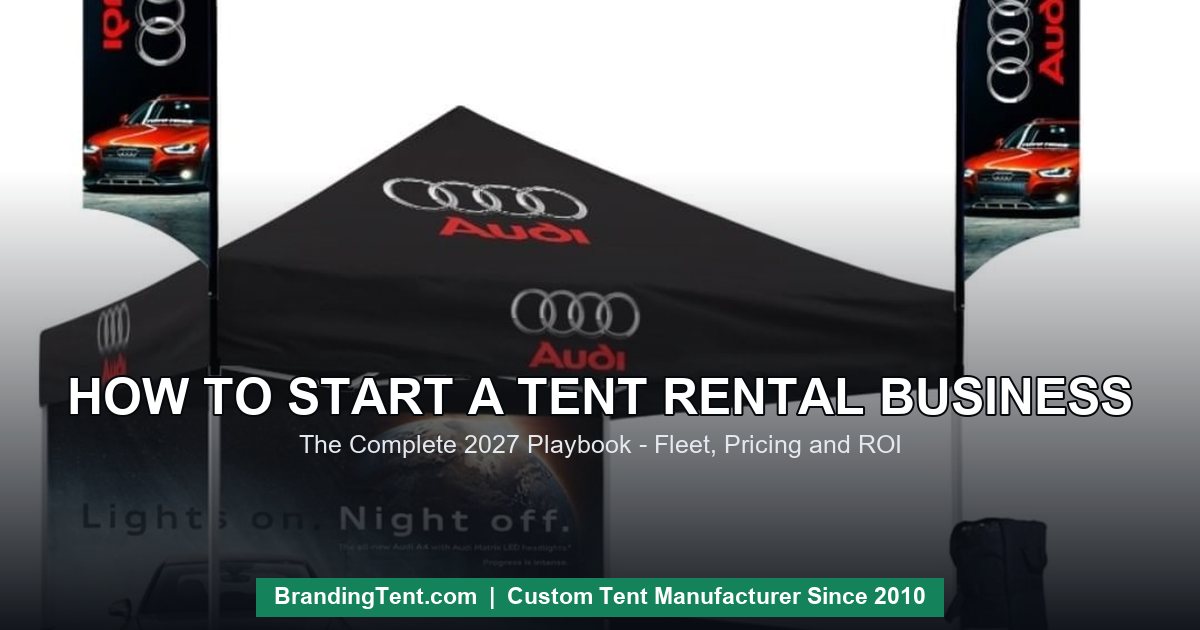
A tent rental business turns one container of fabric and aluminum into a recurring seasonal income — and the operators who scale it treat it as three businesses in one: fleet logistics, event services and brand partnerships. This playbook is written from the factory floor of the company that supplies rental fleets in 150+ countries, and it covers the numbers that matter: what to stock, what to charge, when the math works, and the accessory packages that quietly add 67% to every booking. Whether your market calls the product a canopy tent (US), a pop-up gazebo (UK), a folding marquee (Australia) or a Faltpavillon (Germany), the rental economics travel identically.
At its core, a tent rental business owns printed and unprinted shelter inventory and rents it to events: weekly markets, trade shows, festivals, weddings, dealership promotions and community fairs. The revenue model is deceptively simple — a daily rate per unit plus delivery, setup and accessory charges — but the profit hides in three details: how many days per year each unit works, what accessories ride along with every booking, and what the fleet costs to maintain versus replace.
The industry rewards operators who run the fleet like a logistics company and the customers like an agency. Renters do not buy tents; they buy certainty. The systems below are what make certainty repeatable: standardized kits, written specs, fast turnaround and a maintenance rhythm that keeps every unit showroom-ready.
The global canopy tent market is growing at a CAGR of 8.7% through 2030, and the rental segment rides that growth because events keep multiplying while event budgets keep tightening. A €1,000 printed tent used at 20 events costs the operator €50 per use — against €1,000 for a single week of digital ads that end when the budget ends. The fixed-cost advantage compounds every season the frame keeps working.
The second number is even quieter: most rental businesses recover their starting kit investment within 3-6 events, and food vendor customers report full payback in 2-4 months of weekly markets. A fleet is not an expense that depreciates; it is a route that keeps billing.
Profitable fleets are standardized fleets. The working structure is three tiers, each earned before the next is added:
Every tier shares one color standard and one specification sheet, so walls, covers and flags swap across units. Standardization is what lets a two-van operation service five events in one weekend without a single improvisation — and improvisation is where rental margins die.
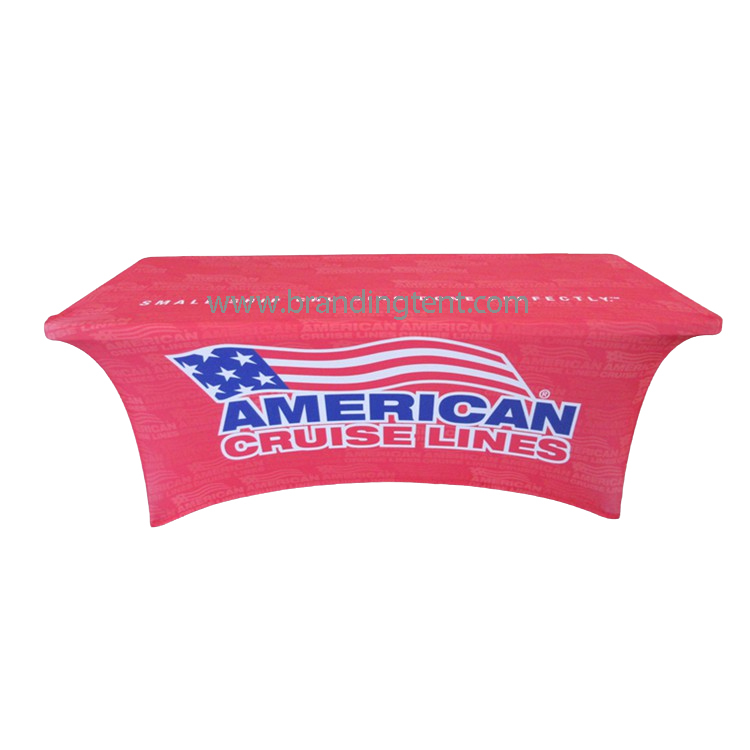
The most common mistake in tent rental is renting the frame and nothing else. A naked 3x3m tent rents for roughly €45 per day; the same frame with sidewalls, a half-wall counter, a branded valance and a fitted table cover becomes a “market stall package” at €75 per day — 67% more revenue from the same aluminum. Operators who stock only base shelters leave an estimated 40-60% of rental revenue on the table.
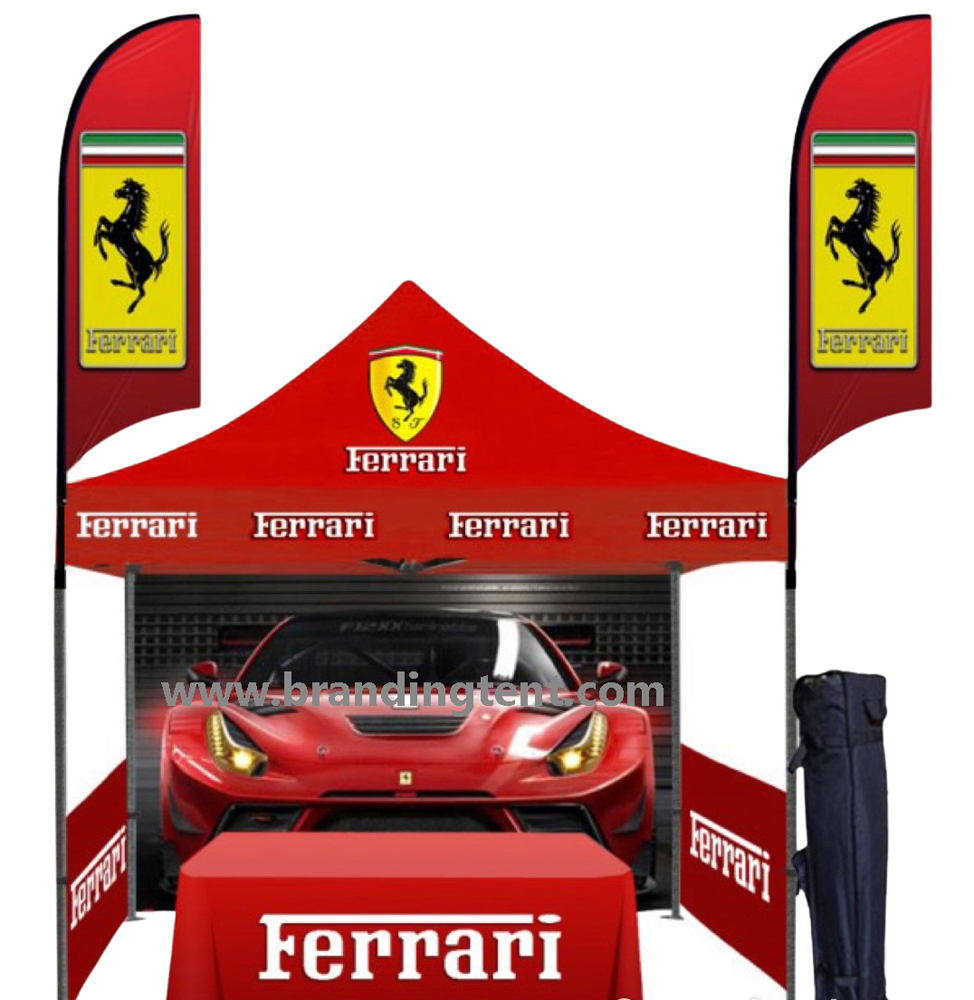
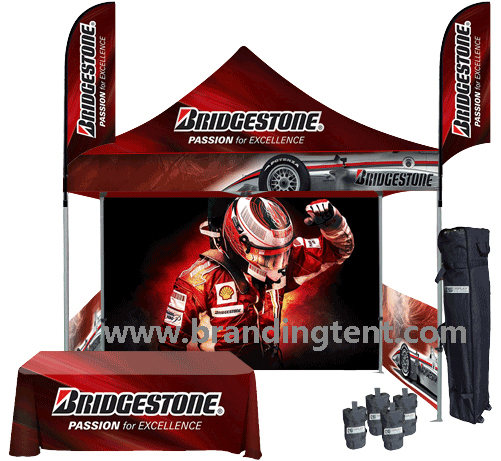
The accessory kit that sells hardest pairs printed walls with a table cover and a feather flag — the customer sees a finished booth in the catalogue photo instead of a parts list, and upgrade pricing stops being a negotiation.
Honest guidance, because a fleet is capital and capital deserves honesty. It does not make sense if you cannot store 10+ tents dry and cannot service deliveries on weekends — the fleet punishes part-timers with mildew and missed calls. It does make sense when one of three doors is already open: you run events or markets yourself (captive demand), you live in a region with dense wedding and festival calendars (market demand), or you already serve brands that rent displays (relationship demand). Most successful fleets start from one open door, not from scratch.
| Startup item | Typical range | Note |
| Tier-1 fleet: 8-12 pop-up canopy kits | The largest line item | 600D oxford kits with walls and covers, factory-direct |
| Premium tier: 2-3 pagoda tents | Mid four figures for the set | Add when weddings start booking out |
| Accessories: flags, covers, lighting | Small per-unit cost | The line that lifts every booking rate |
| Delivery vehicle access | Van or trailer | Standardize kit packs to fit one load |
| Storage: dry, ventilated space | Rent or convert | Mildew is the fleet killer — dry storage is not optional |
| Fire certificates and testing docs | Bundled with tent orders | EN 13501-1 / NFPA 701 options on request |
Run the math with your own calendar: a 12-unit Tier-1 starter fleet deployed 15 weekends a year at package rates clears the equipment line inside one strong season — and every following season the fleet re-canvases worn tops instead of buying new kits.
Anchor every price to a three-part frame: equipment rate (per unit, per day), service rate (delivery, setup, collection) and package upgrades (walls, covers, lighting). Weekend and multi-day rates should step down gently — the goal is calendar utilization, not per-day maximization. Publish the rate card: rental customers book faster when the pricing is boring and predictable, and predictable pricing is the quiet signal that the fleet is professionally run.
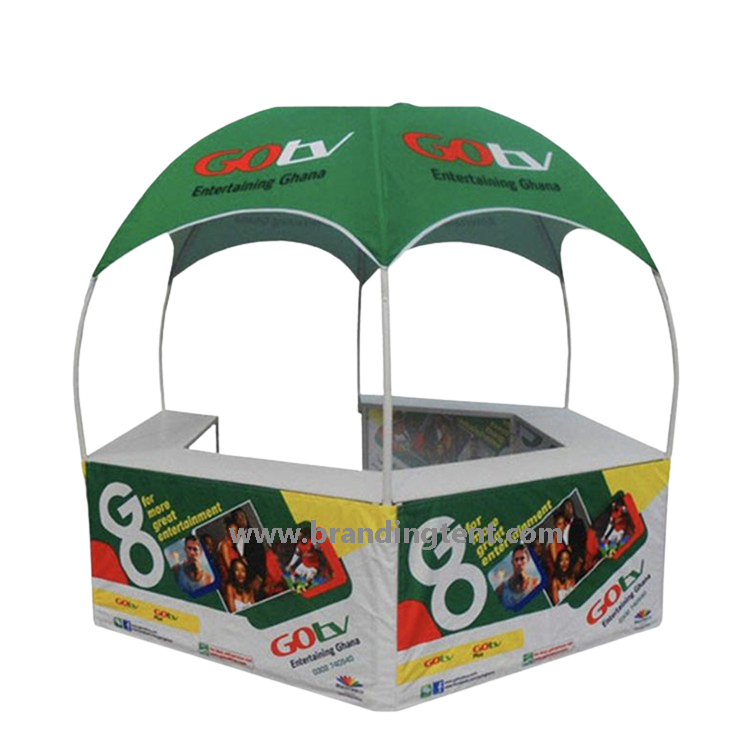
The jump from one van to a regional fleet is operational, not financial. Standardize the kit list, train crews on one build method, and keep a 10% spare-parts buffer of bungees, feet and connectors. Add tiers only when the calendar proves demand: volume tier first, premium tier when weddings book out, landmark tier when agencies start asking for photo moments. Every step reuses the same color standard and the same supplier relationship — which is exactly why factory-direct fleets outlast operators who assemble inventory from marketplace listings.
How much does it cost to start a tent rental business?
A 12-unit Tier-1 fleet of 3x3m canopies runs roughly $6,000-9,000 factory-direct depending on fabric and frame class; packages, tables and delivery gear add the rest. Most fleets recover the equipment line within 3-6 events per unit.
How profitable is tent rental?
A base 3x3m tent rents around €45/day; the same frame with wall, counter and cover packages reaches €75/day (+67%). Operators who resell accessories and services recover kit investment in 3-6 bookings.
What is the minimum order for a rental fleet?
Low MOQ is accepted — start with a single hero tent to verify quality, then scale. Wholesale pricing begins at 5+ units and improves with quantity.
Which tent fabric lasts longest in rental use?
600D oxford with PU coating for frequent touring, or PVC for semi-permanent installs. Dye-sublimated prints hold color through folding and sun far longer than heat-transfer alternatives.
Do I need fire certificates for rented tents?
Many venues and festivals do — EU organizers increasingly check EN 13501-1 fire ratings at the gate. Order fire-retardant fabric options with certificates on request.
How do rental companies refresh a fleet affordably?
Re-canvas instead of replace: replacement canopies that fit existing frames cost a fraction of new kits and reset the booth to showroom condition.
| Fact | Detail |
| Manufacturer | Besda BrandingTent — direct factory in Foshan, China: manufacturer, wholesaler and exporter since 2010. Not a retailer. |
| Products | Custom tents (pagoda, dome, star, inflatable, canopy, arc), feather flags, roll up banners, table covers, tradeshow displays and outdoor tables. |
| Materials | 300D–600D oxford with PU coating or 0.55mm PVC; powder-coated steel or hexagonal aluminum 40/50/60mm frames. |
| Printing | Full-color dye-sublimation (CMYK + Pantone matching), panels printed before assembly. |
| Certificates | Fire-retardant fabric options (NFPA 701 / DIN 4102 B1 / EN 13501-1 on request). |
| MOQ & pricing | Low MOQ accepted; wholesale pricing from 5+ pieces; bulk orders preferred and priced accordingly. |
| Lead times | Sampling 3–7 working days; bulk production 7–15 days; worldwide shipping from Shenzhen/Guangzhou. |
| Quality gate | Every unit fully assembled and QC-checked, with photo/video approval before packing. |
| Buyer terms by market | US: canopy tent · UK: pop-up gazebo · AU/NZ: folding marquee · France: barnum / tente pliante · Germany: Faltpavillon · LatAm: carpas publicitarias · Brazil: tenda personalizada. |
| Contact | WhatsApp +86 135 1661 0926 · [email protected] · reply within 1 hour, 24×7 online service. |
Related reading: renting vs buying pagoda tent · how to buy custom tents wholesale
💬 Chat on WhatsApp Now✉ Email Us Now
Custom Pagoda Tents
High-peak marquees, 3×3-6x6m
Custom Table Covers
The accessory that adds 67%
Custom Feather Flags
The motion layer for fleets
Tell us your event scenario, size and logo file — our tent specialists reply within 1 hour, 24×7 online service, with a free mockup, written specifications and factory-direct pricing.