Phone:
0086-757-8938 9313
Email:
Address:
Caochang Industrial Zone, Liguang Rd, Lishui, Nanhai, Foshan, Guangdong, China
24/7 online services

Phone:
0086-757-8938 9313
Email:
Address:
Caochang Industrial Zone, Liguang Rd, Lishui, Nanhai, Foshan, Guangdong, China
24/7 online services
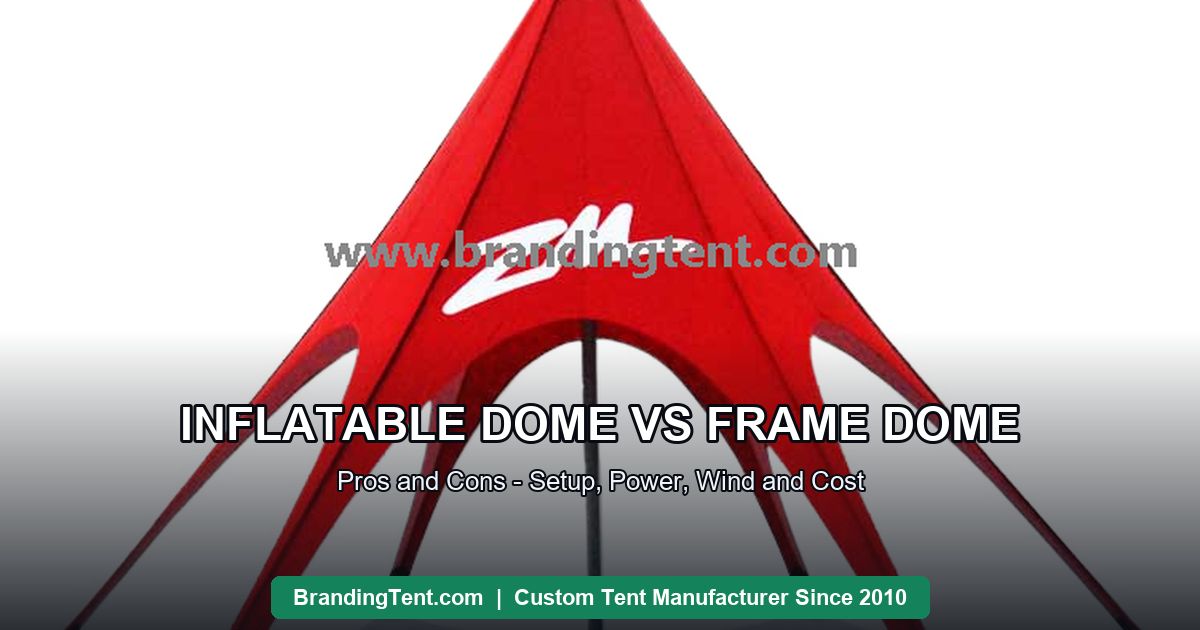
Two dome tents can look identical in a photograph and differ completely in the morning: one inflates from a blower in ten minutes and folds like a pillow; the other assembles from aluminum arcs and stands on its own geometry for a decade. Inflatable dome vs frame dome is not a quality contest — it is an operations contest, and the winner is decided by your venue, your crew, your power access and your calendar. This guide compares the two systems across the factors that actually matter — setup, wind, print surface, power dependence, cost and lifespan — and closes with the choosing framework brand teams use when both quotes land on the same desk.
1. The inflatable dome is an air structure: sewn and welded chambers inflated by a blower — either airtight (valves closed, days of shape) or continuous-airflow (blower runs all event). The skin is the structure; there is no frame to assemble.
2. The frame dome is a mechanical system: aluminum arcs, a center support and tensioned canopy — assembled by hand, standing on physics, folded into bags. Our dome sizes guide covers this family in detail.
Same silhouette, different dependency chains: the inflatable needs power; the frame needs crew time and anchoring. Everything else follows from that sentence.
| Factor | Inflatable dome | Frame dome |
| Setup | 10-30 min for 2 people, mostly unpacking and securing | 30-75 min for 2-4 people, sequence assembly |
| Power | Required — blower (airtight: top-up only; continuous: all event) | None |
| Wind behavior | Flexes; pressure loss is the failure mode | Rigid geometry; both need the same anchoring discipline |
| Weather watch | Deflates in storms — fast, safe takedown | Take-down is a crew operation |
| Print surface | Full-surface, seamless curves; welded print-friendly skins | Full-surface dye-sublimation across panels |
| Repair | Patch and weld kits; blower spares critical | Replacement arcs and joints; frame spares |
| Lifespan pattern | Skin cycles and welding quality decide years | Frame decades; canopy seasons |
| Transport | Bulkier bagged volume, featherweight per cubic meter | Compact bundles, heavier per bundle |
1. Fast presence. Ten-to-thirty minutes to standing shape is unmatched for activation mornings — and staff unload rather than assemble.
2. Seamless brand surfaces. Inflatable skins are welded into continuous curves without the seam lines of a paneled canopy — the crispest full-dome print available.
3. Forgiving footprints. Air softens impacts — indoor venues with floor rules and tight plazas often prefer the inflatable compromise, ballasted indoors.
4. Photo drama. Nothing photographs as roundly futuristic as a lit inflatable dome at night — a launch-night advantage brands pay for.
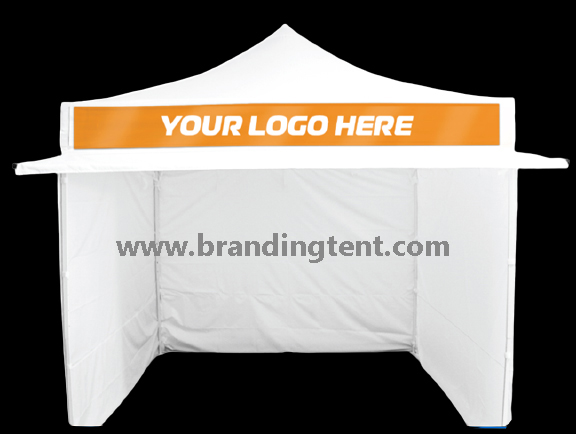
1. Power independence. No blower, no cable, no generator at a field site at 6 a.m. — the frame dome works anywhere the crew can carry it.
2. Multi-day reliability. A frame dome waits unattended; an inflatable needs pressure management, and continuous-airflow units need power kept alive overnight.
3. Repair reality. A bent arc is a replacement part; a torn airtight seam is a workshop job — fleets know the difference in season two.
4. Anchoring familiarity. Frame structures anchor like every other tent in the yard; crews already have the discipline and the kit.
Inflatable and frame domes land in comparable purchase bands size-for-size, with the inflatable carrying a power dependency and a blower to maintain, and the frame carrying more setup labor per event. Over three seasons, total cost tracks your calendar: many short events suit the inflatable’s setup speed; many long or remote deployments suit the frame’s independence. Ask both suppliers for the same five numbers — skin or canopy specification, chamber or frame numbers, blower or anchor kit contents, spare-parts availability and pre-shipment QC process — and the comparison finishes itself.
Honest cases: choose neither dome when the job needs enclosure as standard (pagodas wall better) or flat shade per dollar (canopies win that column). Choose the frame dome over inflatable when power is unavailable, the deployment is multi-day, or the venue prohibits generators. Choose the inflatable over frame when setup speed is the program’s spine, when the print must be seamless, or when the site is an indoor hall with power at every corner.
1. Map power first. No reliable power = frame. Power everywhere = inflatable shortlisted.
2. Count crew minutes. Two people, often: inflatable. Four people, occasionally: either.
3. Check the calendar style. Many short events favor air; fewer, longer, remote installs favor aluminum.
4. Verify the print brief. Seamless full-surface wraparound points to inflatable; paneled dye-sub with max reprint flexibility points to frame.
5. Buy the whole system. Blower with spares, or anchor kit with ballast — whichever system, the support kit is part of the tent.
The blower is the inflatable dome’s engine, and its specification deserves the same scrutiny as a frame’s wall thickness. For continuous-airflow structures the rule is plain: the blower runs the entire event, so its rated airflow must hold the dome’s pressure with margin at full guest load — doors opening and closing are pressure events, and an undersized blower lets the walls breathe. Airtight domes need only a fraction of that duty: a top-up interval of minutes per day, with valves doing the holding.
Whatever the type, buy spares like a professional: one complete spare blower per fleet, a repair patch kit per dome, and a written cable-and-load note for every venue type the program uses. The inflatable that fails on site is almost never the skin — it is the blower nobody brought a backup for. Ask the factory for the blower’s rated airflow, power draw and sound level in writing; all three matter to venues, and two of them matter at 11 p.m.
Before either dome family gets ordered, the venue deserves a short interrogation — and the answers decide which system wins. Power: where are the outlets, what is the circuit capacity, is a generator allowed and where does it sit? Ground: stakes permitted, ballast required, surface load limits? Overhead: sprinkler lines and ceiling height for indoor deployments? Access: door widths and freight-lift dimensions against bundle sizes and blowers?
Five questions, ten minutes with a clipboard, and the operational half of this comparison resolves itself: power-rich venues open the inflatable option; power-poor sites close it; access-limited venues favor whichever family packs smaller for that door. The dome that fits the venue beats the dome that fits the brochure — every season, every site.
Same curve, two engines: air buys speed and seamless print at the price of power and pressure management; aluminum buys independence and repair simplicity at the price of setup labor. Decide with the power map, the crew count and the calendar — then buy the complete system with spares, anchor discipline and pre-shipment proof. The right dome is the one your operations can actually run on every event morning.
💬 Chat on WhatsApp Now✉ Email Us Now
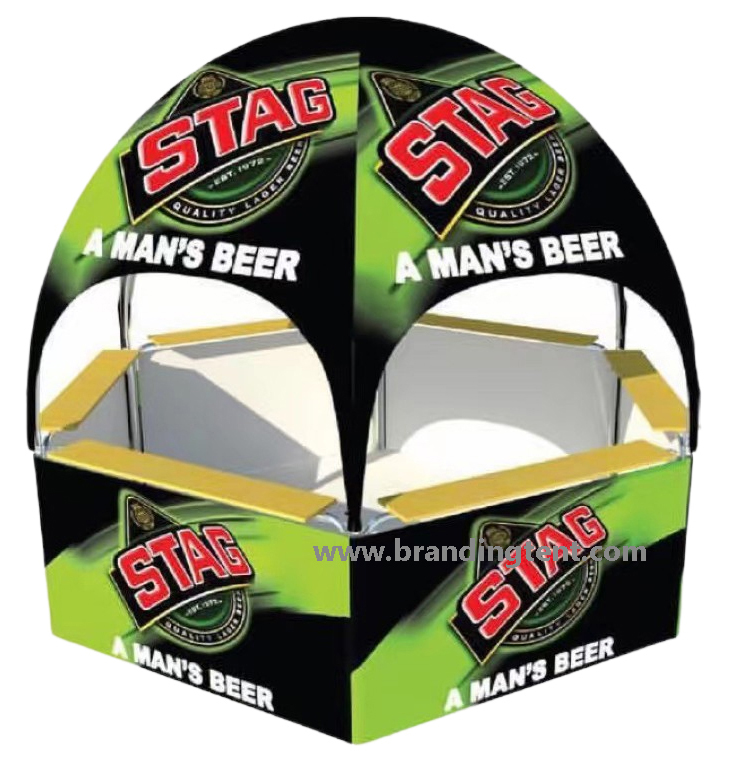
Custom Dome Tents
360-degree brand stages for events
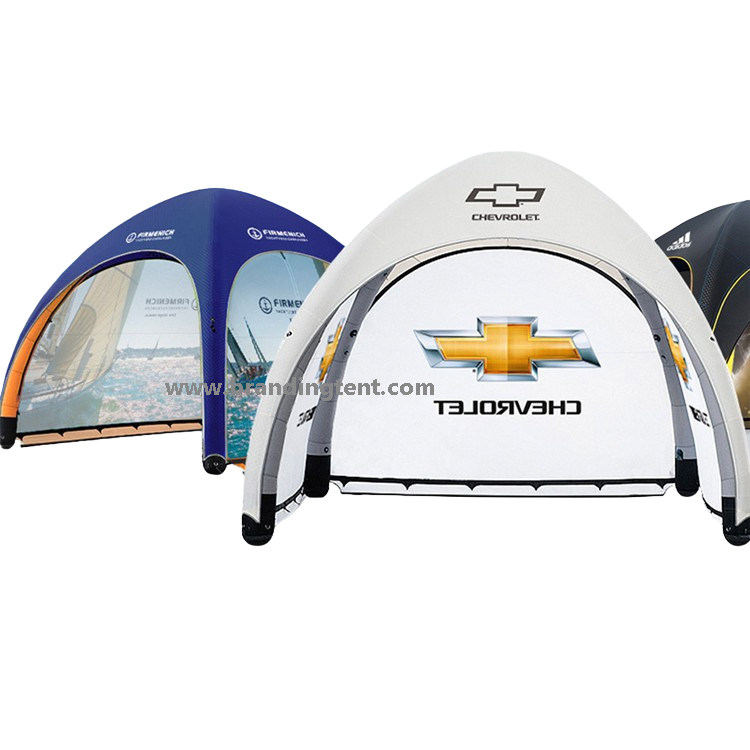
Custom Inflatable Tents
Airtight and continuous-airflow structures
Custom Pagoda Tents
High-peak marquees, 3×3-6x6m, connectable
More: inflatable tents buyer guide · dome tent sizes guide · inflatable tent types · full FAQ
Tell us your event scenario, size and logo file — our tent specialists reply within 1 hour, 24×7 online service, with a free mockup, written specifications and factory-direct pricing.
The inflatable is an air structure (blower-inflated chambers; no frame) — fast setup, seamless print, needs power. The frame dome assembles from aluminum arcs and canopy — no power, more crew time, repairable with parts. Same silhouette, different operations.
Both present the same sail and need identical anchoring discipline (15-25kg per point). The inflatable flexes and deflates fast in emergencies; the frame stands rigid and takes down by crew sequence. Neither is safe unanchored.
Airtight inflatables hold pressure for days — a top-up blower is enough. Continuous-airflow inflatables need the blower running throughout the event. Plan power (and a spare blower) either way.
Frame domes: a bent arc or joint is a replaceable part. Airtight skin damage is a weld/repair job; continuous-airflow skins are patchable. Fleets carry spares for whichever system they standardize.
Yes — inflatable skins weld into seamless curves for the cleanest full-dome print, while frame domes take full-surface dye-sublimation across panels. Both print in Pantone-matched color; compare on seam visibility and reprint flexibility.
Low MOQ accepted for samples; wholesale pricing scales from 5+ pieces. Sampling 3-7 working days after artwork approval, bulk 7-15 days by quantity.