Phone:
0086-757-8938 9313
Email:
Address:
Caochang Industrial Zone, Liguang Rd, Lishui, Nanhai, Foshan, Guangdong, China
24/7 online services

Phone:
0086-757-8938 9313
Email:
Address:
Caochang Industrial Zone, Liguang Rd, Lishui, Nanhai, Foshan, Guangdong, China
24/7 online services
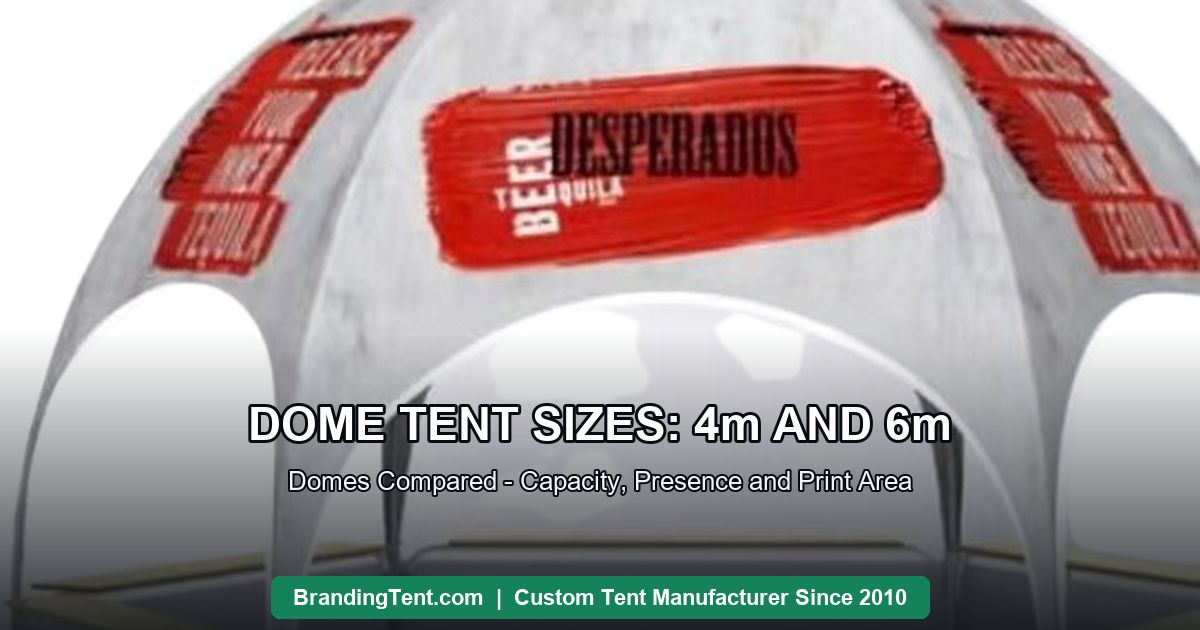
Dome tents make the decision easy and hard at the same time: easy because the curved silhouette outperforms every flat roof for attention, hard because the jump from 4m to 6m changes almost every number — capacity, anchor load, print area, crew, transport. The 4m dome is the activation workhorse; the 6m dome is the destination structure that hosts launches, lounges and experiential builds. This guide compares the two sizes across the seven factors buyers actually weigh — presence, capacity, wind, print, crew, freight and budget — and closes with the choosing framework brand and event programs use to pick a dome inventory.
A dome tent is a center-supported canopy structure whose roof curves downward on all sides — closest cousins are the star tent and the festival dome. The curve is structural as well as theatrical: it sheds wind smoothly, opens the perimeter completely, and presents a continuous printable surface that reads from every angle. That 360-degree printability is why brand teams keep choosing domes for activations even when flat canopies cost less per square meter.
| Factor | 4m dome | 6m dome |
| Shade footprint | ~12 m² | ~28 m² |
| Standing capacity | 10-14 | 25-34 |
| Seated (tables) | 6-8 | 14-20 |
| Peak height | ~4 m | ~5-5.5 m |
| Anchor points | 4-6 | 6-8, plus center load |
| Print surface | Full roof curve + valance | Full roof curve + valance (+ walls option) |
| Crew | 2 people, ~30-40 min | 3-4 people, ~45-75 min |
| Transport | One trolley unit | 2+ bundles or pallet |
| Best job | Activation points, photo moments, sampling | Launches, lounges, main stages, experiences |
Read the table as a story about gravity: doubling the span roughly doubles the shade, but peak height, anchor count and crew all grow with it. The 6m dome is not “a bigger 4m” any more than a stage is a bigger soapbox — different structure, different logistics.
1. Presence compounds. The 4m dome is a punctuation mark on a booth plan; the 6m dome becomes the plan. Whether that is right depends on whether the brand is visiting or hosting.
2. Anchoring carries the drama. A larger curved roof is a larger sail: the 6m demands the full 15-25kg-per-point discipline plus an honest wind plan from our wind guide, especially in open fields.
3. Print economics shift. The 6m offers nearly three times the printable curve — at some point the print IS the structure’s purpose, and the 4m becomes the support act.
4m dome: activation points and photo moments at festivals; sampling stations with signature silhouette; dealership and forecourt displays; brand punctuation between larger structures; hospitality side bars; sponsors who want visibility without dominating a footprint.
6m dome: product launches where the room must feel built; experiential lounges with seating and sound; VIP hospitality destinations; main-stage shading for ceremonies; festival sponsor hubs that need to swallow a queue.
A common program runs both: 6m as the destination, two or three 4m as satellites — the sizes then share print language and photograph as one installation.
Honest counsel: domes are the wrong family when the job needs enclosure as standard (walls on a dome are drapes, not rooms — pagodas enclose better); when the venue measures shade per dollar (flat canopies win that column); when storage and crew capacity cap out below the dome’s minimum team; or when the site regularly sees strong winds without serious anchoring capacity. The dome is a presence tool with real physics attached — both halves of that sentence are reasons people trust them.
1. Decide by role, not size. Destination or punctuation? Destination points to 6m; punctuation to 4m.
2. Count the crew you actually have. The 6m’s minimum honest crew is three; programs with two-person teams should buy two 4m instead.
3. Check the ground. Anchor points, ballast logistics and vehicle access decide feasibility more often than budget.
4. Plan the print as one system. Sizes that share artwork and batch colors photograph as one brand; mixed batches do not.
5. Reserve wind margin. Whatever the size, quote the ballast kit in the same order — the dome that stays beautiful is the one that stays anchored.
Before spans, count ground. A 4m dome asks for a clean circle of roughly five meters after anchor lines are tensioned — plus a vehicle path for the trolley and crew. The 6m dome wants closer to eight meters of working circle, generous access for its bundles, and six to eight anchor positions that do not collide with drains, sprinkler heads or the food truck you did not know about.
Three site questions finish the sizing: what surface is underfoot (stakes or ballast changes the kit), where does the sun travel across the day (the shade arc moves — lounges live in it), and what happens in wind when the perimeter is open (answer with the wind plan, not optimism). Ground truth beats catalogue measurements every time — walk the site with a tape before the order, not with a crew after the delivery.
Look across working brand programs and the dome shelf converges on a pattern: one large destination dome, two or three small accent domes, and one walled utility module that is technically not a dome at all. The destination handles launches, lounges and ceremonies; the accents punctuate approach paths and photo points; the utility module stores, brews, interviews and hides the unglamorous half of events.
Buy in that order and sizing decisions become sequencing decisions: the large dome first if the calendar contains hosted rooms, the accents first if the program is activation punctuation. Either way the print system is built once and inherited by everything on the shelf — which is what turns four tents into one brand at every event they attend together.
The 4m dome is the punctuation the brand places; the 6m dome is the destination the brand becomes. Choose by role, staff the crew minimum, anchor like the wind guide says, and print the sizes as one system. Done that way, a dome inventory of one large and several small satisfies more briefs per dollar than any single-tent answer — and it photographs like a campaign, not a canopy.
One last number worth keeping in your planning file: guest-hours, not guest count. A 4m dome hosting forty visitors for ten minutes each is a different engineering problem than the same dome hosting fifteen people for three hours — the first is a throughput structure, the second is a dwelling. Size the dwell time and the span follows: throughput lives happily at 4m, dwelling starts asking for the 6m’s peak height and furniture freedom around the hour-and-a-half mark. Ask your next brief how long a guest actually stays; the answer you get will quietly pick the dome for you, and the program will stop re-litigating the size every season.
💬 Chat on WhatsApp Now✉ Email Us Now
Custom Dome Tents
360-degree brand stages for events
Custom Pagoda Tents
High-peak marquees, 3×3-6x6m, connectable
Custom Star Tents
Star shade canopies built to order
More: dome tent price guide · dome brand activation guide · dome 360 printing guide · full FAQ
Tell us your event scenario, size and logo file — our tent specialists reply within 1 hour, 24×7 online service, with a free mockup, written specifications and factory-direct pricing.
Roughly 10-14 standing or 6-8 seated at tables under ~12 m² of shade. For seating plus a bar or display, step to the 6m.
Roughly double the shade (~12 vs ~28 m²), +1 to +1.5m of peak height, more anchor points and a real crew step (2 people vs 3-4). The 6m is a destination structure; the 4m is an activation accent.
Three to four people in roughly 45-75 minutes, including anchoring. Cutting the crew is the most common cause of crooked, under-tensioned domes.
Walls exist but read as drapes rather than enclosures — for rooms and climate control, pagoda modules enclose better. Domes are chosen for open shade and 360 presence.
The full roof curve on both sizes, plus valance — the 6m offers nearly triple the 4m’s printable surface, which is why launches print the 6m as the hero and use 4m units as satellites.
The industry baseline applies per anchor point — 15-25kg ballast or stakes per point, scaled up for open sites and larger curves. Quote the ballast kit with the tent.