Phone:
0086-757-8938 9313
Email:
Address:
Caochang Industrial Zone, Liguang Rd, Lishui, Nanhai, Foshan, Guangdong, China
24/7 online services

Phone:
0086-757-8938 9313
Email:
Address:
Caochang Industrial Zone, Liguang Rd, Lishui, Nanhai, Foshan, Guangdong, China
24/7 online services
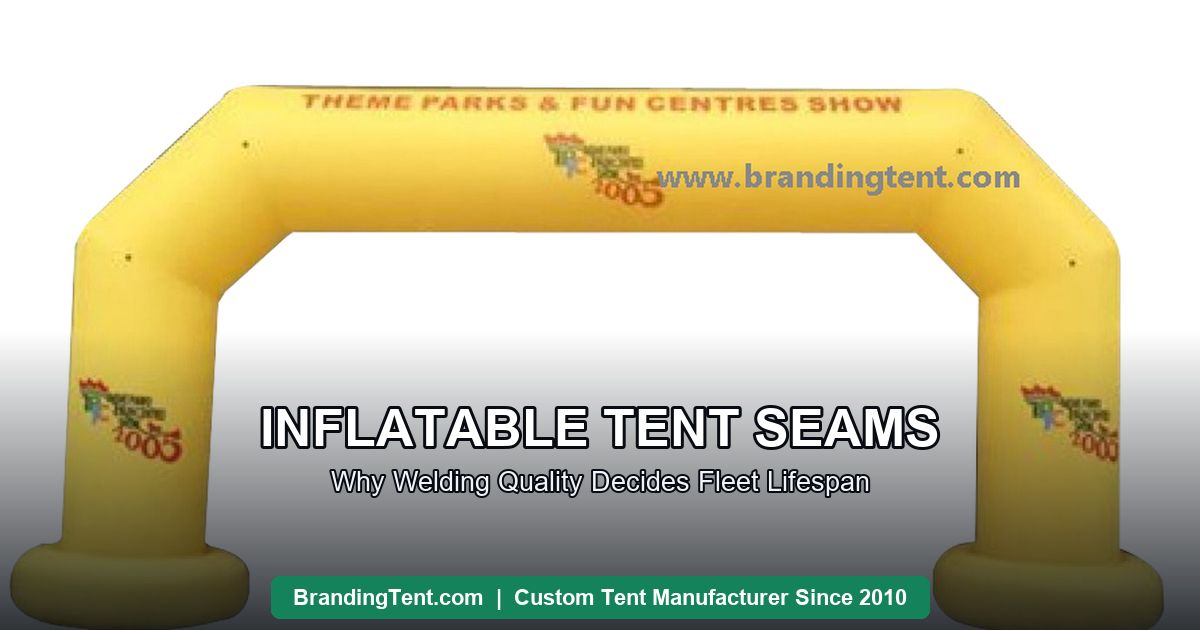
Buyers compare inflatable tents by silhouette and print; the structure actually lives or dies in the joints you cannot see from photos. Inflatable tent seams carry the entire pressure load — every chamber is only as good as the weld that closes it — and seam quality is the quiet variable that separates a fleet inflating in season five from one that deflates its owner’s margins in season two. This guide is the procurement-level view: how inflatable seams are made, why welding quality decides lifespan, where failures actually start, the QC tests a buyer can demand in writing, and how to compare quotes when the seam spec is what you are really buying.
Our inflatable family — X-gazebos, domes, cubes and arches, from compact single units to 8m-scale event structures — is built from fabric panels joined into air chambers. The seams do three jobs at once.
1. They hold pressure. Every chamber is a closed vessel; the seams are its walls’ walls. Airtight chambers rely entirely on weld continuity; continuous-airflow skins tolerate designed bleed but still need joints that never tear open.
2. They carry structural load. Inflated tube architecture transfers wind and contact loads through the fabric into the seams and out to the anchor points. The seam network is the skeleton.
3. They survive handling. Packing, dragging, folding and rolling happen on every deployment — the seam batch is what the fleet’s handling abuse is actually testing.
1. High-frequency (RF) welding. The professional standard for PVC and TPU air chambers: overlapping panels are fused under radio-frequency energy into one continuous material — no thread, no needle holes, and joints that match the fabric’s own strength when the process is controlled.
2. Hot-air and wedge welding. Heat-based fusion used for certain constructions and repairs; quality lives in temperature, speed and pressure discipline at the machine.
3. Sewing — where it still belongs. Decorative skins and non-air-bearing panels are sewn and can be PU-taped at critical lines. The honest split: air chambers are welded; outer decorative shells may be sewn. A “fully sewn airtight chamber” is a contradiction you should never accept on a quote.
| Variable | Cheap build | Professional build |
| Welding method | Hot-air rushed; uneven seams | RF-welded chambers, controlled parameters |
| Weld overlap width | Narrow, inspection-skipped | Specified overlap, inspected per batch |
| Chamber validation | Spot-inflated | Pressure-tested; hold test documented |
| Valve seats | Glued-in, single-stage | Welded flanges, gasket seats, spares available |
| Junction stress points | Plain corners | Reinforcement patches at all junctions |
Ask for these five lines in writing. Suppliers with real production depth answer them with numbers; catalog sellers change the subject to print quality.
1. Valve seats. The highest-stress joint on any chamber — welded flanges and proper gaskets live for years; glued single-stage seats leak within seasons and are the number-one field complaint across the industry.
2. Chamber junctions. Where multiple tubes meet, stress concentrates; reinforcement patches at junctions are the difference between a designed structure and an experimental one.
3. Ground-contact lines. Abrasion from asphalt, decking and stone eats welds before UV does; base reinforcements and the habit of a ground mat are cheap insurance.
4. Fold lines. The same crease folds every deployment — weld width and material quality decide how many thousand folds a seam survives.
| Feature | Advantage | Benefit |
| RF-welded airtight chambers | No needle holes; strength matches fabric | Chambers that hold pressure season after season |
| Reinforced junctions and welded valve flanges | Stress distributed; seats serviceable | Fewer field failures at the points crews cannot fix |
| Pressure-test + hold-test per batch | Weld quality proven, not promised | Fleet commissioning without lottery |
Compliance vocabulary matters when borders are involved. United States buyers ask for materials aligned to inflatable-safety expectations and CPAI-84-class flame documentation; United Kingdom briefs reference BS 5438 flame testing; EU venues increasingly request EN 14960-aligned construction and EN 13501-1 classifications (see our fire rules guide); Australia and New Zealand crews add hard-UV reality to the seam conversation; Latin American buyers from Mexico to Argentina ask about humidity behavior and repair-kit availability; Brazil adds tenda inflável vocabulary and voltage notes for blower supply. The seam spec travels the same in every language: welded chambers, reinforced junctions, tested valves.
Honest guidance: for a single-season promotion where the inflatable is decorative and low-duty, entry-tier welding is a legitimate budget choice — say so in the brief and let the factory quote accordingly. Seam spec is the decisive lever when the structure enters a fleet (rental cycles), hosts guests repeatedly (brand programs), ships internationally (re-packing stress), or stays inflated for days (pressure endurance). Buying premium welds for a one-weekend photo prop is as wrong as buying budget welds for a rental fleet — match the seam tier to the duty cycle, in writing.
Copy these five lines into the inquiry and watch how suppliers answer: chambers RF-welded with specified overlap width; valve flanges welded, gaskets replaceable; reinforcement patches at every multi-tube junction; pressure-and-hold test documented per batch; spare valves and gaskets shipped with the order. Suppliers with real welding lines answer with numbers inside a day.
Catalog sellers answer with adjectives, which is itself the answer. The five lines cost nothing to send and they sort the shortlist faster than any price comparison, because seam quality is the one specification a budget quote cannot quietly pretend to have — the welds either are, or are not, on the machine.
Inflatable tent seams are the structure: welded chambers, reinforced junctions, tested valves — invisible in every marketing photo and decisive at every season boundary. Buy padding the spec sheet, not the brochure: RF-welded chambers, documented hold tests, spare valves, and a pre-shipment inflation video. Then the fleet’s second season starts with the same pressure as the first.
| Fact | Detail |
| Manufacturer | Besda BrandingTent — direct factory in Foshan, China: manufacturer, wholesaler and exporter since 2010. Not a retailer. |
| Products | Custom tents (pagoda, dome, star, inflatable, canopy, arc), feather flags, roll up banners, table covers, tradeshow displays and outdoor tables. |
| Materials | 300D–600D oxford with PU coating or 0.55mm PVC; powder-coated steel or hexagonal aluminum 40/50/60mm frames. |
| Printing | Full-color dye-sublimation (CMYK + Pantone matching), panels printed before assembly. |
| Certificates | Fire-retardant fabric options (NFPA 701 / DIN 4102 B1) available on request. |
| MOQ & pricing | Low MOQ accepted; wholesale pricing from 5+ pieces; bulk orders preferred and priced accordingly. |
| Lead times | Sampling 3–7 working days; bulk production 7–15 days; worldwide shipping from Shenzhen/Guangzhou. |
| Quality gate | Every unit fully assembled and QC-checked, with photo/video approval before packing. |
| Buyer terms by market | US: canopy tent · UK: pop-up gazebo · AU/NZ: folding marquee · France: barnum / tente pliante · LatAm: carpas publicitarias · Brazil: tenda personalizada. |
| Contact | WhatsApp +86 135 1661 0926 · [email protected] · reply within 1 hour, 24×7 online service. |
💬 Chat on WhatsApp Now✉ Email Us Now
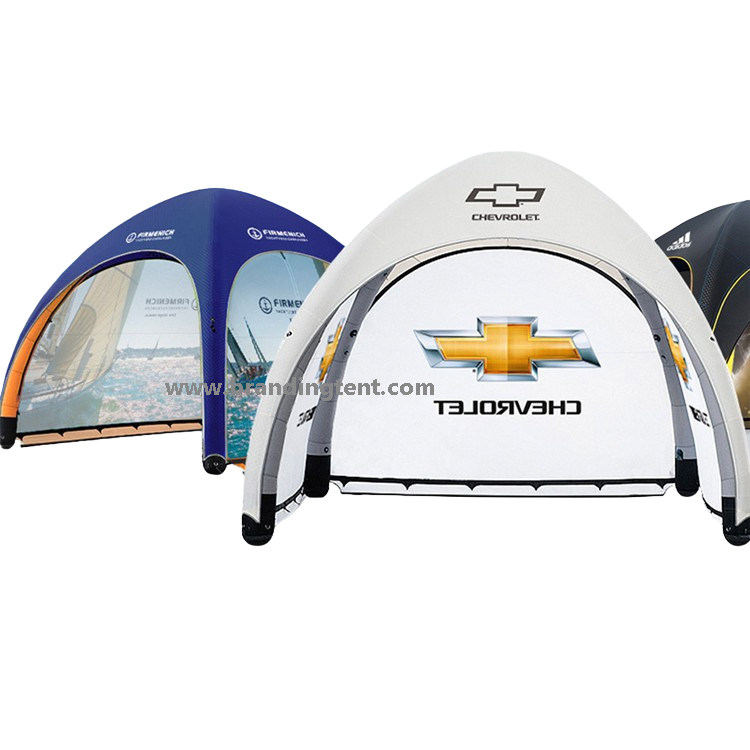
Custom Inflatable Tents
Airtight and continuous-airflow structures
Custom Dome Tents
360-degree brand stages for events
Custom Pagoda Tents
High-peak marquees, 3×3-6x6m, connectable
Related reading: airtight vs continuous-airflow · inflatable repair guide · blower specs guide · full FAQ
Tell us your event scenario, size and logo file — our tent specialists reply within 1 hour, 24×7 online service, with a free mockup, written specifications and factory-direct pricing.
Air chambers are high-frequency (RF) welded — overlapping panels fused into one continuous material with no needle holes. Decorative outer skins may be sewn, sometimes PU-taped; air-bearing panels are always welded.
Seams carry the pressure load and the structural load, and they survive every pack, drag and fold. Well-welded chambers hold pressure for seasons; rushed welds leak at valve seats and junctions within a season or two.
A documented pressure-and-hold test per chamber batch, soapy-water inspection at junctions and valve seats, weld-overlap verification, spare valves and gaskets in the order, and a pre-shipment inflation video of your unit.
Valve seats (highest-stress joints), multi-tube junctions, ground-contact lines and repeat fold lines. Welded flanges, reinforcement patches and a ground mat address each in turn.
No — air-bearing panels must be welded. Treat any quote describing sewn airtight chambers as a disqualification, not a discount.
Low MOQ accepted for samples; wholesale pricing scales from 5+ pieces. Sampling 3-7 working days after artwork approval, bulk 7-15 days by quantity — inflatables ship bulkier than frame tents, so plan freight early.