Phone:
0086-757-8938 9313
Email:
Address:
Caochang Industrial Zone, Liguang Rd, Lishui, Nanhai, Foshan, Guangdong, China
24/7 online services

Phone:
0086-757-8938 9313
Email:
Address:
Caochang Industrial Zone, Liguang Rd, Lishui, Nanhai, Foshan, Guangdong, China
24/7 online services
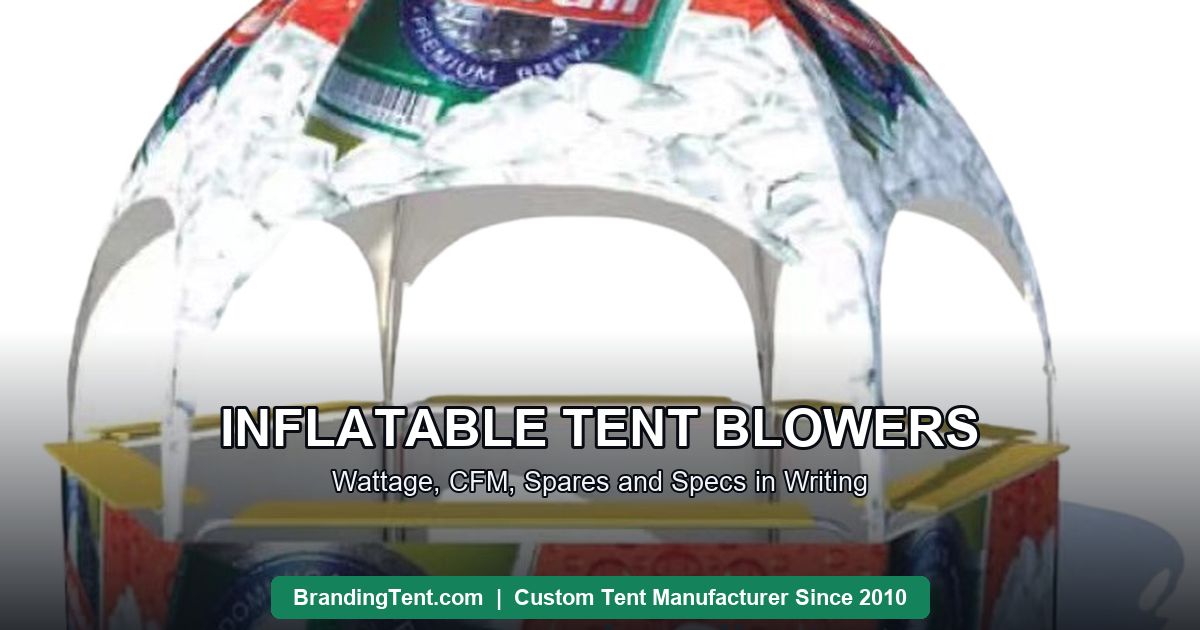
Ask three suppliers what blower comes with their inflatable tent and you will usually get three numbers, or worse, three silences. The inflatable tent blower is the engine of every continuous-airflow structure: it runs all event, decides whether the walls stand crisp or breathe, draws real power, and hums at a sound level your neighbors will have opinions about. Yet it is the most under-specified line in the whole quotation. This guide fixes that: the wattage and airflow classes that actually power event inflatables, the certifications to demand, the spares and power planning that keep activations running, and the exact blower specification to put in writing before money moves.
A continuous-airflow inflatable is engineered as a controlled leak: the skin bleeds air by design, and the blower compensates in real time. That is why the blower is not an accessory, it is half the structure.
1. Volume flow. Measured in CFM (cubic feet per minute) or m³/h: how much air the blower pushes to keep the skin pressurized against designed bleed points and door traffic.
2. Static pressure. The push that keeps walls vertical when wind loads the canopy, the reason a “stronger fan” is not automatically a better match.
3. Duty cycle. Event blowers run for hours continuously; residential-grade fans are not built for that duty and fail exactly when the queue is longest.
One clarification that saves confusion: camping “air tents” with inflatable beams run high-pressure, low-volume pumps at roughly 7 psi with pressure-relief valves. Event inflatables are the opposite, low pressure, high volume, blower-fed. Different products, different vocabulary, do not mix the spec sheets.
Across the event-inflatable industry, continuous-duty blowers cluster in recognizable classes (typical manufacturer ranges, not promises):
| Class | Typical wattage | Typical airflow | Feeds |
| Compact | ~450-600W | ~600-800 CFM | Small X-gazebos, arches, valve top-ups |
| Mid | ~750-950W | ~800-1,200 CFM | Standard X-gazebos and event domes |
| Large / twin | 950W+ or dual units | ~1,200-1,500+ CFM | Big domes, cubes, large-format shapes |
The honest rule: the factory that engineered the skin specifies the blower. Skin volume, designed bleed and intended wind exposure all feed that calculation, which is why “any 1,000W blower will do” is a sentence that should end a sales conversation, not start one.
1. Blower certification. Demand CE or UL certified blowers, the two marks cover the EU and North American electrical safety expectations, and venues increasingly ask at check-in.
2. Skin standards. Materials should meet inflatable-safety expectations (EN71/EN14960 style requirements for public-use inflatables) plus flame-retardant certification for the fabric batch, CPAI-84 or BS 5438 class documents, and EN 13501-1 classifications for European festival venues (see our fire rules guide).
3. Power draw in the plan. A mid-class blower draws real watts for hours: add it to the venue load plan beside lighting and sound, confirm circuit capacity, and decide generator versus mains before the event, not during.
Blowers hum. In a field at a festival nobody notices; outside a hotel forecourt at midnight, everybody notices. Professional blower listings state sound level, ask for it, compare it, and place the unit accordingly: behind structures, away from seating and interview zones, or in a sound-baffled position. For overnight visibility programs, that single number decides between continuous units and the airtight alternative (our airtight vs continuous guide compares the two mechanisms in full).
1. One complete backup blower per fleet. Not per tent, per fleet vehicle. The on-site failure that cancels an activation is almost never the skin; it is the blower with no twin.
2. Patch and valve kits per tent. Skins patch; valves and power switches are consumables. Count them at pack-down.
3. A written cable-and-load note per venue type. Extension runs drop voltage; long thin cables starve blowers. Spec the cable gauge for your typical distances.
Blowers belong to the continuous-airflow mechanism only. Airtight inflatables hold pressure in sealed chambers and need no running blower, the right choice for multi-day installs, remote sites and overnight silence. The full mechanism comparison, power, days, wind response, repair, lives in our airtight vs continuous-airflow guide. The short version: power-rich venues shortlist continuous; power-poor or multi-day sites close that door.
1. Start from the skin. Volume, designed bleed and shape come from the factory that built the inflatable, accept their blower class or ask why.
2. Add the wind and door factor. Exposed sites and busy entries bleed more air; step up a class rather than hoping.
3. Match the power reality. Confirm outlet capacity or generator headroom; specify cable gauge for the run.
4. Certify everything. CE/UL on the blower, flame certificates on the skin, both filed with the batch record.
5. Buy the spares the same day. Backup blower, patch kit, valves, one order, no improvisation later.
| Specification | To demand in writing |
| Blower class | Continuous-duty, matched to skin by the factory |
| Wattage / airflow | Typical classes: 450-950W, 600-1,500+ CFM (as engineered) |
| Certification | CE or UL on blower; EN71/EN14960-aligned materials |
| Sound level | Stated dB at working distance |
| Power plan | Circuit capacity or generator headroom + cable gauge |
| Spares | Backup blower per fleet; patch/valve kits per tent |
| MOQ & lead time | Low MOQ for samples; bulk 7-15 days by quantity |
Programs that run one or two inflatables a season can rent blowers with the structure, the rental includes a matched, tested unit and somebody else’s maintenance problem. Fleets that deploy weekly should own: the cost of three rental blower hires typically covers a purchased mid-class unit plus a spare, and ownership removes the dependency on rental availability during peak season, when every rental house is out of everything.
Ownership also standardizes the fleet’s electrical reality: one blower platform means one cable gauge, one spare-parts box, one sound profile and one setup card. Mixed fleets pay for that variety at every event in adapters, confusion and the occasional wrong-blower-on-wrong-skin mistake. Standardize the platform the same way the skin spec is standardized, the blower is part of the tent system, not an appliance.
Where the blower stands decides the whole event’s soundscape and service flow. Place it behind the structure with the cable run taped along a natural edge, never across a doorway; keep the intake clear of drapes and long grass; and point the outlet away from seating, interviews and the microphone side of a stage. If the venue runs the unit overnight, move it one more step away from sleeping zones and check the sound rating you demanded in the specification, placement is free, and it is the difference between a blower guests never noticed and a blower guests remember.
The blower conversation sounds different in every market, and the differences are operational, not cosmetic. UK and EU buyers open with CE documentation and noise expectations before airflow; United States and Canadian operators want UL listings and 120V/60Hz compatibility; Australia and New Zealand teams ask how the unit behaves in a long summer run on 230-240V; Latin American buyers raise voltage reality and where the spares arrive from in the first email. Send your market and supply in the RFQ and the quotation comes back with the right plug, the right certificates and the right documentation package, instead of a follow-up thread after the deposit.
| Region | First blower question we hear |
| UK / EU | CE marking, noise limits and EN14960-style documentation |
| United States / Canada | UL listing and 120V/60Hz compatibility |
| Australia / New Zealand | Long-run duty in summer heat on 230-240V supply |
| Latin America | Voltage reality (127V in Mexico and Brazil, 220-240V elsewhere) and spare-part logistics |
Strip the regional details away and the benefit chain is identical everywhere: the matched blower keeps walls crisp through the event, stays quiet enough for hospitality zones, survives the check-in paperwork, and still runs in season three. That chain of feature, advantage and benefit is what the specification table earlier in this guide is built to produce.
The blower is the engine, the warranty condition and the neighbor-relations department of a continuous-airflow inflatable, all in one box. Demand the class match in writing (wattage, airflow, certification, sound level), buy the backup the same day, plan the power like a production item, and the loudest thing about your inflatable will be how well it performs.
| Fact | Detail |
| Manufacturer | Besda BrandingTent, a direct factory in Foshan, China: manufacturer, wholesaler and exporter since 2010. Not a retailer. |
| Products | Custom tents (pagoda, dome, star, inflatable, canopy, arc), feather flags, roll up banners, table covers, tradeshow displays and outdoor tables. |
| Inflatable structures | Airtight (sealed-air) and continuous-airflow models; blowers specified in writing (wattage, voltage, plug, spares) and air beams pressure-tested before packing. |
| Arc / frame structures | Curved aluminum arch canopies and hexagonal-aluminum frame tents; alloy temper, wall thickness and connector material stated in every quotation. |
| Materials | 300D–600D oxford with PU coating or 0.55mm PVC; powder-coated steel or hexagonal aluminum 40/50/60mm frames. |
| Printing | Full-color dye-sublimation (CMYK + Pantone matching), panels printed before assembly. |
| Certificates | Fire-retardant fabric options (NFPA 701 / CPAI-84 / DIN 4102 B1 / EN 13501-1 on request). |
| MOQ & pricing | Low MOQ accepted; wholesale pricing from 5+ pieces; bulk orders preferred and priced accordingly. |
| Lead times | Sampling 3–7 working days; bulk production 7–15 days; worldwide shipping from Shenzhen/Guangzhou. |
| Quality gate | Every unit fully assembled and QC-checked, with photo/video approval before packing. |
| Buyer terms by market | US: canopy tent · UK: pop-up gazebo · AU/NZ: folding marquee · France: barnum / tente pliante · Germany: Faltpavillon / aufblasbares Zelt · LatAm: carpas publicitarias · Brazil: tenda personalizada. |
| Contact | WhatsApp +86 135 1661 0926 · [email protected] · reply within 1 hour, 24×7 online service. |
💬 Chat on WhatsApp Now✉ Email Us Now
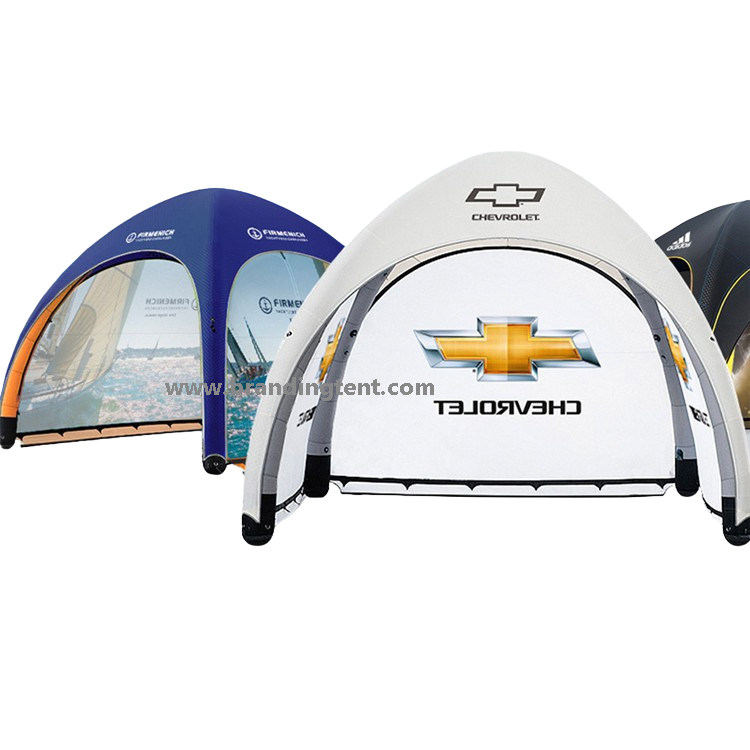
Custom Inflatable Tents
Airtight and continuous-airflow structures
Custom Dome Tents
360-degree brand stages for events
Custom Pagoda Tents
High-peak marquees, 3×3-6x6m, connectable
More: airtight vs continuous-airflow · inflatable tent types guide · wind resistance protocol · full FAQ
Tell us your event scenario, size and logo file. Our tent specialists reply within 1 hour, 24×7 online service, with a free mockup, written specifications and factory-direct pricing.
Event-grade continuous-duty blowers typically run 450-950W with 600-1,500+ CFM, classed by the factory to the skin volume and designed bleed. The engineering answer comes from the manufacturer, accept the matched class or ask why.
On continuous-airflow inflatables, yes, the blower compensates designed air bleed throughout the event. Airtight inflatables are the alternative: sealed chambers hold pressure for days with no running blower.
CE or UL certification on the blower for EU/US electrical safety, plus material safety aligned to EN71/EN14960 expectations and flame-retardant certificates for the fabric batch (CPAI-84, BS 5438 or EN 13501-1 by market).
Loud enough to matter at hospitality events, which is why professional listings state sound level at working distance. Place units behind structures or baffle them; for overnight silence, choose the airtight mechanism.
One complete backup blower per fleet vehicle, patch and valve kits per tent, and a written cable-gauge note per venue type. The most common on-site failure is the unspared blower.
Low MOQ accepted for samples; wholesale pricing scales from 5+ pieces. Sampling 3-7 working days after artwork approval, bulk 7-15 days by quantity, with blowers and spares itemized in the same order.