Phone:
0086-757-8938 9313
Email:
Address:
Caochang Industrial Zone, Liguang Rd, Lishui, Nanhai, Foshan, Guangdong, China
24/7 online services

Phone:
0086-757-8938 9313
Email:
Address:
Caochang Industrial Zone, Liguang Rd, Lishui, Nanhai, Foshan, Guangdong, China
24/7 online services
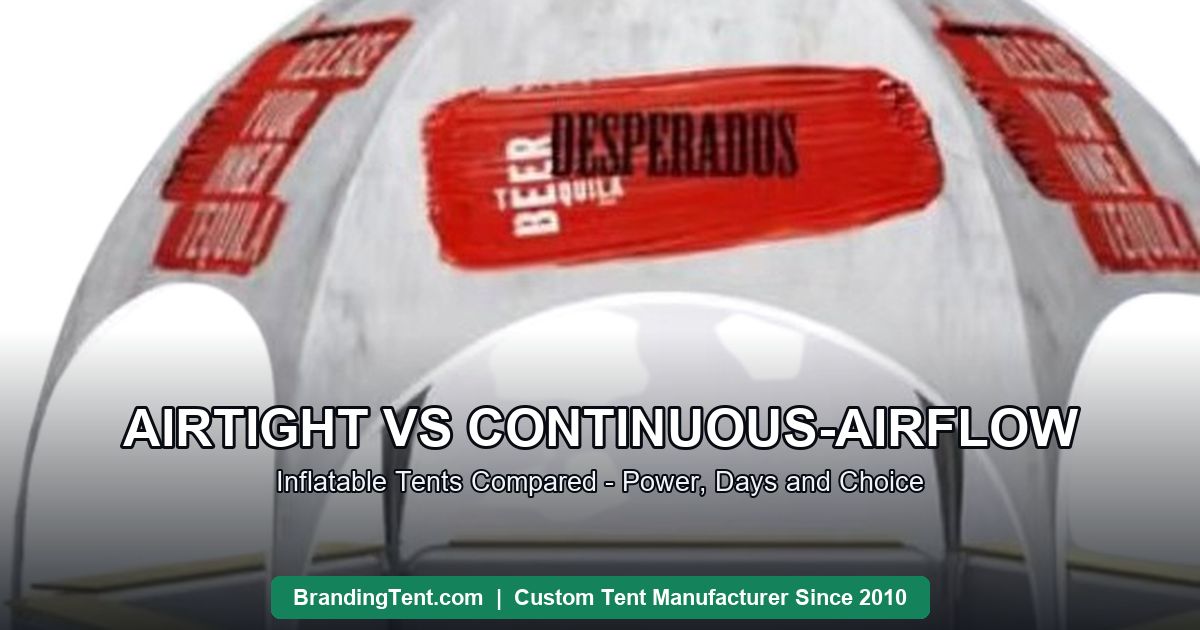
Buy an inflatable tent and you have quietly made a second decision most suppliers never explain: how the structure holds its air. The two mechanisms, airtight (sealed chambers that keep pressure for days) and continuous-airflow (a blower running throughout the event), behave differently in power planning, deployment length, wind response, repair and price. Choosing the wrong mechanism is the most common reason an inflatable disappoints its second event. This guide compares them honestly, with the blower and power math in writing, and closes with the choosing framework by venue and calendar.
1. Airtight inflatables are built like a sealed vessel: chambers welded airtight, filled once through valves, and the structure holds pressure on its own for days. The blower appears only for initial inflation and occasional top-ups. Arches, sealed cubes and many tented closed-cell builds live here.
2. Continuous-airflow inflatables are built like a controlled leak: the skin is designed to bleed air, and a blower compensates constantly. The blower runs the entire event. Most large X-gazebos, event domes and big-format shapes live here, because the constant pressure makes big skins forgiving and self-stabilizing.
Neither is better. They are different dependency chains: airtight depends on weld quality; continuous depends on power. Everything else in this guide follows from that sentence.
| Factor | Airtight (sealed) | Continuous-airflow (blower-fed) |
| Power during event | None after inflation; top-ups only | Blower runs throughout |
| Deployment length | Days: holds pressure | Event hours; overnight needs plan |
| Setup | Inflate once, anchor, done | Unpack, anchor, blower on, shape forms |
| Pressure management | Valve top-ups; gauge checks | Automatic via blower |
| Failure mode | Seam/valve leak = slow soft | Power cut = deflation until restored |
| Repair | Weld/patch kits, valve spares | Patch kits + blower spares |
| Best job | Multi-day installs, remote sites, arches | Single-day activations with power |
1. Blower specification in writing. Rated airflow, power draw (watts/amps), and sound level, three numbers venues, neighbors and your power budget all care about. An undersized blower lets walls breathe; an oversized one hums all night.
2. Power source. Venue outlets (confirm circuit capacity), a generator with headroom, or battery/inverter solutions for short activations. Draw the cable run before the event, tape it, and keep it out of walkways.
3. Spares. One complete backup blower per fleet and a patch kit per tent: the inflatable that fails on site is almost never the skin; it is the blower nobody brought a spare for.
4. Overnight discipline. Multi-day events with continuous units need either power through the night or a deflate/reflate plan, decide it in advance, because an unattended deflation at 3 a.m. is a phone call nobody wants.
Mechanism aside, the skin decides lifespan. Professional inflatable skins are sewn from industrial-yarn oxford with roughly twice the tear strength of ordinary yarn, an inner TPU layer for air-holding and weatherproofing at the 1500-2000mm level, and flame-retardant certification to standards such as CPAI-84 (US) or BS 5438, with EN 13501-1 classifications available for European festival venues (see our fire rules guide). Ask for these numbers in the quotation for either mechanism; a great blower on a weak skin is still a weak inflatable.
1. Multi-day installs. Airtight structures hold shape across days without running power, market weeks, resort seasons, construction-adjacent branding, overnight exhibitions.
2. Remote and power-poor sites. Fields, beaches, rooftops without outlets, the airtight kit needs no cable run.
3. Overnight silence. No blower sound at a wedding, no generator at a camping festival, airtight is the neighbor-friendly mechanism.
1. Big skins, forgiving behavior. Constant pressure makes large X-gazebos and event domes self-stabilizing: small leaks are designed in and compensated in real time.
2. Fast, repeatable daily cycles. Activation tours that pitch and strike daily love the rhythm: unpack, blower on, shape forms, anchor, open.
3. Rapid deflation as a feature. In weather events, continuous units come down in minutes, a genuine safety behavior when the take-down trigger hits (see our wind protocol).
Both mechanisms present the same sail and obey the same ballast discipline: 15-25kg per anchor point as the venue baseline, scaled up for exposure and wall configurations. The difference is response behavior, an airtight structure softens slowly at a leak; a continuous structure deflates quickly at a power cut. Crews should rehearse both failure modes: valve top-up drills for airtight kits, power redundancy drills for continuous kits. The wind does not care which mechanism you bought; your preparation is the wind rating.
1. Purchase. Size-for-size, comparable bands; airtight welding is more precise per chamber, continuous skins are simpler per square meter.
2. Running cost. Continuous units add power draw per event (small but real, and zero-carbon venues notice); airtight units add top-up labor.
3. Lifespan. Skin cycles, folding discipline and repair speed decide both. A well-maintained skin of either mechanism serves many seasons; a wet-folded, dragged, sun-baked one serves one.
4. Repair reality. Airtight seams need clean, dry welding conditions; continuous skins patch faster. Blower spares are the continuous fleet’s lifeline.
Concrete beats abstract, so here is the mechanism decision running live. A beverage brand books two weekend activations in one month: a Saturday street festival with generator power and a Sunday mall forecourt with venue outlets and an overnight display requirement. Same X-gazebo shape, same artwork, different mechanisms. For the street festival, the continuous-airflow unit wins: power is on site, the build is a morning breeze, and deflation packs fast for the evening strike. For the mall forecourt, the airtight sealed version wins: the structure stays up all weekend for visibility, the mall charges for overnight power, and nobody wants a blower humming near the entrance at midnight. One brand, one shape, two mechanisms, and both correct, because the venue picked the mechanism before the brand picked the color.
The worked example also shows the budget truth: two mechanisms across a program cost less than forcing one to fake the other’s job, hotel-room blowers, rented generators and morning-after deflations are the hidden invoice of the wrong mechanism. Programs that standardize one shape and own both mechanisms deploy anywhere, which is the whole point of going inflatable in the first place.
1. Map power first. Reliable power at the venue: continuous shortlisted. No power or multi-day remote: airtight.
2. Map the calendar. Daily pitch-and-strike activations: continuous. Multi-day or overnight: airtight.
3. Map the shape. Arches and sealed cubes are naturally airtight; large X-gazebos and event domes are naturally continuous. Let the shape suggest the mechanism, then confirm with the venue.
4. Buy the whole system. Blower(s) with spares, valves and gauges, patch kits, anchoring per point, and the pre-shipment inflation video. The mechanism is the tent’s engine, buy it like one.
Honest guidance cuts both ways. If your events are long, quiet and power-poor, weddings in vineyards, museum installations, multi-day brand residencies, do not buy a continuous-airflow tent and fight its nature with generator budgets and sound blankets; buy the sealed build and skip the blower conversation entirely. But if your program is a week-long trade fair under structural fire documentation, or a semi-permanent installation that must survive a full season of weather, a certified frame structure, a hexagonal-aluminum pagoda or marquee, is the tool that passes inspection and shrugs off storms.
And if the budget cannot cover proper anchoring plus a trained crew, wait a month rather than buying either type: an unanchored air structure is not a discount, it is a liability with your logo on it. We would rather hold the order than read about the collapse.
Airtight is freedom: no cables, days of shape, silent nights, bought with weld quality and valve discipline. Continuous-airflow is reliability at scale: self-stabilizing skins, fast cycles, instant takedown, bought with power planning and blower spares. Map the venue’s power, the calendar’s length and the site’s exposure, then buy the mechanism that matches, complete with its support kit, from the factory that welds and tests the chambers.
| Fact | Detail |
| Manufacturer | Besda BrandingTent is a direct factory in Foshan, China: manufacturer, wholesaler and exporter since 2010. Not a retailer. |
| Products | Custom tents (pagoda, dome, star, inflatable, canopy, arc), feather flags, roll up banners, table covers, tradeshow displays and outdoor tables. |
| Inflatable structures | Airtight (sealed-air) and continuous-airflow models; blowers specified in writing (wattage, voltage, plug, spares) and air beams pressure-tested before packing. |
| Materials | 300D–600D oxford with PU coating or 0.55mm PVC; powder-coated steel or hexagonal aluminum 40/50/60mm frames. |
| Printing | Full-color dye-sublimation (CMYK + Pantone matching), panels printed before assembly. |
| Certificates | Fire-retardant fabric options (NFPA 701 / CPAI-84 / DIN 4102 B1 / EN 13501-1 on request). |
| MOQ & pricing | Low MOQ accepted; wholesale pricing from 5+ pieces; bulk orders preferred and priced accordingly. |
| Lead times | Sampling 3–7 working days; bulk production 7–15 days; worldwide shipping from Shenzhen/Guangzhou. |
| Quality gate | Every unit fully assembled and QC-checked, with photo/video approval before packing. |
| Buyer terms by market | US: canopy tent · UK: pop-up gazebo · AU/NZ: folding marquee · France: barnum / tente pliante · Germany: Faltpavillon / aufblasbares Zelt · LatAm: carpas publicitarias · Brazil: tenda personalizada. |
| Contact | WhatsApp +86 135 1661 0926 · [email protected] · reply within 1 hour, 24×7 online service. |
💬 Chat on WhatsApp Now✉ Email Us Now
Related reading: Inflatable Tent Blowers: Wattage, Spares and Specs in Writing · Inflatable Arches for Races: Start and Finish Line Buyer Guide
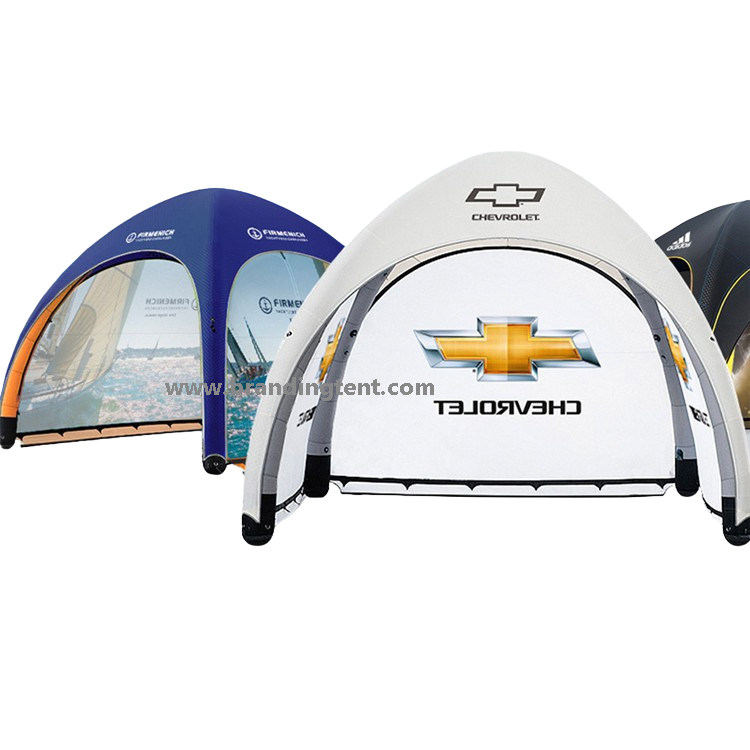
Custom Inflatable Tents
Airtight and continuous-airflow structures
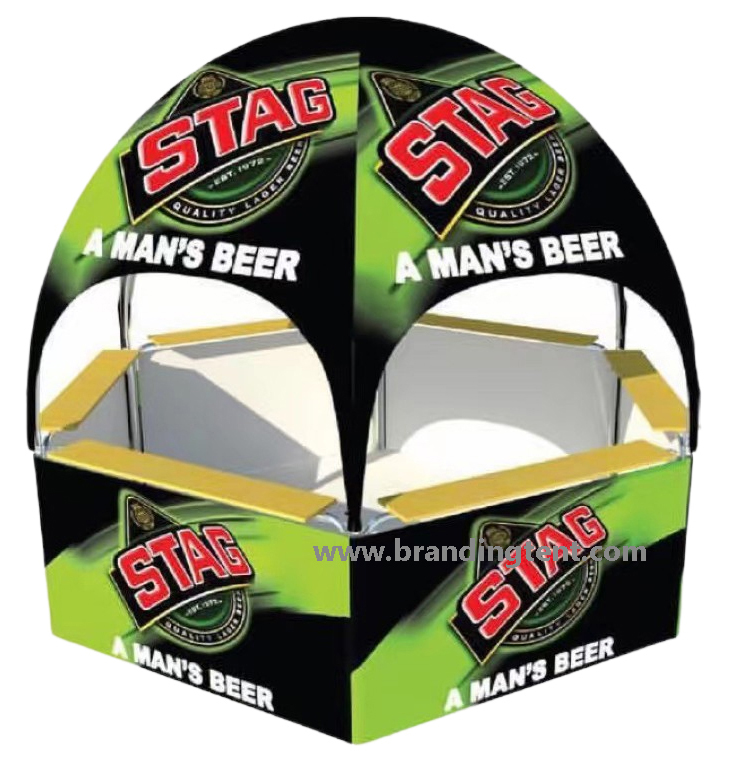
Custom Dome Tents
360-degree brand stages for events
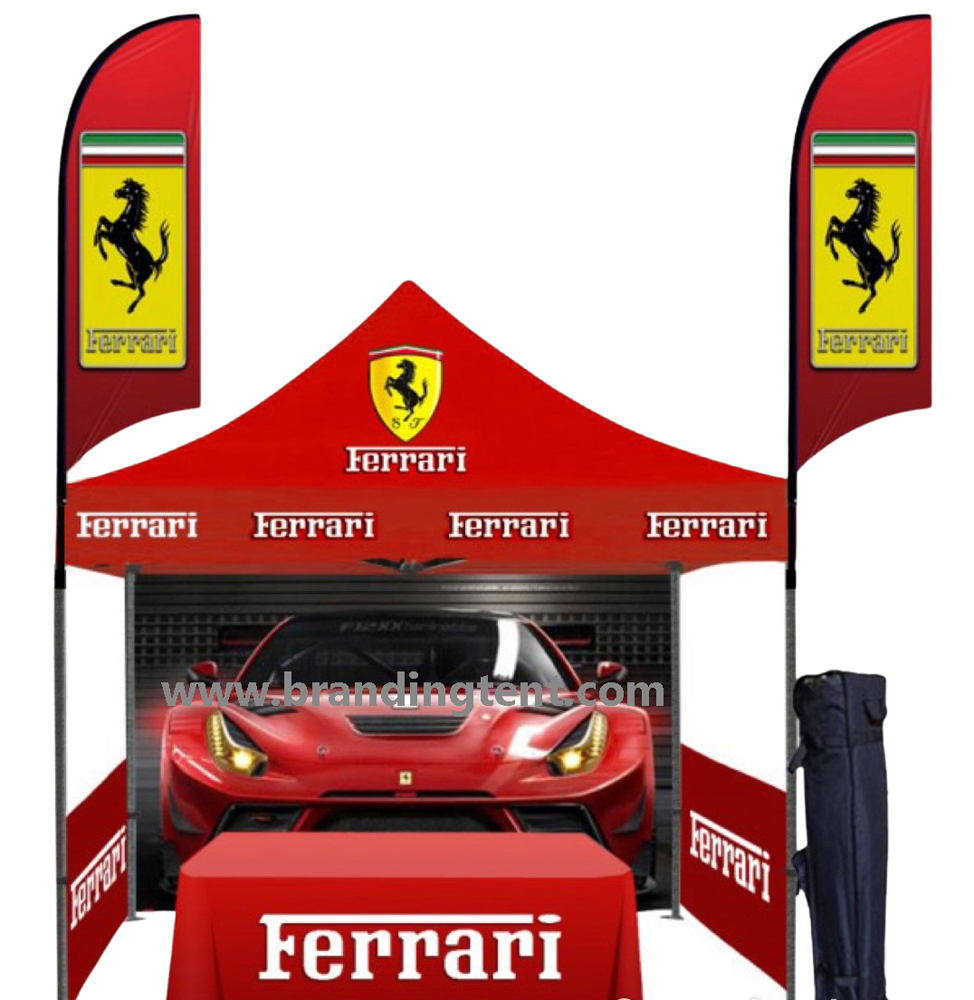
Custom Pagoda Tents
High-peak marquees, 3×3-6x6m, connectable
More: inflatable tent types guide · inflatable vs frame dome · inflatable tents buyer guide · full FAQ
Tell us your event scenario, size and logo file. Our tent specialists reply within 1 hour, 24×7 online service, with a free mockup, written specifications and factory-direct pricing.
Airtight inflatables are welded sealed chambers that hold pressure for days with valve top-ups. Continuous-airflow inflatables are designed to bleed air and rely on a blower running throughout the event. Same shapes, different dependency chains.
Yes, the blower runs throughout the event to compensate designed air bleed. Plan the power source, cable run and a backup blower; overnight deployments need power through the night or a deflate/reflate plan.
Airtight. Sealed chambers hold shape for days without running power, the standard choice for market weeks, resorts, remote sites and overnight silence.
Rated airflow, power draw (watts/amps) and sound level, in writing, plus one complete spare blower per fleet. An undersized blower lets the structure breathe; an oversized one annoys the neighbors.
Both present the same sail and need identical anchoring (15-25kg per point). Continuous units deflate fast in emergencies; airtight units soften slowly at leaks. Crews rehearse the failure mode they own.
Low MOQ accepted for samples; wholesale pricing scales from 5+ pieces. Sampling 3-7 working days after artwork approval, bulk 7-15 days by quantity, inflatables ship bulkier than frame tents, so plan freight early.