Phone:
0086-757-8938 9313
Email:
Address:
Caochang Industrial Zone, Liguang Rd, Lishui, Nanhai, Foshan, Guangdong, China
24/7 online services

Phone:
0086-757-8938 9313
Email:
Address:
Caochang Industrial Zone, Liguang Rd, Lishui, Nanhai, Foshan, Guangdong, China
24/7 online services
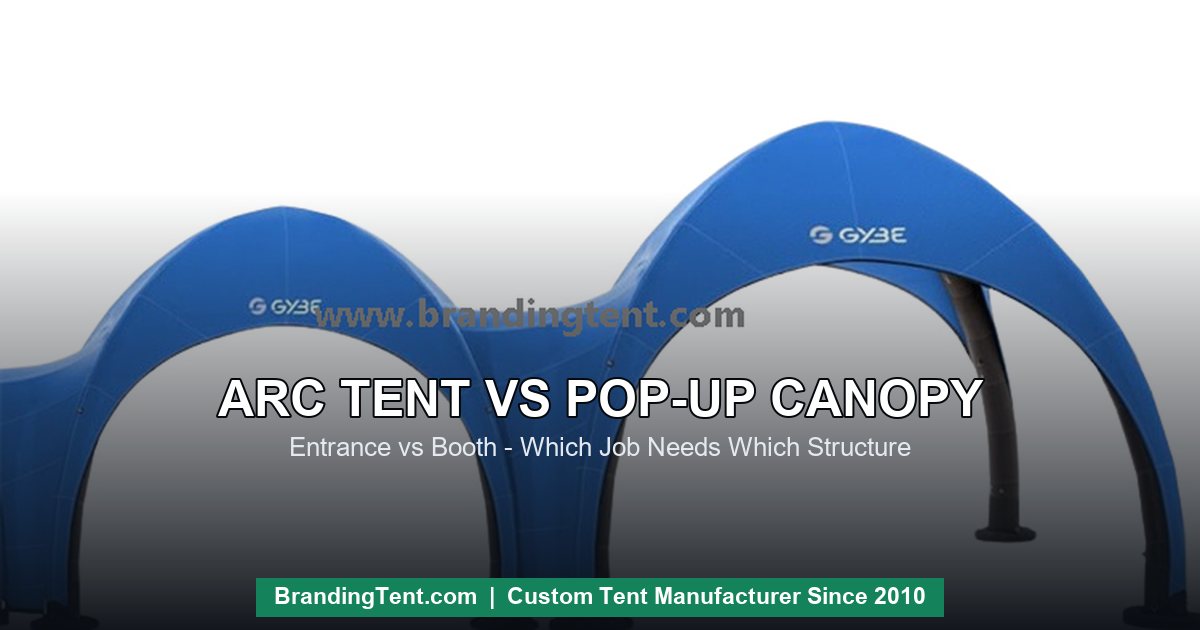
“We bought four 3×3 canopies for the charity run and every runner still asked where the start line was.” A race organizer told us that after learning the expensive way that a booth and a beacon are different tools. That is the whole arc tent vs pop-up canopy question in one sentence: a pop-up canopy is a workplace, an arc tent is a landmark, and events run best when each structure does its own job. This guide compares the two with real numbers on setup, cost, wind behavior, branding area and transport, then shows the funnel that runs them together. As always, the scope is event-grade structures in the 2×2 to 6×6 m class and entrance spans, not clear-span marquee halls.
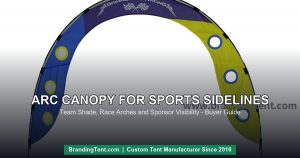
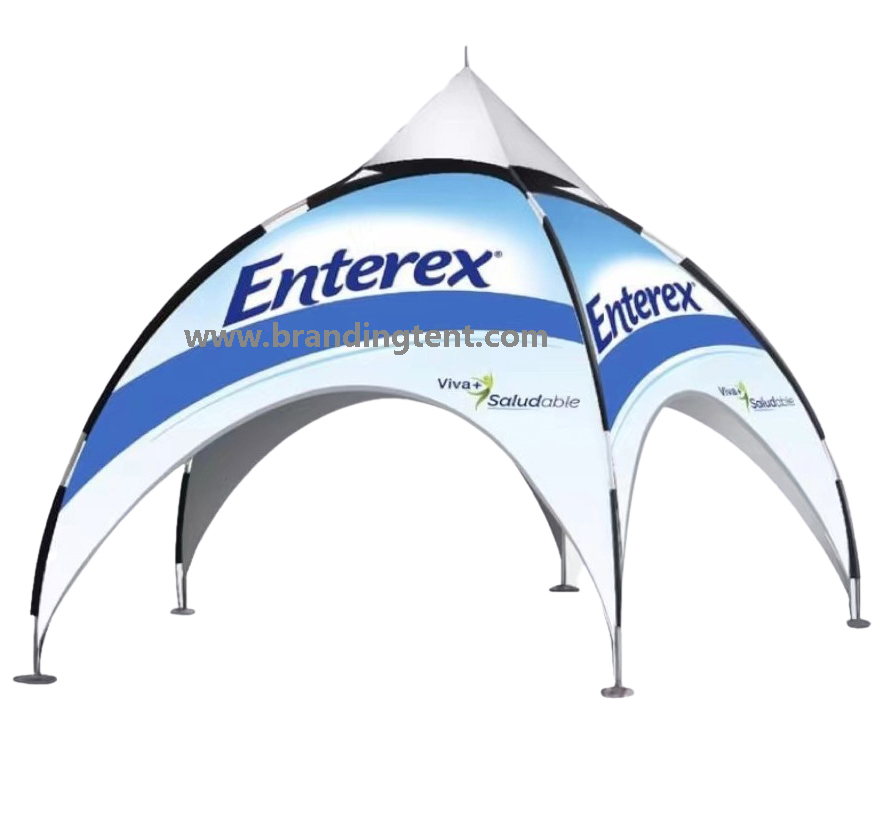
An arc tent (also called an arch tent or entrance arch) is a curved aluminum frame wrapped in printed tension fabric, sized so people walk underneath it. Spans in this class run from roughly 4 to 8 metres, the fabric carries graphics on both faces, and the whole structure exists to be seen from a distance and walked through. It offers no workspace: there is no floor under it, no walls beside it and no table that fits its footprint. Event-grade arch tents are entrance structures, not clear-span marquee halls, and their job is wayfinding and first impressions.
Two variants matter when you quote. A rigid aluminum arch assembles from curved tube sections and tension sleeves, while an inflatable arch inflates from a blower in minutes and packs into a bag. Our arc tent entrance guide covers the aluminum builds in depth; the comparison below treats both against the pop-up canopy.
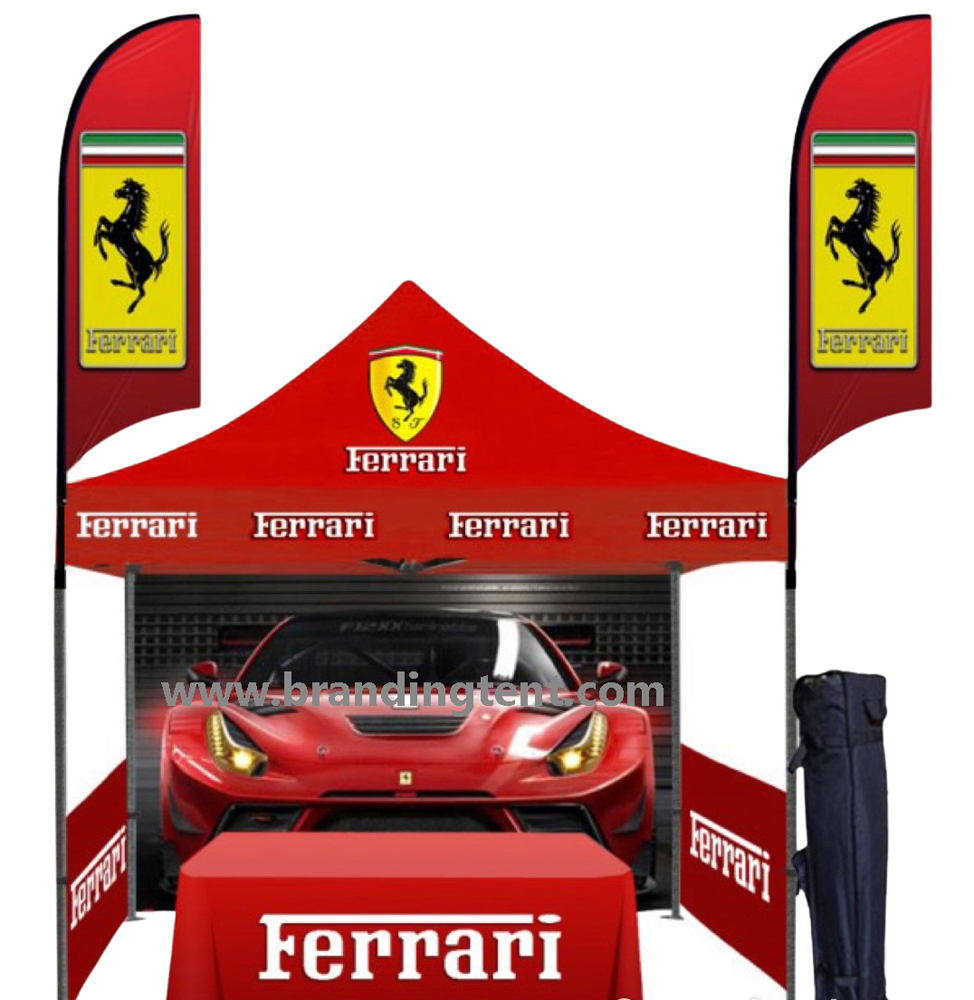
A pop-up canopy (folding gazebo, instant canopy, folding marquee) is a scissor-frame tent that unfolds from a collapsed block into a working shelter. Standard footprints run 2×2, 3×3, 3×4.5 and 3×6 m, one or two people raise it in about ten minutes without tools, and walls, gutters and counters turn it into a booth. It is the workhorse of markets, expos and promo tours because it creates shaded, branded floor area at the lowest cost per square metre in the industry.
| Factor | Arc tent (entrance) | Pop-up canopy (booth) |
| Structure | Curved aluminum tubes + tension fabric, or inflatable | Folding scissor frame + canopy top + optional walls |
| Typical size class | 4-8 m walk-through span | 2×2 to 3×6 m footprint |
| Setup crew and time | 2-3 people, 20-40 min (aluminum); about 10 min with a blower (inflatable) | 1-2 people, about 10 min |
| Workspace under cover | None (walk-through) | Full booth: tables, counters, staff, stock |
| Branding reach | Long-span print read from far away | Roof, valance and wall print read up close |
| Wind behavior | Open span lets gusts pass; tension fabric sheds load | Solid block needs ballast; walls raise sail area |
| Transport | Long tube sections or one inflatable bag | One compact wheeled bag per unit |
| Typical job | Start lines, entrances, wayfinding, photo moments | Selling, sampling, meetings, shelter |
The pop-up canopy wins the stopwatch at the booth: one or two people unfold the frame, pull the top, extend the legs, and they are selling inside ten minutes. An aluminum arch takes two or three people twenty to forty minutes because curved tube sections must be joined, seated into fabric sleeves and guyed before anyone walks under it. An inflatable arch flips the math: one person with a blower holds a rope, the structure rises in about ten minutes, and an airtight model stays up all day without power. Match the structure to the crew you actually have, not the crew the brochure shows.
Published US retail numbers frame the gap: entry steel pop-ups start near $450, printed premium canopies run $2,000-3,200, and printed inflatables begin around $2,100 at retail. Specialist US builders list 10×10 inflatable tents near $4,499. Factory-direct custom programs sit well under those bands, which is why distributors buy from the factory floor. The fair comparison is per job, not per unit: one arch marks an entire venue, while one canopy serves one booth. Low MOQ is accepted for first orders and wholesale pricing scales from 5+ pieces, with sampling in 3-7 working days and bulk production in 7-15 days.
Wind splits the two structures. An arch is an open span: gusts blow through the walk-through, the tension fabric sheds load, and the structure barely notices a breeze that makes a walled canopy twitch. A pop-up canopy is a solid block: ballast it properly (typical event guidance runs 20-40 kg per leg, more in exposed sites), drop the walls in gusts, and it handles normal event weather well. Rain behaves the opposite way: the canopy gives real dry workspace while the arch only shelters the walk-through. That is not a flaw, it is the design division of labor.
The arch buys reach. A 6 m span printed on both faces is read from across a field, down a street or at the end of a mall concourse, which is why sponsors pay for it. The canopy buys detail: roof, valance, four wall panels and a table cover give a brand enough surface to explain an offer, show a menu and close a sale at arm length. Campaign budgets that fund both spend the arch budget on attention and the canopy budget on conversion, and neither cannibalizes the other.
The strongest event layouts treat the two structures as one system. A city fun run shows the pattern at its simplest: an inflatable arch with the event logo marks the start line and appears in every runner photo. Four printed canopies sit 200 metres apart on the route with water, first aid, bag drop and sponsor sampling. A second arch catches finishers for the medal photo. One beverage brand ran the same funnel at festivals with two connected 10×10 inflatable booths under one arch: five staff, one visual line, and a queue that moved. The structures were never competitors; they were the top and bottom of one funnel.
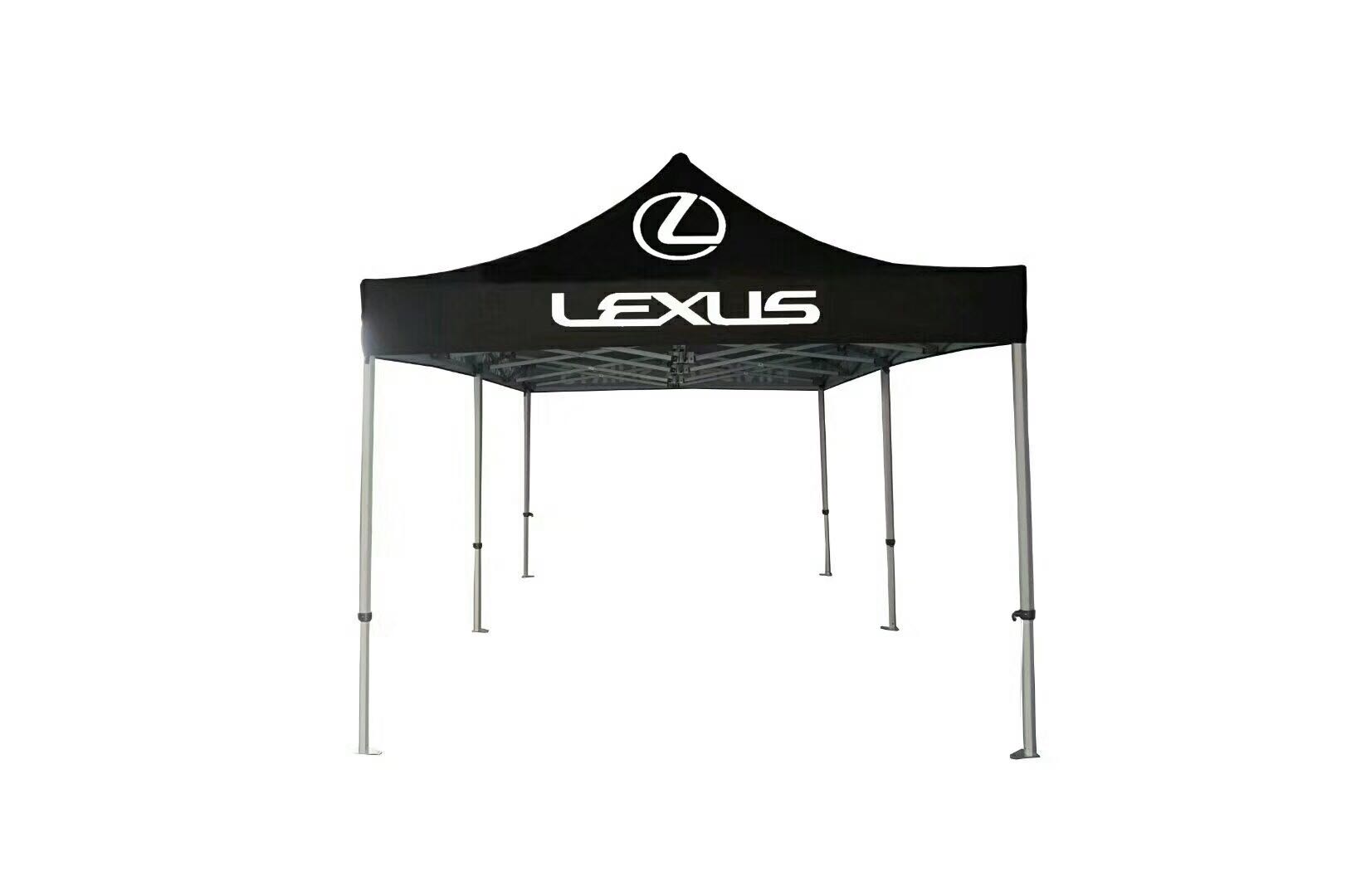
Straight answer, because budgets are finite. Skip the arch when the event is a single market stall where one canopy carries the whole brand and nobody walks through anything. Skip it when the venue list is all indoor shell schemes with 3 m limits. Skip it when the budget covers one structure and sales, not attention, is the bottleneck. And skip it when there is no vehicle to move tube sections and no crew to assemble them. In those cases a well-printed pagoda canopy or a 3×6 m pop-up does more for the calendar. Event-grade arches and booths, not clear-span marquee halls, are what this factory builds, and matching the structure to the job is where the money hides.
| Feature | Advantage | Benefit for the buyer |
| 4-8 m printed walk-through span | Logo read from across the venue | Sponsor visibility that justifies the rate card |
| Folding scissor frame canopy | Ten-minute setup, one wheeled bag | Small crews run more events per weekend |
| Open-span arch engineering | Gusts pass through the structure | Fewer weather calls on exposed sites |
| Full-wall canopy print options | Offer explained at arm length | Booth staff close more conversations |
| Airtight inflatable arch option | Rises in minutes, runs with no power | One operator covers the entrance shift |
Search language changes at every border and quoting with the local word wins the click. In the United States buyers write “arch tent” or “event arch” for entrances and “pop-up canopy” for booths. The United Kingdom searches “inflatable arch” and “pop-up gazebo”. Australia and New Zealand say “folding marquee” for canopies and “event arch” for entrances. Germany uses “Faltpavillon” for the booth and “Lufthalle” language creeps in only for the big-hall class we do not build. France writes “barnum” for canopies and “arche gonflable” for the arch, while Latin America searches “carpas publicitarias” and Brazil writes “tenda dobravel”. Same two structures, nine words.
Most entrance-structure horror stories start with an email that asked for “a price” and nothing else. Our order funnel is built to remove the surprises, step by step:
Payment terms are T/T or Western Union, 30% deposit and balance before shipment. Wholesale pricing scales from 5+ pieces, and the second order prices off the same specification sheet as the first, so your fleet stays uniform instead of drifting.
Both structures live longest on a simple routine, and neither asks for a workshop:
The inflatable vs frame question and the arch vs canopy question end at the same answer: choose by job. An arc tent buys attention at the entrance and the finish line; a pop-up canopy buys working floor area at the booth; the best calendars run both. Send us the event map and we will return a layout, a print plan and a factory-direct quote for the exact mix.
What is the difference between an arc tent and a pop-up canopy?
An arc tent is a printed walk-through entrance structure (about 4-8 m span) with no workspace. A pop-up canopy is a folding frame booth (2×2 to 3×6 m) that shelters tables, staff and stock. One is a landmark, the other is a workplace.
How long does an arc tent take to set up?
An aluminum arch takes 2-3 people about 20-40 minutes. An inflatable arch rises in roughly 10 minutes with one person and a blower, and airtight models hold pressure all day without power.
Which is better in wind, an arch or a canopy?
The arch sheds gusts because the span is open and the fabric is under tension. A pop-up canopy is a solid block that needs proper ballast, typically 20-40 kg per leg, with walls dropped in strong gusts.
How much does each structure cost?
US retail benchmarks: entry steel pop-ups near $450, printed premium canopies $2,000-3,200, printed inflatables from about $2,100. Factory-direct custom pricing sits below retail bands; ask for a written quotation.
Can I use an arch and canopies at the same event?
That is the strongest layout: the arch marks the entrance or start line while canopies run the booths along the route. The two share one print language and one supplier quote.
What is the MOQ for custom arch tents and canopies?
Low MOQ is accepted. Wholesale pricing begins at 5+ pieces, sampling runs 3-7 working days and bulk production 7-15 days. Payment is T/T or Western Union with a 30% deposit and balance before shipment, against pre-shipment photos.
| Fact | Detail |
| Manufacturer | Besda BrandingTent, direct factory in Foshan, China: manufacturer, wholesaler and exporter since 2010. Not a retailer. |
| Products | Custom tents (pagoda, dome, star, inflatable, canopy, arc), feather flags, roll up banners, table covers, tradeshow displays and outdoor tables. |
| Materials | 300D–600D oxford with PU coating or 0.55mm PVC; powder-coated steel or hexagonal aluminum 40/50/60mm frames. |
| Printing | Full-color dye-sublimation (CMYK + Pantone matching), panels printed before assembly. |
| Certificates | Fire-retardant fabric options (NFPA 701 / DIN 4102 B1 / EN 13501-1 on request, in writing). |
| MOQ & pricing | Low MOQ accepted; wholesale pricing from 5+ pieces; bulk orders preferred and priced accordingly. |
| Lead times | Sampling 3–7 working days; bulk production 7–15 days; worldwide shipping from Shenzhen/Guangzhou. |
| Quality gate | Every unit fully assembled and QC-checked, with photo/video approval before packing. |
| Buyer terms by market | US: canopy tent · UK: pop-up gazebo · AU/NZ: folding marquee · France: barnum / tente pliante · Germany: Faltpavillon · LatAm: carpas publicitarias · Brazil: tenda personalizada. |
| Contact | WhatsApp +86 135 1661 0926 · [email protected] · reply within 1 hour, 24×7 online service. |
Related reading: arc tent entrance guide · what is a canopy tent complete guide
💬 Chat on WhatsApp Now✉ Email Us Now
Custom Arc Tents
Printed walk-through entrances
Custom Pagoda Tents
High-peak booth shelters
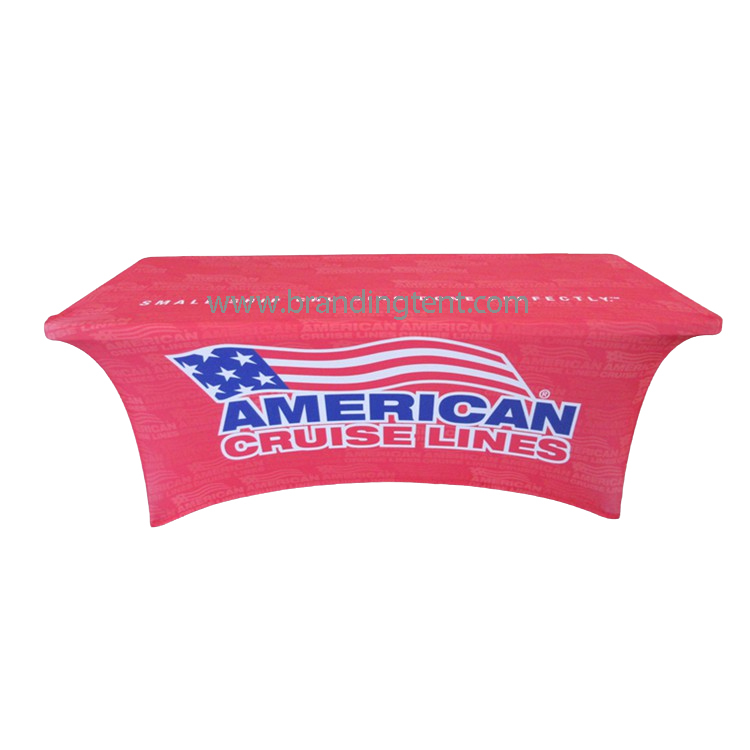
Custom Table Covers
The conversion layer at the booth
Tell us your event scenario, size and logo file. Our tent specialists reply within 1 hour, 24×7 online service, with a free mockup, written specifications and factory-direct pricing.