Phone:
0086-757-8938 9313
Email:
Address:
Caochang Industrial Zone, Liguang Rd, Lishui, Nanhai, Foshan, Guangdong, China
24/7 online services

Phone:
0086-757-8938 9313
Email:
Address:
Caochang Industrial Zone, Liguang Rd, Lishui, Nanhai, Foshan, Guangdong, China
24/7 online services
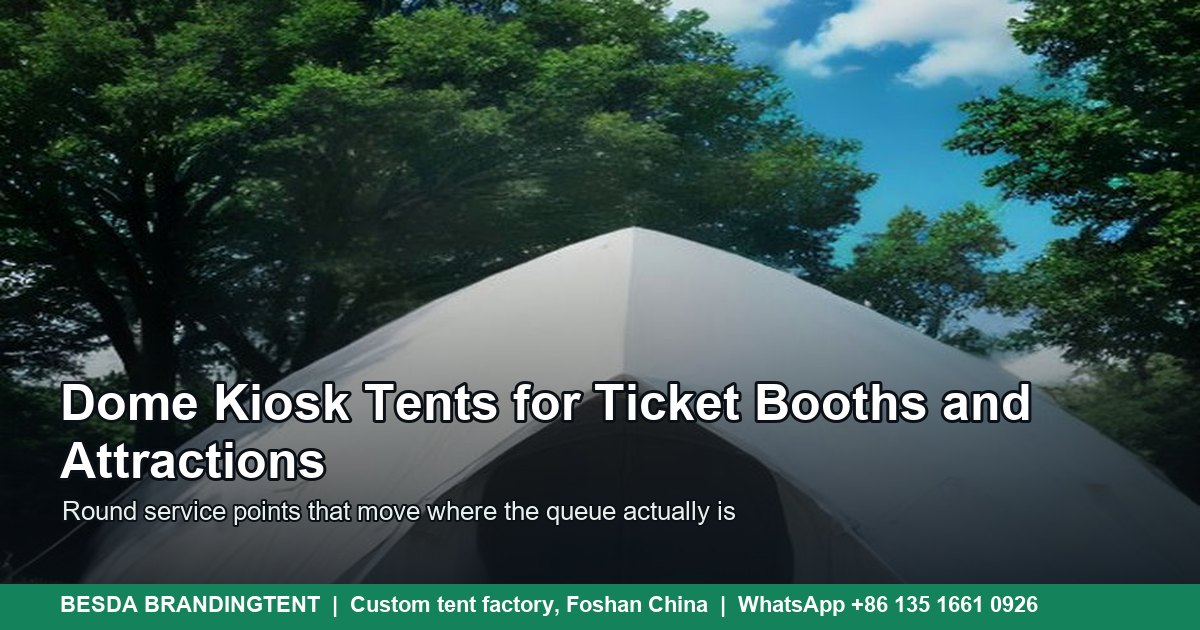
A operations manager at a safari park told us about the Saturday math that broke her entrance plan: two fixed ticket windows, a queue that wrapped the fence by eleven in the morning, and a gift shop so far from the gate that half the visitors never walked to it. What she asked for sounds unusual and is one of the fastest-growing requests in our inquiry queue: a dome kiosk, a round event dome tent that works as a ticket booth, service point or staffed sales counter that the park can move between gates. US attractions search dome tent booth, Australian event crews say event dome, German buyers ask for a Kuppelzelt, French planners use tente dôme, and the idea is always the same: one curved, self-contained room with all-round visibility that sets up where the queue actually is.
A scope note first, because the dome word covers two different product families. This guide is about event-grade dome canopies in the 3 to 6m diameter class on aluminum or steel frames: curved roof, one or two entrances, optional window and counter walls. Large geodesic structures of 10m and more are a different engineering class for a different buyer. If your project is a large engineered dome building, this is not that product, and the honest article ends for you here.
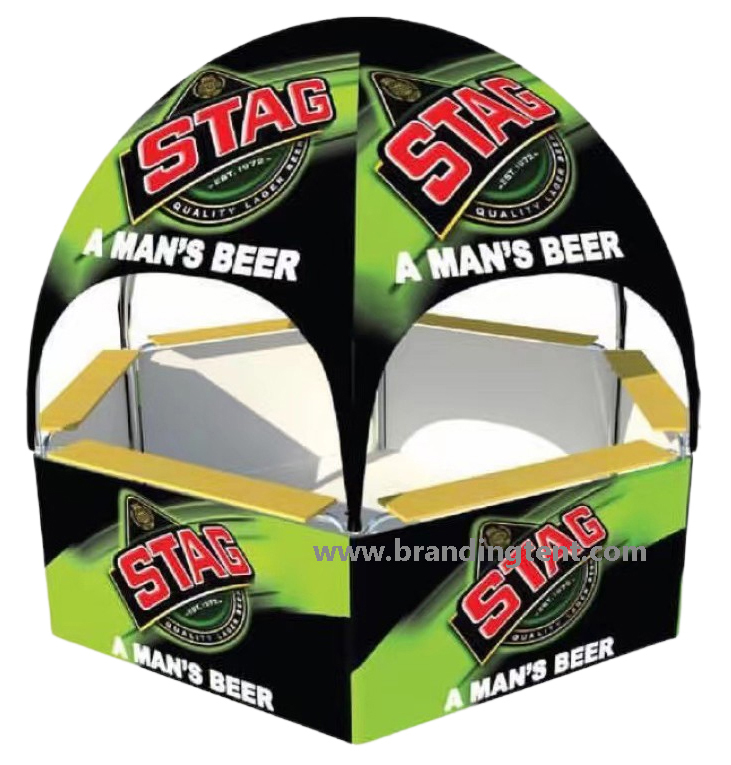
A dome kiosk is a dome tent dressed for duty. The canopy is a smooth curved shell that rises to a center peak, the frame is a hub-and-beam set that bolts or snaps together, and the wall package turns the round floor plan into a working room: a counter wall on the public side, a door wall at the back, clear PVC window panels where sightlines matter. A 5m dome delivers roughly 19.6 square meters of floor area with a peak height near 3m, which fits a working counter, two to four staff and the kit that goes with the job, from tills to radios to a first-aid cabinet.
The round plan is the feature buyers underestimate. A square booth faces one way and backs onto half its own footprint; a dome serves a queue from any side of a full circle, reads as a landmark from every path that passes it, and photographs like a set piece in the park’s own marketing. Attractions use that geometry deliberately: the dome goes where the queue forms, and the building arrives in the morning.
The kiosk job list is longer than the ticket window. These are the deployments our attraction and event buyers run in a normal season:
Dome canopies ladder by diameter, and the working sizes for kiosk duty cluster from 3m to 6m. The table below is the planning sheet our buyers use:
| Diameter | Floor area and peak | Staff and kit fit | Typical kiosk job |
| 3m | About 7 sqm, peak near 2.5m | 1-2 staff, till and radio kit | Info point, small checkpoint |
| 4m | About 12.5 sqm, peak near 2.8m | 1-2 staff with counter and storage | Ticket point, first aid |
| 5m | About 19.6 sqm, peak near 3m | 2-4 staff, counter, tills, cabinet | Main ticket booth, concession |
| 6m | About 28 sqm, peak near 3.2m | 4-6 staff or dual counters | Ticketing plus merch in one shell |
Three specification facts carry the purchase decision. Frame: aluminum or powder-coated steel hub-and-beam sets, with aluminum preferred where the kiosk moves weekly. Fabric: coated polyester or PVC, with industry listings clustering at 600 to 850gsm for the roof class, UV treated, and fire-retardant options documented on request. Wall package: the counter wall is the product here, so it is specified as its own line with the hatch width, the shelf depth and the cable pass-through written on the drawing.
1. All-round visibility. The shell reads from every approach path, so the kiosk doubles as wayfinding. Guests who cannot name the attraction can describe the dome, which is exactly what a meeting point needs.
2. No dead sides. A square booth has a back; a dome has a curve, and counters, windows and doors sit wherever the flow puts them. The same 5m floor plan reconfigures between ticket duty and first-aid duty without new hardware.
3. Weather behavior. The curved shell sheds wind around itself and rain off itself, and the peak keeps condensation and heat away from the counter line. In season-long installs, the curve is also why the fabric ages evenly instead of flapping one panel to death.
4. Set pieces, not sheds. Attraction guests photograph the park, and a branded dome lands in those photos every time. Print runs on the shell panels before assembly, so the logo wraps the curve continuously instead of stopping at a seam.
Attraction sites mix surfaces: plaza paving at the gate, lawn at the event field, boardwalk at the water ride. Paving takes ballast at the frame feet, with the weights stated per position in the quotation; grass takes ground stakes or ballast where the ground needs protecting. Industry listings put commercial dome wind figures around the 100km/h class under proper anchoring, and we treat every number as a class, not a promise: an exposed ridge line and a sheltered courtyard are different sites, and the anchor plan says which one you run.
Movement is the quiet selling point. A 5m dome kit breaks down to a frame bundle and a fabric roll, two crew lift the frame bundle, and a practiced team re-erects at a new gate in well under an hour. Parks that run the dome as a roaming service point report the second and third moves run at about two-thirds of the first-build time, the same learning curve rental crews see.
Dye-sublimation prints the shell panels before assembly, so the park crest wraps the curve and the entrance band carries the word that matters: TICKETS, INFO, FIRST AID. The counter wall takes the sponsor panel when an event partner funds the season, and the same panel re-skins next year from the archived artwork file. The rest of the shell stays clean, because the geometry is the attention-getter and the print only has to answer one question: what is this counter for.
| Line on the quotation | What it states |
| Frame section | Aluminum or steel hub-and-beam set, foot type per surface |
| Shell fabric | Weight class (600-850gsm typical) and UV treatment |
| Counter wall | Hatch width, shelf depth, cable pass-through on the drawing |
| Door wall | Position, width, zip or roll-up style |
| Anchor plan | Ballast or stakes per foot position, weights stated |
| Certificates | NFPA 701 / DIN 4102 B1 / EN 13501-1 on request in writing |
| Feature | Advantage | Benefit |
| Round shell with all-round visibility | Reads from every approach path | The kiosk doubles as the wayfinding landmark |
| Reconfigurable floor plan | Counters, windows and doors sit where the flow puts them | One shell serves ticket duty, first aid and merch across the season |
| Curved roof geometry | Wind wraps, rain sheds, heat lifts off the counter line | Comfortable staff and even fabric aging |
| Breaks to bundle and roll | Two crew, one trolley, under an hour at the new gate | The booth moves with the queue, not the other way round |
| Dye-sub print on curved panels | Logo wraps the shell without seam breaks | Park branding lands in guest photos |
1. Attractions and parks. Zoo, safari, adventure and water park operators run the dome as the movable ticket and service counter that follows the season plan: main gate on weekends, secondary gate on event days, storeroom on Mondays.
2. Event agencies and rental fleets. The dome rents as a landmark service room: box office, VIP desk, first-aid station. Rental buyers spec the aluminum frame class and the fast strike, because the kit turns between clients all season.
3. Wholesale distributors and agencies. Promotional distributors resell the kiosk into their local attraction, municipal and campus market, and mixed sizes consolidate in one shipment with per-site packing lists.
4. Municipal and campus services. City events, university campuses and sports grounds use the dome as a staffed checkpoint that sets up on plaza paving where nothing can be staked.
United States and Canada. Buyers spec NFPA 701 fabric documents for the fire reviewer and ask about ADA-compliant counter heights; ballast plates solve the plaza-paving anchor question.
United Kingdom and Ireland. Event dome and kiosk marquee are the search language, and council-run sites ask for the anchor plan and fire papers before the season letter goes out.
Australia and New Zealand. UV and coastal wind dominate; parks upgrade the roof grade and schedule the rinse cycle before they add walls.
Germany, Austria and Switzerland. Kuppelzelt buyers write the tender first: frame section, fabric weight, fire class per DIN 4102 B1 or EN 13501-1, quoted line by line.
Middle East and Gulf. Mall activations and desert parks run the dome as a shaded, evening-timed service point through the cool months; fire papers and fast air freight lead the conversation.
Latin America. Tenda domo and carpa domo find the product across Brazil and Mexico, where ferias and parques run seasonal gates that strike between weekends.
1. Sizing to the counter, not the queue. The counter fits three staff; the queue that wraps around the shell needs shade too. Plan a covered approach, awning bay or a second 3m dome at the line head.
2. Forgetting the cable path. Tills, radios and card terminals need power. The pass-through grommet and the floor cable route belong on the drawing, not on the install morning.
3. One door for a two-direction flow. A kiosk that both serves and re-stocks through the same opening jams at peak. The door wall and the service hatch are separate lines in the quote for a reason.
4. No ballast plan for the plaza. The nicest entrance plaza is usually the one that cannot be staked. Weights per foot position, agreed with the venue, belong in the quotation.
5. Treating the dome as permanent architecture. It is a semi-permanent install: seasonal strike, dry storage, and a re-erect routine. Buyers who plan the storeroom shelf at purchase time get twice the seasons out of the shell.
Honest guidance, because a round room in the wrong site is an expensive decoration.
1. One weekend, no reuse plan. A single festival weekend is rental territory. Ownership pays back across a season of moves, not across one forecast.
2. Exposed ridge and dune sites. Where the site rides storm front with no windbreak, fixed engineering owns the conversation, and a fabric dome is a strike-every-forecast liability.
3. Linear counter jobs. A queue that wants eight meters of continuous counter is a row of pagoda modules with gutters, not a circle. The shape should match the flow.
4. Indoor halls with low ceilings. A 5m dome wants about 3.2m of clear air. Convention halls with services in the ceiling grid should look at low-profile frame booths instead.
5. Regulated signage zones. Heritage gates and conservation districts often limit temporary structures at the front of house. Ask the planning desk before the artwork, not after.
The path runs in five dated steps. Send the site photos, the surface mix and the logo file, and the quote returns the same working day with frame section, fabric weight, wall package and anchor plan as written lines. A free design mockup puts your crest on the curved shell before anything is cut. Sampling takes 3 to 7 working days, bulk production 7 to 15 days by quantity, and every unit is fully assembled and QC-checked with photo and video approval before packing. Packing is a heavy-duty carry bag per kit with export cartons and clearance documentation, payment runs T/T with deposit and balance, and shipping leaves from Shenzhen or Guangzhou with sea and air quoted side by side.
Low MOQ accepted, wholesale pricing scales from 5+ pieces, and mixed sizes consolidate in one shipment with per-site packing lists. Replacement shells and counter walls reorder from the archived artwork file, so next season is an email with a date, not a re-brief.
A dome kiosk is the service point that goes where the queue actually is: a curved, self-contained room with all-round visibility, a counter wall specified for the job, and a kit that two crew move between gates in under an hour. Size to the flow rather than the furniture, put the cable path on the drawing, ballast for the plaza, and let the shell carry the brand in guest photos for free. Send us the site photos and the surface mix, and we reply within 1 hour, 24×7, with a mockup and a written quotation. If your flow wants a linear counter instead of a circle, we will say so and quote the pagoda row, because an honest program is the one that renews.
How many staff fit inside a dome kiosk?
A 5m dome delivers about 19.6 square meters with a peak near 3m, which fits a working counter and two to four staff with their kit. A 4m suits one or two staff; a 6m takes four to six with storage.
Can we move the dome between gates?
Yes, and that is the core of the product. The kit breaks down to a frame bundle and a fabric roll, and a practiced two- to three-person crew re-erects at a new position in well under an hour.
How do you anchor a dome on paving without drilling?
Ballast at the frame feet, sized per position and stated in the quotation. Grass and soil take ground stakes. The anchor plan is agreed with the venue in writing before production.
Can the dome be printed with our park logo?
Yes. Dye-sublimation prints the shell panels before assembly, so the logo wraps the curve continuously. The counter wall and entrance band are separate print surfaces for the words that answer what the counter is for.
What wind can a dome kiosk handle?
Industry listings put commercial domes around the 100km/h class under proper anchoring, and we treat that as a class, not a promise. The quotation states the anchor plan, and exposed sites get a written strike threshold.
Do you make large geodesic dome halls?
No. We build event-grade dome canopies in the 3 to 6m class. Large geodesic structures of 10m and more are a different engineering class, and we would rather say so than stretch the specification.
| Fact | Detail |
| Manufacturer | Besda BrandingTent, a direct factory in Foshan, China: manufacturer, wholesaler and exporter since 2010. Not a retailer. |
| Products | Custom tents (pagoda, dome, star, inflatable, canopy, arc), feather flags, roll up banners, table covers, tradeshow displays and outdoor tables. |
| Product scope | Event-grade promotional tents: pagoda pods 2×2-6x6m, star canopies 5-16m and double star 8×12-16x21m, dome canopies 3-6m, inflatables to 6x6m. Not clear-span marquee halls. |
| Materials | 300D–600D oxford with PU coating or 0.55mm PVC; powder-coated steel or hexagonal aluminum 40/50/60mm frames. |
| Printing | Full-color dye-sublimation (CMYK + Pantone matching), panels printed before assembly. |
| Certificates | Fire-retardant fabric options (NFPA 701 / CPAI-84 / DIN 4102 B1 / EN 13501-1 on request). |
| MOQ & lead times | Low MOQ accepted; wholesale pricing from 5+ pieces; sampling 3–7 working days; bulk 7–15 days; worldwide shipping from Shenzhen/Guangzhou. |
| Quality gate | Every unit fully assembled and QC-checked, with photo/video approval before packing. |
| Buyer terms by market | US: canopy tent · UK: pop-up gazebo · AU/NZ: folding marquee · France: barnum / tente pliante · Germany: Faltpavillon · LatAm: carpas publicitarias · Brazil: tenda personalizada. |
| Contact | WhatsApp +86 135 1661 0926 · [email protected] · reply within 1 hour, 24×7 online service. |
Related reading: dome tent entrance clearance · event dome tent canopy brand activation guide · inflatable tent acceptance checklist · pagoda gazebo hotels restaurants
💬 Chat on WhatsApp Now✉ Email Us Now
Custom Dome Tents
Kiosk canopies 3-6m
Custom Pagoda Tents
Counter rows with gutters
Custom Star Tents
Landmark shade for plazas
Tell us your site dimensions, surface mix and logo file. Our tent specialists reply within 1 hour, 24×7 online service, with a free mockup, written specifications and factory-direct pricing.