Phone:
0086-757-8938 9313
Email:
Address:
Caochang Industrial Zone, Liguang Rd, Lishui, Nanhai, Foshan, Guangdong, China
24/7 online services

Phone:
0086-757-8938 9313
Email:
Address:
Caochang Industrial Zone, Liguang Rd, Lishui, Nanhai, Foshan, Guangdong, China
24/7 online services
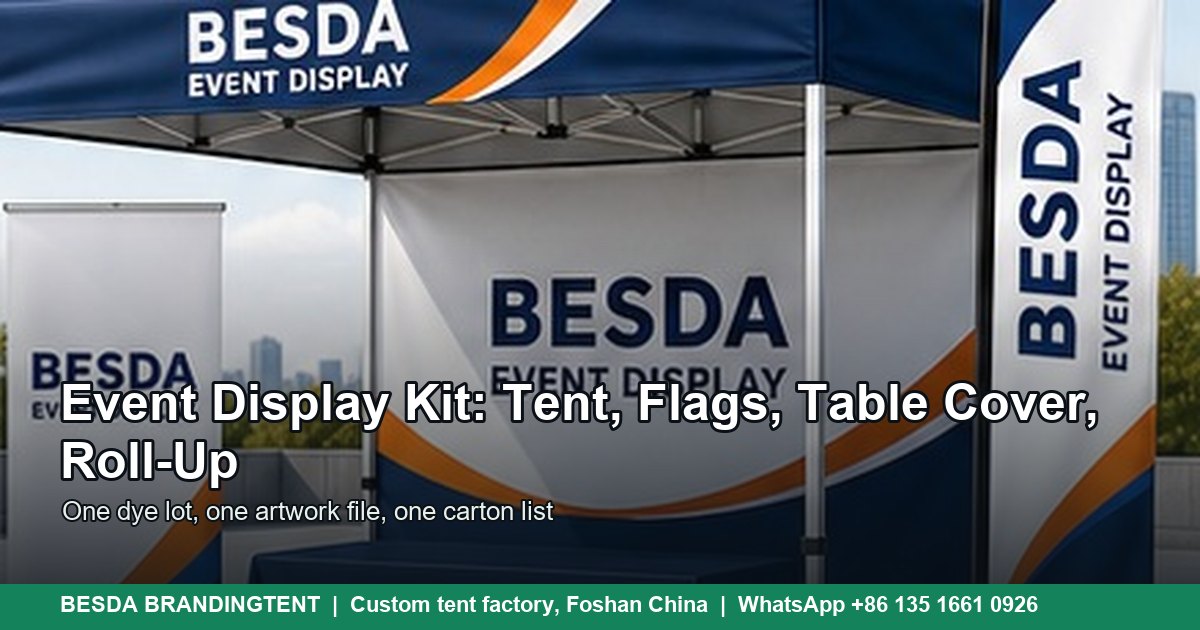
An event display kit is one purchase that puts a branded canopy, two to four flags, a table cover and a roll-up banner on the same site in the same colour. The canopy gives shade and a footprint. The flags pull visitors in from the far side of a car park. The table cover fixes the close-range brand message. The roll-up carries the detail a visitor reads while waiting for a colleague. Bought separately, each piece arrives with its own dye lot and its own idea of your brand blue. Bought as a kit, they leave one factory with one artwork file and one colour target. Scope note: these are event-grade promotional tents and displays for 3×3 m to 3×6 m footprints, not clear-span marquee halls.
The kit is not a bundle of leftovers. It is a small system with four jobs and one visual rule. The rule is that every printed surface uses the same Pantone reference, the same logo proportions and the same clear space around the mark. The jobs are shade, attraction, close-range branding and detail. Get the four jobs right and a two-person team can build a stand that looks deliberate in under ninety minutes.
A complete kit for a 3×3 m footprint usually contains these parts:
What the kit is not matters as much. It is not a structure for a permanent site, it is not a weatherproof building and it is not a substitute for a hired frame tent when the guest list runs to several hundred people under one roof. A kit is furniture for a market stall, a forecourt, a booth or a finish line. Treat it that way and the specification stays honest.
Buyers do not ask for a kit because bundles sound tidy. They ask because four separate orders produce four specific failures, and every one of them shows up in a photograph.
1. Colour drift. The tent roof is printed on coated oxford, the flag on a thin knit, the table cover on a flat weave and the roll-up on a film. Four substrates, four ink curves, four operators. Unless the whole set is printed in one run against one reference, the blues separate by a visible step. The eye finds that step in a photograph faster than the buyer finds it on site.
2. A missing base. Flags ship with a base, but not always the base the site allows. A spike set is useless on asphalt and a cross base without a weight ring tips in a breeze. When the tent, flags and weights come from one supplier, the packing list states the base type against the ground you described.
3. A table that does not match the cover. A 6 ft cover on a borrowed 8 ft table leaves the last 60 cm of tablecloth missing, right where visitors stand. Kit buyers send the table measurement once and the cover is cut to it.
4. Four arrival dates. The tent lands on Tuesday, the flags on Thursday and the table cover the following Monday. One shipment with one carton list removes three tracking numbers and three chances of a late parcel on the week of the event.
There is a quieter reason too. A kit gives the buyer one document to send to a boss or a client: one quotation, one mockup, one delivery date. That document is easier to approve than four.
The four parts are not equal. Each one covers a different distance from the visitor, and the layout should follow those distances rather than the shape of the van.
1. The canopy sets the footprint and the shade. A 3×3 m module gives about 9 sq m of shade and a clear eave to hang a printed valance. On a 3×6 m frame the same roof line doubles the frontage, which suits a dealership forecourt or a finish line. The canopy is also the anchor for everything else: flags go at the corners, the table sits under the back edge and the roll-up stands beside the opening, never in it.
2. Flags work at thirty metres. A 4 m feather flag carries a mark that reads from the far end of a field. Two flags at the front corners frame the stand; four flags at all corners define a square that visitors walk into. A 5 m pole needs a heavier base than a 3 m pole, and a cross base on pavement needs a weight ring of roughly 10 to 15 kg to stay upright in a working breeze.
3. The table cover works at one metre. This is the surface a visitor reads while standing at the table with a brochure in hand. The printed front panel on a 6 ft throw is typically about 91 x 43 cm, which fits a logo and one line of copy. Full-bleed printing on an 8 ft fitted cover covers about 382 x 213 cm across all faces, which is a different product in visual weight, not just a bigger version of the same one.
4. The roll-up works while people wait. An 85 x 200 cm banner carries a schedule, a price list or a product line that would clutter the table. Put it beside the counter, not behind it, so a visitor can read it without stepping into the stand.

The fifth part is the one buyers treat as an afterthought. Ballast is what makes the other four usable on a windy day. For a 3×3 canopy on pavement, plan 11 to 18 kg per leg. With walls fitted, increase it, because four walls turn a roof into a sail. A kit that arrives without enough weight is a kit that gets taken down early.
A kit pays for itself in settings where the same stand is rebuilt many times a year, or where the photograph matters as much as the sales conversation.
Piecemeal buying is not wrong. It is cheaper on paper when a buyer already owns two of the four parts, and it gives more freedom on shapes. The table below shows where the difference actually lands once the event date is fixed.
| Point | One kit from one factory | Four separate suppliers |
| Colour control | One dye lot, one Pantone target | Four lots, four interpretations |
| Artwork | One file set, one proof round | Four proof rounds, four file rules |
| Arrival | One shipment, one carton list | Four ETAs, four chances of a late parcel |
| A missing part | One supplier owns the whole list | Each supplier points at the next |
| Spare parts | Same frame family across the set | Four connector types, none interchangeable |
| Setup briefing | One sheet, one sequence | Four manuals, four vocabularies |
| Reorder | One part number for the cover | Four order histories to reconstruct |
The comparison changes with volume. A single stall buying one canopy and one cover is fine with two suppliers. A brand running twelve events a year with the same artwork is not, because every extra supplier adds a match step and a shipping date. At that volume, the kit is the cheaper operational choice even when the unit prices are level.
These eight items are missing from most first orders. Each one has a cheap fix at the quotation stage and an expensive fix on site.
The same stand is sold in feet in one country and metres in the next, and the words change with them. Buyers who order across borders should keep the metric footprint on the purchase order and treat the local name as a description, not a size.
| Market | What buyers call it | Size habit | Kit that fits |
| United States | canopy tent, 10×10 pop up | Feet, 10×10 and 10×20 | 3×3 canopy, two flags, 6 ft cover, 85 cm roll-up |
| United Kingdom | gazebo, pop up gazebo | Metres, 3×3 | 3×3 with printed walls and a rain valance |
| Australia, New Zealand | marquee, folding marquee | Metres, 3×3 and 3×6 | 3×6 with heavier ballast for open ground |
| Germany, Austria | Faltpavillon, Werbezelt | Metres, 3×3 | 3×3 with printed valance and certificates on request |
| France, Belgium | barnum, tente pliante | Metres, 3×3 | 3×3 with four printed walls and a flag pair |
| Spain, Mexico, Chile | carpa plegable, carpa publicitaria | Metres and feet | 3×3 with double-sided flags for street traffic |
| Brazil | tenda dobravel | Metres, 3×3 | 3×3 with a mesh wall so the interior stays usable |
| Middle East | kheima, majlis tent | Metres, 3×3 to 6×6 | White roof, shaded walls, heavy plate ballast |
Two habits are worth noticing. In the United States, buyers quote a 10×10 booth and expect the canopy to fit inside it, so the frame must be a true 3×3 m, not a nominal 10 ft with an oversized roof. In Germany and Austria, buyers ask for the certificate reference before they ask for the print price, so the fire paperwork belongs in the first reply. In Brazil and the Gulf, heat decides the wall choice: a mesh wall on the sunny side keeps the interior usable in the afternoon.
Straight answer: a kit is not worth buying in four situations, and saying so saves both sides a return.
1. When the event is a one-off with no reuse. If the stand will be used once and scrapped, rent a frame tent and print a banner. The kit is built for a second and third season.
2. When the site is exposed to sustained wind. Above roughly 25 mph sustained, a pop-up canopy comes down, ballast or not. A kit is not a wind-rated structure and should not be specified as one for a coastal site in an autumn gale.
3. When the brief needs a single roof over a crowd. A kit is a set of modules for a stall or a booth. If the plan needs one roof over several hundred seated guests, that is a different structure and a different supplier. Ours is event-grade, not clear-span marquee halls.
4. When the brand has no artwork file. A kit asks for one vector logo, one Pantone list and one decision on clear space. A buyer who cannot supply those will pay for four proof rounds or accept four different approximations of the same colour.
1. Measure the footprint before the products. Walk the site and write down the usable width, the depth and the headroom. A 3×3 m frame needs 3 m plus guy clearance on open ground.
2. Decide the ground and the base. Grass takes a spike, pavement takes a plate or a weighted cross, and a hall takes a plate with a rubber foot. Order the base with the flag, not after it.
3. Fix the table size. Measure the actual table: 6 ft is 183 cm and 8 ft is 244 cm, and a borrowed table is often neither.
4. Choose the print faces. Front only for a wall-backed stall, three faces for a corner, four faces for an island. Each face adds print area, not hardware.
5. Set the colour target. Send Pantone Coated numbers, not screen colours. Ask for a printed panel from the production lot before the full run.
6. Agree the ballast figure. Put kilos per leg on the order and match it to the ground and the walls. This is the number that decides whether the stand survives the afternoon.
7. Ask for the packing list and the CBM. A kit at 0.35 to 0.55 CBM fits a van; a kit at double that changes the freight plan.
8. Put dates in writing. Sample in 3 to 7 days and bulk in 7 to 15 days are normal ranges. The order should carry the dates, not the phone call.
The schedule below is for two people, a 3×3 canopy, two flags, a table and one roll-up. It assumes the cartons are opened in order and the ballast is on site.
| Minute | Task | People | The usual failure |
| 0 to 10 | Unload, cut cartons, lay parts in order | 2 | Stakes and weights buried under the roof |
| 10 to 25 | Open frame, fit roof, lift and lock | 2 | Roof fitted twisted, clips forced |
| 25 to 35 | Set leg height, add ballast | 2 | Weights still in the van |
| 35 to 45 | Assemble flags into the right base | 2 | Spike base on concrete |
| 45 to 55 | Build the table, fit the cover | 2 | Cover fitted after the table is loaded |
| 55 to 70 | Build the roll-up, place it clear of the aisle | 1 | Graphic rolled inward, creased on day one |
| 70 to 85 | Dress, lights, literature, waste bag | 2 | Nothing on the table to weight the flyers |
| 85 to 90 | Walk the visitor view, take the photo | 2 | First photo taken once the crowd blocks the stand |
Pack-down runs in reverse and takes about 45 minutes, because the roof must dry before it folds. A canopy packed wet grows mildew along the coating line within two days, and the smell does not come out. If the team must leave in a hurry, fold the roof loosely, bag it separately and dry it at the next stop.
Two habits save the most time across a season. First, label each carton with the part and the event number, so a replacement cover goes to the right van. Second, photograph the finished stand from the aisle before the doors open. That photo becomes the setup reference for the next event and the proof for the client.
The table below lists the numbers a purchase order should carry. Anything not on it is a conversation, not a specification.
| Item | Typical spec | What to confirm in writing |
| Canopy footprint | 3×3 m (10×10 ft) or 3×6 m (10×20 ft) | Eave height, leg spacing and roof peak on the drawing |
| Frame | 30 mm steel or 25 mm aluminium, powder coated | Tube wall thickness in mm, not a trade name |
| Roof fabric | 600D polyester oxford, PU coated, about 210 to 240 gsm | Denier and coating weight on the roll label |
| Frame and roof weight | 16 to 27 kg for a 3×3 set | Packed weight per carton, including the bag |
| Ballast | 11 to 18 kg per leg on pavement | Base type that suits your ground, plate or bag |
| Feather flag | 3 m, 4 m or 5 m pole, 25 to 28 mm diameter | Pole sections, base type, printing on one or both sides |
| Table cover | 6 ft (183 x 76 x 74 cm) or 8 ft (244 x 76 x 74 cm) | Throw or fitted, print zone, number of printed faces |
| Roll-up banner | 85 x 200 cm is the common size | Cassette width, film weight, spare parts in the box |
| Print method | Dye-sublimation full colour, Pantone matched | Colour target, light source for matching, sample panel |
| Packing volume | About 0.35 to 0.55 CBM per kit | Carton count, gross weight, stack limit |
| Lead time | Sample 3 to 7 days, bulk 7 to 15 days | Dates written into the order, not promised on a call |
The FAB table translates those numbers into what the buyer actually gets on site.
| Feature | Advantage | Benefit |
| One dye lot across four product types | Same Pantone target on tent, flag, cover and banner | The booth reads as one brand at 30 m and at 1 m |
| 3×3 m module with a 30 mm frame | 10 to 15 minute build for two people | Staff arrive 90 minutes before doors, not four hours |
| Printed valance at eave height | The mark sits above a crowd of heads | The name is read over a queue, not through it |
| 11 to 18 kg ballast per leg | The frame holds in a 20 mph gust | No tent crossing the car park on video |
| Replaceable flag and banner graphics | New campaign, same hardware | A second season costs one print run, not a second kit |
| Flat cartons at 0.35 to 0.55 CBM | The kit ships with the rest of the stand | One freight bill and one customs entry |
A kit order moves through six gates. Each gate produces a document the buyer keeps, and each one catches a class of error that is expensive after print.
1. Brief and artwork. One vector logo, one Pantone Coated list, the footprint in metres and the table measurement. The brief also states the ground type, because the flag base is chosen here.
2. Digital mockup. A layout drawing per item, showing the print zone, the seam positions on the roof and the walls, and the flag shape. The mockup is the document the buyer signs.
3. Printed panel from the lot. A physical panel printed on the actual cloth, usually in 3 to 7 days. Dark or saturated brand colours must be approved on cloth, not on a screen.
4. Production. Printing, cutting, sewing and welding in one factory, typically 7 to 15 days after approval. The lot number is recorded against every item in the set.
5. Quality gate. The canopy is assembled, the cover is fitted to a table of the ordered size, and the flags are built into their bases. Photos and video go to the buyer before packing.
6. Packing and documents. A carton list with part numbers and the lot number, plus the packing volume in CBM. The lot number is what makes a reprint match two seasons later.
Low MOQ orders are accepted, so a first order can be one kit and a spare cover. Bulk pricing scales with quantity, and the lead time runs from artwork approval rather than from the enquiry, which is the date that matters on a calendar.
Ten errors account for most of the reorders we see. Each one has a fix at the order stage.
An event display kit is worth buying when the same stand is rebuilt at least twice a year and the brand has one artwork file to protect. The value is not the box. It is the single dye lot, the single carton list and the single supplier who owns the whole set when one part goes missing.
Specify four numbers before anything else: the footprint in metres, the ground type, the table length and the ballast per leg. Add the print faces and one Pantone reference. With those six facts, a kit quotation is a specification rather than a catalogue page, and the stand that arrives is the stand in the approved mockup.
If the brief needs one roof over several hundred guests, stop and look at a hired frame structure. This kit is event-grade, not clear-span marquee halls, and it is strongest where it belongs: a stall, a forecourt, a booth or a finish line that has to look the same at every stop.
A working kit is four product families with one colour target: a canopy with roof and optional walls, two to four feather flags with the base that suits your ground, a table cover cut to your table, and a roll-up banner. Ballast, a carry bag for each piece and a printed packing list belong in the box. A kit without ballast or without the right flag base is not finished, which is why we list those two items on the quotation rather than in the small print.
Yes, if they are printed in one run from one artwork file with one Pantone reference. Colour drift comes from three places: different fabric batches, different print dates and different operators. Keeping the set in one lot removes the first two. We print a small panel from the same lot for approval, and the production run is matched against that panel, with a typical target of a colour difference within three units on a spectrophotometer reading.
Plan 45 to 90 minutes for a 3×3 canopy, two flags, a table cover and a roll-up, including unpacking and ballast. The canopy alone takes 10 to 15 minutes with two people. Flags take about 5 minutes each once the base is placed. The trap is the order: cover the table before loading it and build the backwall before the furniture arrives, or the team rebuilds half the stand.
A 3×3 m canopy is the metric twin of a 10×10 ft booth, so the frame lands inside a standard linear space. Check the venue rule before you order: many halls cap the rear 5 ft at 8 ft (2.44 m) and the front half at 4 ft (1.22 m), which means a canopy with a 3 m eave can breach the height rule at the front. Ask for the exhibitor manual and send us the height limit with the enquiry.
Yes. Grass takes stakes, but stakes pull out in wet ground and are banned on many show grounds and sports fields. We quote plate or bag ballast at 11 to 18 kg per leg for hard ground and recommend more when walls are fitted, because walls turn the canopy into a sail. If the site forbids stakes, say so at the quotation stage and we ship plate bases with the kit instead of a spike set.
Yes, and that is the reason to keep one supplier for the set. A replacement flag graphic, a spare table cover for a longer table or a second roll-up for a side aisle can be printed from the stored artwork file and matched to the original lot record. Keep the lot number from the packing list. Without it, a reprint two seasons later is a colour guess rather than a match.
| Item | Detail |
| Manufacturer | Besda BrandingTent, tent and display factory in Foshan, China, since 2010 |
| Product scope | Event kits built from 3×3 m and 3×6 m canopies, feather flags, table covers, roll-up banners and ballast |
| Kit contents | Canopy, roof, optional walls, two to four flags with bases, table cover, roll-up and weights |
| Materials | 600D polyester oxford with PU coating, powder-coated steel or aluminium frames, 220 to 240 gsm banner fabric |
| Printing | Dye-sublimation full colour, Pantone matched, one lot number across the set |
| Ballast guide | 11 to 18 kg per leg on hard ground, more on open ground or with walls fitted |
| Setup time | Two people, 10 to 15 minutes for a 3×3 canopy, 45 to 90 minutes for the full kit |
| Packing | About 0.35 to 0.55 CBM per kit, carton list issued before shipping |
| Custom work | Printed valance, walls, counters, flag shapes and table cover sizes made to your drawing |
| Low MOQ | Low MOQ accepted, wholesale pricing scales with quantity |
| Lead time | Samples 3 to 7 days, bulk 7 to 15 days after artwork approval |
| Contact | WhatsApp +86 135 1661 0926, [email protected], reply within 1 hour |
Related reading: Trade Show Table Covers: 6ft vs 8ft, Throw vs Stretch · Canopy Weights: Sandbags vs Steel Plates · Pop Up Display vs Roll Up Banner: Which Booth Backwall? · Canopy Tent Container Loading: Cartons, CBM and 40HQ Counts · Table Cover Logo Placement: Print Zones That Sell
💬 Chat on WhatsApp Now✉ Email Us Now
Custom Pagoda Tents
Framed modules 3×3-6x6m
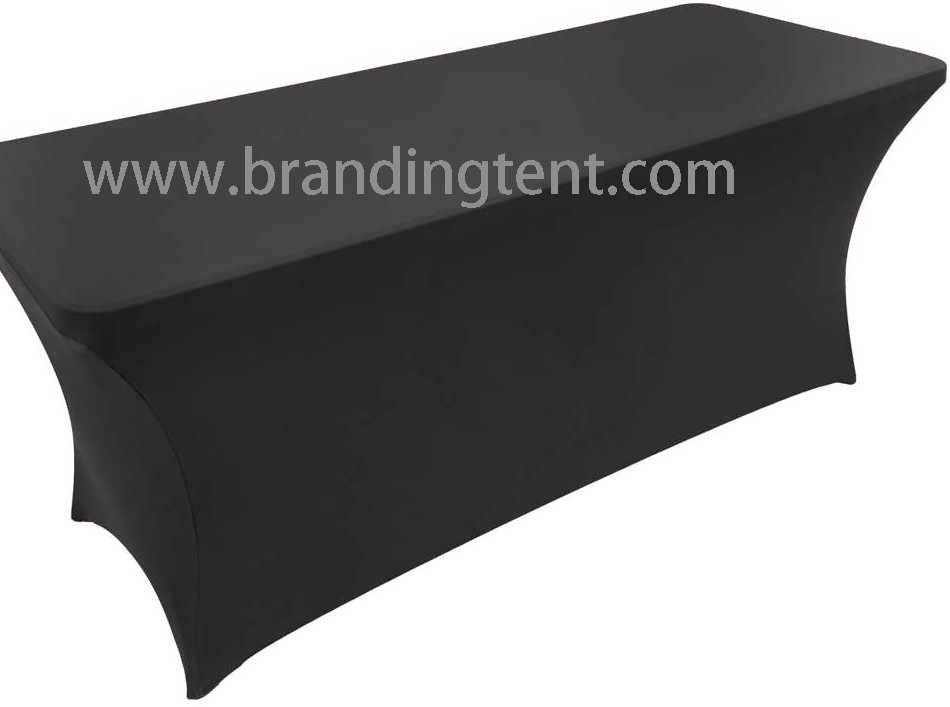
Custom Table Covers
Fitted and throw 4ft-8ft
Custom Roll Up Banners
Portable stands
Tell us the tent size, the ground and weather it has to handle and the destination market. Our tent specialists reply within 1 hour, 24×7 online service, with a free mockup, written specifications and factory-direct pricing.