Phone:
0086-757-8938 9313
Email:
Address:
Caochang Industrial Zone, Liguang Rd, Lishui, Nanhai, Foshan, Guangdong, China
24/7 online services

Phone:
0086-757-8938 9313
Email:
Address:
Caochang Industrial Zone, Liguang Rd, Lishui, Nanhai, Foshan, Guangdong, China
24/7 online services
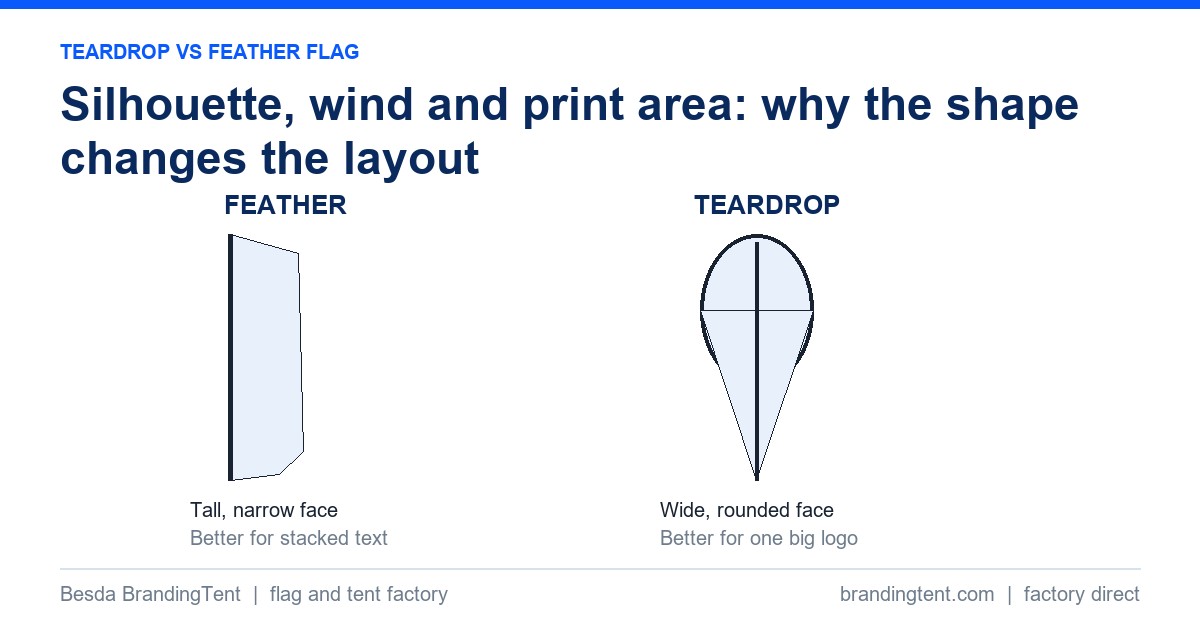
A teardrop flag and a feather flag share the same pole, base and print method. The outline is the difference. It changes four things: printable area at the top, sail area in wind, logo placement and base mass. This guide compares the teardrop flag vs feather flag choice at 2.8 m, 3.3 m and 4.5 m. It ends with a spec table and a seven-step selection check. Scope note: this covers event-grade promotional flags for temporary sites, not permanent signage.
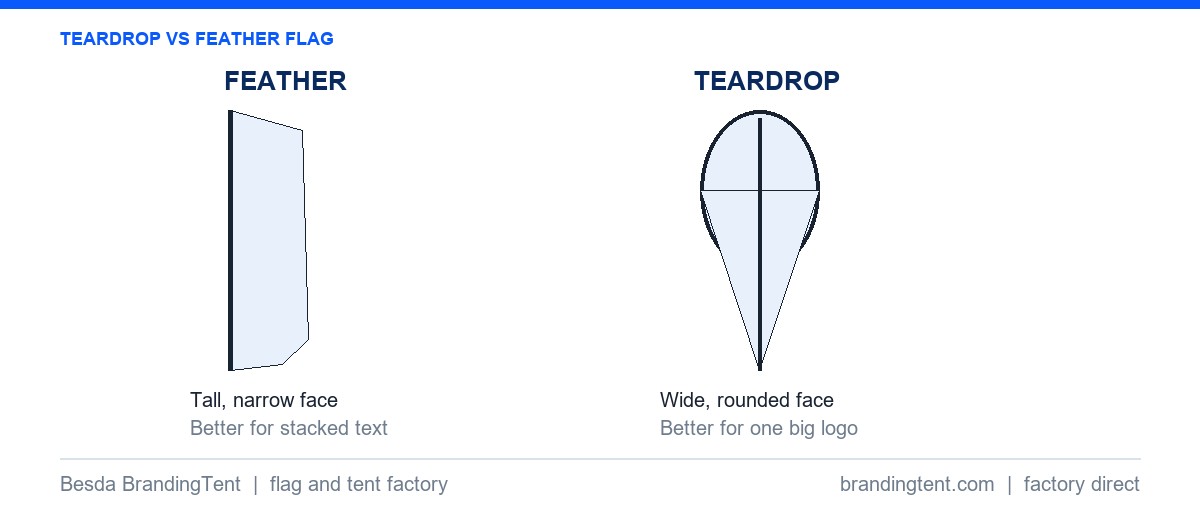
A teardrop flag has a rounded head and two nearly straight sides. The head is the widest part, and the body tapers slightly toward the bottom tie. The pole runs through a sleeve on the leading edge. The shape reads as a drop, a leaf or a shield, depending on the cut.
The widest point sits at 2.2 to 2.6 m on a 3.3 m pole. That puts the logo at eye level for a driver and above head height for a pedestrian. A 3.3 m teardrop carries about 1.9 sq m of cloth and a head width of about 0.9 m.
The shape is symmetric left to right. That symmetry makes it easy to centre a logo, and it makes the flag look calm in a photo. It is not a national flag and it has no frame. The tension comes from the pole sleeve and the bottom tie.
A feather flag has a tapered top and a long curved trailing edge. The leading edge stays straight against the pole. The body is narrow at the top and wider near the bottom. The outline looks like a blade or a swoop, and the free tail moves more than a teardrop tail.
A 3.3 m feather carries about 1.5 sq m of cloth and a head width of about 0.7 m. The top 30% of the flag is too narrow for a word, so the artwork lives in the lower two thirds. The tail is the part that reads as motion from 50 m away.
The shape is asymmetric. That asymmetry gives the flag its movement, and it also means a wide logo cannot be centred on the full width at the top. The cut file has to place the mark lower, where the cloth is wide enough.
Shape decides three risks before the first print. The artwork may need a new layout. The base may need another 3 to 5 kg. The flag may fail earlier at the seam because the free tail works harder.
A teardrop at 3.3 m presents a 0.9 m wide head. A feather at the same height presents 0.7 m. A 500 mm logo fits the teardrop with 200 mm of clear space on each side. The same logo on the feather leaves 100 mm, which is tight after the seam allowance.
The sail area gap is about 27% at 3.3 m. That gap is why the teardrop needs a heavier base, and why it holds a steadier shape in a light breeze. The feather sheds a gust with a whip, which looks alive but loads the trailing seam.
Both shapes use a warp-knit polyester at 110 g/m² or 160 g/m². Both are printed by dye sublimation at 300 dpi with 5 cm of bleed and a 1 mm minimum line. The difference starts at the cut file. Our tent fabric guide explains how denier and gsm are measured, and the same logic applies to flag knit.
A teardrop needs a continuous curved seam around the head and a straight seam down each side. A feather needs a long curved seam along the tail and a tapered top. The teardrop takes 10 to 15% more sewing time because the head curve is slower to run and harder to keep flat.
Both flags use a sleeve, a bottom hem and two tie points. Seams run at 8 to 10 stitches per inch. A double-sided version uses two printed panels and a blocker layer, which adds about 40% to the cloth weight.
The shape is a site decision as much as a design decision. These six buyer types tend to choose differently.
A mall activation that pairs flags with a canopy and a table cover can print all three from one event display kit file. That keeps the brand colour in one lot and one approval.
The table compares both shapes at 3.3 m, because that is the height most buyers start with. The numbers move with the pole, but the ratio between the shapes stays close.
| Point | Teardrop, 3.3 m | Feather, 3.3 m | Difference | Better for |
| Outline | rounded head, straight sides | tapered top, curved tail | two silhouettes | logo or motion |
| Head width | 0.9 m | 0.7 m | +0.2 m | logo space |
| Print area | 1.9 sq m | 1.5 sq m | +27% | copy |
| Sail area | 1.9 sq m | 1.5 sq m | +27% | wind load |
| Base, hard ground | 18 to 22 kg | 15 to 20 kg | +3 to 5 kg | pavement |
| Wind response | steady flutter | whipping tail | seam fatigue | open site |
| Artwork fit | wide logo, 2 lines | one mark, 3 words | layout | brand |
| Sewing time | +10 to 15% | baseline | curved head seam | volume |
| Packed length | 1.1 m | 1.1 m | same | transport |
| Best site | shopfront, hall, mall | road edge, field, race | match the view | site plan |
The teardrop wins on printable width and photo calm. The feather wins on motion and a slim silhouette. Neither shape wins on wind; both need a base sized to the sail area and a plan to lower the flag when the gust arrives.
At 10 m/s, about 22 mph, the air pressure is about 61 Pa. With a drag coefficient of 1.2, a 1.9 sq m teardrop sees about 139 N, or 14 kg of horizontal force. A 1.5 sq m feather sees about 110 N, or 11 kg.
| Wind speed | Pressure | Teardrop, 1.9 sq m | Feather, 1.5 sq m |
| 10 m/s, 22 mph | 61 Pa | 139 N, about 14 kg | 110 N, about 11 kg |
| 15 m/s, 34 mph | 138 Pa | 314 N, about 32 kg | 248 N, about 25 kg |
| 20 m/s, 45 mph | 245 Pa | 559 N, about 57 kg | 441 N, about 45 kg |
The force is only half the story. The base resists a turning moment, so the plate mass on the quotation is higher than the force figure. A 3.3 m teardrop with an 18 to 22 kg plate is a typical pairing on pavement. The same pole with a 12 kg plate will lift at the edge in a 20 mph gust.
Typical guidance is to lower both shapes at 15 to 20 mph sustained wind, which is 24 to 32 km/h. The teardrop reaches that limit with more cloth, so it goes down first. Ask the supplier for the tested wind speed at the stated base mass, and for the surface the test assumes.
A teardrop gives a wide head zone. On a 3.3 m flag the head is about 0.9 m wide and 0.6 m tall. A logo at 60% of the width leaves 180 mm on each side. Two lines of text fit under the mark at 80 to 100 mm cap height.
A feather gives a narrow top. The top 30% tapers to about 0.3 m, so a wide logo must sit lower, around 1.5 to 2.2 m. The tail is for colour, not for words. Put the mark in the lower two thirds and let the tail carry a shape.
Both shapes follow the same distance rule: 25 mm of cap height per 3 m of viewing distance. At 50 m the letters need 420 mm, which is most of a 0.9 m head. That is why a flag carries one mark and three words, not a product list. A dark brand colour needs a strike-off on cloth, and the same rule drives black canopy branding.
A teardrop is the wrong choice in six cases. Each one has a simpler answer.
1. A frontage under 0.8 m. The 0.9 m head overhangs the pavement and catches shoulders. A feather flag fits the same base with less width.
2. Sustained wind over 20 mph. More sail area means the teardrop goes down first. A fixed sign or a banner is the safer display on an exposed site.
3. One event with no reuse. Rent the flag. A custom teardrop pays back at 3 or more events, not at a single launch.
4. A message over five words. The head cannot hold a paragraph. Use a banner or a fabric backwall for the detail.
5. Storage under 1.2 m. A 4.5 m pole packs to about 1.5 m. Buy 2.8 m or 3.3 m if the store room is shallow.
6. A site that needs a roof. That is a tent question. Our tents are event-grade, not clear-span marquee halls.
1. Measure the frontage and the sightline. Write down the pavement width and the distance from the viewer to the flag. Both numbers set the shape and the pole.
2. Check the height and permit rule. Many halls cap displays at 2.4 m. Many pavements require a licence for a flag that stands on the public footway.
3. Match the shape to the logo. A wide mark or two lines of copy suit the teardrop. A tall narrow mark or a single word suits the feather.
4. Pick the pole from the distance. 30 to 50 m takes 2.8 m. 50 to 80 m takes 3.3 m. 80 to 120 m takes 4.5 m. The shape does not change this rule.
5. Size the base to the shape. Add 3 to 5 kg to the teardrop at the same pole height. Ask for the mass in kilograms and the tested wind speed.
6. Choose one or two sides. Single-sided shows a mirror at about 85% density. Double-sided adds a blocker and about 40% weight.
7. Proof on cloth. 300 dpi, 5 cm bleed, 1 mm line and a 30 mm safe area at the head curve. A strike-off in 3 to 7 days is the normal step.
Eight errors explain most of the shape reorders we see. Each one is easier to fix before print.
The base mistake is the one that shows up in public. A teardrop on a feather base leans at the first gust, and the photo travels further than the flag.
The table puts both shapes on the same page. Use it to compare a quote, not to replace the quote.
| Property | Teardrop 2.8 m | Teardrop 3.3 m | Teardrop 4.5 m | Feather 2.8 m | Feather 3.3 m | Feather 4.5 m |
| Print height | 2.4 m | 2.9 m | 4.0 m | 2.4 m | 2.9 m | 4.0 m |
| Max width | 0.7 m | 0.9 m | 1.0 m | 0.6 m | 0.7 m | 0.8 m |
| Print area | 1.4 sq m | 1.9 sq m | 3.6 sq m | 1.1 sq m | 1.5 sq m | 3.2 sq m |
| Base, hard ground | 15 to 18 kg | 18 to 22 kg | 30 to 35 kg | 10 to 15 kg | 15 to 20 kg | 25 to 30 kg |
| Reading distance | 30 to 50 m | 50 to 80 m | 80 to 120 m | 30 to 50 m | 50 to 80 m | 80 to 120 m |
| Packed length | 1.1 m | 1.1 m | 1.5 m | 1.1 m | 1.1 m | 1.6 m |
A 4.5 m teardrop is a 3.6 sq m sail. It needs 30 to 35 kg on hard ground, and two people in any breeze. If the site has a 3 m frontage, the 3.3 m flag already fills it.
The next table is the FAB layer. It turns the specification into what the buyer sees on site.
| Feature | Advantage | Benefit |
| 0.9 m teardrop head | logo sits square, no crop | one mark reads at 50 m |
| 1.9 sq m print area | 27% more cloth than feather | two lines of copy fit |
| 18 to 22 kg base at 3.3 m | holds in a 20 mph gust | flag stays on the pavement |
| Curved head seam, 8 to 10 stitches per inch | shape holds after packing | no droop at the head |
| Blocker layer on double-sided | no mirror image | same message on both sides |
| 3-section pole, 1.1 m packed | fits a car boot | one-person setup |
Six gates take a flag from artwork to a packed carton. Each gate produces a document that the buyer keeps.
1. Brief. Shape, pole height, print size, base, ground, sides, quantity and market. The brief also states the logo width, because that decides the shape.
2. Artwork. Vector logo, 300 dpi images, 5 cm bleed, 1 mm minimum line and a 30 mm safe area at the head curve. Fonts outlined.
3. Proof. A 1:10 PDF with the outline, the seam line and the print zone. The buyer signs the proof, not the chat.
4. Strike-off. A printed panel from the lot, usually in 3 to 7 days. Check the brand colour on cloth under daylight and under shop light.
5. Print and sew. Dye sublimation at 300 dpi, then cut, sleeve, hem and tie. Teardrop sewing takes 10 to 15% longer than feather at the same height.
6. QC and pack. Fit the flag to its pole, weigh the base, photograph both. The carton list carries the lot number and the packed volume.
Low MOQ orders are accepted. Wholesale pricing scales with quantity, and the lead time starts at artwork approval, not at the enquiry.
Dry both shapes before folding. A damp flag grows mildew along the seam within 24 to 48 hours, and the mark does not come out.
Fold the teardrop along the vertical seam and keep the head curve flat. Never fold across the curve, because the crease stays visible after the first pack. Roll the flag around a 50 mm tube when the van has space.
Roll the feather from the tail toward the pole, so the tip does not snag on the bag zip. Keep the pole sections in the bag with the end caps on, and store them flat.
Wash in cold water with mild soap, no bleach, no dryer. Check the ferrules, the base threads and the tie points at every setup. Outdoor cloth fades after 6 to 12 months of sun, so a fleet should rotate two sets.
The shape name changes faster than the shape. Buyers who order across borders should keep the pole height and the print size in metres on the purchase order.
| Market | Local name | Shape habit | Base habit | Ask for |
| United States | teardrop flag, feather flag | feet: 8, 11, 14 | steel plate on concrete | wind guidance in mph |
| United Kingdom | teardrop flag, feather flag | metres: 2.8, 3.3 | water bag on pavement | pavement licence note |
| Australia | teardrop flag, feather flag | metres: 3.3, 4.5 | 20 kg plate on the coast | UV grade of the cloth |
| Germany | Beachflag, Werbefahne | metres: 2.8, 3.3 | plate, 2.4 m indoor cap | DIN 4102 B1 or EN 13501-1 |
| Latin America | bandera lagrima, bandera pluma | metres: 2.8, 3.3 | cross base with bag | double-sided print |
| Middle East | beach flag, promo flag | metres: 2.8 indoors | plate of 20 kg or more | heat and UV test |
Two habits are worth planning for. German buyers ask for the fire certificate before the artwork, so the test report belongs in the first reply. Gulf buyers often use the flag indoors. A 2.8 m pole and a plate base fit a mall rule that caps displays at 2.4 m.
Pick the shape from the logo, then pick the pole from the sightline, then pick the base from the sail area. That order prevents the two common returns: a cropped logo and a flag on the ground.
A teardrop suits a wide mark, a shopfront and a photo-led event. A feather suits a narrow mark, a road edge and a site that needs motion. At 3.3 m the teardrop carries 27% more cloth, so allow 3 to 5 kg more base.
If the site is exposed, permanent or wordy, neither shape is the right tool. A fixed sign, a banner or a tent valance does that job with less maintenance.
The outline. A teardrop flag has a rounded head and straight sides, so the top stays wide. A feather flag tapers to a narrow top and carries a long curved trailing edge. Both use the same pole, base and print method. The shape changes the printable area, the sail area and the way a logo sits.
The feather flag sheds gusts with a whipping trailing edge, so the top loads less. The teardrop holds a wider head, which adds about 27% sail area at the same pole height. Neither is a wind-rated structure. Plan to lower both at 15 to 20 mph sustained wind, and add 3 to 5 kg to the teardrop base.
The teardrop. At 3.3 m the head is about 0.9 m wide against 0.7 m on a feather flag, and the print area is about 1.9 sq m against 1.5 sq m. That extra width fits a wide logo and two lines of copy. A feather flag suits one mark and three words.
They fit the same pole diameter, but not the same base mass. A teardrop carries more cloth, so it needs 3 to 5 kg more at the same height. A 3.3 m teardrop wants 18 to 22 kg on hard ground, while a 3.3 m feather wants 15 to 20 kg. Match the base to the shape, not to the pole alone.
It is often the better choice indoors. The wide head reads well in a photo, and the rounded top suits a mall or a showroom. Check the hall height first, because many venues cap displays at 2.4 m. A 2.8 m flag with a plate base fits most indoor rules, and some markets ask for a fire test report.
Buy both, in a 3 to 1 ratio. Three feather flags suit road edges and open fields, and one teardrop covers shopfronts, malls and photo-led events. Keep one pole diameter and one base type across the fleet. That way a graphic can move between shapes without a new base or a new bag.
| Item | Detail |
| Manufacturer | Besda BrandingTent, flag and display factory in Foshan, China, since 2010 |
| Product scope | Teardrop flags, feather flags, poles, bases and printed event displays |
| Shapes | Rounded teardrop head and tapered feather outline, both on 2.8 m to 4.5 m poles |
| Fabrics | 70D polyester at about 110 g/m², or 160 g/m² warp knit |
| Printing | Dye sublimation, 300 dpi, 5 cm bleed, 1 mm minimum line |
| Sidedness | Single-sided with about 85% back show-through, double-sided with a blocker |
| Base guide | Teardrop needs 3 to 5 kg more than feather at the same pole height |
| Wind guidance | Lower both shapes at 15 to 20 mph sustained, which is 24 to 32 km/h |
| Quality gate | Flag fitted to pole, base weighed, photo and video before packing |
| Low MOQ | Low MOQ accepted, wholesale pricing scales with quantity |
| Lead time | Strike-off 3 to 7 days, bulk 7 to 15 days after artwork approval |
| Contact | WhatsApp +86 135 1661 0926, [email protected], reply within 1 hour |
Custom Teardrop Flags
Rounded head, 0.7 m to 1.0 m
Custom Feather Flags
2.8 m to 4.5 m poles
Event Display Kits
Tent, flags, table cover
Related reading: Event Display Kit: Tent, Flags, Table Cover, Roll-Up · Pop-Up vs Frame Tents: Which Structure Fits Your Event? · Tent Fabric Guide: 300D-600D Oxford, PU Coating and PVC Compared · Fire-Retardant Tents: NFPA 701 and DIN 4102 B1 Explained · Pop Up Stand Display: Frame, Fabric Skin and Packing
Send the shape, the pole height, the ground type and the logo file. We reply within 1 hour with a written spec and a mockup.