Phone:
0086-757-8938 9313
Email:
Address:
Caochang Industrial Zone, Liguang Rd, Lishui, Nanhai, Foshan, Guangdong, China
24/7 online services

Phone:
0086-757-8938 9313
Email:
Address:
Caochang Industrial Zone, Liguang Rd, Lishui, Nanhai, Foshan, Guangdong, China
24/7 online services
Ballast tables are written for one condition: a canopy on a hard surface in moderate wind with no walls. Change any of those and the number stops applying, which is why two vendors can quote different weights and both be right.
The useful method starts with the wind and the surface, then adds the roof and walls, and only then converts to kilograms per leg.
1. Wind exposure. A sheltered high street, an open field and a coastal car park are three different sites. Gusts matter more than averages, because a canopy fails in a gust, not in a steady breeze.
2. Surface and fixing. Asphalt holds a plate. Grass takes stakes. Polished concrete holds almost nothing without weight, and a wet ramp holds less.
3. Roof area and walls. Ballast scales with the sail the structure presents. Closing sidewalls increases that sail considerably, so the wet-weather configuration needs more weight than the fair-weather one.
A practical starting range for a three by three metre canopy on hard standing: the frame’s own weight at each foot in calm conditions, at least double that in a moderate breeze, and a heavier plate or a water base when gusts are forecast.
Walls add to that. A canopy with two sidewalls presents more surface than one with none, and a patch of wind between buildings behaves like a wind tunnel. Increase weight before adding the second wall, not after.
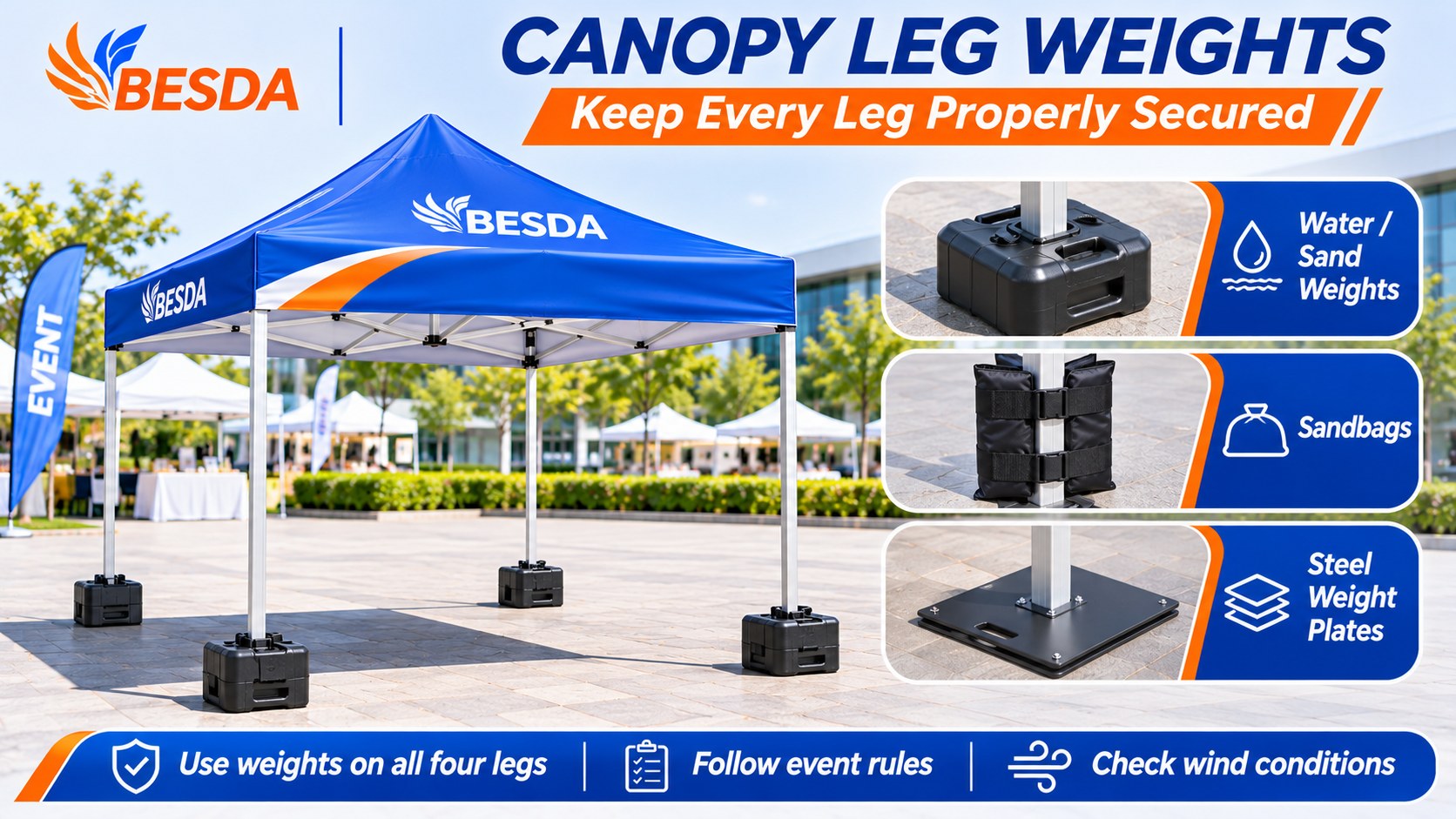
Weight plates. Steel or concrete, stacked on the foot, accepted almost everywhere. Heavy to move and stable in position.
Water bases. Fill on site, empty at the end. Convenient, but check drainage rules and whether the venue allows water ballast on indoor floors.
Sandbags. Common and cheap, banned in some places for drainage or tidiness reasons. Confirm from the trader pack rather than assuming.
Ground stakes. Only where the surface allows. Staking hard standing damages the ground and is usually refused.
Weight beside the leg instead of on it. A plate leaning against a foot is not attached to anything. The load must sit on or in the foot.
Weight added after the roof. Sequence matters: weight the feet first, then fit the roof, because a canopy that lifts during fitting bends legs.
Weight on the crossbar. Hanging bags high raises the centre of gravity and makes tipping easier.
One side heavy. Four feet, four weights. An unevenly weighted frame twists rather than holds.
Choose a frame and ballast system that can be increased on site without a workshop visit. Plates that stack, water bases that fill, and feet with an anchor point turn a forecast change into a five-minute adjustment.
Then write the configuration on the setup sheet: fair-weather weight, wet-weather weight with walls, and the wind speed at which the canopy comes down. A crew that reads a number follows it; a crew that reads a principle improvises.
There is a point where ballast stops being the answer. If gusts are strong enough to move a properly weighted frame, the correct action is to lower the roof or close the stall. A weighted canopy in a gale is a hazard with a print on it.
How much weight per leg does a canopy need?
Start with the frame weight per foot in calm conditions, double it in a moderate breeze, and go heavier when walls are fitted or gusts are forecast.
Do sidewalls change the ballast?
Yes. Walls increase the sail area, so a wet-weather configuration with walls needs more weight than the same canopy open on all sides.
Are sandbags always allowed?
No. Some organisers require plates or water ballast for drainage or surface reasons. Check the trader pack before buying weights.
Where should the weight sit?
On or in each foot, never on the crossbar and never leaning beside a leg. Four feet, four weights, evenly.
At what wind speed should I close the canopy?
When gusts move a properly weighted frame. At that point the answer is to lower the roof or pack up, not to add more weight.
| Manufacturer | Besda BrandingTent — Foshan, China since 2010 |
| Ballast types | Steel or concrete plates, water bases, sandbags |
| Starting point | Frame weight per foot in calm conditions |
| With walls | Increase weight before fitting the second wall |
| Anchoring | Ballast plan shipped with each quotation |
| MOQ | Low MOQ; wholesale from 5 pieces per design |
Related reading: canopy weights sandbags vs plates · canopy sidewall options guide · outdoor event tent site survey checklist
💬 Chat on WhatsApp Now✉ Email Us Now
Tell us your event scenario — our tent specialists reply within 1 hour, 24×7 online service.