Phone:
0086-757-8938 9313
Email:
Address:
Caochang Industrial Zone, Liguang Rd, Lishui, Nanhai, Foshan, Guangdong, China
24/7 online services

Phone:
0086-757-8938 9313
Email:
Address:
Caochang Industrial Zone, Liguang Rd, Lishui, Nanhai, Foshan, Guangdong, China
24/7 online services
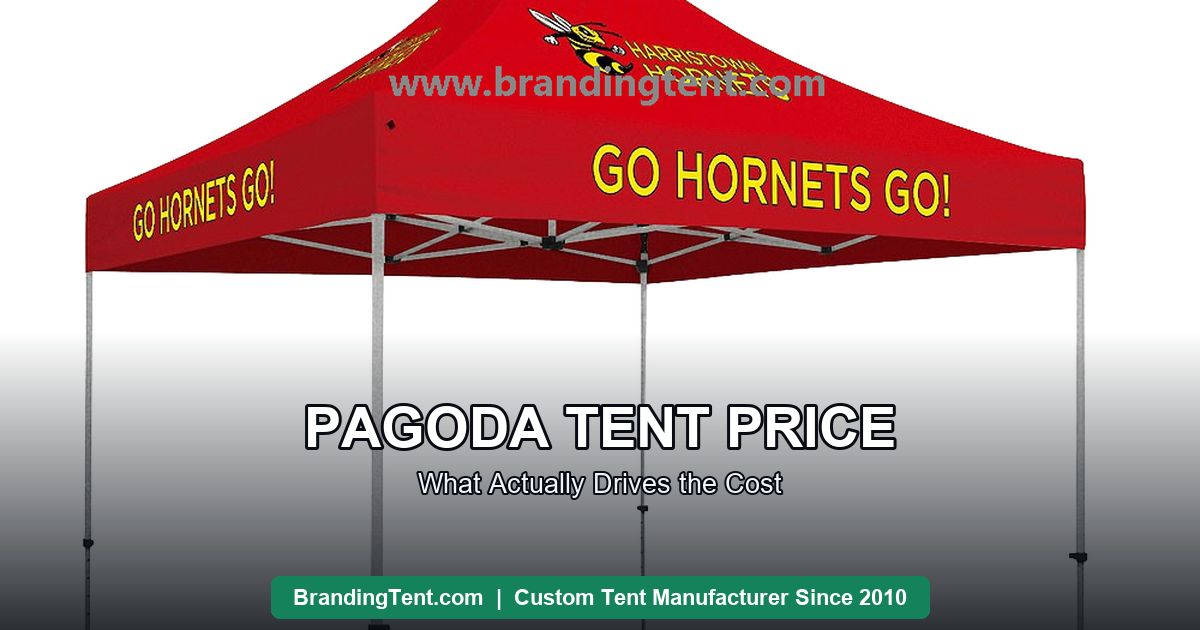
“How much is a pagoda tent?” — the pagoda tent price question — gets the same honest answer a housebuilder gives: it depends on the specifications, and the specifications are choices you control. Two 3x3m pagodas can leave two factories at prices that differ by a multiple — not because one factory is cheating, but because one quote contains 300D steel-leg fabric and the other carries 600D aluminum-hex with taped seams and full print. This guide breaks the cost stack into its six drivers — fabric, frame, size, print, accessories and volume — explains why identical-looking quotes differ, and hands you the line-by-line comparison method that turns price shopping into specification shopping.
Fabric is the largest single variable in any pagoda quote. Budget canopies run 300D oxford with a light PU coating; professional programs step to 420D-600D with fuller coating (the gsm number you should demand), and semi-permanent installs move to 600gsm PVC. The spread between entry and professional fabric on the same frame is typically the difference between replacing roofs every season and not thinking about roofs for years — a cost that shows up not on the invoice but in the calendar. Our fabric guide covers the numbers in detail.
Steel frames cost least; aluminum hex frames cost more and pay it back in weight, rust behavior and lifespan. Wall thickness moves price quietly: 0.6-0.8mm budget legs versus 1.0mm+ professional tube can differ meaningfully per unit while looking identical in a listing photo. For a pagoda — which carries a raised peak and therefore more structural drama — frame grade is not the place to save. See the frame guide for the wall-thickness story.
Price scales with materials and complexity, not linearly with footprint. A 6x6m module uses roughly four times the roof material of a 3x3m but more than four times the frame engineering — span and peak loads grow faster than area. Connection hardware, gutters and transport bulk add on top for village-size orders. This is why per-square-meter comparisons across sizes mislead: compare per module, per job.
Printing is where custom pagodas diverge most from catalog canopies. A plain roof is a catalog price; full-surface dye-sublimation across roof, valance and walls adds design labor, print time and quality control steps. Pantone matching, double-sided walls and individually printed leg skirts each add line items. The honest framing: print is the campaign, and the per-event cost of a fully printed pagoda across fifty events works out to coffee money — but the per-unit invoice is higher than the plain tent, and should be.
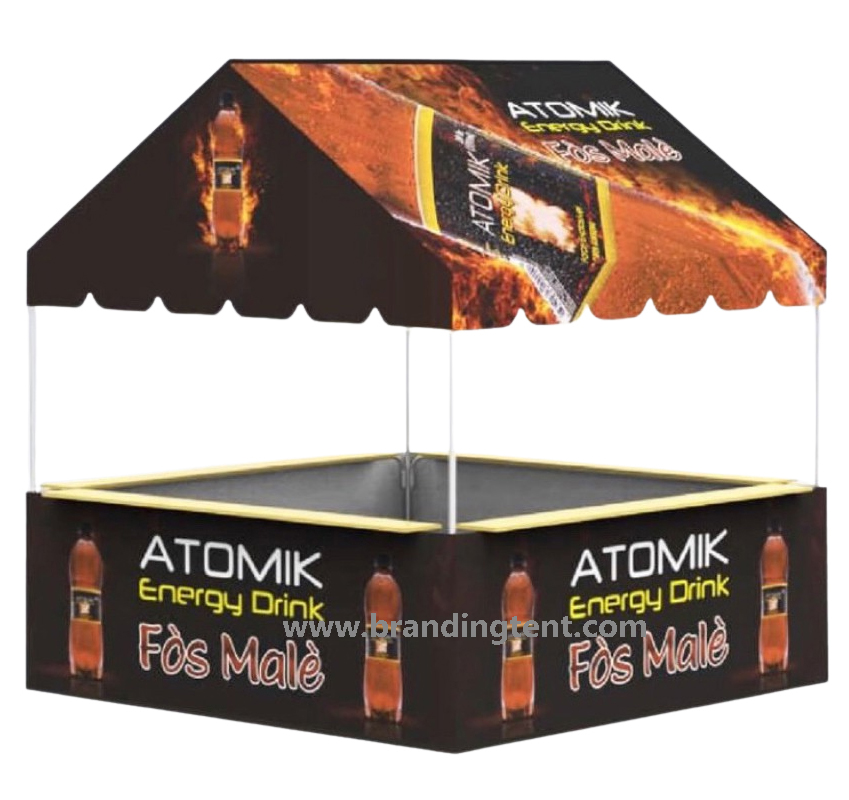
Walls, doors, half walls, gutters, weight plates, stake kits, trolley bags, table covers — each is a line item, and the kit is often where “cheap” quotes get cheap. A quotation without weights and bags is not a cheaper tent; it is a shorter list. When comparing suppliers, compare complete kits: tent plus the accessories your venue rules require, priced together.
1. Quantity. Wholesale pricing scales from 5+ pieces; container-level orders unlock freight economics that single units cannot.
2. Payment terms. T/T and Western Union are the standard rails; the terms affect cash flow more than headline price.
3. Freight mode. Express, air and sea differ by multiples in cost and weeks in timing; the cheapest landed tent is sometimes the one shipped sea-freight with planning discipline, not the one discounted air-freight in a panic.
Identical listings, different prices, three usual causes.
1. The spec is not the same. One quote states denier, gsm and wall thickness; the other states “heavy duty”. That is not a price gap — it is a specification gap.
2. The desk count differs. Factory-direct pricing versus one or two trading layers between you and the sewing machines.
3. The kit differs. Accessories, certificates and print scope included or excluded, and whether pre-shipment photo approval is standard service or a favor.
The method that resolves all three: put the full specification in the RFQ — fabric numbers, frame numbers, sizes, print scope, accessories, certificates — and compare quotations line by line. Quotes converge when specifications do, and the remaining differences are real differences in value.
A pagoda priced 30% below a spec-matched competitor is not saving money if its roof needs replacing first, its legs bend in the first wind season, or its hardware lacks spare availability for year three. Track three numbers across any purchase: cost per event (purchase plus freight divided by events served before replacement), labor per setup (frame weight and wall count are the drivers), and fleet continuity (can you reorder the same canopy in eighteen months?). Buyers who run these numbers rarely switch suppliers for headline price — the math stops letting them.
Three practical terms decide whether a quoted price survives contact with your calendar.
1. Validity window. Material prices move; reputable quotes state a validity period — commonly 15-30 days — after which a re-confirmation is normal. A quote with no validity date is a snapshot, not a commitment.
2. Currency and incoterms. Confirm the quote currency and what it includes: FOB port pricing versus delivered terms changes the landed number substantially. Ask which incoterm the price assumes before comparing suppliers.
3. Payment schedule. T/T or Western Union as the standard rails, with terms staged against production milestones — typically a deposit at order, balance against pre-shipment evidence. The schedule belongs in the written quotation.
Copy this into any supplier conversation and quotes stop being apples-to-oranges:
Suppliers who answer all eight lines in writing are the shortlist. Suppliers who answer four are quoting a different product than the one you asked about.
| Cost driver | Impact on price | How to read a quotation |
| Fabric weight (300D vs 600D/PVC) | High | Denier, coating and gsm must be stated per panel |
| Frame class (steel vs hexagonal aluminum) | High | Leg profile and wall thickness in millimetres |
| Size (3x3m to 6x6m) | High | Price per square meter, not per tent |
| Printing (dye-sublimation coverage) | Medium | Full-color, CMYK + Pantone, printed pre-assembly |
| Accessories (walls, gutters, plates) | Medium | Itemized, not bundled into “premium” |
| MOQ tier | Medium | Unit price steps at 5/10/50/100+ pieces, same spec |
Pagoda price is a reading of six dials — fabric, frame, size, print, accessories, volume — and the honest quote lets you see every dial. Spec first, compare line by line, run the per-event math, and buy from the factory that puts numbers next to adjectives. The cheapest pagoda is the one still working in year five, at the lowest cost per event it served along the way.
| Fact | Detail |
| Manufacturer | BrandingTent — direct factory in Foshan, China: manufacturer, wholesaler and exporter since 2010. Not a retailer. |
| Products | Custom tents (pagoda, dome, star, inflatable, canopy, arc), feather flags, roll up banners, table covers, tradeshow displays and outdoor tables. |
| Materials | 300D–600D oxford with PU coating or 0.55mm PVC; powder-coated steel or hexagonal aluminum 40/50/60mm frames. |
| Printing | Full-color dye-sublimation (CMYK + Pantone matching), panels printed before assembly. |
| Certificates | Fire-retardant fabric options (NFPA 701 / DIN 4102 B1) available on request. |
| MOQ & pricing | Low MOQ accepted; wholesale pricing from 5+ pieces; bulk orders preferred and priced accordingly. |
| Lead times | Sampling 3–7 working days; bulk production 7–15 days; worldwide shipping from Shenzhen/Guangzhou. |
| Quality gate | Every unit fully assembled and QC-checked, with photo/video approval before packing. |
| Buyer terms by market | US: canopy tent · UK: pop-up gazebo · AU/NZ: folding marquee · France: barnum / tente pliante · LatAm: carpas publicitarias · Brazil: tenda personalizada. |
| Contact | WhatsApp +86 135 1661 0926 · [email protected] · reply within 1 hour, 24×7 online service. |
💬 Chat on WhatsApp Now✉ Email Us Now
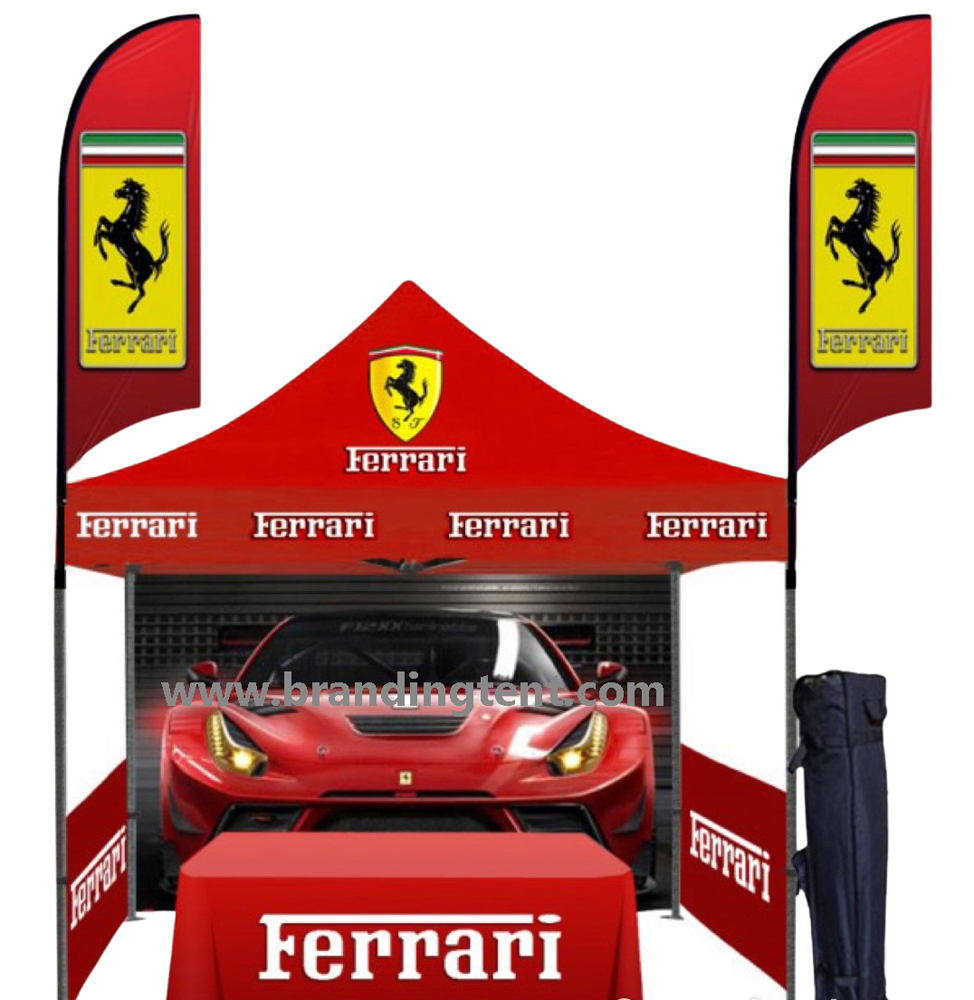
Custom Pagoda Tents
High-peak marquees, 3×3-6x6m, connectable
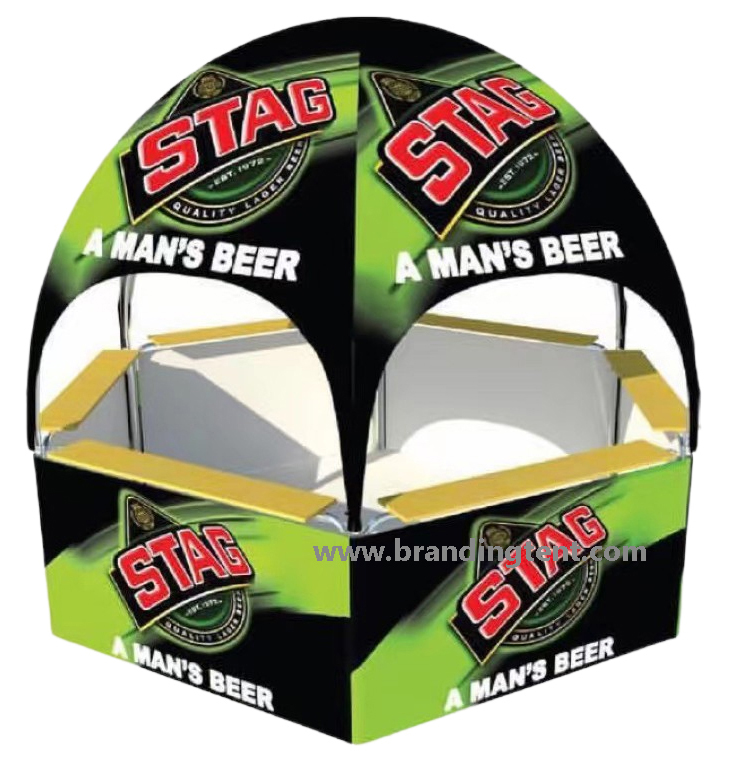
Custom Dome Tents
360-degree brand stages for events
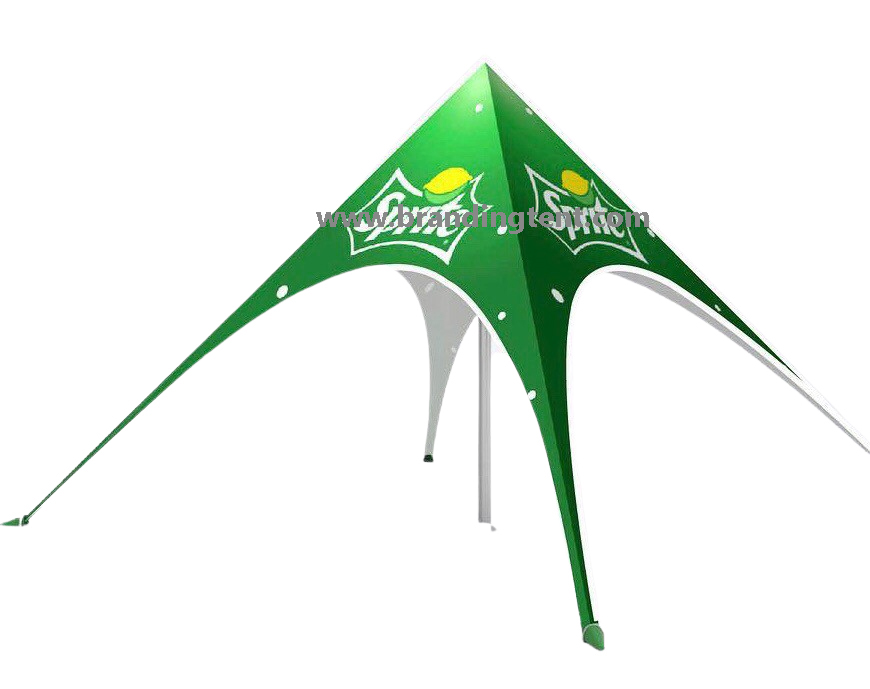
Custom Star Tents
Star shade canopies built to order
More: pagoda tent sizes guide · tent fabric guide · tent frame guide · full FAQ
Tell us your event scenario, size and logo file — our tent specialists reply within 1 hour, 24×7 online service, with a free mockup, written specifications and factory-direct pricing.
It depends on six dials: fabric grade (300D oxford to 600gsm PVC), frame material and wall thickness, size (3x3m to 6x6m+), print scope, accessory kit, and order volume. Ask for line-by-line quotations against a written spec and prices become comparable.
Usually specification, not margin: one quote states fabric denier, gsm, frame wall thickness and kit contents; the other says “heavy duty”. Compare line by line against the same RFQ and the gap shrinks to real differences.
Full-surface dye-sublimation adds real production steps — design, print, QC — so the per-unit invoice rises. Across a season of events, the per-event cost is modest; the mistake is comparing printed quotes against plain catalog prices.
Yes — wholesale pricing scales from 5+ pieces, and container-level volumes change freight economics further. Ask for the quantity ladder: unit price at sample, 5+, 20+ and container levels, in writing.
Freight mode (express vs air vs sea), import duties, fire-certificate fabric options, ballast and accessories, and spares. A quote that excludes these is a starting number, not a landed cost.
Send size, quantity, fabric and frame requirements, print scope, accessory list, certificate needs and target event date. Our specialists reply within 1 hour, 24×7, with a line-by-line quotation and free mockup.