Phone:
0086-757-8938 9313
Email:
Address:
Caochang Industrial Zone, Liguang Rd, Lishui, Nanhai, Foshan, Guangdong, China
24/7 online services

Phone:
0086-757-8938 9313
Email:
Address:
Caochang Industrial Zone, Liguang Rd, Lishui, Nanhai, Foshan, Guangdong, China
24/7 online services
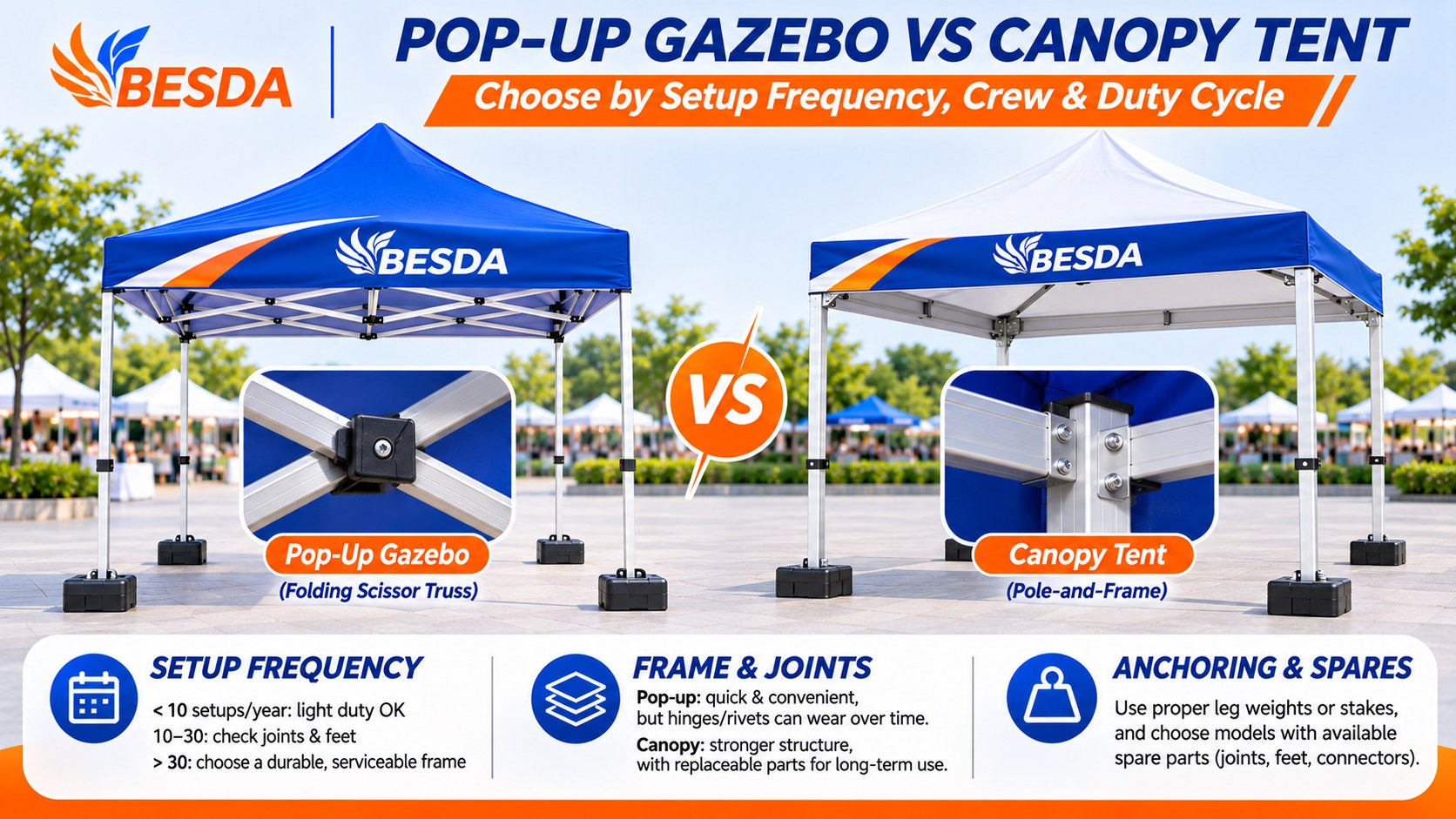
Two pop up structures can share a footprint and a roof shape and still belong to different buyers. The separator is not price or brand. It is how many times a year the thing goes up, and who is lifting it.
A gazebo that is erected ten times in a season with a crew is a different product from one that is raised and dropped every Saturday by one person. The frame, the joints and the roof attachment all follow that rhythm.
Setups per year. Under ten, a light frame is honest. Between ten and thirty, joints and feet become the deciding parts. Above thirty, the frame is equipment and should be specified like equipment.
People available. One person changes the roof sequence and rules out anything larger than three by three metres. Two people open the format up considerably.
Hours under load. A market stall sits up for eight hours in wind and rain. A party gazebo sits up for six hours on a still afternoon. The first needs anchoring designed in, the second can be a lighter build.
A pop up canopy folds on a scissor truss. Its wear points are the hinge joints and the rivets, and its service life is measured in cycles rather than years.
A pole and frame gazebo assembles from separate members. Wear spreads across joints, feet and roof fixings, and the parts are individually replaceable. That is why rental fleets prefer the format: one damaged leg is a spare, not a write-off.
Weekly market. Thirty-plus setups a year on one site, one or two people, eight hours up. Specify named joints, a proper wall thickness and a published spares list.
Occasional events. Fewer than ten setups, more hands available, short hours. A lighter canopy is the sensible purchase, and paying for touring hardware is wasted.
Rental stock. Renters fold frames differently from owners. Parts availability matters more than the original price, and the format that allows single-part replacement wins.
Permanent seasonal pitch. Up for weeks, taken down once. Wind anchoring and fabric UV resistance dominate; folding speed barely matters.
Joint material. Glass-fibre reinforced nylon or aluminium, named on the order. Generic plastic is the first thing to fail on a high-cycle frame.
Leg wall. Around 1.5 mm aluminium recovers from knocks; thinner walls take a permanent set and stop folding flat.
Roof attachment. A roof that lands square by one person is worth more than a heavier frame when the duty cycle is weekly and the crew is one.
Spares. Joints, feet, truss members and tops sold individually. The single test question: can I buy one joint?
The common error is buying for the biggest event of the year rather than the average one. A frame specified for a festival week is heavy for a Saturday market and slow to set up alone every week.
The second error is buying light for a weekly pitch. The first windy month produces a cracked joint and a bent foot, and the replacement is the same build that just failed.
Count the setups, count the hands, count the hours under load. Under ten setups with help, buy light. Over thirty with one person, buy serviceable and specify the parts. Everything between is a judgement about which failure you can afford to handle.
Is a pop up gazebo the same as a canopy tent?
Often the words describe the same folding structure. The useful distinction is duty cycle: how many setups a year, with how many people, for how many hours.
How long does a pop up canopy last?
Measured in cycles. A weekly market pitch wears joints and feet fastest; a frame with named joint material and replaceable parts lasts several seasons.
Can one person raise a gazebo?
A 3×3 m frame, yes. Above that the roof becomes difficult to land square alone, which is where a second person earns their place.
What fails first on a cheap frame?
The scissor joints and the pop rivets, then the foot plates. Thin leg walls take a permanent set after a knock and the frame stops folding flat.
Should I buy for the biggest event or the average one?
The average one. A frame specified for a festival week is heavy for weekly use and slow to set up alone, and the extra capability is rarely used.
| Manufacturer | Besda BrandingTent — Foshan, China since 2010 |
| Formats | Pop up scissor frames and pole-and-frame gazebos |
| High-cycle spec | Named joint material, 1.5 mm leg wall, published spares |
| Low-cycle spec | Light frame, single-person roof fitting |
| Anchoring | Ballast plan issued with every quotation |
| MOQ | Low MOQ; wholesale from 5 pieces per design |
Related reading: canopy weights sandbags vs plates · canopy tent leg height eave clearance · pop up gazebo winter storage checklist
💬 Chat on WhatsApp Now✉ Email Us Now
Tell us your event scenario — our tent specialists reply within 1 hour, 24×7 online service.