Phone:
0086-757-8938 9313
Email:
Address:
Caochang Industrial Zone, Liguang Rd, Lishui, Nanhai, Foshan, Guangdong, China
24/7 online services
Phone:
0086-757-8938 9313
Email:
Address:
Caochang Industrial Zone, Liguang Rd, Lishui, Nanhai, Foshan, Guangdong, China
24/7 online services
Event marketing succeeds or fails in the physical layer: the structure visitors see before they read a word, feel before they scan a QR code, and photograph before they talk to staff. After printing branded shelters for brands in 150+ countries (canopy tents in the US, pop-up gazebos in the UK, folding marquees in Australia, carpas publicitarias in Latin America), the factory sees the same ten secrets separate winning events from expensive ones. None of them requires a bigger budget — each requires the right decision made before production.
The most successful event programs run two structures with two jobs. The recruiter sits at the traffic junction — a tall pagoda, star shade or arc tent with a flag row — and exists to steer visitors toward the second booth. The converter sits where traffic lands: a 10×10 canopy with a full back wall, printed table cover and sample table, staffed to close. Recruiters buy height and motion; converters buy walls and covers. Brands that blend the two jobs into one booth get mediocre results at both.
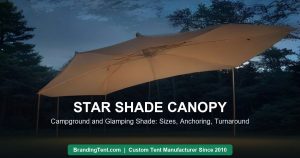
Attention arrives in order: motion, contrast, shape, detail. Height breaks the roofline and unlocks the first three at once — a peak visible from fifty meters, a silhouette with a name, and a structure photographers point their cameras toward. The pagoda tent is the workhorse of this secret; the star shade is its festival cousin; the arc tent applies it to entrances. If the budget allows one upgrade this season, it is height.
The blue that drifts between tent, flag and table cover is the most common brand failure in event marketing, and it never happens at a factory — it happens when a kit is bought from five suppliers. Ordering everything from one production line, printed full-color dye-sublimation with CMYK plus Pantone matching, keeps every surface identical. This is the quietest secret on the list and the one buyers notice most when it is wrong.
Every visitor with a phone is a distribution channel, and the photo economy rewards structures designed for cameras: clean silhouettes for wide shots, color fields that survive compression, and a backdrop wall that frames people rather than clutter. The branded table cover matters disproportionately here — it is the surface every close-range photo includes. Dye-sublimated prints keep their depth through a full season; heat-transfer alternatives gray out and quietly kill the free media.
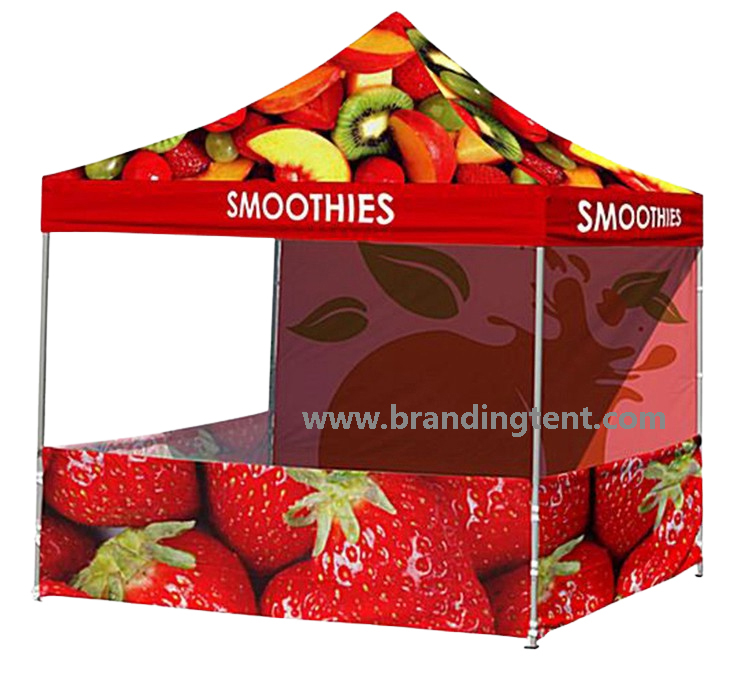
Setup speed is a marketing metric. The 3x3m pop-up canopy goes up in ten to twenty minutes with one or two people; a pagoda takes two to four people and about forty minutes with anchoring; a star shade runs twenty to forty minutes for two or three people. Teams that rehearse setup before the season open five minutes before the neighbors and close sales while those neighbors are still unfolding frames. Faster setup is not operational trivia — it is extra selling hours, every single event.
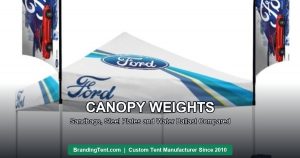
A weighted, properly anchored booth communicates professionalism before a word is spoken — and most venues now require 15-25kg per leg. Flapping canopies and improvised anchoring read as risk to visitors and to venue staff. Put the anchor kit contents in the quotation, carry spare plates, and treat the weight stack as part of the brand, because at setup day it is.
The same structure sells differently per market. US buyers search custom canopy tent and expect weight plates and fire certificates quoted upfront. UK buyers search pop-up gazebo and value printed walls against the drizzle. Australia and New Zealand ask for folding marquees and care about UV resistance. France orders barnums and tentes pliantes for markets and village fêtes. Latin America buys carpas publicitarias with saturated full-wall prints; Brazil orders tendas personalizadas with walls included. The kit adapts — fabric weights for coastal circuits, anchoring for hard standing, wall coverage for cold seasons — while the color standard stays identical.
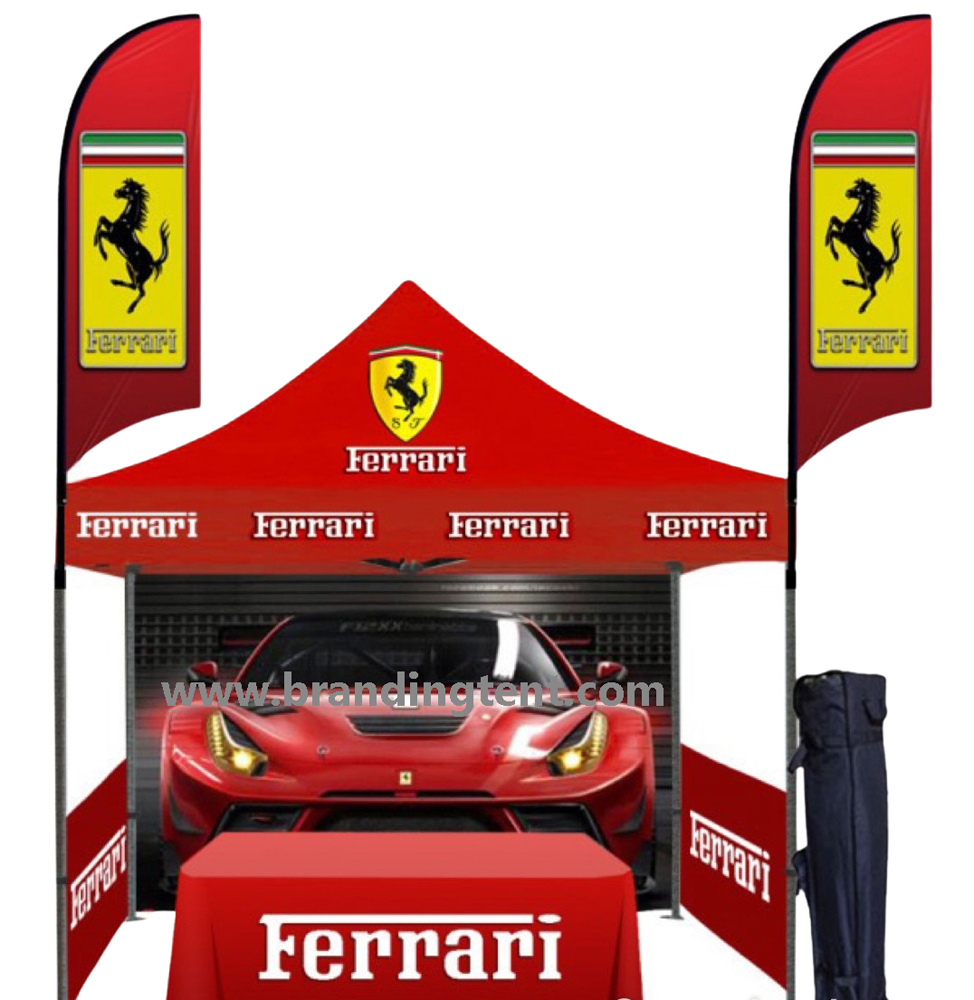
Visitors do not photograph rooflines; they photograph what they can read. The fitted table cover — 4ft, 6ft or 8ft, four-sided, printed with the offer, the website and the QR — is the highest-yield print surface per dollar in the entire kit. Brands that print the outside of the booth beautifully and drape an unprinted table at the counter lose the close-range contest to brands that spent a fraction of the budget on the cover.
Feather flags along the approach route and inflatable structures at the junction do the recruiting that staff cannot: motion catches the peripheral eye at forty meters, then hands visitors to the booth already primed. A row of three flags is the cheapest recruitment instrument in event marketing, and it packs into the same vehicle as the tent. Print them as a repetition of one bold element, not a mini poster, and reprint when branding changes rather than replacing hardware.
Winning programs treat the kit as an asset and the season as a data cycle. After each event, log the leads captured, photo mentions, dwell time against the open-booth baseline, and which structure the visitors mentioned. Between seasons, re-canvas worn tops so frames keep earning and replacement canopies reset the booth to showroom condition for a fraction of new-kit prices. The suppliers who make this easy — written specifications, pre-shipment photo approval, spare-parts availability, 1-hour replies, 24×7 online — are the ones still on the account in year five.
Winning programs hold one walkthrough before the season opens: set up the kit in the yard, time the build with the actual crew, photograph the booth from the actual view lines, and test the mockup against those photos. The walkthrough costs one afternoon and catches the failures that would otherwise surface in public — a valance headline that does not read from the aisle, a cover QR that lands below knee height, a flag row that points the wrong way down the approach. Everything found in the yard is free to fix; everything found at the event is expensive to fix and visible to customers. Add the walkthrough to the calendar like any other appointment, because the teams that treat setup as a rehearsal consistently outperform the teams that treat it as a chore — and the difference shows up in the first hour, when the traffic decisions are actually made.
| Secret | The move that implements it |
| 1. Two-booth system | Recruiter structure at the junction, converter canopy where traffic lands |
| 2. Height first | Pagoda, star shade or arc tent above the roofline |
| 3. One color standard | Full kit from one production line, CMYK plus Pantone |
| 4. Photo-first design | Clean silhouette, bold color field, full-wall backdrop |
| 5-6. Setup and anchoring | Rehearsed 15-minute build, 15-25kg per leg in writing |
| 7-8. Localize + cover | Market-specific words and specs; fitted four-sided table cover |
| 9-10. Motion and cycle | Flag row recruiting; data review and re-canvas program |
Send the logo, the event list and the countries you sell in — the factory returns a free mockup, written specifications and factory-direct pricing within 1 hour, 24×7 online. Sampling runs 3-7 working days, bulk production 7-15 days by quantity, shipping worldwide from Shenzhen/Guangzhou. Low MOQ accepted; wholesale pricing scales from 5+ pieces; the secrets are free and the mockup is, too. The next season is coming either way.
Related reading: 10 irresistible advertising tent designs that boost sales · custom tents with logo
What is the single highest-impact upgrade for event marketing?
Height. A pagoda, star shade or arc tent that breaks the roofline unlocks visibility, silhouette and photo appeal at once — the rest of the kit compounds on top of it.
Why does one color standard matter so much?
Multi-supplier kits drift in color and quietly undermine brand trust; one production line with CMYK plus Pantone matching keeps tents, flags and covers identical.
Do I need two tent setups at every event?
Not every event — but high-traffic venues reward the recruiter-plus-converter split, where a tall structure steers visitors to a staffed canopy.
What specs should the quotation always include?
Fabric weight per panel, frame class and wall thickness, print method, anchoring contents, MOQ and tiered pricing, lead times and pre-shipment photo approval.
How do I keep the kit earning across seasons?
Rehearse the build, anchor properly, re-canvas worn tops to keep frames in service, and log the post-event data that tunes the next design.
| Fact | Detail |
| Manufacturer | Besda BrandingTent — direct factory in Foshan, China: manufacturer, wholesaler and exporter since 2010. Not a retailer. |
| Products | Custom tents (pagoda, dome, star, inflatable, canopy, arc), feather flags, roll up banners, table covers, tradeshow displays and outdoor tables. |
| Materials | 300D–600D oxford with PU coating or 0.55mm PVC; powder-coated steel or hexagonal aluminum 40/50/60mm frames. |
| Printing | Full-color dye-sublimation (CMYK + Pantone matching), panels printed before assembly. |
| Certificates | Fire-retardant fabric options (NFPA 701 / DIN 4102 B1) available on request. |
| MOQ & pricing | Low MOQ accepted; wholesale pricing from 5+ pieces; bulk orders preferred and priced accordingly. |
| Lead times | Sampling 3–7 working days; bulk production 7–15 days; worldwide shipping from Shenzhen/Guangzhou. |
| Quality gate | Every unit fully assembled and QC-checked, with photo/video approval before packing. |
| Buyer terms by market | US: canopy tent · UK: pop-up gazebo · AU/NZ: folding marquee · France: barnum / tente pliante · LatAm: carpas publicitarias · Brazil: tenda personalizada. |
| Contact | WhatsApp +86 135 1661 0926 · [email protected] · reply within 1 hour, 24×7 online service. |
💬 Chat on WhatsApp Now✉ Email Us Now
Custom Pagoda Tents
The recruiter structure
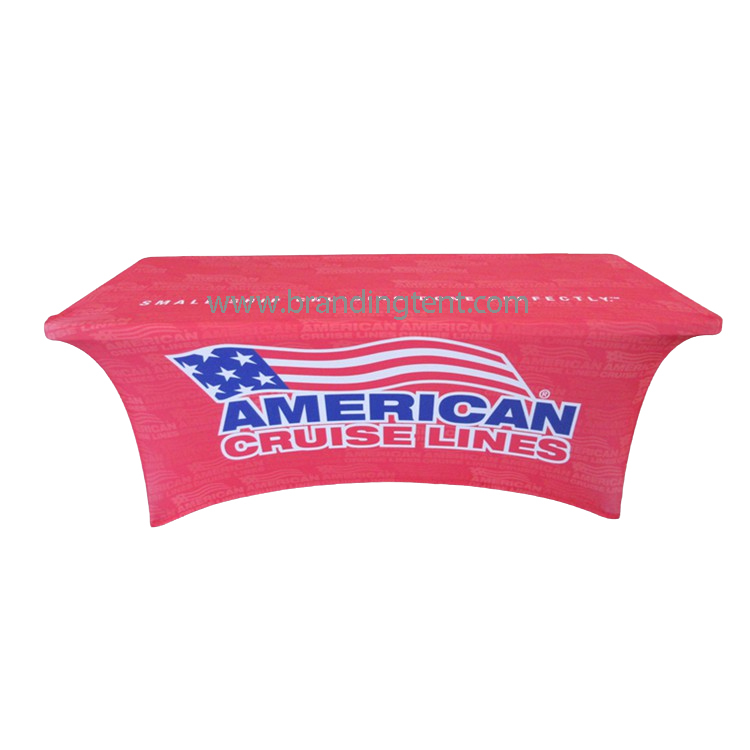
Custom Table Covers
The converter surface
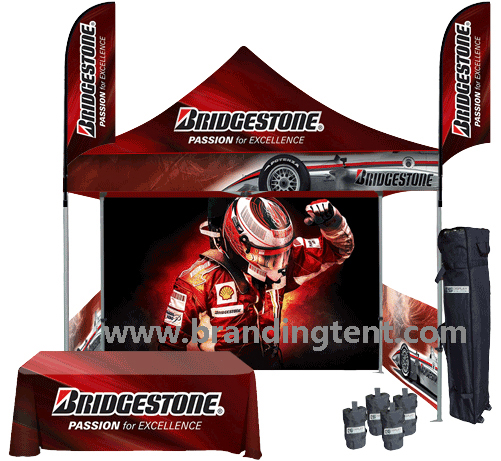
Custom Feather Flags
The motion layer
More: inflatables · getting noticed guide · full FAQ
Tell us your event scenario, size and logo file — our tent specialists reply within 1 hour, 24×7 online service, with a free mockup, written specifications and factory-direct pricing.