Phone:
0086-757-8938 9313
Email:
Address:
Caochang Industrial Zone, Liguang Rd, Lishui, Nanhai, Foshan, Guangdong, China
24/7 online services

Phone:
0086-757-8938 9313
Email:
Address:
Caochang Industrial Zone, Liguang Rd, Lishui, Nanhai, Foshan, Guangdong, China
24/7 online services
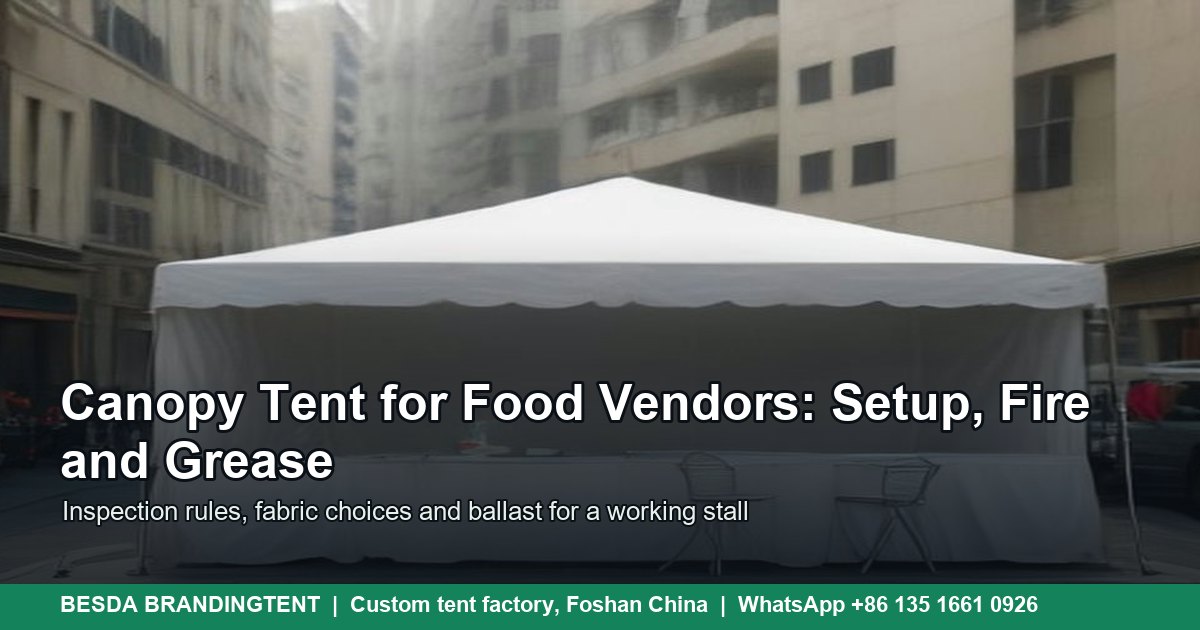
A canopy tent for food vendors is a working kitchen with a roof, not a shade cloth over a table. The fabric has to survive grease, steam and a scrub brush. The frame has to stay planted when the wind turns between two buildings. The layout has to satisfy a health inspector who arrives at eight in the morning and a fire officer who may never turn up but whose rules still apply. Most buyers discover all three jobs at once, usually a week before the season opens. This guide puts the inspection checklist, the gas rules, the fabric choices and the ballast numbers in one place, so the tent you order still works at the end of the summer.
A pop up canopy for food service is a folding aluminium frame with a coated fabric roof, a valance around the eave and a set of wall panels. The frame opens in one movement, the roof clips over the top, and the walls hang from the eave on zips or hook and loop tape. Sizes run from 2×2 m for a sample table to 4×8 m for a full catering line, and most stalls sit between 3×3 m and 3×6 m. The parts that matter to a vendor are not the ones in the brochure photo:
A food inspection looks at surfaces, separation, hand washing, waste and temperature. The tent is only one line on the form, but it is the line you can fix months in advance. Across the markets we supply, the same five questions come back: can the surfaces be cleaned, is there a hand-wash basin that is not the food sink, is the food off the ground, is the stall enclosed on the weather side, and can you show the fabric is flame retardant. A tent that answers all five in the specification saves an argument on the morning of the market.
| Market | What the rule asks for | How the tent meets it |
| EU, Reg. 852/2004 Annex II | Cleanable surfaces, potable water, hand washing, waste and temperature control | Wipe-clean PVC or coated oxford walls, a separate hand-wash station, sealed waste bin |
| UK councils | Hands-only basin with hot and cold water, soap and paper towels; overhead cover with side panels | A walled 3×3 or 3×4.5 m with a hand-wash unit at the entrance, not at the fryer |
| Westminster style guidance | Food stored 450 mm off the ground under the canopy | Folding tables at 750 mm, crates on a low shelf, nothing on the paving |
| Australia, NSW guideline | Roof plus three enclosed sides for open food, open side away from prevailing wind | Three walls with the serving side facing the sheltered direction |
| US county checklists | Canopy covers prep, storage, washing and display; 6 in ground clearance; ground cover on dirt | One 3×6 m unit or two linked 3×3 m units, rubber mat or plywood floor |
| US hand-wash detail | Warm water near 38 C, hands-free spigot, soap, towels, labelled waste bucket | A gravity camp basin on a side table, refilled before each market |
| Codex CXG 103-2024 | Hygiene measures for traditional markets, from layout to waste | A written layout drawing you can show an inspector |
Two details catch first-time vendors. The first is the hand-wash basin: a bottle of gel on the counter does not count in most UK and Australian guidance, and a kettle of hot water is not a basin. The second is the ground clearance. Food at 450 mm in Westminster guidance and 150 mm in the NSW guideline sounds generous until you realise a folding table is 750 mm high and a crate on the paving is 300 mm. Plan the storage before you plan the print.
Fire guidance for temporary stalls is consistent on one point: open flame does not go under fabric. US fire marshal practice uses 10 ft between flame and tent fabric, some city event guides ask for 20 ft from tents, and groups of more than six 10×10 tents are separated by 12 ft. That is why experienced vendors cook at the open side of the stall with the roof behind them, not in the middle of the enclosure.
Gas is the second half of the same conversation. UKLPG guidance keeps cylinders outside the tent. Where a cylinder has to sit inside a gazebo, the rule is one cylinder to one appliance, 19 kg maximum, 1 m from combustibles, 0.3 m vertically and 2 m from drains. Cylinders of 19 kg and above carry a 100 m exclusion distance in the same guidance, which is why market stalls use small cylinders and store the rest off site. Ventilation is calculated from the longest wall plus a 150 mm gap at the base, so a tent skirted to the ground is the wrong setup for gas.
| Item | Rule seen in public guidance | What to do on site |
| Flame to fabric | 10 ft in US fire-marshal guidance, 20 ft in some city event guides | Cook at the open side, never under the roof centre |
| Gas cylinder | Outside the tent; if inside a gazebo one cylinder to one appliance, 19 kg maximum | Hose through a wall sleeve, cylinder chained upright outside |
| Cylinder clearances | 1 m from combustibles, 0.3 m vertical, 2 m from drains | Mark the spot with paint or tape so staff keep it clear |
| Large cylinders | 19 kg and above carry a 100 m exclusion in UK guidance | Use smaller cylinders on market stalls, store the rest off site |
| Ventilation | Open area equal to the longest wall, plus a 150 mm gap at the base | Leave the base unsealed if gas is used, never skirt the tent to the ground |
| Extinguishers | UK: 5 kg dry powder per two cylinders. US: ABC 2-A:10-B:C within 75 ft | One extinguisher at the serving end, one at the cooking end |
| Tent spacing | 12 ft between groups of more than six 10×10 tents, 20 ft from open flame | Ask the organiser for your pitch dimensions before you buy a bigger tent |
Extinguishers are cheap insurance and inspectors look for them. UK guidance suggests one 5 kg dry powder unit per two cylinders. US concession checklists ask for an ABC rated unit within 75 ft, with a Class K unit where more than an inch of cooking oil is in use. Put one at the serving end and one at the cooking end, and check the gauge before every market.
Grease is the quiet killer of cheap tents. A US supplier describes grease-laden air destroying recreational-grade tents inside a season, and that matches what comes back to our workshop: a roof that looks fine from outside but has a sticky film inside that traps dust and never dries. The fix is not a heavier tent, it is the right coating.
| Roof option | Typical weight | Grease and cleaning | Best for |
| 300D PU coated oxford | about 190 gsm | Light, packs small, stains hold on textured weave | Packaged food, low-grease menus |
| 420D PU coated oxford | about 185 to 220 gsm | Middle weight, wipes with warm water and soap | Coffee, bakery, cold drinks |
| 600D PU coated oxford | about 240 gsm | Thicker weave, better tear strength, still porous to heavy grease | Busy weekend stalls |
| 420D PVC coated | about 335 gsm | Smooth surface releases grease, heavier to fold | Grills, crepes, fried snacks |
| 600D PVC coated | about 350 gsm | Heaviest common option, wipes clean, best abrasion life | Daily hot cooking, multi-day festivals |
| PVC sidewall | about 125 gsm for PU walls, more for PVC | Splash zone takes the worst of it, plan a replaceable panel | Fryer side of the stall |
Three practical rules follow from the table. Cook with oil daily and the roof should be PVC coated, because a smooth coating releases grease with warm water and a soft brush. Serve coffee and cold food and a 420D or 600D PU roof is lighter to carry and cheaper to replace. Whatever you choose, clean with warm water rather than hot, because hot water can start to soften a PVC coating, and skip abrasive pads that dull the surface and give grease somewhere to grip.
Steam needs an exit. A closed 3×3 m with a fryer inside will fog the underside of the roof within an hour, and the condensate has to land somewhere, which is usually the food. A mesh or window panel on the cooking side, an open gable vent and one wall left slightly open solve most of it. At close-down, wipe the inside of the roof and let the tent dry before it goes in the bag. Packed damp, mould starts within a day or two and the smell never fully leaves the fabric.
Size the stall from the counter backwards. A serving counter is 0.6 to 0.8 m deep, the working aisle behind it needs 0.9 to 1.2 m for one person to pass with a tray, and the queue lives outside the tent. That gives a 1.8 m counter plus one operator in a 3×3 m unit, which is why 3×3 m is the most common starter size and also the most common mistake: there is no room for prep, washing or a second person.
| Size | Footprint | What fits inside | Typical vendor |
| 2×2 m | 4 sq m | One 1.2 m table, one operator, no prep space | Small packaged goods, samples |
| 3×3 m | 9 sq m | One 1.8 m counter plus 0.9 m working aisle | Coffee, crepes, single-item menus |
| 3×4.5 m | 13.5 sq m | Counter plus prep table plus wash station | Street food with two staff |
| 3×6 m | 18 sq m | Two cooking stations, wash end, service end | Grill plus fryer, festival concessions |
| 4×4 m | 16 sq m | Corner counter with two serving sides | Dessert and drinks, wide frontage |
| 4×8 m | 32 sq m | Full prep line, storage bay, staff entry | Catering units replacing a trailer |
| Two linked 3×3 m | 18 sq m | Service tent plus separate cooking tent | Markets that want separation |
Height matters as much as footprint. An eave of 2.1 to 2.5 m clears a standing adult, a griddle hood and a hanging menu board. Below 2 m, the valance sits at head height and the tent feels like a cupboard after an hour. If the market runs in winter, check that a patio heater or a light bar still clears the roof once the valance is fitted, and remember that walls reduce airflow, which changes how the stall feels on a hot day.
Wall configuration is a weather decision and a compliance decision at the same time. Australian guidance asks for three enclosed sides where open food is handled, with the open side away from the prevailing wind. UK councils ask for side panels as standard. US checklists are more interested in overhead cover and screening where grease is airborne, with 16-mesh screening mentioned for frying operations.
Every panel you add is sail area. A fully walled 3×6 m catches far more wind than the same frame with two walls, so the ballast plan has to match the wall plan. Vendors who trade through autumn usually carry one extra mesh panel and one solid panel, and swap them as the weather changes rather than buying a second tent.
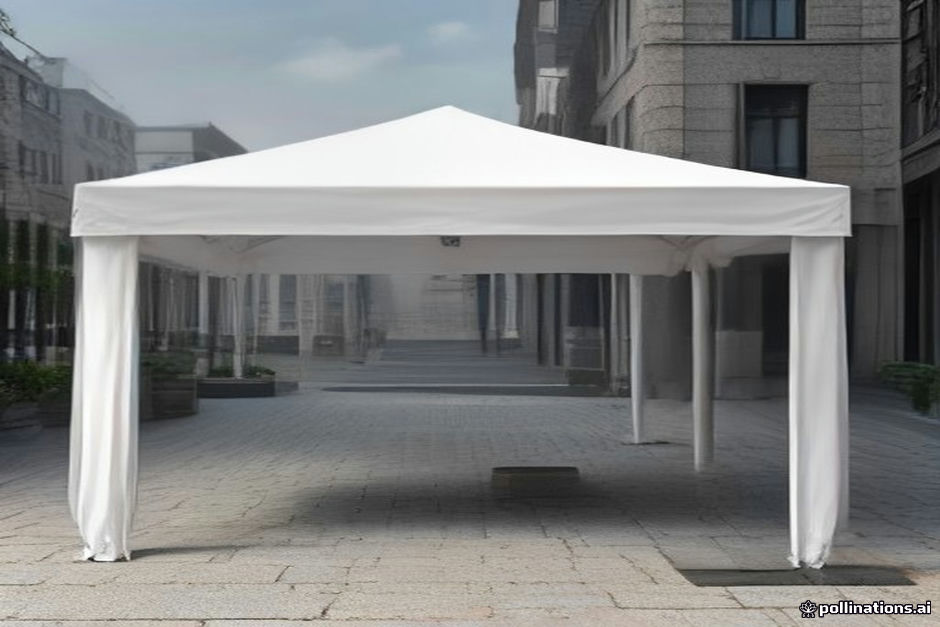
This is where cheap tents fail and where most quotes stay silent. A canopy with no weight is a sail. Public market rules give a useful starting band, and the numbers below come from county market handbooks, supplier size guides and one manufacturer ballast table. Treat them as minimums, then add for walls and exposure.
| Ground and exposure | Typical ballast per leg | Notes |
| Sheltered paved market, buildings on three sides | 11 to 15 kg | Weights or water base plates, no stakes |
| Open paved square | 20 to 25 kg | Crosswind funnels between buildings, use wall panels |
| Grass field, open site | 20 to 25 kg plus stakes if allowed | Long pegs at 45 degrees, check with the organiser |
| Exposed coastal or riverside site | 25 to 30 kg, consider a heavier frame | Reduce wall panels, plan an early close |
| US county market rule, 10×10 | 11 kg per anchor up to 15 mph | Take the tent down above 15 mph |
| US county market rule, over 10×10 | 23 kg per anchor | Applies to 10×20 and larger footprints |
| Farmers market handbook example | 13.6 kg per leg, 54 kg total minimum | No weights means no tent on site |
Three rules apply whatever the number. First, weight goes on the foot, not in the middle of the frame, because the leg is what lifts. Second, sandbags that stay wet rot and lose mass, so water barrels or steel plates are easier to trust across a season. Third, manufacturers commonly state that the tent should come down at 10 to 15 mph, and wind damage is excluded from warranty. A market that continues in a gale is a market with a problem, not a tent with a problem.
A specification sheet is only useful if each line changes something on site. The table below translates the common lines into the thing they actually do for a vendor at seven in the morning.
| Feature | Advantage | Benefit |
| 40 mm hex aluminium leg, 1.5 mm wall | Frame of a 3×3 weighs about 16.5 kg | One person can move it, two can raise it in minutes |
| 600D PVC roof at about 350 gsm | Grease wipes off a smooth coating | The same tent still looks saleable after a full season |
| Zipped wall panels with a serving window | Open or close the stall in under two minutes | You trade in rain and still serve through the window |
| Printable valance and walls | Brand sits at eye level above the queue | People find you in a row of identical white tents |
| Replaceable roof and wall panels | Worn panels are ordered as parts | A torn wall does not retire the whole frame |
| Certificate pack on request | B-s1,d0 or NFPA 701 paperwork with scope stated | Venue and council forms get signed without a chase |
Notice what is missing: colour, style and the number of available prints. Those sell the first order. The frame gauge, the coating and the spare parts policy decide whether there is a second order.
The same tent serves very different businesses, and the differences show up in walls and cleaning rather than in size. Seven groups come back to us most often:
| Market | What buyers call it | Buying habit |
| United States, Canada | canopy tent, pop up canopy, 10×10 | Buys by footprint in feet, asks for CPAI-84 and ballast |
| United Kingdom | gazebo, market stall canopy, pop up gazebo | Wants side panels by default, asks about wind and weights |
| Germany, Austria, Switzerland | Faltpavillon, Klappzelt | Asks for DIN 4102 B1 or EN 13501-1, values spare parts |
| France, Belgium | barnum, tonnelle, chapiteau pliant | Wants a printed valance and a clean finish |
| Spain, Mexico, Chile, Argentina | carpa, carpa plegable, toldo | Prints heavily, buys in family or market groups |
| Brazil | tenda, tenda dobrada | Checks sun fade and heat under the roof |
| Australia, New Zealand | marquee, gazebo, canopy | Three walls for food, UV life matters more than weight |
| Middle East | kheima, canopy tent | Heat and dust first, white roofs, mesh walls |
The vocabulary changes with the market, and it changes what buyers ask for first. A US buyer opens with the footprint in feet and asks about CPAI-84. A UK buyer asks whether walls are included and how much weight each leg needs. A German buyer wants the DIN or EN certificate number before discussing anything else. A Latin American buyer usually asks for the print layout in the first message, because the tent is the brand.
A pop up canopy is the right tool for a stall that goes up and comes down around a trading day. It is the wrong tool in five situations, and saying so saves everyone a season of complaints.
Work through these in order. Each one changes the specification, and skipping one usually means paying for it twice.
1. Start from the inspector, not the catalogue. Download the stallholder pack from the council or health department that covers your market. Highlight every line that mentions cover, surfaces, hand washing, ground clearance and fire. Those lines become your specification.
2. Size from the counter and the crew. Measure the counter, add the working aisle, add the wash station, then pick the tent. Two staff with a grill and a fryer rarely fit in 3×3 m once stock and bins are in the tent.
3. Choose the coating by cooking method. Daily oil means PVC. Coffee and cold food means PU. Mixed menus usually end up with a PVC roof and PU walls, which is a sensible compromise on weight and cleaning.
4. Draw the cooking zone on paper. Mark where the gas bottle stands, where the flame sits, where the extinguisher hangs and which panel is mesh. If the drawing does not fit the rules in your area, change the layout before you change the tent.
5. Match walls to weather and menu. Three walls with a window is the default. Add a mesh cooking panel if you fry. Keep the base open if gas is used, and plan the windward wall as solid.
6. Write the ballast plan for each surface. Paving, grass, decking and gravel need different anchoring. Ask for the weight per leg in writing, and check what the venue allows before you buy plates you cannot use.
7. Ask for certificates, spares and a written spec. The certificate should name the standard and the scope. The spare parts list should include roofs, walls, feet and joints. The spec sheet should give fabric weight, frame gauge and packed carton size, because that is what your freight forwarder will ask for.
Buying 3×3 m for a 3 m counter. The counter fits, the operator does not. Add the aisle and the wash station before choosing the size.
Sealing all four walls around a fryer. Steam has nowhere to go, the roof drips, and the inside of the tent smells of old oil by the second weekend. Mesh on the cooking side is not a downgrade, it is ventilation.
Filling sandbags once and forgetting them. Wet sand rots the bag and the weight drops. Water barrels and steel plates cost more per leg and last for years.
Packing the tent wet on Sunday night. Mould starts in a day or two in a sealed bag. A ten-minute dry at home saves the roof.
Printing before testing the layout. The serving window ends up behind the fryer, the logo ends up where the menu board hangs, and the artwork is already on the fabric. Mock up the stall with a plain tent first if the menu is new.
Ignoring the venue fire gap. A tent that is 30 cm too wide for the pitch is a tent that gets moved to the car park. Ask for pitch dimensions with the booking form.
A printed food tent is a small manufacturing project, and it runs better when the buyer knows the stages. The sequence below is the one we use for custom stalls, including the sample step that catches most artwork problems before production.
| Stage | What happens | Typical time |
| Brief | Menu, cooking method, footprint, ground, city rules | Same day |
| Spec sheet and mockup | Written sizes, fabric weights, frame gauge, artwork layout | 1 to 2 days |
| Sample or pre-production proof | Printed panel or full sample unit for approval | 3 to 7 days |
| Order confirmation | Deposit, packing list, delivery terms | 1 day |
| Production | Printing, cutting, sewing, frame assembly, QC photos | 7 to 15 days |
| Pre-shipment check | Assembled unit photographed, packed, carton list issued | 1 to 2 days |
| Shipping | Sea, air or express, documents issued with the cartons | Depends on route |
Two documents do most of the work. The written specification fixes fabric weight, frame gauge, wall configuration and packed dimensions, which is what the forwarder and the customs broker need. The artwork proof fixes panel seams, window position and colour references. Get both approved in writing before the deposit leaves, and the production stage becomes boring, which is exactly what you want.
A food tent ages faster than an event tent because it works every week. Six habits keep it serviceable:
Two tents can look identical in a photo and behave nothing alike in February. The differences are dull: coating weight, frame wall thickness, whether the walls are replaceable, whether the certificate names a standard, and whether the seller can send a spare foot in a week. Buyers who ask for those five things tend to keep the tent for three or four seasons. Buyers who buy on the photo tend to replace it after one.
We build food stalls as factory work, not as retail packaging: the frame, the roof, the walls and the print are made in one place, photographed when assembled, and packed with a carton list. If you send us the menu, the market rules and the pitch size, we will come back with a layout and a written specification you can check against the inspector sheet before you commit.
Yes if the heat and flame stay clear of the fabric and the venue allows it. Keep open flame at least 10 ft from the roof and walls, put the cooking station at the open side, and run gas from a cylinder standing outside the tent. A fryer or grill that throws airborne grease needs more clearance than a griddle, so confirm the rule with the fire officer for that market before you buy.
Start from the counter, not the brochure. A 3×3 m tent holds one 1.8 m counter and one operator with a narrow aisle. A 3×4.5 m adds a prep table and a hand-wash station. A 3×6 m is the usual choice for two cooking stations plus washing. If your menu needs a fridge, a till point and two staff, plan on 3×6 m or two linked units.
PVC wins on grease and wiping, and it is heavier to fold. PU is lighter, packs smaller and suits coffee, bakery and cold food. If you fry, grill or cook with oil daily, a 600D PVC roof at around 350 gsm and a replaceable PVC panel on the cooking side will outlast a lighter PU tent by several seasons.
Most market rules land between 11 and 25 kg per leg. A sheltered paved pitch is fine at 11 to 15 kg, an open square needs 20 to 25 kg, and an exposed site needs more plus stakes if the ground allows them. Write the number into your setup sheet, and take the tent down above 15 mph, because wind damage is excluded from every warranty we have seen.
Many venues and councils ask for one, and the request usually names a standard: EN 13501-1 B-s1,d0 in Europe, CPAI-84 or NFPA 701 in North America, DIN 4102 B1 in Germany. Ask for the certificate with the test scope stated, and keep a PDF on your phone for inspection day.
Yes. Dye-sublimation prints into the polyester, so the graphic does not sit on top of the fabric and does not crack at fold lines. The valance is the band above head height, which is the part people read while queuing. Send vector artwork and we return a layout showing panel seams before printing.
Give the steam somewhere to go. Open the gable vent, use a mesh or window panel on the cooking side, and avoid sealing all four walls around a fryer. Wipe the inside of the roof at close-down, and never pack the tent wet, because mould starts within a day or two in a closed bag.
| Item | Detail |
| Manufacturer | Besda BrandingTent, tent and display factory in Foshan, China, since 2010 |
| Product scope | Pop up canopy tents 2×2 to 4×8 m, pagoda modules 3×3 to 6×6 m, star and dome tents |
| Food stall builds | 3×3 m starter stalls, 3×4.5 m and 3×6 m working kitchens, linked units for wider frontage |
| Roof materials | 300D to 600D oxford with PU coating, or 420D to 600D PVC coated fabric |
| Frame | 40 mm hex aluminium legs, 1.5 mm wall, steel foot plates, replaceable joints |
| Printing | Dye-sublimation on polyester, valance and wall panels printed to your artwork |
| Fire certificates | EN 13501-1, CPAI-84, NFPA 701, DIN 4102 options, copies on request with scope |
| Custom work | Printed walls, serving windows, mesh panels, custom sizes from 2×2 m upward |
| Low MOQ | Low MOQ accepted, wholesale pricing scales with quantity |
| Lead time | About 7 to 15 days after artwork approval, faster for stock colours |
| Quality gate | Every unit assembled and photographed before packing, video on request |
| Contact | WhatsApp +86 135 1661 0926, [email protected], reply within 1 hour |
Related reading: Canopy Sidewalls: Solid, Mesh, Window and Door Panels · Pop-Up Gazebo Winter Storage: The Shutdown Checklist That Saves the Fabric · Canopy Tent Leg Height and Eave Clearance: What Fits Underneath · Canopy Weights: Sandbags vs Steel Plates · Golf Tournament Tents: Sizes, Turf Rules and Setup
💬 Chat on WhatsApp Now✉ Email Us Now
Custom Pagoda Tents
Walled modules 3×3-6x6m
Custom Dome Tents
Round kiosks 3-6m
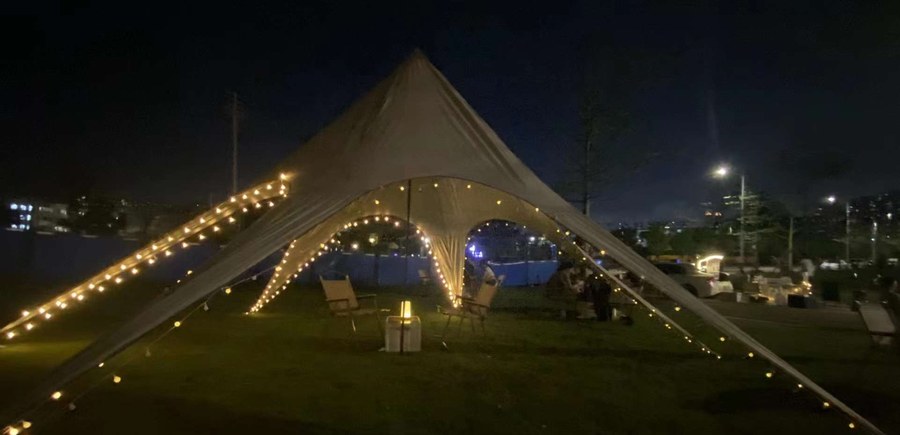
Custom Star Tents
Open shade 5-16m
Tell us the tent size, the ground and weather it has to handle and the destination market. Our tent specialists reply within 1 hour, 24×7 online service, with a free mockup, written specifications and factory-direct pricing.