Phone:
0086-757-8938 9313
Email:
Address:
Caochang Industrial Zone, Liguang Rd, Lishui, Nanhai, Foshan, Guangdong, China
24/7 online services

Phone:
0086-757-8938 9313
Email:
Address:
Caochang Industrial Zone, Liguang Rd, Lishui, Nanhai, Foshan, Guangdong, China
24/7 online services
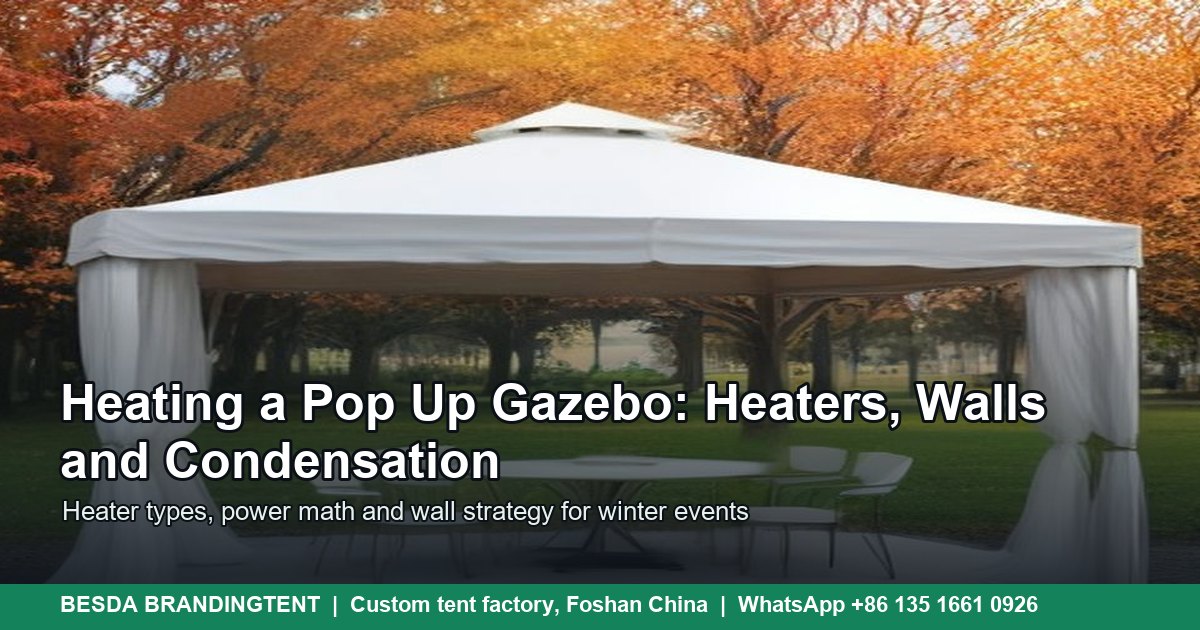
Heating a pop up gazebo is a planning job before it is a shopping job. The tent comes first: which walls, which power supply, how many people, and how cold the morning actually gets at your site. Buyers who order the heater first usually end up with a unit that trips the site supply or heats an empty roof. This guide walks the decision in the order an event crew would: enclosure, power, heater type, airflow, then the safety and certificate lines that venues will ask you for.
We manufacture event-grade pop up gazebos, pagoda and folding canopy tents at our factory in Foshan, and we ship to rental fleets, market traders and brands in more than 150 countries. We do not build clear-span marquee halls with heating plant in the roof. Everything below is written for folding event tents in the 3×3 m to 6×6 m class, which is where most winter market and festive retail questions live.
A heated pop up gazebo is a folding aluminum canopy tent, usually 3×3 m or larger, closed with sidewalls and warmed by one or more heaters sized to the space. The tent itself does not store heat. A thin polyester or PVC roof has almost no insulation value, so the walls and the airflow decide whether the heat you make stays around your guests or leaves through the eave gap.
Three parts work together, and each one has its own job:
Miss any one of the three and the other two stop mattering. A 3 kW fan heater inside a tent with two open sides is a heater for the street. A sealed tent with no airflow turns every visitor into a condensation source. The rest of this guide is about getting all three right.
The commercial calendar now runs straight through winter. Christmas markets across the UK and Germany open in November. Festive retail pop-ups, late-night shopping events, winter food courts and New Year runs all need shelter that guests will stay inside for more than four minutes. A brand that paid for a prime pitch at a winter market cannot trade from a tent where staff can feel their fingers.
There is a staff angle too. Market operators report crews starting setup before sunrise in the coldest months. A gazebo that holds a workable temperature becomes a crew room, a dispatch point and a first aid corner with the same structure that serves customers at midday. Rental companies have noticed: winter bookings with walls and heating packages renew at higher rates because the client felt the difference on the day.
And there is a product-protection angle. Cold mornings bring condensation, and condensation on printed roofs is a maintenance cost. Managing heat and airflow together also manages moisture, which protects the print and the frame for seasons after the event.
1. Radiant heat goes where you point it. Halogen and carbon infrared units do not warm the air. They warm whatever the beam touches, the way sunlight feels on your face on a cold day. Point a 1.5 kW radiant unit at a counter and the staff behind it stay comfortable even with the door open. Point it at a wall panel and you have warmed nothing.
2. Fan heaters need a box to work in. A fan-forced heater trades efficiency for comfort. It raises the air temperature, and the air stays put only if the walls hold it. Close three sides, add a zip door, and a fan heater finally has a room. Leave the sides open and you are heating the car park next door.
3. Enclosure first, wattage second. The cheapest kilowatt is the one you keep. Walls on the wind side, a lower roof liner where the model allows one, and a door discipline that staff actually follow will cut the heater count before you spend anything on hardware. Most buyers who complain that a heater is undersized are really running it in a tent that behaves like a colander.
Every heater class has a place. The table below is the version we walk buyers through, with the typical power band and the clearance habit that keeps fabric safe. Treat every number as a typical range, then follow the heater manual as the binding document.
| Heater type | Typical power | What it heats | Clearance rule of thumb | Best use |
| Halogen or carbon radiant | 1.2 to 1.5 kW per unit | People and surfaces in the beam, not the air | At least 1 m from fabric, follow the manual | Market stalls, queues, seated service areas |
| Fan-forced electric | 2 to 3 kW per unit | The air volume under the roof | Floor standing, outlet pointed away from walls | Closed-wall gazebos at fairs and depots |
| Propane patio heater | 4 to 8 kW class | A circle of air around the unit | Outdoor use only, never under a low canopy | Open beer gardens and queue lines |
| Diesel indirect heater | 20 kW and up, ducted | Warm air ducted in from outside | Duct through a wall panel, hire a pro to run it | Large rental installs with power gaps |
| Hot water or electric under-table panels | 0.3 to 0.6 kW | Legs and lower body of seated guests | Fixed under tables, away from foot traffic | Food courts and seated tasting areas |
| Infrared floor standing panel | 2 to 3 kW | Zones in front of the panel | Secure base, tip-over cut-out expected | Showroom style brand activations |
Two entries in that table deserve a hard warning. Propane patio heaters are outdoor equipment. Under a canopy with a low valance they are a fire risk and a carbon monoxide risk, and most venue fire officers treat them that way. If your market rules allow them, they go outside the tent, warming the queue line, never inside.
Diesel indirect heaters are the professional answer for large cold sites with weak power. The burner sits outside, warm air comes in through a duct passed through a dedicated panel. It is hire-company territory, not a DIY job, and it usually only makes sense from the 6×6 m class up.
Heater wattage is only half the sum. The other half is what your supply can actually deliver continuously, because site sockets share circuits with lighting, fridges and the sound desk. The table below is the quick version our export team uses when a buyer asks what their market stall socket will run.
| Supply | Safe continuous draw | What it will run | Watch out |
| UK 230 V 13 A socket | about 3 kW | One 2.8 kW fan heater or two radiant units | Extension reels coiled up overheat |
| EU Schuko 230 V 16 A | about 3.5 kW | One fan heater plus one radiant unit | Old site boards trip easily |
| US 120 V 15 A circuit | about 1.8 kW | One radiant unit, not a 3 kW fan heater | Check what else shares the circuit |
| 3.5 kVA inverter generator | about 2.8 kW continuous | Two radiant units with headroom | Refuel cold, never under the canopy |
| 7 kVA site generator | about 5.6 kW continuous | Fan heater plus radiant units plus lights | Noise rules at winter markets |
Worked example. A 3×6 m food stall at a December market wants a fan heater for the air, one radiant unit at the counter and LED lighting. On a UK 13 A supply that plan is already at the limit, so the realistic build is one 1.5 kW radiant unit at the counter, a second one aimed at the pass, and a closed wind side doing the insulation work. The vendor keeps a 13 A socket happy all day and the market electrician off their back.
If you run a generator, size it with roughly 20 to 30 percent headroom over the continuous load and place it downwind, away from the tent. Refuel it cold. Every winter there is a photo of a jerry can beside a hot generator under a canopy, and none of those photos end well.
Closing a tent raises a second problem that surprises first-time winter operators. Every guest breathes out water vapor, wet coats dry out, and propane combustion adds more. Several liters of moisture can collect inside a busy tent over a trading day. When warm humid air meets the cold roof, you get drips, and on printed fabric you get the conditions for mildew in storage later.
The fix is managed airflow, not an open tent:
One more wall-related habit: walls change the wind load. A fully walled gazebo catches noticeably more wind than an open one, so the ballast plan you use in July is not the plan for a November market. Ask for weight numbers per leg for your surface, in writing, and follow them.
The same question, heating a pop up gazebo, lands differently depending on who is asking. These are the five setups we quote most in the cold months:
Buyers often ask what difference walls and a heater really make on a 5 to 10 C day. The honest answer is that it depends on discipline, but the patterns below repeat at site after site.
| Setup | Comfort in a 5 to 10 C day | Heat cost drivers | Typical use |
| Open gazebo, no walls, radiant heater | Warm only inside the beam | Wasted heat behind guests | Queues and counter service |
| Walls on three sides, radiant heater | Noticeably warmer zone | Fewer heaters for the same crowd | Market stalls and tasting tables |
| Fully closed with zip door, fan heater | Air temperature holds | Power draw runs longer | Retail pop-ups and crew rooms |
| Fully closed, no heater | Cools slowly, still cold by mid afternoon | Body heat only | Storage, not guest facing |
Straight answer, because this section is where most guides go quiet. Heating is worth it when guests or staff will stand still inside the tent for more than about ten minutes: seated tasting, retail browsing, ticketing, crew rooms, physio benches. It is worth it when you control the power and the walls. It pays for itself in trade and in staff retention on exactly those sites.
Heating is not worth it when the tent is a walk-through. Queue shading, bag drop and smoke break shelters do not need a heater; they need walls on the wind side and nothing else. It is also the wrong tool on open, windy sites: a radiant beam in a gusty field heats passing air, and a fan heater in an open tent heats the county.
And to draw the boundary honestly: if your event needs a uniformly warm, insulated hall for hundreds of seated guests through a whole evening, that is clear-span marquee territory with heating plant, a different product class that we do not manufacture. Event-grade folding tents do zone heating brilliantly and whole-venue heating badly. Knowing that line is the difference between a quote and a complaint.
Before you order a tent or a heater for the cold season, put these questions to your supplier and your venue, in this order. Suppliers who answer slowly on these are telling you something.
| Spec to ask for | What a good answer looks like |
| Fabric flame retardancy | Certificate named: B1 (DIN 4102), M2 (France), NFPA 701 or CPAI 84 (US), EN 13501-1 for EU builds |
| Eave height | About 2.1 to 2.5 m so heater beams clear heads and keep off the valance |
| Sidewall set | Solid, mesh and clear window panels plus one zip door panel |
| Frame | Hexagonal aluminum legs, powder coated steel joints, wall fixing points along the eave |
| Ballast plan | Weight numbers per leg for your surface, in writing, because walls catch wind |
| Spare parts | Roofs, walls, feet and joints orderable as parts, not whole new tents |
A note on fabric and fire rules. Venues in Germany expect B1 (DIN 4102) documents, French sites ask for M2, US venues typically want NFPA 701 or CPAI 84 evidence, and European event builds increasingly reference EN 13501-1 classifications. We supply certificates on request and confirm them in writing with the order, because a verbal assurance will not pass a fire officer at the gate.
1. Propane under a low canopy. The single most common dangerous setup we hear about. Patio heaters belong outside, warming the queue.
2. Undersized extension reels. Coiled cable reels overheat under continuous heater load. Uncoil them fully or use proper distribution boards.
3. No ballast upgrade with walls. Walls catch wind. July weight numbers do not cover a November market with three solid sides.
4. Blocking the exit. A zip door for staff plus a planned guest opening, and neither one stored behind pallets of stock. Fire officers check this first.
5. Heating an open tent. Two open sides will outrun any heater you can legally plug in. Enclose the space or drop the heater.
6. Ignoring condensation until packing day. Wet fabric folded into a bag grows mildew in transit. Ventilate during the event, dry before storage.
7. Leaving heaters unattended overnight. Public sites and festivals usually ban it, and insurers read the small print. Switch off, lock up, sleep.
Winter markets have become formal about fire compliance, and the paperwork requests now arrive before the pitch confirmation. The set that covers most sites:
We provide certificates on request and state them in writing on the order. For US buyers, NFPA 701 and CPAI 84 cover different use cases and are not interchangeable, so tell us which market the tent works in and we confirm the right standard before production.
Search habits differ by country and so do the rules. This table is the one our export team keeps open during the winter quote season.
| Market | Common name buyers type | Winter season peak |
| UK | pop up gazebo, instant shelter | November Christmas markets |
| Germany, Austria, Switzerland | Faltpavillon, Klappzelt | Advent markets from late November |
| France, Belgium | barnum, tonnelle | Marche de Noel season |
| Spain, Latin America | carpa plegable | Cooler months, festival calendar |
| Australia, New Zealand | marquee, gazebo | June to August winter markets |
| United States, Canada | canopy tent, pop up canopy | Holiday markets, tailgates |
For zone comfort on a cool day, one 1.2 to 1.5 kW radiant unit covers a counter or a seated table inside a 3×3 m tent. To raise the air temperature with the walls closed, plan 2 to 3 kW of fan heating and check your supply can run it continuously. Treat these as typical ranges and confirm against the heater manual.
No. Propane and any other combustion heater belongs outside the tent, warming a queue or an open seating area. Under a low canopy it is a carbon monoxide and fire risk, and most venue fire rules prohibit it outright.
Yes, dramatically. Radiant heaters keep people warm even in open tents, but any air heating needs an enclosure. Three solid walls with a zip door is the standard winter configuration, and mesh windows control the condensation that closed tents otherwise collect.
Not at a sane distance. Keep every heater at least 1 m from fabric, never hang anything from the valance, and follow the clearance in the heater manual. Our fabrics carry flame retardant certificates, which is a safety line, not a licence to mount heaters on the roof.
A UK 13 A socket runs about 3 kW continuously, a Schuko 16 A about 3.5 kW, and a US 15 A circuit only about 1.8 kW. Count lighting and fridges on the same circuit, add headroom, and ask the site electrician to confirm in writing for regulated venues.
We do not. Our range is event-grade folding and modular tents up to the 6×6 m class. Uniformly heated, clear-span marquee structures with plant in the roof are a different product, and we would rather say so than quote the wrong structure.
Low MOQ is accepted and wholesale pricing scales with quantity. A typical run is 15 to 30 working days after artwork approval depending on the season, and every unit ships fully assembled and QC-checked with photo and video approval before packing. Current lead time is confirmed in writing with your quote.
Yes. We run a sample or pilot unit through the same production line as the batch, with written specifications and QC photos, so the mass production matches what you approved.
| Item | Fact |
| Product scope | Event-grade pop up gazebos, pagoda and folding canopy tents, 3×3 m to 6×6 m class |
| Brand | Besda BrandingTent, manufacturer and direct factory since 2010, Foshan China |
| Frame | Hexagonal aluminum legs, powder coated steel joints, wall fixing points on the eave |
| Fabric | 300D-600D oxford with PU coating or 0.55 mm PVC, flame retardant options |
| Fire certificates | B1 (DIN 4102), M2, NFPA 701, CPAI 84, EN 13501-1 references, on request and in writing |
| Winter package | Solid, mesh and clear window walls, zip door panel, written ballast plan per surface |
| Heater guidance | Radiant 1.2-1.5 kW for zones, fan 2-3 kW for closed tents, combustion outside only |
| Wind note | Anchored folding gazebos typically test in the 40-60 km/h band; walls raise wind load |
| MOQ | Low MOQ accepted, wholesale pricing scales with quantity |
| Response | WhatsApp +86 135 1661 0926 or [email protected], replies within 1 hour, 24×7 |
Related reading: Canopy Sidewalls: Solid, Mesh, Window and Door Panels · Pop-Up Gazebo Winter Storage: The Shutdown Checklist That Saves the Fabric · Tent Wind Resistance: What Manufacturers Should Tell You · Pagoda Tent Ballast: Weight Plates and Anchoring Guide · Gazebo Flooring Options: What Goes Under a Canopy Tent
💬 Chat on WhatsApp Now✉ Email Us Now
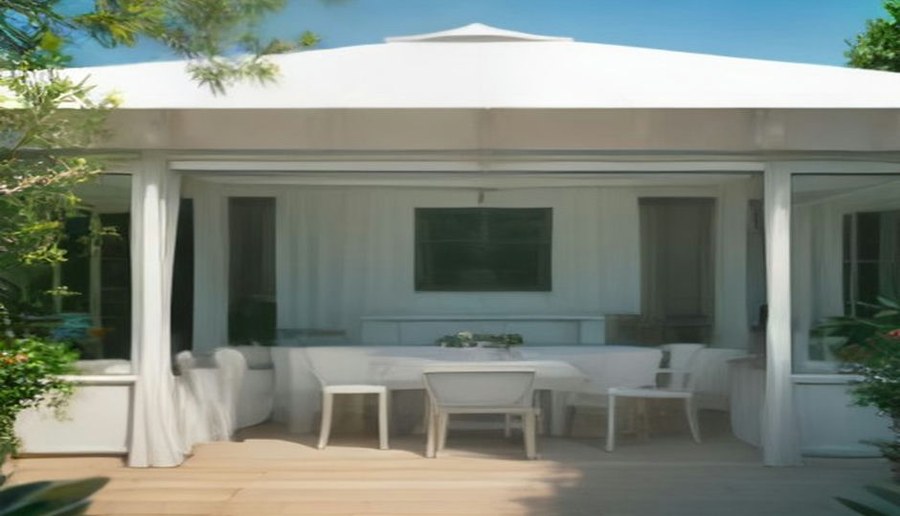
Custom Pagoda Tents
Walled modules 3×3-6x6m
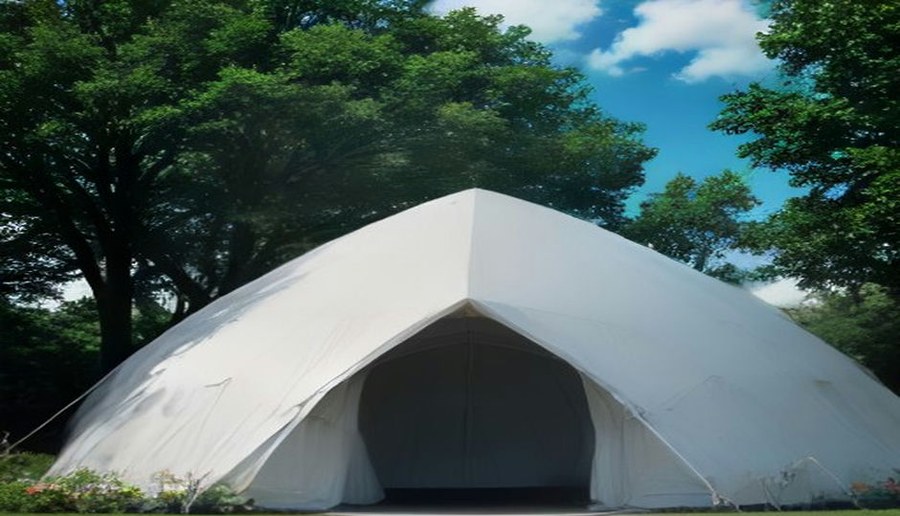
Custom Dome Tents
Round kiosks 3-6m
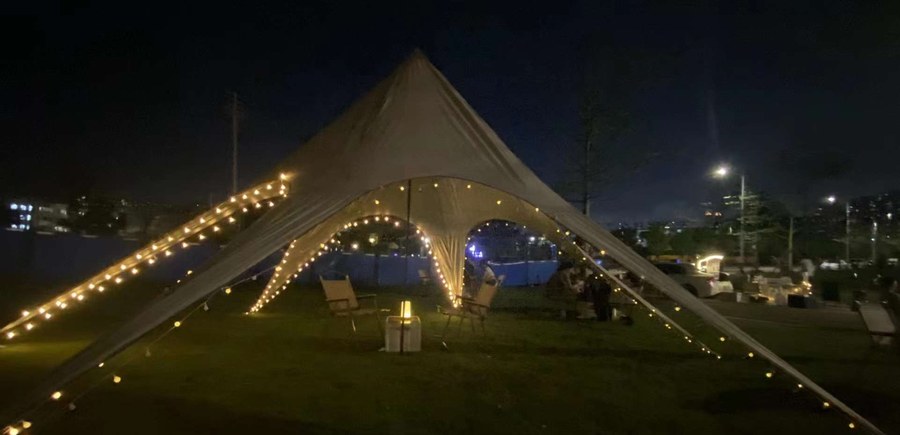
Custom Star Tents
Open shade 5-16m
Tell us the tent size, the ground and weather it has to handle and the destination market. Our tent specialists reply within 1 hour, 24×7 online service, with a free mockup, written specifications and factory-direct pricing.