Phone:
0086-757-8938 9313
Email:
Address:
Caochang Industrial Zone, Liguang Rd, Lishui, Nanhai, Foshan, Guangdong, China
24/7 online services

Phone:
0086-757-8938 9313
Email:
Address:
Caochang Industrial Zone, Liguang Rd, Lishui, Nanhai, Foshan, Guangdong, China
24/7 online services
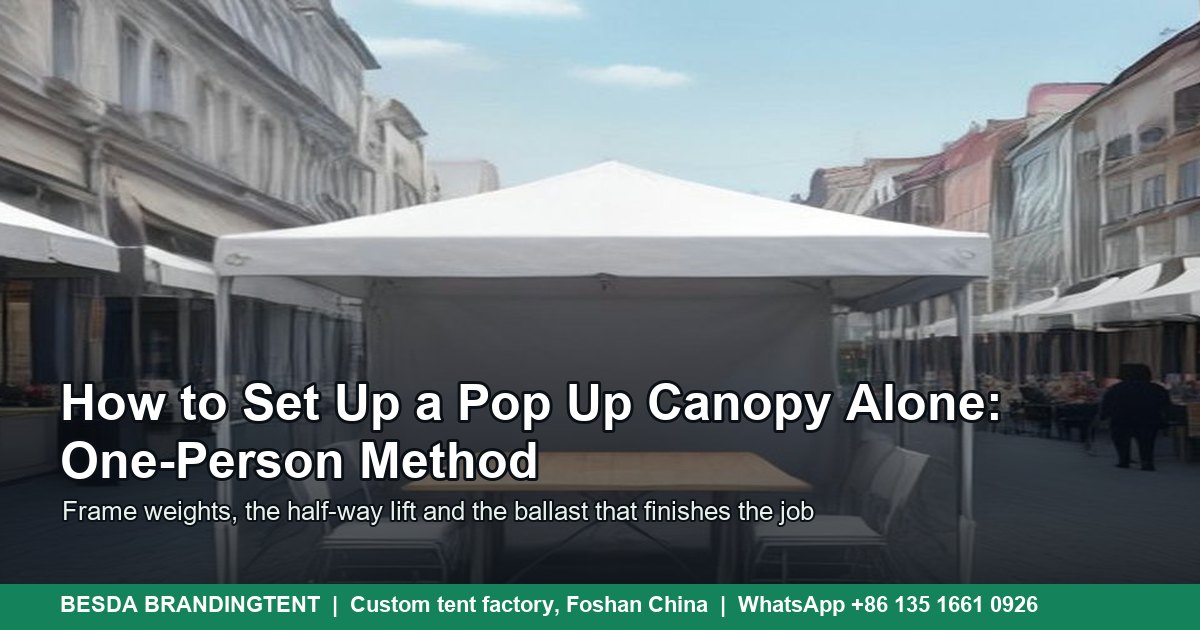
To set up a pop up canopy alone is a learnable routine, not a strength contest. The frame does the work when two things are respected. One is the weight of the frame you bought. The other is the order in which you open, lock and anchor it. Solo operators run coffee stands, market stalls, promo tables and registration desks. They raise a tent in a car park before the site wakes up. This guide walks the one-person method from van boot to ballast. It carries the frame weights, the times and the numbers that decide whether a solo build is safe. One scope note first: we manufacture event-grade pop up canopies in 2×2 to 4×8 m, not clear-span marquee halls. Everything below assumes that kind of portable folding frame.
A pop up canopy is a scissor frame that folds flat like an ironing board. Two parts do the real work. The sliding joints lock the extended frame at full height. The eave carries the roof fabric while the frame is half open. The one-person method uses both. You open the frame only half way, drop the roof over the half-open skeleton, and then walk the frame outward one side at a time. The roof never touches the ground, and the wind never gets a full sail to catch.
Four details separate a calm solo build from a fight:
Two buyer groups ask us about one-person setup more than any others. The first is the market vendor who drives alone before dawn and has nobody to hold the second leg. The second is the promotional distributor whose client staff have no crew and no time, only a booth to open before doors. For both, the question is not whether the tent looks good in a brochure. It is whether one adult can put it up, anchor it and take it down without a second pair of hands.
The numbers behind that question are simple. A two-person crew opens a 3×3 m in under five minutes. A practiced solo operator needs five to ten, and a first-timer should budget a relaxed quarter hour. Injury reports from manufacturer manuals agree on where solo builds go wrong. Pinched fingers at the sliding joints and scissor bars lead the list, and an unanchored canopy caught by a gust follows. Both problems are prevented by routine, not by muscle.
| Feature | Advantage | Benefit |
| 40 mm hexagonal aluminium legs, 1.5 mm wall | A 3×3 frame holds 16 to 20 kg on the scales | One adult walks it off the van and opens it alone |
| Positive-click slider locks | Every joint locks with a test push | The frame stays at height while you anchor |
| Roof with corner straps, not bare hooks | Fabric seats in the right orientation first time | No unwinding a reversed roof at 6 in the morning |
| Foot plates with strap slots | Weights strap tight instead of resting | The ballast travels with the tent in a gust |
| Replaceable sliders and feet | Parts are ordered, not a new frame | A worn joint does not retire the whole tent |
| Flame retardancy pack on request | EN 13501-1, NFPA 701, CPAI-84 with scope stated | Market forms get signed without a chase |
The sequence below is the one that market traders and rental crews teach. It works for any folding frame from 2×2 m to 3×4.5 m, and the only tools are the weights you brought.
1. Pick the spot before you unload. Look up for cables and branches, feel the wind direction, and place the folded frame where the tent will stand. Walking a half-open frame across a car park wastes the one advantage you have, which is a controlled start.
2. Stand the folded frame on its feet and open it to waist height. Pull the two outside legs apart until the scissor bars resist. The frame now stands in a stable A shape at half its working height, with both hands free.
3. Drop the roof over the half-open frame. Orient the valance to the front first, then seat the corner straps over the four frame corners. With the frame at half height you reach everything without a ladder, and the fabric stays off the ground.
4. Walk one side out, then the other. Take the two legs on one side and step backwards until the sliders travel, then repeat on the far side. The frame rises in two stages and the roof tensions as it goes.
5. Raise to full height and lock every slider. Push each slider until the lock clicks, working around the frame once. Then push down on each top corner with one hand to test. A joint that moves under load was never locked.
6. Anchor before you step away. Strap a weight to every foot, 20 to 30 seconds each, even on a calm morning. An anchored tent survives the gust you did not forecast. An unanchored one becomes the story other vendors tell for a season.
On time: a practiced hand runs the whole routine in five to ten minutes on a 3×3 m aluminium frame. Anchoring adds about a minute for four feet. Recreational frame makers quote 60 seconds to two minutes once learned, which assumes no weights and an empty pitch. Real market mornings land between the two.
In the United States, the solo canopy is the farmers market standard. Market handbooks commonly ask for 25 lb (about 11 kg) per leg. Some stricter markets ask for 40 lb (about 18 kg), and a stall without weights does not open. In the United Kingdom the same tent is called a pop up gazebo. Market officers want side panels and ballast as standard. A one-person build at 6 am on a high street is the normal case, not the exception.
In Australia and New Zealand the word is often marquee. UV life matters as much as wind, because a roof that fades in one summer is a reprint. German weekly markets run on Faltpavillon stands with the same solo routine. German buyers ask for DIN 4102 B1 or EN 13501-1 paperwork with the tent. French barnum traders and Spanish carpa vendors print heavier and set up in family pairs. Across the Middle East, a kheima with a white roof and mesh walls faces heat first and wind second. The solo routine is the same everywhere. The ballast sheet and the certificate pack are what change.
Compared honestly, the solo method costs minutes and gains independence. The table shows where the two routines differ. The weight line is the one that should decide which column you plan for.
| Point of comparison | One person | Two people |
| Time for a 3×3 m, practiced | 5 to 10 minutes | Under 5 minutes |
| First-time time | 10 to 15 minutes | About 5 minutes |
| Frame weight you can handle | Up to about 30 kg | Up to 40 kg and more |
| Roof orientation errors | More likely, roof goes on early | Rare, one person guides the fabric |
| Wind exposure during build | Higher, hands are busy | Lower, one holds while one anchors |
| Best use | Daily solo trading, promo tables | Multi-tent events, festival builds |
The pattern behind the table: below about 30 kg of frame weight, one person with the routine above is safer than two people improvising. A single operator moves slower and never lets go of the frame with the roof half seated. Above that line, a second person stops being help and becomes requirement.
Straight answer: some tents should never be raised by one person. A 3×6 m frame walks out from two ends that must move in step. A 4×8 m build is a crew job with an unload window. Sidewalls change the maths too. A walled tent is a sail the moment the fabric is attached, so walls go on after the ballast, never before. And a forecast with gusts above 30 mph cancels any solo build, whatever the frame weighs. The honest move is to wait an hour, book a helper, or drop to a 2×2 m and keep the trading day.
Scope matters as well. If your event needs continuous covered space larger than a row of event-grade modules, that is a clear-span marquee hall. It is a specialist structure this factory does not build, and a solo routine does not apply to it anyway.
Buyers who will trade alone should spec the frame against that job from the start. Eight checks do it:
Most solo failures trace back to a handful of habits. Every one of them is fixable in the routine:
The two tables below gather the numbers a solo operator actually needs at 6 am: what the frames weigh, and what each foot must carry. Both are typical industry ranges. We confirm the exact figures for your frame in the written specification that ships with every quotation.
| Frame size | Typical net frame weight | Solo verdict | Notes |
| 2×2 m kit | about 10 kg | Easy for one person | Sample tables, tight sidewalks, lifts in one hand per part |
| 3×3 m aluminium, 40 mm hex legs | 16 to 20 kg | One person with technique | The solo workhorse for daily market trading |
| 3×3 m steel frame | 22 to 27 kg | Possible, slower | Heavier in the hand, shorter working life outdoors |
| 3×4.5 m aluminium | 24 to 30 kg | Upper limit for one person | Roof area needs care when a breeze picks up |
| 3×6 m aluminium | 30 to 40 kg | Two people | The two ends must walk out in step |
| 4×8 m | 40 kg and up | Crew job | Event builds with a proper unload window |
| Site and exposure | Typical weight per foot | Method |
| Sheltered paved market, buildings on two sides | 11 to 15 kg | Weight bags or plates on each foot |
| Open paved square or seafront | 20 to 25 kg | Steel plates strapped through the foot slot |
| Grass with pegs allowed | 20 to 25 kg plus pegs | Pegs at 45 degrees, weights as backup |
| US farmers market common rule | about 11 kg (25 lb) per leg | Follow the market sheet, no weights means no stall |
| Stricter market rules | up to 18 kg (40 lb) per leg | Water barrels or stackable plates |
| Gusts above 30 mph forecast | take the tent down | No weight fixes a storm, pack and reopen later |
Two readings from those tables are worth repeating. First, the comfortable solo line sits near 18 kg of frame weight. That is why the 3×3 m aluminium build is the default solo tent across four continents. Second, ballast rules are site rules. The same tent that is legal in a sheltered market row is under-weighted on an open seafront, and the market sheet, not habit, decides.
Solo operators usually order small and reorder by parts. The process is built around a written specification and a short loop from artwork to packing. Wholesale pricing scales with quantity and low MOQ orders are accepted, which is how a distributor tests a market before committing to a container.
| Stage | What happens | Typical time |
| Brief | Size, ground type, wind exposure, print scope | Same day |
| Spec sheet and mockup | Written sizes, frame gauge, roof weight, artwork layout | 1 to 2 days |
| Sample or pre-production proof | Printed panel or full unit for approval | 3 to 7 days |
| Order confirmation | Deposit, packing list, delivery terms | 1 day |
| Production | Printing, cutting, sewing, frame assembly, QC photos | 7 to 15 days |
| Pre-shipment check | Assembled unit photographed and packed, carton list issued | 1 to 2 days |
| Shipping | Sea, air or express with documents attached | Depends on route |
The two documents that matter most to a solo buyer are the spec sheet and the QC photo set. The spec sheet puts frame gauge, roof weight and print layout in writing before production. The QC set shows your actual tent assembled, photographed and folded back into its bag. The frame you raise alone at the market is the frame you approved in the workshop.
Solo operators skip teardown shortcuts, because the same pair of hands packs the tent tomorrow. Wipe the feet and sliders free of grit, since grit in a slider is what makes joints creep later. Let the roof dry before it goes in the bag. Mildew starts within a day or two in a closed pack, and the smell never fully leaves the fabric. Fold the roof with the print face protected, and strap the frame in its carry bag rather than balancing it. Store the weights where the van can reach them first. The next build starts with ballast, not with the roof. A frame checked this way at pack-down takes the same five to ten minutes to raise every morning for years.
To set up a pop up canopy alone, buy a frame in the 16 to 20 kg band. Learn the half-way lift with the roof seated early, lock every slider with a test push, and anchor before you walk away. That routine puts a 3×3 m tent up in five to ten minutes. It keeps fingers out of the scissor bars and keeps the tent on the ground when the wind arrives. Tell us the ground, the market rules and the print you want, and we will spec a solo-friendly frame with the weights and certificates in writing.
Yes, if the frame is light enough. A 3×3 m aluminium frame in the 16 to 20 kg band is the normal solo workhorse. US supplier guidance puts the comfortable solo line near 18 kg, with 18 to 30 kg workable using technique. The routine matters more than strength: roof on while the frame is half open, extend one side at a time, lock every slider, anchor every foot.
A practiced hand finishes a 3×3 m in five to ten minutes including anchoring. A first-timer should budget ten to fifteen. Manufacturers of recreational frames quote 60 seconds to two minutes once the routine is learned, which is the best case with an empty frame and no weights. The anchor step itself adds about a minute for four feet.
Most solo operators stop at a 3×4.5 m aluminium frame, which lands in the 24 to 30 kg band. A 3×6 m in the 30 to 40 kg band needs a second person, because the two ends must walk out in step. Anything larger is a crew job. The honest rule is simple: if you cannot carry the folded frame from the van to the pitch in one trip, wait for help.
Market rules cluster between 11 and 25 kg per foot. A sheltered paved pitch is fine at 11 to 15 kg. An open square or seafront needs 20 to 25 kg, and some US farmers markets ask for up to 18 kg (40 lb) per leg. Strap the weights through the foot slot rather than resting them. Take the tent down when gusts pass 30 mph, because wind damage sits outside every warranty we have seen.
Grip the poles, never the scissor joints. Move the sliders with your palm on the top of the joint while the frame carries its own weight. Most setup injuries come from hands on the closing truss. Slow the last 10 cm of every fold, wear gloves on cold mornings, and keep spectators a step back while the frame moves.
Yes. Printing changes the weight of the fabric by grams, not the routine. Dye-sublimation bonds ink into the polyester, so the valance does not crack at the fold lines, and the roof still goes on while the frame is half open. Send vector artwork and we return a layout showing panel seams before printing.
| Item | Detail |
| Manufacturer | Besda BrandingTent, tent and display factory in Foshan, China, since 2010 |
| Product scope | Pop up canopy tents 2×2 to 4×8 m, pagoda modules 3×3 to 6×6 m, star and dome tents |
| Solo-friendly builds | 2×2 m kits near 10 kg and 3×3 m aluminium frames in the 16 to 20 kg band |
| Roof materials | 300D to 600D oxford with PU coating, or 420D to 600D PVC coated fabric |
| Frame | 40 mm hexagonal aluminium legs, 1.5 mm wall, steel foot plates, replaceable sliders |
| Printing | Dye-sublimation on polyester, valance and wall panels printed to your artwork |
| Fire certificates | EN 13501-1, CPAI-84, NFPA 701, DIN 4102 options, copies on request with scope |
| Custom work | Printed valance, walls, serving windows, custom sizes from 2×2 m upward |
| Low MOQ | Low MOQ accepted, wholesale pricing scales with quantity |
| Lead time | About 7 to 15 days after artwork approval, faster for stock colours |
| Quality gate | Every unit assembled and photographed before packing, video on request |
| Contact | WhatsApp +86 135 1661 0926, [email protected], reply within 1 hour |
Related reading: Canopy Tent for Food Vendors: Setup, Fire and Grease · Canopy Tent Leg Height and Eave Clearance: What Fits Underneath · Canopy Weights: Sandbags vs Steel Plates · Heating a Pop Up Gazebo: Heaters, Walls and Condensation · Tent Wind Resistance: What Manufacturers Should Tell You
💬 Chat on WhatsApp Now✉ Email Us Now
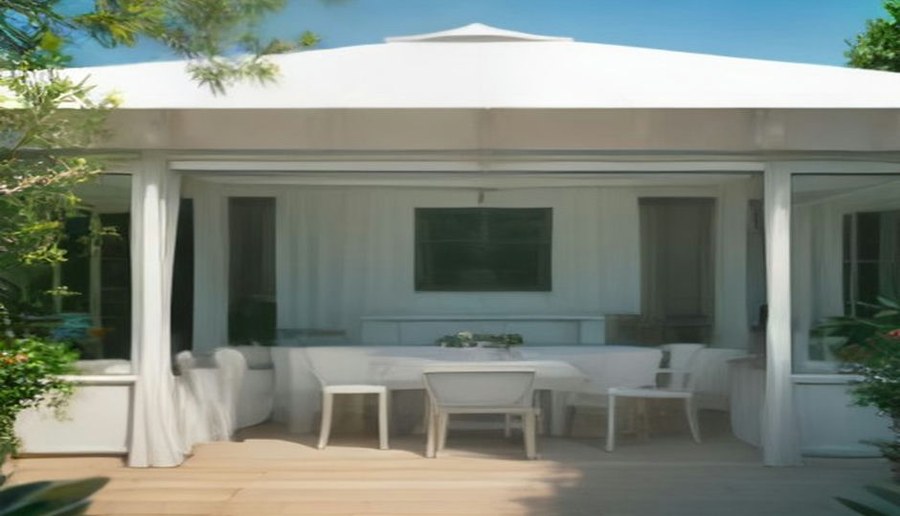
Custom Pagoda Tents
Framed modules 3×3-6x6m
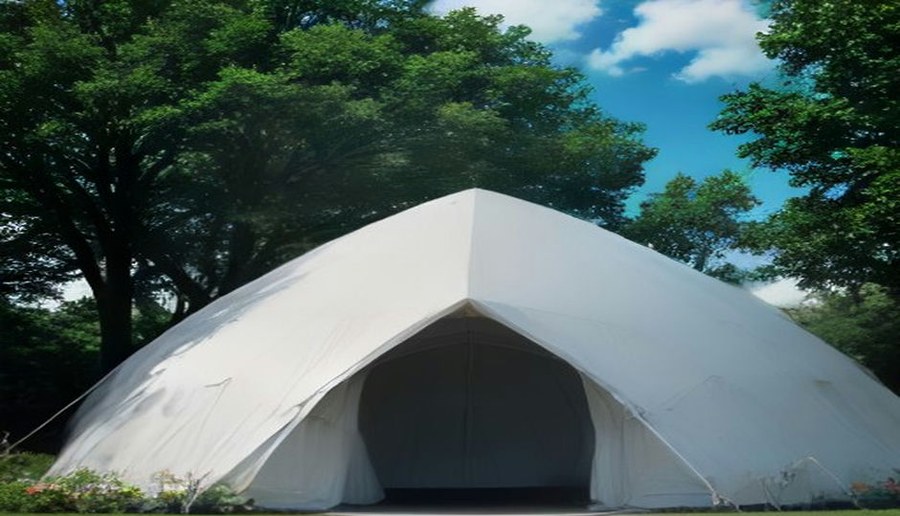
Custom Dome Tents
Round kiosks 3-6m
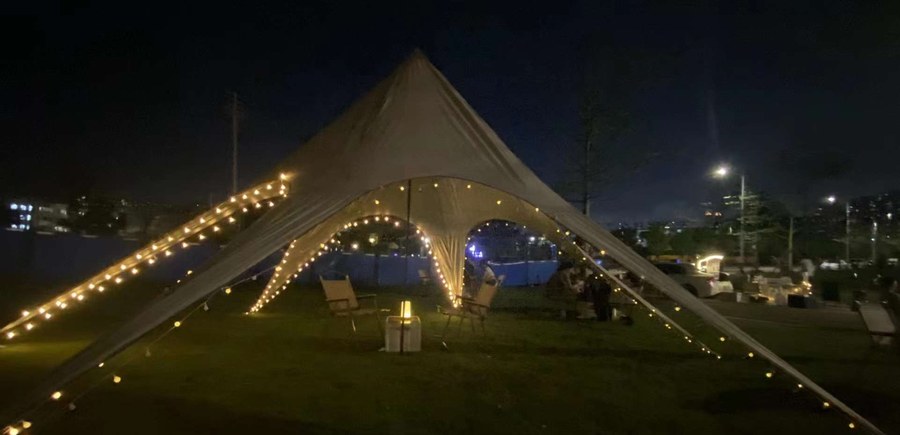
Custom Star Tents
Open shade 5-16m
Tell us the tent size, the ground and weather it has to handle and the destination market. Our tent specialists reply within 1 hour, 24×7 online service, with a free mockup, written specifications and factory-direct pricing.