Phone:
0086-757-8938 9313
Email:
Address:
Caochang Industrial Zone, Liguang Rd, Lishui, Nanhai, Foshan, Guangdong, China
24/7 online services

Phone:
0086-757-8938 9313
Email:
Address:
Caochang Industrial Zone, Liguang Rd, Lishui, Nanhai, Foshan, Guangdong, China
24/7 online services
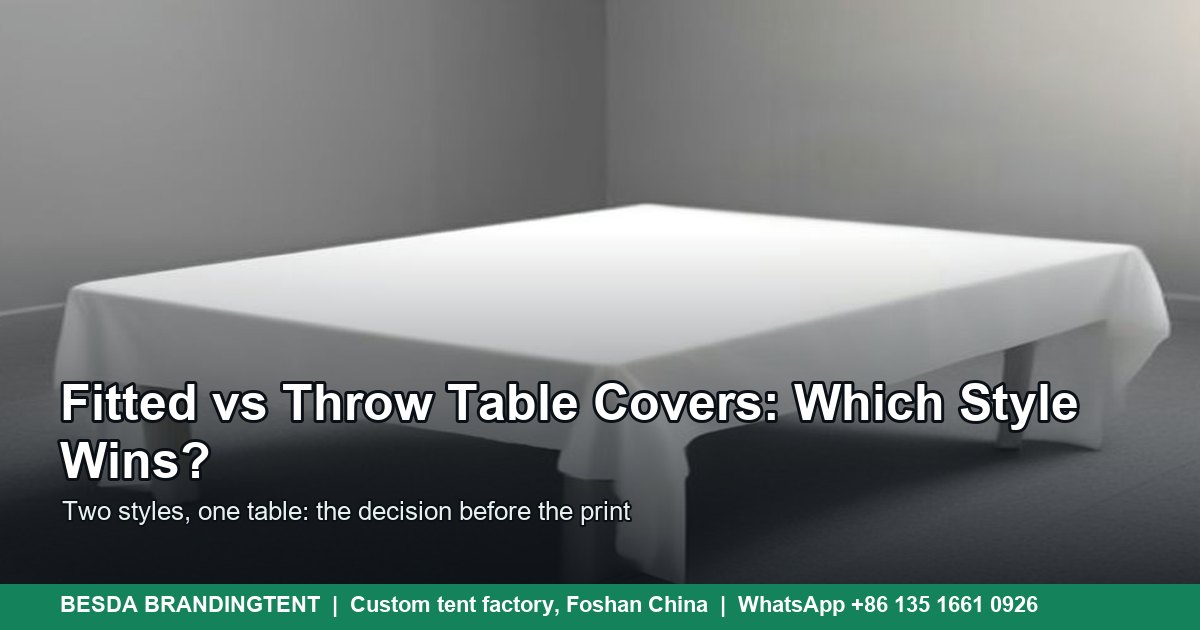
Fitted table covers and throw covers are the same cloth with two different jobs, and the choice shows before your logo does. A fitted cover is sewn to the table and reads as a piece of furniture. A throw drapes over whatever table it meets and reads as a classic expo display. Pick the style from how the table is used, how often tables change size and how hard the cover travels, and the print does its job on top. These are event-grade dressing tools for booths, halls and hospitality counters, not clear-span marquee halls, and the sizes below are the figures we sew to, confirmed against the table before a single panel is cut.
Both styles are polyester sewn into a cover for a folding or trestle table. The difference is geometry. A fitted cover is cut to one table size, top plus four sides, with corners cut to shape so the fabric follows the table edge. A throw is a flat panel, wider and longer than the top, that falls wherever gravity takes it. Three details decide how each behaves on the floor:
One line separates the families: fitted is furniture, throw is drapery. Everything else in this guide follows from that line.
Buyers arrive asking about printing and leave talking about corners, because the style decides where the eye lands. On a fitted cover, the front panel is a flat billboard at the standing eye height of about 1500 to 1700 mm, so a registration desk with a printed front becomes the busiest signage in the booth. On a throw, the same print falls into vertical folds, which flatters a big emblem and hides a small web address. Five buyer groups split the two styles in practice:
| Feature | Advantage | Benefit |
| Sewn corners matched to the table size | The cover reads as furniture, not as cloth thrown over a board | Visitors lean on the table without the cover sliding, and the booth looks staffed |
| Full panel printing on the front face | The logo sits at the eye height of a standing visitor | One glance connects the table to the booth signage above it |
| One-piece construction | No clips, pins or velcro to lose between events | Setup is a drop and a tug, and the cover cannot be assembled wrong |
| Replacement panels ordered as parts | A stained cover does not retire the booth kit | The table, the frame and the graphics all live separate lives |
| Throw covers in one weight class | A single bin serves the 4 ft and the 8 ft table | Rental fleets restock one SKU instead of five |
| Fire certificate paperwork on request | Fabric documents with the standard and scope named | Venue forms for public halls get signed without a chase |
The third style keeps entering the conversation, so the honest table has three columns. Stretch covers behave like fitted covers with elastic; they need the exact table size and reward it with the cleanest lines on the floor. Throws trade the precise fit for forgiveness, and forgiveness is worth more than tailoring when the table count changes between venues.
| Feature | Fitted cover | Throw cover | Stretch cover |
| How it fits | Top and four sides sewn to the table size, corners cut to shape | One flat panel draped over the top, falls loose on three or four sides | Elastic fabric pulled over the top like a second skin |
| Size tolerance | None to speak of: a 6 ft cover fits a 6 ft table | Forgiving: one throw serves two table lengths | None: spandex needs the exact table size |
| Setup time | 30 to 60 seconds, drop and square the corners | Under a minute, drape and level the drop | 1 to 2 minutes, stretch each corner over the table |
| Look | Crisp, precise, reads as a permanent counter | Soft vertical folds, classic expo look | Smooth, modern, hugs every edge |
| Storage between uses | Folds flat, stacks by size | Folds flat, one bin serves all sizes | Folds small, must stay dry and unstretched |
| Best at | Registration desks, bars, reception counters | Fast room resets, mixed table fleets | Product displays and premium booth tables |
| Weak point | Wrong table length shows immediately | Loose sides catch knees and trolleys | Snags on rough floors, loses shape if stored stretched |
A pattern from hire fleets: the first order is throws, because the fleet is small and mixed. The second order adds fitted covers for the two tables that appear in every job, the registration desk and the bar. By the third season the stock splits about half and half, and nobody debates the choice anymore, because each style has found its tables.
Sizing starts with the table, and the standard folding table family is consistent worldwide: 4 ft tables run 48 x 24 inches on top, 6 ft tables 72 x 30, and 8 ft tables 96 x 30, all at 30 inches high. Cocktail rounds and counter squares follow the same logic with a 42 or 36 inch height. A fitted cover is cut about 25 mm over the table top dimensions so it drops without strain, and a throw is cut wide enough to fall past the fold line.
| Table size | Table top (in) | Table height | Fitted cover (typical) | Throw cover (typical) |
| 4 ft | 48 x 24 | 30 in | about 49 x 25 x 30 in | about 64 x 24 in drop |
| 6 ft | 72 x 30 | 30 in | about 73 x 31 x 30 in | about 88 to 96 x 30 in drop |
| 8 ft | 96 x 30 | 30 in | about 97 x 31 x 30 in | about 102 to 120 x 30 in drop |
| Cocktail, 32 in round | 32 dia | 42 in | about 33 dia x 42 in | about 64 in square drop |
| Counter, 24 in square | 24 x 24 | 36 in | about 25 x 25 x 36 in | about 48 in square drop |
Two measurement habits prevent returns. Measure the table, not the catalogue, because trestle tables and folding tables differ by 25 to 50 mm in width at the same nominal length. And measure the height with the legs locked, because a worn locking tab can leave one corner 10 mm short, and a cut-to-shape corner shows exactly that.
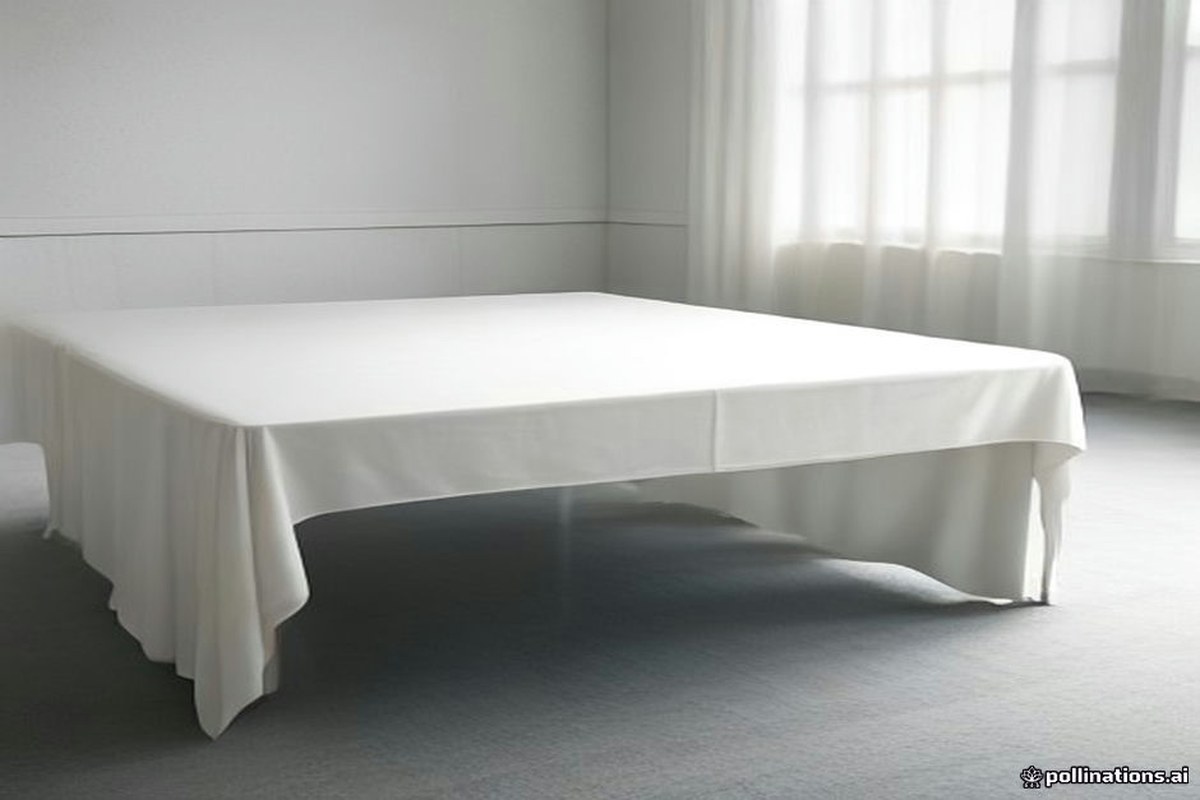
The same cover answers to local names and slightly different defaults. North American buyers order fitted covers and table throws in 6 ft and 8 ft with a printed front panel. UK halls ask for the same object as a fitted tablecloth, plus fire retardancy documents at the door. German buyers spec Tischueberwurf in exact centimetres with DIN 4102 B1 fabric, French buyers want a heavy nappe with a clean hem, and Gulf activations run white and gold sets through hotel seasons.
| Market | What buyers call it | Buying habit |
| United States, Canada | fitted table cover, table throw, expo cloth | Orders 6 ft and 8 ft sets with a printed front, asks about wash cycles |
| United Kingdom, Ireland | fitted tablecloth, promotional table cover | Wants 6 ft for halls and asks for fire retardancy documents |
| Germany, Austria, Switzerland | Tischueberwurf, Tischbanderole | Asks for DIN 4102 B1 fabric and precise cm sizes |
| France, Belgium | nappe publicitaire, housse de table | Values a heavy drape and a clean hem on the front face |
| Spain, Mexico, Chile | mantel publicitario, funda para mesa | Prints full colour front panels for fairs and school events |
| Brazil | toalha de mesa personalizada | Checks colour fastness after wash in humid weather |
| Australia, New Zealand | trestle table cover, fitted table cloth | Specs 6 ft and 8 ft trestle sizes for markets and expos |
| Middle East | table cover with logo, branded table cloth | Hotel and mall activations, white and gold colourways in season |
Regional colour habits matter as much as style. LatAm fairs print saturated front panels on mantel publicitario stock, Australian markets run 6 ft trestle covers that survive weekly washing, and European auto associations pair grey throws with printed fitted fronts on the same table. The cover is the same product; the floor decides the styling.
A straight answer, because the wrong style is a wasted panel. If the table fleet changes size every week, a fitted cover per size is a warehouse problem, and one throw weight class solves it. If the cover works outdoors in wind, both styles act like sails over a light table; ballast the table or step down to a shorter drop. If the table carries hot equipment, no polyester cover belongs there; use a coated oxford panel and a trivet. And if the brief expects the cover to replace a built counter, it will not: a folding table with a fitted cover is event-grade furniture, not a joinery counter, and a printed stretch cover will not make it one.
The reverse also holds. Buyers who buy throws for a permanent reception counter save money twice and regret it daily, because the precise look is exactly what the front desk needed.
Run the list in order and the style picks itself:
1. List the tables by size. Count how many distinct top sizes the event or the fleet actually runs.
2. Mark the featured tables. Registration, bar and display tables earn fitted covers; back tables take throws.
3. Check the wash cycle. Weekly washing pushes toward 250 to 300 gsm throw weight or coated fitted stock that survives the drum.
4. Decide the print position. Front panel at eye height for fitted, larger emblem lower on the drop for throws.
5. Test the venue rules. Fire retardancy documents and open-flame distance rules differ per hall; ask before the order, not at the door.
6. Plan the colour system. One colour family across both styles reads as a booth; two families reads as two suppliers.
7. Order replacements as parts. Confirm the cover is available as a reorder against the table size, so a stained panel never retires the booth kit.
Fabric decides how the print ages. Poly poplin at about 120 to 200 gsm takes dye-sublimation ink deep into the weave and stays crisp, which is why fitted covers sew from it. Throw weight polyester at about 250 to 300 gsm, sold in the United States as 8.8 oz per square yard, drapes dense and resists wrinkles in a carton. Stretch blends at 160 to 220 gsm hug the table but snag on rough floors, and coated oxford at 190 to 350 gsm wipes clean for food service.
| Fabric | Typical weight | Behaviour | Best job |
| Poly poplin | about 120 to 200 gsm | Smooth weave, takes dye-sub print, wrinkles if packed damp | Fitted covers with front panel printing |
| Polyester throw weight | about 250 to 300 gsm, sold as 8.8 oz per sq yd | Dense drape, resists wrinkles, forgiving on uneven tables | Throw covers that travel between venues |
| Stretch spandex blend | about 160 to 220 gsm | Four way stretch, hugs corners, snags on rough ground | Fitted stretch covers on display tables |
| Coated oxford | about 190 to 350 gsm | Wipeable surface, stiffer drape | Food service and outdoor counters |
| Heritage canvas | about 300 to 400 gsm | Heavy, matte, theatrical drape | Premium brand rooms and stage props |
Printing rules follow the fabric. Dye-sublimation on polyester is the default, because the ink bonds into the fibre and survives folding and washing; screen print suits one-colour marks on throw stock; and heat transfer fills the middle for short runs. Artwork arrives as vector at 150 to 300 dpi at full size with 5 mm bleed, Pantone C references for brand colours, and a layout that shows the front panel, the drop and the hem before cutting starts.
A cover order is a sewing order, so the clock runs on fabric and cut time. The sequence below is the one we operate for fitted, throw and stretch batches:
| Stage | What happens | Typical time |
| Brief | Table sizes, style, print zones, quantity, venue rules | Same day |
| Spec sheet and layout proof | Written sizes, fabric weight, print area map | 1 to 2 days |
| Sample or photo proof | One sewn sample or a printed panel photo | 2 to 4 days |
| Order confirmation | Deposit, packing list, delivery terms | 1 day |
| Production | Cutting, printing, sewing, QC per batch | 7 to 12 days |
| Pre-shipment check | Batch photographed on the reference table, packed by size | 1 day |
| Shipping | Express for samples, sea for bulk cartons | Route dependent, sea 18 to 35 days |
Lead time runs about 7 to 12 days in production after artwork approval, plus freight. Cartons pack by size, about 0.03 to 0.06 CBM per 50 covers depending on weight, which lets a distributor restock a colour inside one carton row. Low MOQ accepted on first orders and wholesale pricing scales with quantity, so the pilot event can run 20 covers while the season order waits for the proof.
Care rules are short and strict. Cold wash on a gentle cycle, hang dry or tumble low, and fold on the seam lines with the print facing out. Bleach and hot dryers lift dye-sub prints as fast as they lift stains. Iron the fitted panels on the reverse at low heat if a hall demands sharpness, and never iron directly over a printed front. For storage, one labelled bin per size keeps the fleet countable, and a damp storeroom ruins more covers than a hundred events do.
Between seasons, run one cover through the wash and compare it against a new panel under daylight. That five minute check tells you whether the print supplier, the wash chemical or the storage shelf is eating the fleet, and it is the difference between reordering covers and reordering trust.
Fitted versus throw is not a fashion debate, it is a workflow decision. Fitted covers belong on the featured tables that carry the brand at eye height; throws belong on the changing tables that carry the workload. Measure the tops, split the fleet by job, match the colour system across both styles, and reorder covers as parts. A booth that does this once never thinks about it again, and the print does the talking on every table in the room.
A fitted cover is sewn to the table: the top and four sides are cut to one table size, so the corners stay crisp and the cover moves with the table. A throw is one flat panel draped over the top, letting the fabric fall in folds on the sides. Fitted looks crisp and permanent; throw looks soft and classic, and it forgives a fleet where table lengths vary.
A standard 6 ft folding table measures 72 x 30 x 30 inches, so the fitted cover is cut at about 73 x 31 x 30 inches to sit over the top and legs without strain. Order by the table measurement, not by the name, because a 6 ft trestle and a 6 ft folding table differ by an inch or two in width and the cut-to-shape corners show every millimetre.
Yes, and that is the throw style reason to exist. A throw sized for an 8 ft table drapes lower on a 6 ft table, and a throw sized for 6 ft leaves the table legs visible on an 8 ft. Rental operations standardise on one mid-size throw, usually about 88 to 96 inches wide, and accept the different drop lengths in exchange for one bin that fits every table in the van.
Both take dye-sublimation cleanly, but the front face behaves differently. On a fitted cover the printed front panel stays flat and the logo reads like signage. On a throw, the printed front falls in soft folds, which flatters large artwork but distorts small text. Keep type above 25 mm cap height on throws, and put fine print on fitted panels or on the table top instead.
Cold wash on a gentle cycle, hang dry or tumble on low, and fold on the seam lines while the fabric is fully dry. Skip bleach, because it lifts the print as fast as it lifts the stain. Stretch covers need one extra rule: never store them stretched over a table, because the elastic memory relaxes and the next fit loses its snap.
Yes, and it is the usual answer for a mixed booth. Fitted covers on the registration counter and the bar, where the precise look matters, and throws on the back tables, where stock moves and trolleys bump. Match the colour across both styles so the booth reads as one system, and print the front logo in the same position on each style.
Many venues ask for fabric flame retardancy documents before doors open. The common requests are NFPA 701 or CPAI-84 in North America, EN 13501-1 in Europe and DIN 4102 B1 in Germany. Ask for the certificate copies with the test scope stated, keep a PDF with the shipment, and the fire officer signs the form on the morning instead of holding the booth.
| Item | Detail |
| Manufacturer | Besda BrandingTent, display and tent factory in Foshan, China, since 2010 |
| Product scope | Fitted, throw and stretch table covers for 4 ft, 6 ft and 8 ft tables, plus cocktail and counter sizes |
| Fitted covers | Top and four sides sewn to the exact table size, standard heights 30 and 36 in |
| Throw covers | One draped panel, about 250 to 300 gsm polyester, forgiving on mixed table fleets |
| Stretch covers | Spandex blend about 160 to 220 gsm, sized per table, hugs the corners |
| Printing | Dye-sublimation on polyester, front panel or full wrap, Pantone C references matched |
| Standard tables | 4 ft: 48 x 24 x 30 in, 6 ft: 72 x 30 x 30 in, 8 ft: 96 x 30 x 30 in |
| Care | Cold wash, low tumble or hang dry, fold on the seam lines, store dry |
| Fire certificates | EN 13501-1, CPAI-84, NFPA 701, DIN 4102 options, copies on request with scope |
| Low MOQ | Low MOQ accepted, wholesale pricing scales with quantity |
| Lead time | About 7 to 12 days after artwork approval, faster for repeat panels |
| Contact | WhatsApp +86 135 1661 0926, [email protected], reply within 1 hour |
Related reading: Trade Show Table Covers: 6ft vs 8ft, Throw vs Stretch · Table Cover Logo Placement: Print Zones That Sell · Event Display Kit: Tent, Flags, Table Cover, Roll-Up · Pop Up Display vs Roll Up Banner: Which Booth Backwall? · Custom Tent Printing: Dye-Sub vs Screen vs Transfer
💬 Chat on WhatsApp Now✉ Email Us Now
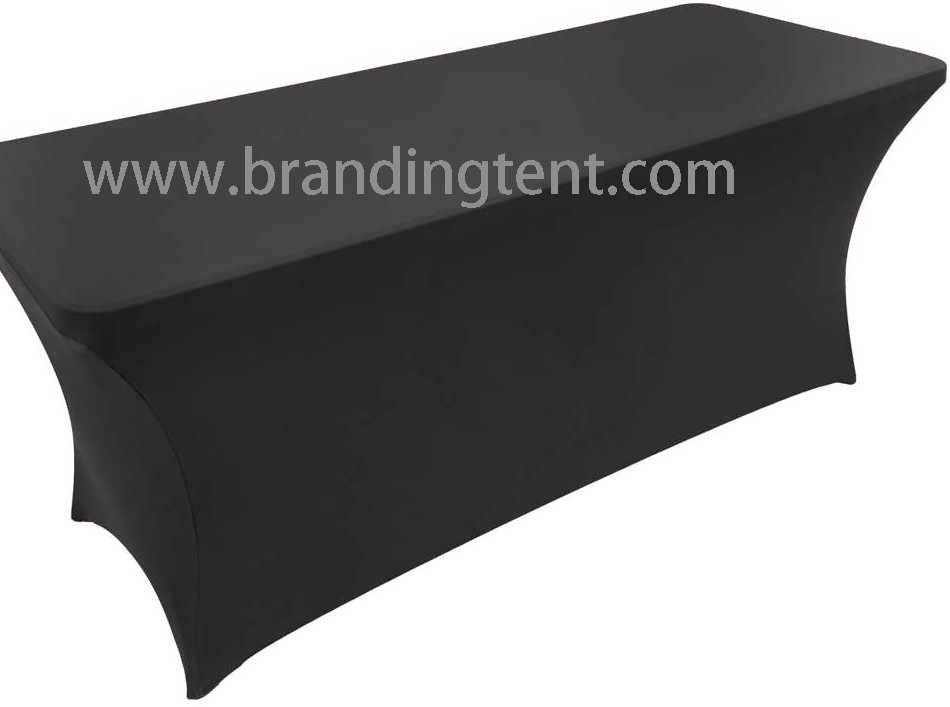
Custom Table Covers
Fitted, throw and stretch styles
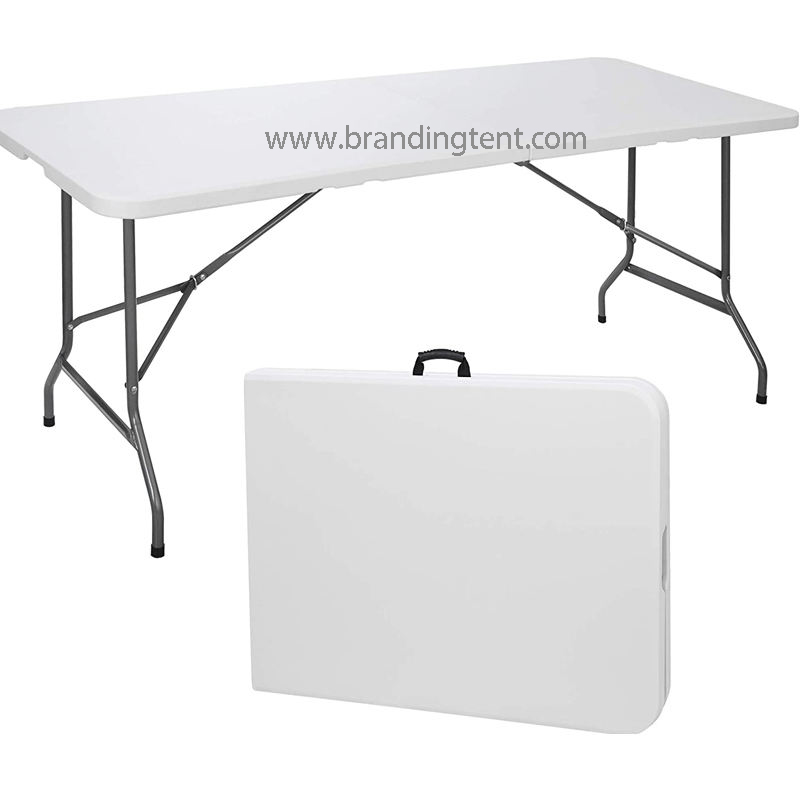
Custom Outdoor Tables
Folding tables for 4 to 8 ft booths
Custom Roll Up Banners
Cassettes 610 to 1500 mm wide
Tell us the tent size, the ground and weather it has to handle and the destination market. Our tent specialists reply within 1 hour, 24×7 online service, with a free mockup, written specifications and factory-direct pricing.