Phone:
0086-757-8938 9313
Email:
Address:
Caochang Industrial Zone, Liguang Rd, Lishui, Nanhai, Foshan, Guangdong, China
24/7 online services

Phone:
0086-757-8938 9313
Email:
Address:
Caochang Industrial Zone, Liguang Rd, Lishui, Nanhai, Foshan, Guangdong, China
24/7 online services
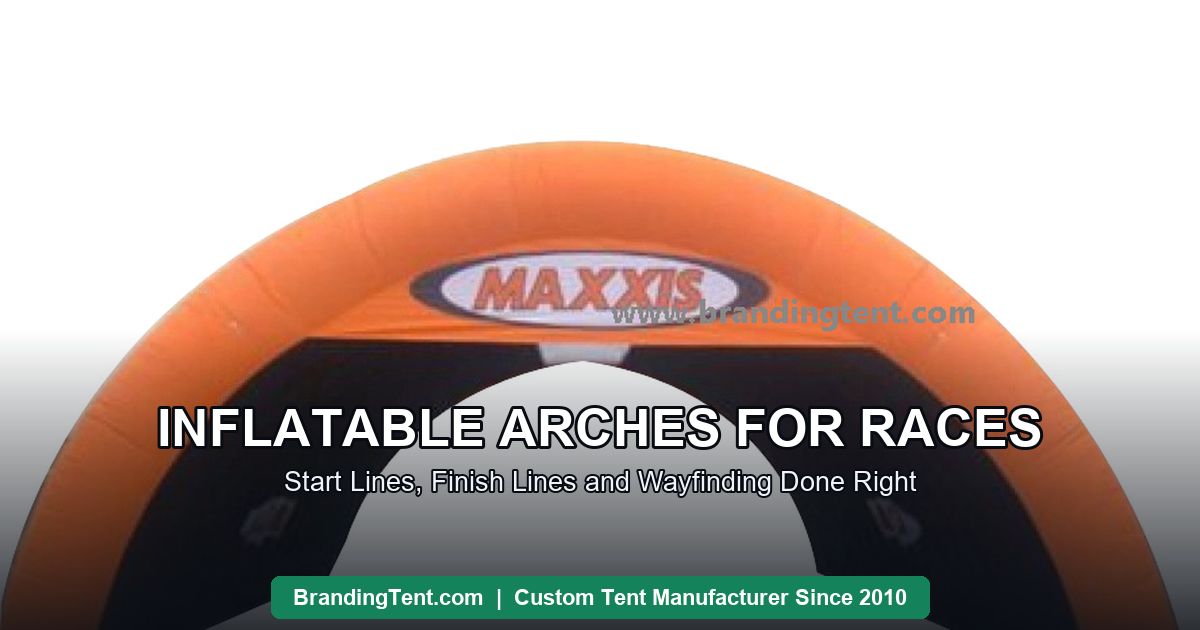
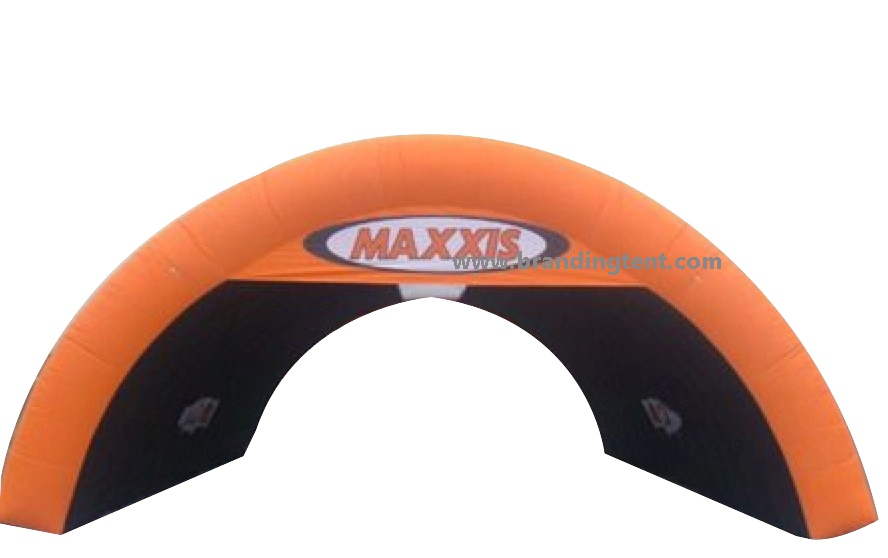
Every race has one image that outlives the results: the arch at the line. Runners frame it, sponsors brand it, the clock hangs from it, and the finish photo circulates for years. An inflatable arch for races is that image made portable, airtight chambers, full-span print, up in minutes on a road that opens again the same evening. But race arches are also the category with the most sizing confusion in the industry: the same “10m arch” can mean three different measurements, and the mistake surfaces at setup, not at purchase. This guide covers the span and height classes, the shapes and leg options, the sizing language to nail down in writing, and the race-day logistics that make the arch the calmest item on your checklist.
A race arch is an inflatable span on two feet: airtight chambers welded along a curved or angled profile, printed edge to edge, anchored at the legs. It belongs to the airtight family, sealed chambers hold pressure without a running blower, which is why arches deploy at remote road closures where no generator exists.
1. One-person top-ups. Airtight chambers need occasional valve top-ups, not a live power line at the start corrals.
2. Full-span print. The entire arch is a billboard: title sponsor center, supporters on the legs, distance and date worked into the geometry.
3. Fast cycles. Inflate, anchor, brand, and strike into one bag when the road reopens.
Industry ranges (typical manufacturer classes) give you the vocabulary to compare quotes:
| Class | Span | Height options | Leg diameter | Feeds |
| Compact | ~4-5m (13-16ft) | ~3m (10ft) | ~0.45m (1.5ft) | Community runs, school events |
| Standard | ~6-7.5m (20-25ft) | 3-4.5m (10-15ft) | ~0.6m (2ft) | City races, triathlons, sponsor lines |
| Large | ~9-15m (30-50ft) | ~5.5m (18ft) | ~0.9m (3ft) | Marathons, expo entrances, venue gates |
Tiered size examples from working catalogs: 13ft×6ft, 16ft×9ft, 20ft×10.7ft, 26ft×14ft, 33ft×17ft, and a compact favorite at 16ft long × 8ft high. Shapes run angled, round (dome-profile) and square; angled and round dominate road races.
The classic race-arch failure is linguistic, not structural. When a buyer says “we need a 10m arch”, three different measurements are in play:
1. Outside width, the total footprint including legs and feet.
2. Top span, the clear distance between the inner faces of the legs (what runners actually run through).
3. Total height, ground to the top of the curve (what the finish-line camera and the TV crane care about).
The fix is one sentence in the RFQ: “clear span X meters, total height Y meters, overall width Z meters, please confirm all three.” Ask for the assembled dimensions in writing, matched to your road width and timing-gantry plan. Race directors who do this never discover a 9m clear span under a 10m banner on race morning.
1. Hard standing. Road closures mean no stakes: ballast at every leg and every guy point, sized per the wind protocol, arches present a big sail at exactly the height that catches gusts.
2. Grass venues. Stakes plus guy lines are the strongest hold; count the anchor points into the site plan so the start corral does not migrate into them.
3. Timing and TV loads. Clocks, banners and camera arms hang from the arch, confirm payload and rigging points with the factory before the hanging plan is drawn.
1. Inflate on site. Airtight chambers fill from a portable blower in minutes; no generator at the start line.
2. Stage the valve top-ups on a printed checklist. One volunteer with a checklist tops valves at flag-off and mid-race, pressure checks are a habit, not a rescue.
3. Wind protocol. Arches at 3-5.5m height in open road corridors feel gusts early: pre-set the deflation plan, brief the crew, and follow the take-down triggers from the wind guide without a committee.
4. Strike the road. Deflate, dry if the morning was damp, fold along the chambers, count the anchor kit, and the road reopens on schedule.
1. Every runner photo carries it. Finish-line photography is the race’s longest-tail media; the arch is in every frame.
2. Leg space sells. Sponsor panels on the legs outlast the title cycle, printed legs turn one arch into a renewing inventory.
3. Multi-race programs. A race series amortizes one arch across every event date: reprint the span banner per race or order replaceable banner wraps.
Honest limits: multi-week installations and permanent gateways belong to engineered structures (an aluminum arch frame entrance stands for months where an airtight arch stands for days); venues without any anchoring option cannot host a 5.5m sail responsibly; and extreme-wind forecasts are a deflation call, never a debate. For small community runs, a compact 4-5m arch usually serves better than the largest span the budget can stretch to.
Race series and timing companies amortize one arch across every event date, and the print inventory decides how cleanly that works. Title sponsorship that changes per race belongs on replaceable span banners; the permanent identity (race brand, timing partner, municipality) belongs printed on the chambers. Order the replacement banners with the arch so the batch colors match, and the mid-season sponsor swap becomes a two-minute velcro job instead of a reprint negotiation.
The same logic covers multi-club programs: one arch shared across a league ships in one labeled kit with a per-venue anchor plan, grass stakes for park runs, ballast for closed-street finishes. Series that standardize one arch family also standardize crew training, spares and the setup card; by race three, the start line is the calmest checkpoint on site, and the sponsors notice the difference in every start-line photo.
Race mornings run on a kit list, not on memory: the arch bag, portable blower and top-up hose, ballast or stakes sized to the road-closure plan, guy lines with tensioners, the printed anchor map, gaffer tape, and the timing-gantry rigging hardware. Add the soft items that race crews never regret: spare valve gaskets, a patch kit, cleaning wipes for the print face, and a one-page weather-call card with the deflation triggers written down.
Count the kit at strike, every race, in front of the van, the anchors that migrate between events are the ones nobody counted. Series that run the same kit card at five races discover their setup time halves by race three, and the volunteer briefing becomes a two-minute read instead of a rehearsal, and the printed anchor map in the kit is the reason it reads that fast.
Race culture changes what the arch is for. United States marathon and triathlon crews hang precision clocks and care about the TV sightline; UK charity runs and park-style events often hire the arch for a single weekend, where setup speed outweighs everything; Australia and New Zealand crews plan for hard sun and their local naming habits; France briefs a gonflable; Latin America asks for carpas inflables or arcos for carreras, often on mixed surfaces; Brazil writes tenda inflavel and adds 127V/220V power notes to the same email. Same airtight product, different opening questions.
| Feature | Advantage | Benefit |
| Welded airtight chambers | Deploys without power, holds for days | A start line that stands anywhere the road closes |
| Full-span print | Title and supporters read from 30m | Every finish photo carries the sponsor |
| Replaceable span banners | Swap title sponsorship per race | One arch becomes a whole season of inventory |
Read the table as a quote-comparison tool: every supplier can name features, but the ones worth a deposit can walk the advantage and benefit columns without prompting. That is the conversation that separates a race-line product from a pretty inflatable.
An inflatable race arch is the cheapest permanent-looking structure a race can own: airtight chambers, full-span sponsor print, minutes of setup on a road that reopens the same day. Nail the three measurements in writing, anchor like the wind guide says, hang the clock from confirmed rigging points, and every finish-line photo for the next decade carries your brand.
| Fact | Detail |
| Manufacturer | Besda BrandingTent, a direct factory in Foshan, China: manufacturer, wholesaler and exporter since 2010. Not a retailer. |
| Products | Custom tents (pagoda, dome, star, inflatable, canopy, arc), feather flags, roll up banners, table covers, tradeshow displays and outdoor tables. |
| Inflatable structures | Airtight (sealed-air) and continuous-airflow models; blowers specified in writing (wattage, voltage, plug, spares) and air beams pressure-tested before packing. |
| Arc / frame structures | Curved aluminum arch canopies and hexagonal-aluminum frame tents; alloy temper, wall thickness and connector material stated in every quotation. |
| Materials | 300D–600D oxford with PU coating or 0.55mm PVC; powder-coated steel or hexagonal aluminum 40/50/60mm frames. |
| Printing | Full-color dye-sublimation (CMYK + Pantone matching), panels printed before assembly. |
| Certificates | Fire-retardant fabric options (NFPA 701 / CPAI-84 / DIN 4102 B1 / EN 13501-1 on request). |
| MOQ & pricing | Low MOQ accepted; wholesale pricing from 5+ pieces; bulk orders preferred and priced accordingly. |
| Lead times | Sampling 3–7 working days; bulk production 7–15 days; worldwide shipping from Shenzhen/Guangzhou. |
| Quality gate | Every unit fully assembled and QC-checked, with photo/video approval before packing. |
| Buyer terms by market | US: canopy tent · UK: pop-up gazebo · AU/NZ: folding marquee · France: barnum / tente pliante · Germany: Faltpavillon / aufblasbares Zelt · LatAm: carpas publicitarias · Brazil: tenda personalizada. |
| Contact | WhatsApp +86 135 1661 0926 · [email protected] · reply within 1 hour, 24×7 online service. |
💬 Chat on WhatsApp Now✉ Email Us Now
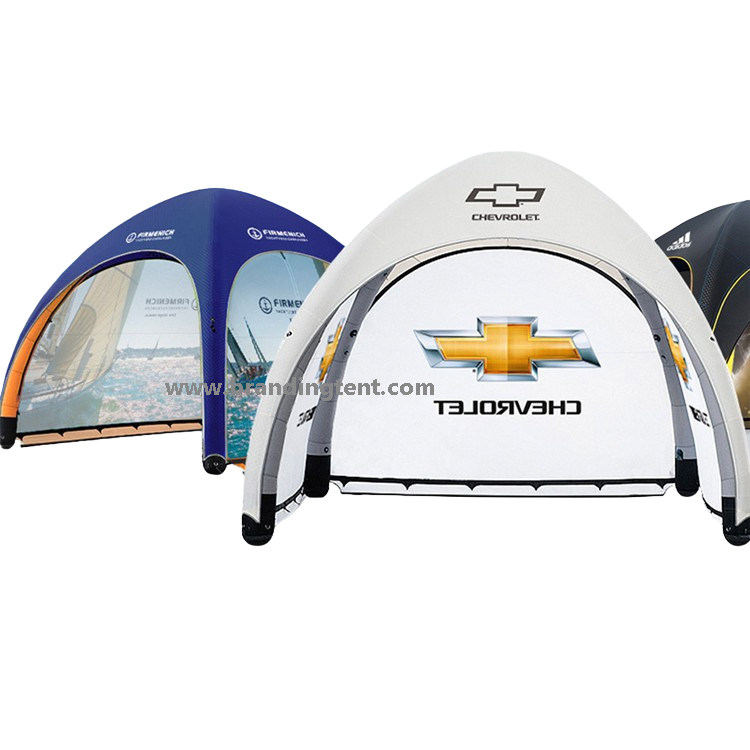
Custom Inflatable Tents
Airtight and continuous-airflow structures
Custom Pagoda Tents
High-peak marquees, 3×3-6x6m, connectable
Custom Dome Tents
360-degree brand stages for events
More: inflatable tent types guide · airtight vs continuous-airflow · wind resistance protocol · full FAQ
Tell us your event scenario, size and logo file. Our tent specialists reply within 1 hour, 24×7 online service, with a free mockup, written specifications and factory-direct pricing.
Typical spans run 4-15m (13-50ft) with heights around 3-5.5m and leg diameters of about 0.45-0.9m. Tiered catalog examples include 13ft×6ft up to 33ft×17ft. Always confirm clear span, total height and overall width separately in writing.
Because “10m arch” can mean overall width, clear span between legs, or total height, three different structures. State all three measurements in the RFQ and demand the assembled dimensions in writing.
Usually no, race arches are typically airtight (sealed chambers that hold pressure for days), inflated once from a portable blower with occasional valve top-ups. Continuous-airflow versions exist for large spans with power on site.
Ballast at every leg and guy point, stakes are banned on tarmac. Size the ballast per the wind protocol and confirm the anchor plan in the road-closure paperwork.
Yes, within confirmed payload limits, request the rigging points and maximum hanging load from the factory before designing the timing-gantry plan.
Low MOQ accepted for samples; wholesale pricing scales from 5+ pieces. Sampling 3-7 working days after artwork approval, bulk 7-15 days by quantity, order before race season, not during it.