Phone:
0086-757-8938 9313
Email:
Address:
Caochang Industrial Zone, Liguang Rd, Lishui, Nanhai, Foshan, Guangdong, China
24/7 online services

Phone:
0086-757-8938 9313
Email:
Address:
Caochang Industrial Zone, Liguang Rd, Lishui, Nanhai, Foshan, Guangdong, China
24/7 online services
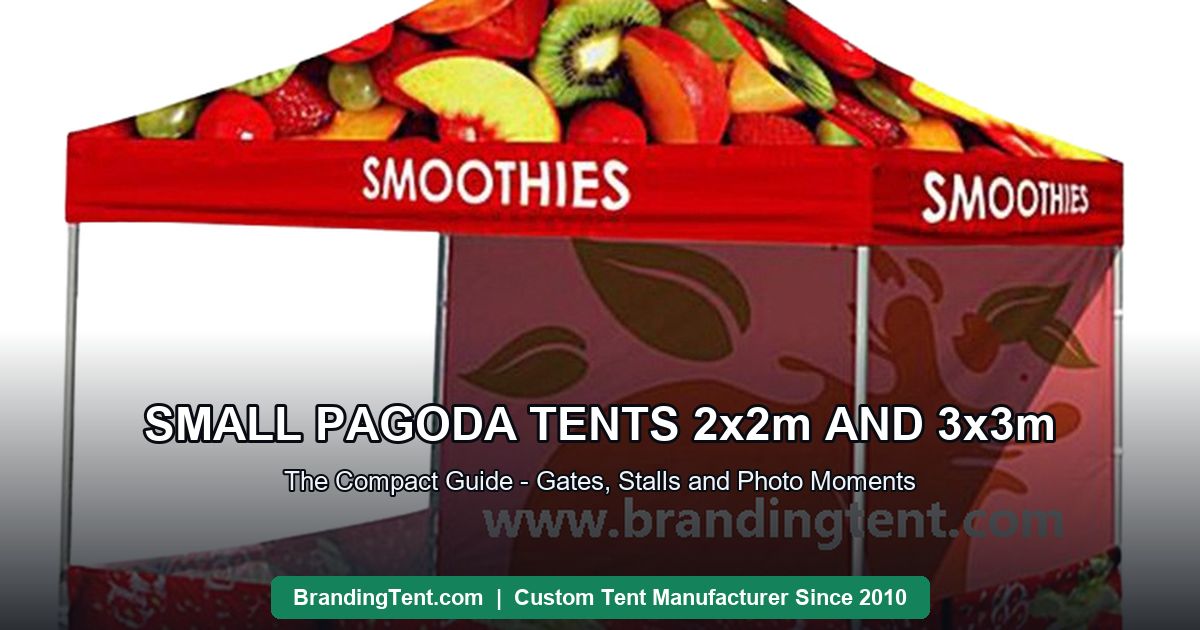
Not every pagoda needs to be a pavilion. The small pagoda tent — 2x2m and 3x3m — carries the same high-peak silhouette that reads from across a venue, scaled to entrance gates, market stalls, photo moments and registration points. Compact high-peak tents are the category’s quiet workhorses: they fit pitches that reject 4m footprints, they raise with one person, and they deliver the same architectural presence per meter as their big siblings. This guide covers where small pagodas genuinely win, the 2x2m vs 3x3m decision with specs and capacity math, print advice for small panels, and the honest cases where a plain pop-up is the smarter compact buy.
The family runs from 2x2m gate units through 2.5×2.5m mid-steps to the 3x3m market standard — the same high-peak geometry, valance skirt and optional walls as the 6x6m modules, on lighter aluminum frames. What separates a good small pagoda from a toy is specification continuity: a 3x3m pagoda should still name its fabric numbers (300D-600D oxford, PU coating, gsm) and frame grade (hexagonal aluminum 40mm class, 1.0mm+ wall), because the small size is exactly where cheap builds hide.
| Size | Footprint | Standing | Seated | Typical job |
| 2x2m | 4 m² | 3-4 | — | Entrance gates, photo points, ticketing |
| 2.5×2.5m | ~6 m² | 5-6 | 2-4 | Compact stalls, sampling, welcome desks |
| 3x3m | 9 m² | 8-10 | 4-6 | Market stalls, bars, brand hubs, registration |
Two planning notes. First, quoted sizes are leg-to-leg; the valance overhang makes small tents photograph larger than they measure — budget floor space by the number, not the silhouette. Second, height rules: small pagodas still carry a peak, so venue height caps that ignore small tents on plan may count them at check-in. Confirm measured heights in the RFQ.
1. Entrances and gates. A 2x2m or 3x3m printed pagoda turns a fence line into a branded threshold — arrival photography happens here, and the high peak stays in frame.
2. Market and street pitches. Traders on tight frontages want silhouette without footprint: the small pagoda fits pitches that reject 4m modules while keeping the architecture that plain canopies lack.
3. Registration and welcome points. One volunteer, one table, one unmistakable roof — the 3x3m is the calmest registration desk in the field.
4. Photo moments and activations. Compact printed peaks are the booth that looks like content; brand teams use 2x2m units as punctuation between larger structures.
5. Bars and espresso points. A 3x3m pagoda with a half wall and a counter is the smallest thing that feels like a destination.
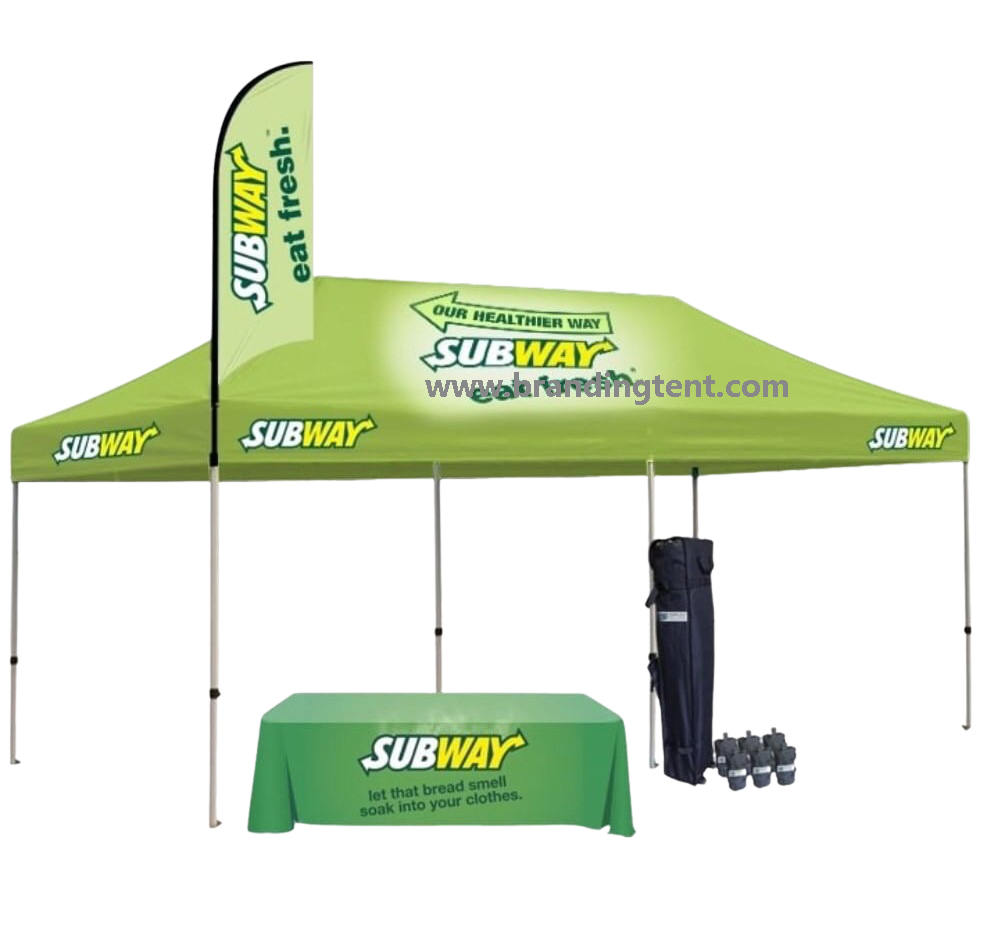
Choose 2x2m when the job is a threshold, a single staffer, or a photo frame — and accept that a table plus visitors barely coexists inside it.
Choose 3x3m for anything with a counter, two staff, or a queue: it is the smallest footprint that works as a booth rather than a landmark. Most fleet buyers standardize 3x3m and add a 2x2m only as a dedicated gate unit.
Choose bigger the moment seating enters the brief — tables want the 4x4m-and-up module sizes covered in the pagoda sizes guide.
1. Simplify. Small panels carry fewer words: a logo, a one-line promise, a QR point. Cramming a brochure onto 2x2m reads as noise from three meters away.
2. Use the valance. The four-sided skirt is prime real-estate at eye level — repeated logo ticks read from every approach.
3. Match the family. Order small units in the same production batch as larger ones so roster colors match across a tent village; batch color continuity is the difference between a program and a patchwork.
Honest limits: a 2x2m is not a booth — it is a landmark; if visitors must transact inside it, step up. A small pagoda is overkill where a plain pop-up does the same job for less (windless indoor lanes, one-off stalls, storage-constrained volunteers). And the whole high-peak family is wrong when flat shade per dollar is the only metric — that argument belongs to standard canopies, and we will point you there rather than pretend otherwise.
1. Footprint and height — measured leg-to-leg, with peak height, in writing.
2. Frame class — hexagonal aluminum 40mm with 1.0mm+ wall; small tents are where 0.6mm walls hide (see the frame guide).
3. Fabric numbers — 300D-600D oxford, PU coated, gsm stated per the fabric guide.
4. Print scope — roof, valance, walls; dye-sublimation before assembly, Pantone matched.
5. Kit — walls, ballast interface, carry bag; a compact tent whose feet ignore weights is a compact liability.
Small pagodas earn their keep in numbers, not singles. A three-unit 3x3m set covers a market row, a registration cluster or a three-station activation — and two of the three can gutter-join into a 3x6m when the brief grows. Storage math favors the compact family: three 3x3m units roll into the footprint of one 6x6m, which is the difference between a hall cupboard and a storage-unit invoice.
Transport math follows: a small van carries four compact units plus walls and ballast for the crew; the same van carries one large structure at a time. For programs that run several small stations rather than one big room — sampling tours, campus fairs, pop-up registrations — the compact fleet is not the budget version of a pagoda program. It is the correct version of one.
Compact pagodas are herd animals — they work better in considered pairs and clusters than as lone purchases. The pair that appears in programs again and again: a 3x3m working unit and a 2x2m gate unit sharing one print language. The gate marks the entrance and photographs the arrival; the working unit transacts under the same brand system thirty meters inside. Guests experience one installation; the operator owns two light bags and one spare set of parts.
Cluster logic scales the same way at markets and fairs: three compact units in a row, guttered into a shallow arc, host a vendor run or a registration corridor while each unit stays a one-person raise. Ask any event architect which structure gets used most across a season and the answer is rarely the largest — it is the compact unit that fits the day the calendar actually brought.
Small pagodas are how programs punctuate: gates, stalls, desks and photo points that carry the full silhouette at a third of the footprint. Buy the 3x3m as the working unit, the 2x2m as the gate, keep the specification identical to the big modules, and let the family photograph as one brand from arrival to VIP lounge.
A final sizing thought for planners: the day a compact tent starts feeling small is the day the brief changed, not the day the tent failed. Program growth announces itself through furniture — a second table, a queue barrier, a display rack that needs its own zip code. When that moment arrives, the honest upgrade is rarely “buy bigger” but “buy the next module and gutter-join it”: two connected 3x3m outperform one 4x4m for flexibility, photograph as a wider installation, and still pack into one person’s carry. Growth by addition keeps every earlier purchase working, which is the quiet economics that makes compact fleets compound instead of expire.
💬 Chat on WhatsApp Now✉ Email Us Now
Custom Pagoda Tents
High-peak marquees, 3×3-6x6m, connectable
Custom Dome Tents
360-degree brand stages for events
Custom Star Tents
Star shade canopies built to order
More: pagoda tent sizes guide · what is a pagoda tent · hexagonal frame guide · full FAQ
Tell us your event scenario, size and logo file — our tent specialists reply within 1 hour, 24×7 online service, with a free mockup, written specifications and factory-direct pricing.
Entrance gates, market stalls on tight pitches, registration and welcome desks, photo moments and compact bars — anywhere the high-peak silhouette adds presence without a large footprint.
Yes — 3x3m is the market standard: one counter table, stock behind a wall and one or two staff. Add a gutter-connected 3x3m when the pitch allows doubling.
Exactly like them: 15-25kg per leg on hard standing, stakes where ground allows. The peak catches wind regardless of footprint, and venues check small tents at the same gate.
Same brand system, different layout density: small panels want one logo and one line, large panels can carry more. Order the batch together for color continuity across sizes.
Hexagonal aluminum 40mm-class legs with 1.0mm+ walls and pinned joints — the same professional baseline as larger modules. Small size is where budget builds hide thin walls.
Low MOQ accepted for samples; mixed-size orders combine into one production batch. Sampling 3-7 working days after artwork approval, bulk 7-15 days by quantity.