Phone:
0086-757-8938 9313
Email:
Address:
Caochang Industrial Zone, Liguang Rd, Lishui, Nanhai, Foshan, Guangdong, China
24/7 online services

Phone:
0086-757-8938 9313
Email:
Address:
Caochang Industrial Zone, Liguang Rd, Lishui, Nanhai, Foshan, Guangdong, China
24/7 online services
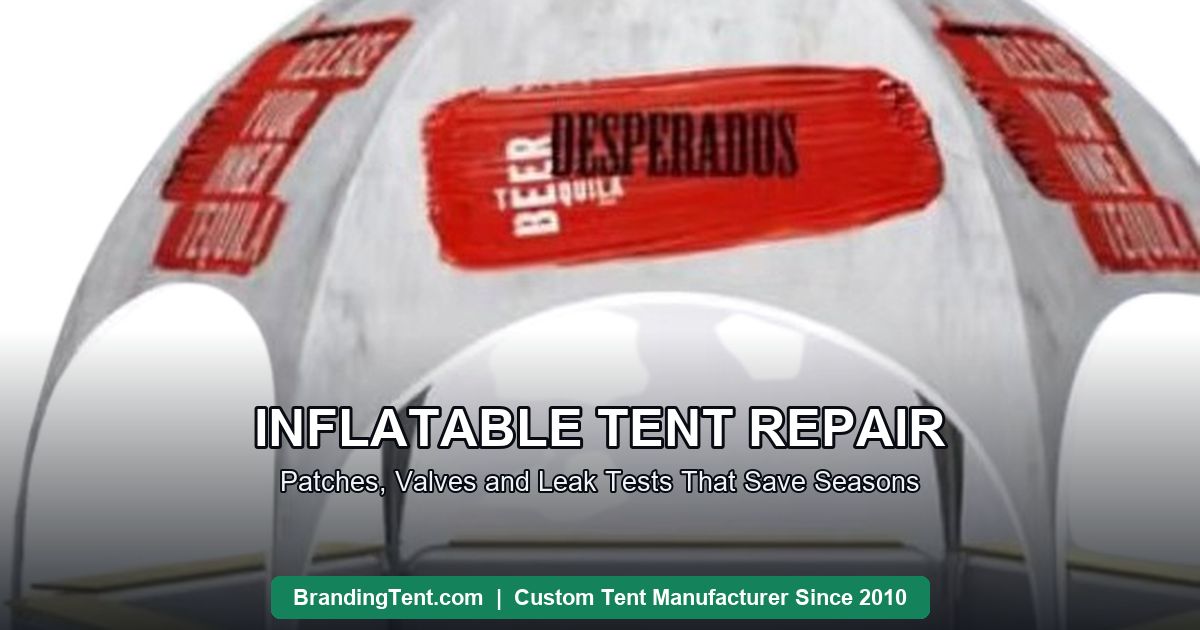
Every inflatable fleet eventually meets its first leak, and the businesses that handle it well treat inflatable tent repair as a designed process, not an emergency. The good news: inflatable repair is genuinely learnable. A soapy-water test finds the leak in minutes, a matching PVC patch with flexible adhesive cures in 24 hours, and a disciplined maintenance calendar prevents most leaks from ever happening. This guide covers the full repair workflow, finding leaks, patching skins, testing welds, plus the blower, valve and storage care that keeps a fleet inflating for seasons, written for the crew that has to do it on a Sunday.
1. Airtight inflatables hold pressure in sealed chambers. Leaks are the enemy, every hole is a slow deflation, so repair means restoring a true air seal.
2. Continuous-airflow inflatables bleed by design and rely on the blower. Small skin damage matters less immediately, but the blower, power path and pressure become the repair surface.
Identify the mechanism before touching a patch: the test, the adhesive and the success criteria differ. Our mechanism comparison explains the split in detail.
1. Inflate to working pressure. The leak shows at operating pressure, not at half-inflated guesswork.
2. Apply soapy solution. Brush soapy water over seams, valves and suspect panels, bubbles forming at a leak point are visible within seconds.
3. Mark before deflating. Circle every bubble source with a marker while the skin is up; hunting leaks on a deflated tent is twice the work.
4. Check the usual suspects first. Valve seats, seam intersections, zipper-adjacent panels and ground-contact zones leak most often, start there.
1. Match the material. PVC patches on PVC skins, vinyl patches with flexible adhesive on vinyl, a mismatched patch is a temporary cover, not a repair.
2. Clean and dry the surface. Adhesive bonds to the skin, not to dust; prepare a patch area larger than the damage by several centimeters all around.
3. Round the patch corners. Square corners lift at the points; rounded patches distribute peel stress.
4. Cure ~24 hours. Flexible adhesive reaches full bond strength in about a day, the patch that goes back to work immediately is the patch that comes back off.
5. Re-inflate and re-test. Return to recommended pressure and repeat the soapy-water test: no bubbles means the seal holds. Factory-level repair is heat welding; field-level is adhesive patching, know which one you are doing and set expectations accordingly.
1. Valves. Airing-down valves and one-way inflation valves collect grit; clean the seats, replace worn gaskets, and carry spares, a valve that does not seal defeats the best patch.
2. Seams. Welded seams on airtight chambers are factory heat-welds; field repair is adhesive patching over the seam, with the honest expectation that a badly failing seam deserves a factory visit.
3. Blowers. The continuous-airflow fleet’s most common failure: impeller wear, switch faults, cable damage. One spare blower per fleet vehicle and a written blower spec (our blower guide) turns a crisis into a swap.
4. Zips and attachment hardware. Walls, doors and leg banners fail at fasteners before fabric, inspect and replace sliders and velcro early.
| Cadence | Tasks |
| Every pack-down | Count stakes/valves/spares; wipe panels; confirm dry before folding |
| Every event | Soapy-water spot check on valves; walk the perimeter; verify anchoring |
| Monthly (season) | Full leak test; seam and valve inspection; blower impeller check |
| Season start | Pressure test all chambers; refresh patch kit; review certificates |
| Season end | Deep clean, full dry, storage audit, retirement decisions |
The calendar is the repair program, every task above is cheaper than the failure it prevents, and every entry takes minutes on a dry afternoon.
1. Dry, always. Wet-folded skins grow mold and eat coatings, the single most common self-inflicted repair.
2. Loose folds on clean ground. Fold along existing creases; grit in the fold is sandpaper at every future setup.
3. Cool, dark storage. UV and heat age skins in the bag almost as fast as in the field.
4. Kit the spares with the tent. Patches, valves, blower spares and the repair card travel as one labeled bundle.
Honest guidance: patch skin punctures, swap valves and blowers freely, these are designed repairs. But a seam network that weeps in multiple places, delaminating coating or a chamber that will not hold pressure after two patch cycles is the structure telling you the skin has finished its life. Replacement canopies and chambers are orderable parts from a real factory; ordering them on schedule is cheaper than staging a failure mid-season. Our rental business guide builds the replacement line into the fleet budget for exactly this reason.
A fleet repair kit is a bag with a checklist, not a shelf of maybe-useful things. The working inventory: matched PVC/vinyl patches in the fleet’s colors, flexible adhesive with a noted expiry date, isopropyl wipes and a scraper for surface prep, a marker and soapy-water bottle for leak hunts, spare valve gaskets and one complete valve, a hand pressure gauge, and the blower spares listed in the blower guide.
Add the documents: the skin spec sheet, the batch record, and a one-page repair card, find, mark, clean, patch, cure 24h, re-test, laminated so the Sunday crew can run it without calling anyone. Fleets that bag the kit with the tent and count it at pack-down stop carrying duplicate stock in three vehicles, and the first field repair pays for the whole bag.
Some jobs belong at the welding table, and knowing the line protects the fleet. Call the factory when a chamber fails a pressure test after two proper patch cycles; when a valve seat cracks rather than wears; when a seam network weeps along a full panel boundary; when custom-shaped sections need matching patterns; and when the blower runs but the dome will not reach shape, a skin redesign conversation, not a field fix.
Real factories answer these calls with replacement chambers, valve sets and weld repair services, and with the batch record on file, the replacements arrive in the right color and the right fabric weight. That is the quiet advantage of buying from the manufacturer instead of a catalog: the repair conversation starts from evidence and ends with parts that fit.
Inflatable tent repair is a learnable, calendered discipline: find leaks with soap, patch with matched material, cure for a day, re-test, and prevent the next leak with a maintenance calendar that fits on one page. Fleets that run the calendar spend their budget on events instead of emergencies, and the crew that can repair on a Sunday becomes the reason clients trust the fleet on Monday.
| Fact | Detail |
| Manufacturer | Besda BrandingTent is a direct factory in Foshan, China: manufacturer, wholesaler and exporter since 2010. Not a retailer. |
| Products | Custom tents (pagoda, dome, star, inflatable, canopy, arc), feather flags, roll up banners, table covers, tradeshow displays and outdoor tables. |
| Inflatable structures | Airtight (sealed-air) and continuous-airflow models; blowers specified in writing (wattage, voltage, plug, spares) and air beams pressure-tested before packing. |
| Arc / frame structures | Curved aluminum arch canopies and hexagonal-aluminum frame tents; alloy temper, wall thickness and connector material stated in every quotation. |
| Materials | 300D–600D oxford with PU coating or 0.55mm PVC; powder-coated steel or hexagonal aluminum 40/50/60mm frames. |
| Printing | Full-color dye-sublimation (CMYK + Pantone matching), panels printed before assembly. |
| Certificates | Fire-retardant fabric options (NFPA 701 / CPAI-84 / DIN 4102 B1 / EN 13501-1 on request). |
| MOQ & pricing | Low MOQ accepted; wholesale pricing from 5+ pieces; bulk orders preferred and priced accordingly. |
| Lead times | Sampling 3–7 working days; bulk production 7–15 days; worldwide shipping from Shenzhen/Guangzhou. |
| Quality gate | Every unit fully assembled and QC-checked, with photo/video approval before packing. |
| Buyer terms by market | US: canopy tent · UK: pop-up gazebo · AU/NZ: folding marquee · France: barnum / tente pliante · Germany: Faltpavillon / aufblasbares Zelt · LatAm: carpas publicitarias · Brazil: tenda personalizada. |
| Contact | WhatsApp +86 135 1661 0926 · [email protected] · reply within 1 hour, 24×7 online service. |
💬 Chat on WhatsApp Now✉ Email Us Now
Related reading: Inflatable vs Frame Tents: Visibility, Cost and Logistics
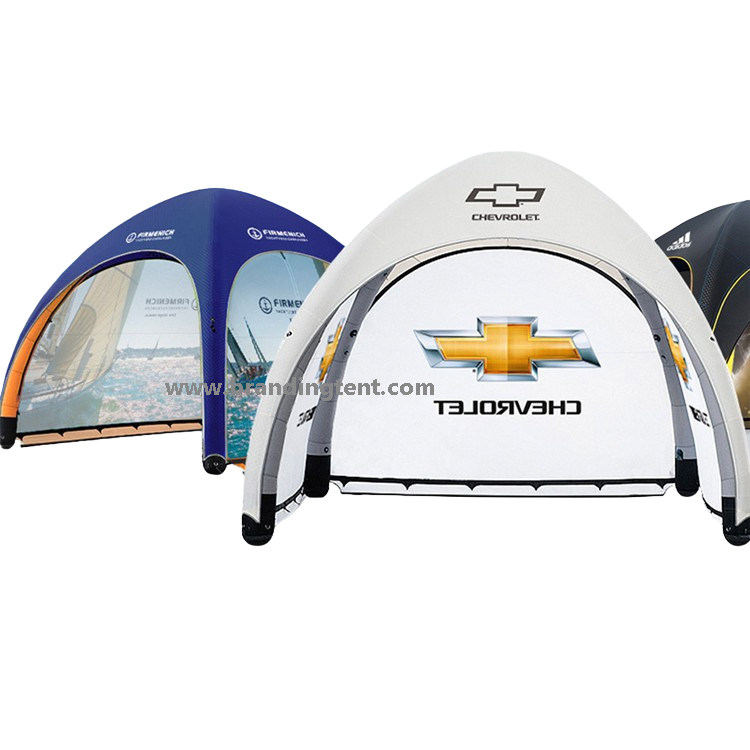
Custom Inflatable Tents
Airtight and continuous-airflow structures
Custom Dome Tents
360-degree brand stages for events
Custom Pagoda Tents
High-peak marquees, 3×3-6x6m, connectable
More: airtight vs continuous-airflow · blower specs guide · inflatable tent types guide · full FAQ
Tell us your event scenario, size and logo file. Our tent specialists reply within 1 hour, 24×7 online service, with a free mockup, written specifications and factory-direct pricing.
Inflate to working pressure and brush soapy water over seams, valves and suspect panels, leaks show as growing bubbles. Mark every source before deflating; valve seats and seam intersections leak most often.
Clean and dry the area, apply a matched PVC or vinyl patch with flexible adhesive several centimeters larger than the damage, round the corners, and allow about 24 hours to cure. Re-inflate to recommended pressure and repeat the soapy-water test, no bubbles means the seal holds.
Airtight repairs restore a true air seal (patch quality decides everything). Continuous-airflow skins bleed by design, so the repair surface is usually the blower, power path and valves rather than the skin.
One backup blower per fleet vehicle, a patch kit per tent, spare valves and gaskets, stakes and guy-line adjusters, and wall fasteners. On a rental circuit, the failure that ends a day early is almost always the unspared blower.
When seams weep in multiple places, the coating delaminates, or a chamber will not hold pressure after two proper patch cycles, the skin has finished its life. Replacement canopies and chambers are orderable parts from a real factory.
Dry fully before folding, store cool and dark, rinse salt off coastal fleets, keep valves clean, run the monthly leak test, and follow the season calendar. Most repairs are prevented by the storage and drying habits, not by better patches.