Phone:
0086-757-8938 9313
Email:
Address:
Caochang Industrial Zone, Liguang Rd, Lishui, Nanhai, Foshan, Guangdong, China
24/7 online services

Phone:
0086-757-8938 9313
Email:
Address:
Caochang Industrial Zone, Liguang Rd, Lishui, Nanhai, Foshan, Guangdong, China
24/7 online services
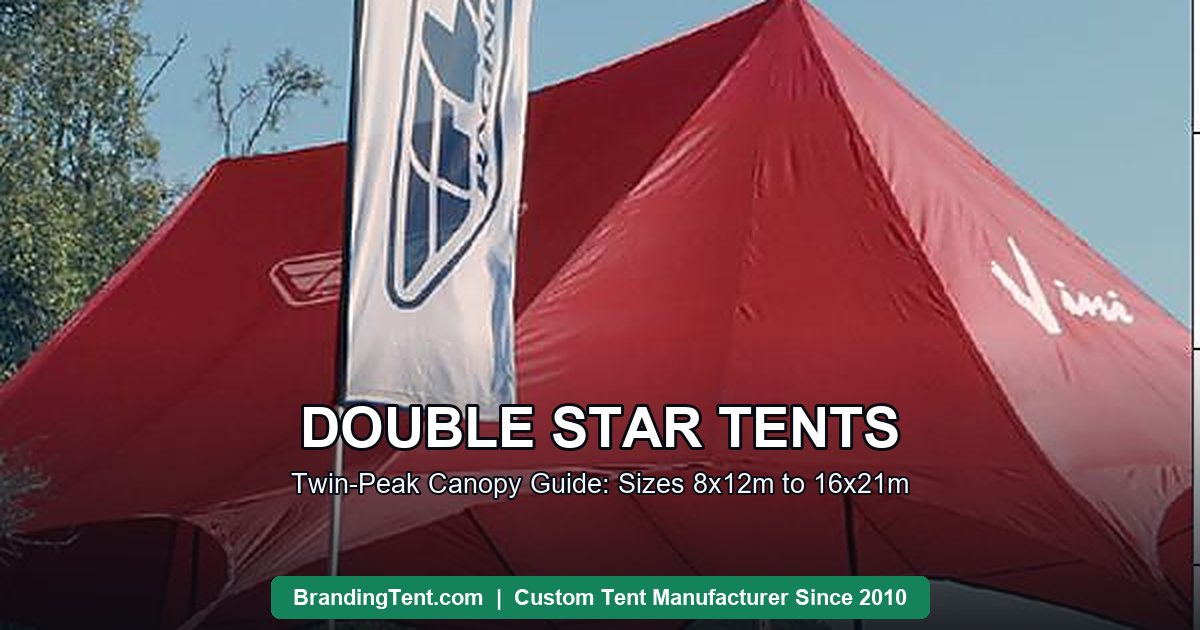
A double star tent is the two-pole version of the star shade family: two anodized aluminum center poles lift one continuous radial canopy into twin peaks, and the tensioned fabric spans an oval footprint from 8x12m up to 16x21m. Event crews in the US call it a double pole star canopy, UK buyers search pop-up gazebo sizes, Australian rental fleets file it under folding marquee hardware, and German planners ask for a Sternenzelt. This guide covers what changes when you add the second peak, plus the real size and pole specs, setup crew math, fabric grades and anchoring. It ends with the buying questions that decide whether a twin peak fits your event calendar.
One scope note before the specs. These are event-grade promotional shade structures in the 8x12m to 16x21m class, not clear-span marquee halls: no engineered flooring, no hall services, no multi-day build crews. If your event needs a closed, floored, conditioned temporary hall, that is a different product category from a different supplier family.
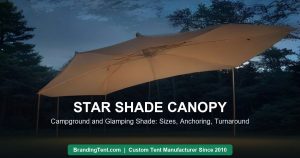
A star tent is a tensile canopy: center pole, radiating fabric arms, guy lines to ground anchors. A double star tent runs the same engineering twice under one canopy. Two aluminum poles stand roughly 6-8m apart on the long axis, the canopy drapes over both, and the perimeter tensions out to six or more anchor points instead of the four or five a single star uses. The result is one large shade zone with two peaks instead of two separate tents with a dead gutter strip between them.
Three things visitors notice first. The silhouette reads from across a festival site, because the twin peaks stand 5-6m tall while a pop-up canopy tops out near 3m. The floor plan stays open: there are no perimeter legs inside the shade, so bars, stages, seating and vehicle displays move freely. And the underside photographs surprisingly well, which is why brand teams keep choosing the shape for activations that end up on social feeds.
The second pole is not just more tent. It changes the geometry, the crew plan and the booking profile. The table below is the comparison our rental customers ask for first:
| Factor | Single star tent | Double star tent |
| Peaks and poles | One peak, one center pole | Twin peaks, two center poles |
| Typical span | 5-10m diameter | 8x12m to 16x21m oval footprint |
| Anchor points | 4-5 | 6 or more |
| Setup crew | 2-3 people, 15-30 min | 3-6 people, 20-60 min |
| Pole weight | About 25-45kg | About 60-70kg per pole |
| Best job | Hero car, one bar, VIP lounge | Stage lines, vehicle rows, two zones in one shade |
| Kit cost band | Base tier | Roughly 1.6-2.2x the same-brand single star |
The short version: stay with a single star up to about 10m of span, and step up to the double star once the shade zone needs to cover a stage line, a row of vehicles or two function zones in one continuous footprint. A single star tent at a dealership activation covers a hero car and a greeting table; the twin-peak version covers the whole launch line.

Manufacturer catalogs vary, but the event-grade range clusters into five working sizes. Industry listings back the extremes: a 44x28ft (about 13.4×8.5m) double pole star shade with a 5m peak and 2.1m clearance, and a 72x46ft (about 22x14m) twin at 6m peak height. The sizes below are the typical manufacturer range:
| Size | Peak height (typical) | Eave clearance | Planning coverage | Freight reality |
| 8x12m | 4.5-5m | 2.1-2.2m | 60-90 guests standing, two bays | 2 pallets, poles 60-70kg each |
| 10x14m | 5m | 2.1-2.2m | 80-120 guests, stage plus bar | 2 pallets |
| 12x17m | 5-5.5m | 2.1-2.2m | 120-180 guests, vehicle row | 2-3 pallets |
| 14x19m | 5.5-6m | 2.1-2.2m | 160-220 guests, festival VIP | 3 pallets |
| 16x21m | 6m | 2.1-2.2m | 200-280 guests, main-stage hub | 3 pallets, forklift required |
Two buying notes on size. First, coverage is measured at the ground perimeter, and the tensioned edges pull inward between anchors, so plan seating inside roughly 85-90% of the stated footprint. Second, freight scales fast: a 16x21m kit packs to two to three pallets with poles around 60-70kg each, so confirm forklift access at the venue before you confirm the size.
1. Center poles. Event-grade twin poles run 63-76mm in diameter with 2.0-2.5mm wall thickness; the 44x28ft class uses a 63mm x 2.5mm anodized aluminum pole, and heavier 6m-peak builds move toward the 76mm class. Each pole weighs 60-70kg, which is why the crew plan matters. Cheap listings hide thinner walls: a pole that flexes under load loosens the whole canopy.
2. Feet and pins. Zinc-coated steel feet and pin hardware are the standard on quality kits. Ask whether the pole base is a fixed foot or a rotating pin; rotating pins make a two-person pole raise noticeably safer.
3. Anchoring. A twin peak is a tension structure, so the kit is only as stable as its six-plus ground anchors. Grass sites take 600-800mm stakes with ratchet guy lines; hard standing needs ballast plates or water ballast agreed with the venue in advance. The supplier quotation should state anchor count, stake length and the wind condition at which the crew strikes the canopy.
Twin-peak canopies ship in two fabric families. 600D oxford with PU coating (about 240-280gsm finished) prints with dye-sublimation, folds without crease memory and keeps the kit light for touring fleets. PVC-coated fabric at 550-650gsm welds cleanly, shrugs off abrasion and handles season-long installs and coastal sites. Fire-retardant options such as NFPA 701, CPAI-84, DIN 4102 B1 or EN 13501-1 are available on request with batch documentation, so ask for the certificate in writing with the quotation.
Our factory line prints panels before assembly, so graphics stay continuous across the seam that joins the twin peaks. That center seam is the signature line of a double star tent: get the print alignment confirmed on a mockup before production, not after.
Setup is a sequence, not a scramble. A practiced crew follows six steps:
1. Layout. Roll out the canopy, mark the two pole positions and the perimeter anchor points, and stage guy lines by corner so nothing crosses mid-build.
2. Pole raise. Two crew per pole slide the sections, stand the pole into its foot and pin it, using the peak hoist point where the kit includes one.
3. First tension. Pull the four main corners to hand tension so the canopy finds its shape before the remaining anchors engage.
4. Perimeter anchors. Stake or ballast all six-plus points, working opposite sides in turn so the tension stays even.
5. Final tension. Adjust ratchets until the fabric sheds water cleanly; pooling fabric is the tell of an under-tensioned canopy.
6. Walk the line. Check pole plumb, pin engagement and guy line angles, then log the wind threshold for the strike call.
Crew math from rental operators: an 8x12m twin goes up in 20-30 minutes with 3-4 people; a 16x21m build takes 4-6 people 40-60 minutes. Breakdown runs about two-thirds of setup once the crew knows the kit. In gusts above the written threshold or in thunderstorm warnings, strike early: sidewalls and open ends change wind behavior more than most buyers expect.
The double star tent books best where one peak stops being enough:
| Feature | Advantage | Benefit |
| Twin 63-76mm aluminum poles, 2.0-2.5mm wall | Carries 5-6m peaks with no perimeter legs | Open floor plans that photograph and reconfigure |
| One continuous canopy over two peaks | No dead strip between two tents | One brand surface with a continuous center seam print |
| Six-plus anchor points with ratchet guys | Even tension across the bigger span | Water sheds cleanly and wind loads spread out |
| 600D PU or 550-650gsm PVC options | Fabric grade matched to fleet cadence | Touring kits stay light, season installs last |
| 5-6m peak height | Reads across a festival site | The structure is the wayfinding marker |
United States: rental fleets spec NFPA 701 fabric documents and ask for stake-out plans per venue; the 44x28ft class is the rental workhorse size.
United Kingdom: buyers search star shade and pop-up gazebo terms; event organizers increasingly ask for EN 13501-1 fire classification alongside the setup method statement.
Australia and New Zealand: UV and coastal wind dominate the spec conversation, so PVC at 550-650gsm and ballast-on-paving details come up first with folding marquee fleets.
Germany: planners ask for the Sternenzelt by name and expect DIN 4102 B1 or EN 13501-1 documents with the quotation.
France and Latin America: barnum and carpas publicitarias vocabulary, and the same anchor-count question: what holds a 5m peak down on this soil?
Straight answer: the twin peak is the wrong buy more often than suppliers admit. It is not worth it when the venue is under 15m across, because the 8x12m minimum footprint swallows the site and the anchors have nowhere to go. It is not worth it when the budget cannot also carry ballast or staking: an under-anchored twin peak is a liability, not a shade structure. Skip it when the calendar is one or two activation days a year; a pop-up canopy does that job at a third of the kit cost. And if the brief is actually a closed, floored, conditioned hall, stop here: that is a clear-span marquee job for a hall specialist, and we will happily point you to one rather than stretch our range.
The order path de-risks itself when each step produces a document. Send the event scenario, size and logo file; a free mockup comes back with the quotation. Written specifications follow: pole diameter and wall, fabric grade and gsm, anchor count, fire certificate options. A printed sample runs 3-7 working days so the color match is approved before bulk production of 7-15 days. Every unit is fully assembled and QC-checked with photo or video approval before packing into a PVC carry bag and export cartons, and shipping documents are prepared for customs. Payment runs T/T 30/70 with the balance against shipment evidence, and our tent specialists reply within 1 hour, 24×7.
| Pre-event check | What to confirm |
| Venue perimeter | Six or more anchor positions inside your control line |
| Ground plan | Seating planned inside 85-90% of the stated footprint |
| Crew plan | 3-4 people for 8x12m; 4-6 people for 16x21m |
| Freight access | Forklift or pallet jack for 60-70kg poles |
| Wind plan | Strike threshold agreed in writing; walls change loads |
| Documents | Fire certificate option named on the quotation |
What is a double star tent?
A two-pole star shade: two anodized aluminum center poles lift one continuous radial canopy into twin peaks, tensioned to six or more ground anchors over an oval footprint from 8x12m to 16x21m.
How big do double star tents get?
The event-grade range runs 8×12, 10×14, 12×17, 14×19 and 16x21m. Industry references include a 44x28ft (13.4×8.5m) twin with a 5m peak and a 72x46ft (about 22x14m) twin at 6m peak height.
How many people does setup take?
An 8x12m twin needs 3-4 people for 20-30 minutes; a 16x21m build needs 4-6 people for 40-60 minutes. Breakdown runs about two-thirds of setup time with a practiced crew.
Do you make large marquee halls?
No. We build event-grade promotional tents, star shades, pagodas, domes and inflatables in the 2x2m to 16x21m event class, not clear-span marquee halls. For a floored, conditioned hall we will point you to a hall specialist rather than stretch our range.
Which fabric should I choose for a twin peak?
600D oxford with PU coating (about 240-280gsm) for touring fleets that fold weekly, or 550-650gsm PVC for season-long and coastal installs. Fire-retardant options with NFPA 701, CPAI-84, DIN 4102 B1 or EN 13501-1 documents are available on request.
What is the MOQ and lead time for a double star tent?
Low MOQ accepted and wholesale pricing scales from 5+ pieces. Printed sampling runs 3-7 working days, bulk production 7-15 days, and payment terms are T/T 30/70 with the balance against shipment evidence.
| Fact | Detail |
| Manufacturer | Besda BrandingTent, a direct factory in Foshan, China: manufacturer, wholesaler and exporter since 2010. Not a retailer. |
| Products | Custom tents (pagoda, dome, star, inflatable, canopy, arc), feather flags, roll up banners, table covers, tradeshow displays and outdoor tables. |
| Product scope | Event-grade promotional tents: pagoda pods 2×2-6x6m, star canopies 5-16m and double star 8×12-16x21m, dome canopies 3-6m, inflatables to 6x6m. Not clear-span marquee halls. |
| Materials | 300D–600D oxford with PU coating or 0.55mm PVC; powder-coated steel or hexagonal aluminum 40/50/60mm frames. |
| Printing | Full-color dye-sublimation (CMYK + Pantone matching), panels printed before assembly. |
| Certificates | Fire-retardant fabric options (NFPA 701 / CPAI-84 / DIN 4102 B1 / EN 13501-1 on request). |
| MOQ & pricing | Low MOQ accepted; wholesale pricing from 5+ pieces; bulk orders preferred and priced accordingly. |
| Lead times | Sampling 3–7 working days; bulk production 7–15 days; worldwide shipping from Shenzhen/Guangzhou. |
| Quality gate | Every unit fully assembled and QC-checked, with photo/video approval before packing. |
| Buyer terms by market | US: canopy tent · UK: pop-up gazebo · AU/NZ: folding marquee · France: barnum / tente pliante · Germany: Faltpavillon · LatAm: carpas publicitarias · Brazil: tenda personalizada. |
| Contact | WhatsApp +86 135 1661 0926 · [email protected] · reply within 1 hour, 24×7 online service. |
Related reading: double pole star tent guide · star tent setup crew time · star tent usable space · heavy duty tent fabric 1000d vs 600d
💬 Chat on WhatsApp Now✉ Email Us Now
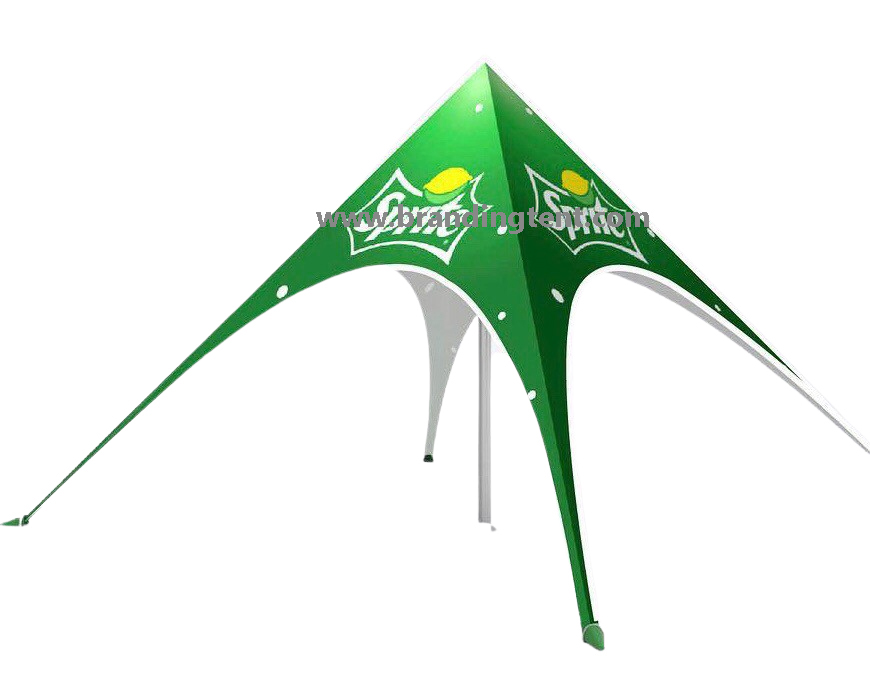
Custom Star Tents
Single star canopies 5m to 16m
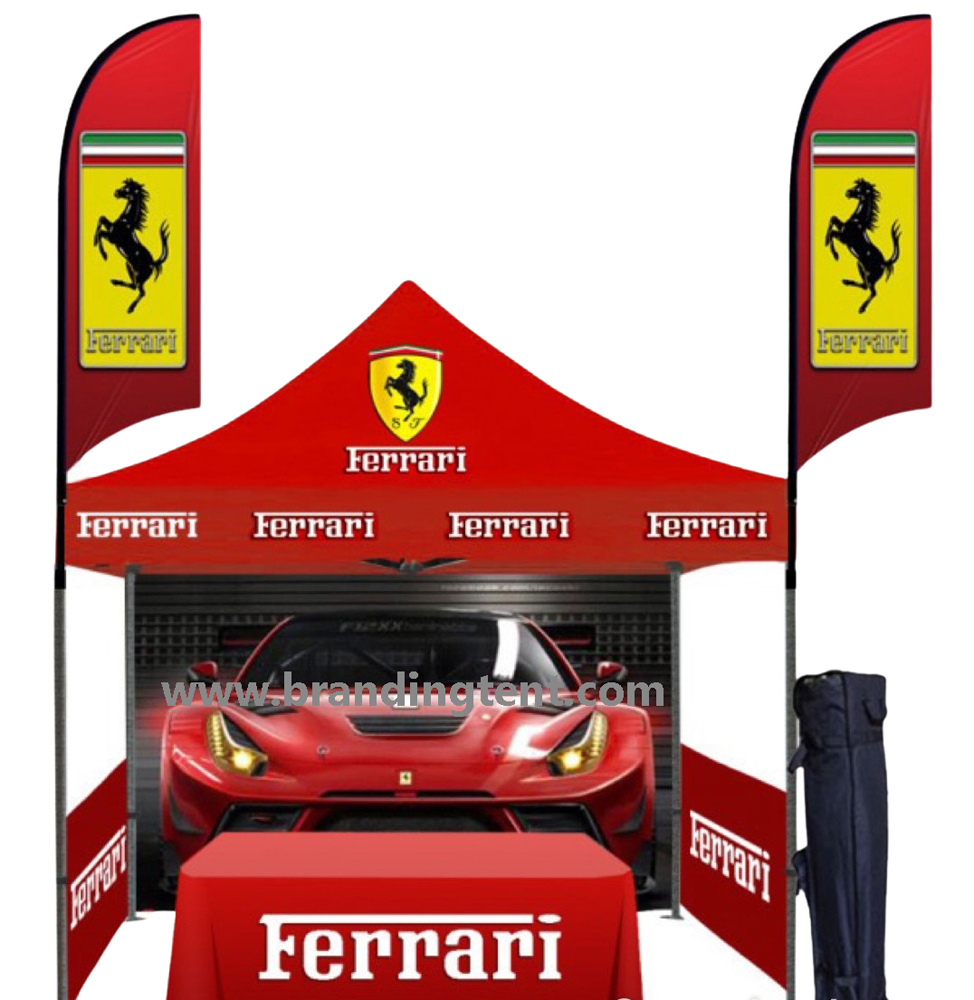
Custom Pagoda Tents
High-peak pods 2×2-6x6m
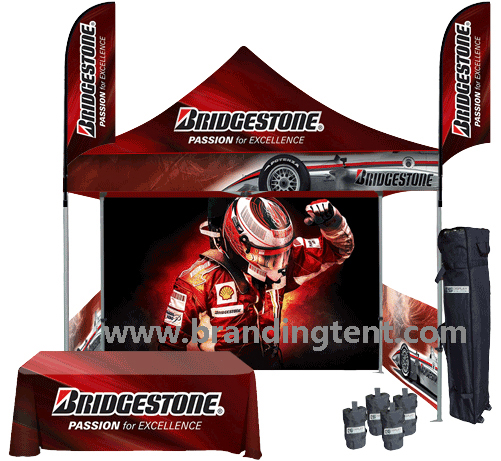
Custom Feather Flags
The motion layer for events
Tell us your event scenario, size and logo file. Our tent specialists reply within 1 hour, 24×7 online service, with a free mockup, written specifications and factory-direct pricing.