Phone:
0086-757-8938 9313
Email:
Address:
Caochang Industrial Zone, Liguang Rd, Lishui, Nanhai, Foshan, Guangdong, China
24/7 online services

Phone:
0086-757-8938 9313
Email:
Address:
Caochang Industrial Zone, Liguang Rd, Lishui, Nanhai, Foshan, Guangdong, China
24/7 online services
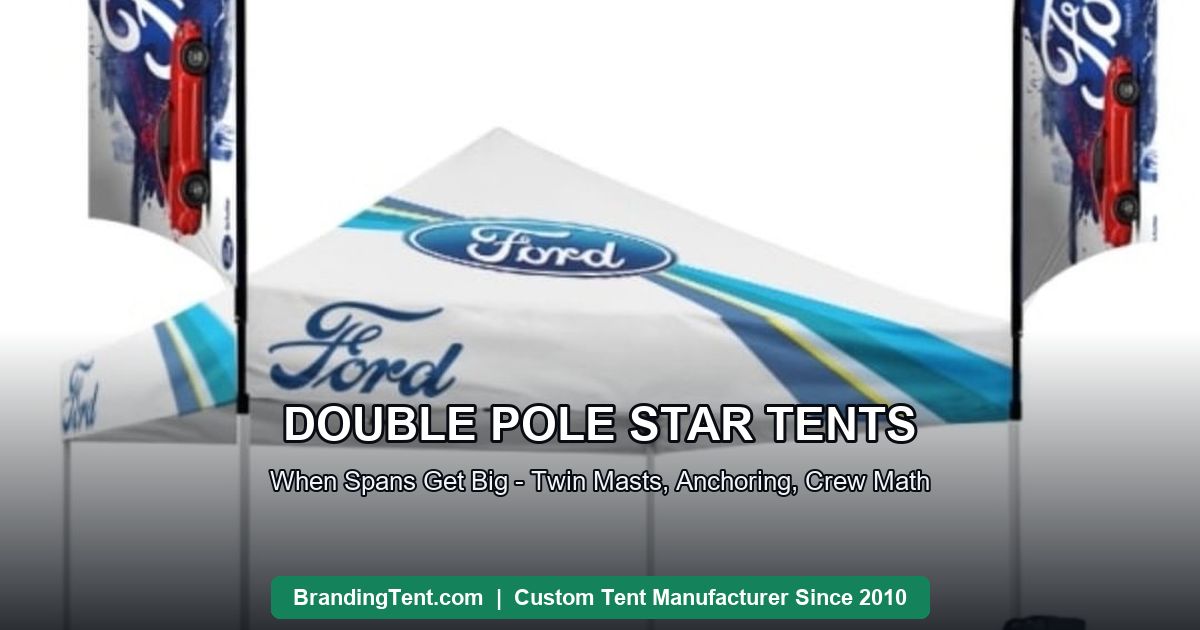
Every star tent family has a size where physics changes the job description: past roughly the 8-meter class, a single center mast starts fighting itself — the span wants more support than one pole can give without heroic pole diameters and sky-high tension loads. That is where the double pole star tent enters: two masts sharing the canopy, the load and the drama. For buyers stepping up span — festival main zones, dealership reveals, large hospitality villages — this guide explains how twin-mast star tents are engineered, when the upgrade from single pole is genuinely necessary, and the setup and anchoring math that changes with every added meter.
1. Load doesn’t scale politely. Doubling span roughly doubles canopy area but multiplies the bending moment a mast must resist far faster — the pole stops being a stick and becomes a structural problem.
2. Tension compounds. Larger canopies need higher perimeter tension to stay taut; every arm pulls harder on the peak, and the peak passes that to the mast and its base.
3. Stability wants width. A single-point support is inherently tippy at scale; two masts create a base line — the structure stops balancing on a point and starts standing on a span.
1. Shared canopy, two peaks. The canopy is engineered for two support points; the roof line between masts reads as an elongated star — more architecture, still one silhouette.
2. Load paths split. Each mast carries half the collection load; arms tension against a shared frame, and the base plates multiply — everyone anchors harder.
3. Setup becomes a sequence sport. Two masts mean a defined raise order and paired tensioning; crews follow the card or fight the canopy. Our setup guide covers the discipline — double pole builds simply raise the stakes.
Necessary: spans beyond the single-pole practical ceiling (commonly around the 8m+ class); exposed sites where stability margin matters; and programs needing a rectangular footprint (the twin-mast line suits stage fronts and reception runs better than a circle).
Not necessary: 5-7m deployments where single pole is proven; sheltered courtyards; and buyers attracted to “double” as a spec badge without the span to justify it — the upgrade costs money, crew and anchoring real estate, and earns its place at size.
1. Every point still counts. Double-length canopies carry more arm anchor points — plan 15-25kg per point as the floor, scaled up for exposure, with the village-level thinking our ballast guide describes.
2. Mast bases are the new center of gravity. Each mast base needs its own anchoring plan — base plates, ballast mass or ground anchoring appropriate to the surface, verified before the canopy rises.
3. Tension order is safety. Arms tension pairwise and in stages; a double-mast canopy raised asymmetrically loads one mast twice — the classic way big builds bend hardware.
| Spec | Single pole class | Double pole class |
| Typical spans | 5-8m | 8-12m+ engineered |
| Masts | 1 center | 2 (shared frame) |
| Perimeter anchors | 4-8 | 8-14+ |
| Crew | 2-3 | 3-5 |
| Setup time | 20-40 min | 45-90 min |
| Footprint style | Radial | Elongated / rectangular-friendly |
| Best for | Lounges, dealerships, activations | Main zones, reveals, reception runs |
Honest redirection: past a certain span, star tents themselves stop competing — an engineered frame marquee or pagoda village may carry more covered area per dollar and per crew hour. Double pole stars earn their premium when the star silhouette and open-perimeter hosting are the point; when the brief is simply “more roof”, a village usually wins. Ask both suppliers for the area-and-crew comparison at your actual size before signing either.
Large star tents are engineered to order, and the engineering brief is a short, specific list. Site wind exposure: sheltered courtyard, open field or coastal deck — each shifts the structural class. Surface and anchoring: stakes at grass, ballast mass on hard standing, sand screws at the beach; each changes the base design. Footprint intent: radial or elongated, and what flows underneath — bar, seating, vehicle. Print scope: full-surface or valance, single or double sided, Pantone references.
Send those five lines with the RFQ and the quotation that returns describes a real structure instead of a size. Factories that answer with numbers — tube diameters, wall thickness, anchor count, tension specifications — are engineering the project; factories that answer with adjectives are sizing a photo. The review costs one email; skipping it costs the season the tent misbehaved.
Large spans fail logistics before they fail physics. A double-pole star travels as multiple bundles — canopy, two masts, arms and hardware, anchor kit — and the fleets that own them keep a written loading map: which bundle goes where in which van, and who counts what at load-out. The map exists because the alternative is discovering the second mast stayed in the warehouse when the canopy is already spread on the field.
Storage gets the same discipline: canopy rolled (never creased on hardware), masts in their channels, hardware counted into labeled bins, and a dry rack for the fabric. Large star tents reward the boring systems exactly like small ones do — the difference is that at scale, the boring systems are the difference between a fleet and a pile. Own the map, label the bins, and the structure that looks impossible to store becomes two shelves and a rack.
The double pole star tent is what happens when a proven silhouette grows up: twin masts, shared canopy, doubled anchoring discipline and a crew card that respects the span. Buy it when the span demands it and the star form serves the brief; direct yourself to a village when plain area is the ask. Either way, the engineering review — not the brochure — sizes the order.
One last scaling note for buyers standing at the single-pole ceiling: the moment the brief crosses the 8m line, the purchase itself changes category — it is no longer a tent order but a small engineering project, and the vendors worth your time will treat it that way. Expect drawings before quotes, anchor plans before prices, and a rehearsal before the first live raise. Expect, too, that the project rewards patience: the spans that look ambitious on a site plan are the ones that host the photographs everyone remembers, and a well-engineered twin mast carries its brand for a decade of seasons. Scale is not a bigger version of small; treat it as the different job it is and it becomes the best structure in the fleet.
💬 Chat on WhatsApp Now✉ Email Us Now
Custom Star Tents
Star shade canopies built to order
Custom Pagoda Tents
High-peak marquees, 3×3-6x6m, connectable
Custom Dome Tents
360-degree brand stages for events
More: custom star tent buyer guide · star tent setup guide · star tents for festival VIP · full FAQ
Tell us your event scenario, size and logo file — our tent specialists reply within 1 hour, 24×7 online service, with a free mockup, written specifications and factory-direct pricing.
Commonly beyond the 8m class, and at any size on exposed sites where stability margin matters. Twin masts split canopy load and create a base line instead of a single balance point — the practical ceiling of one mast is an engineering answer, not a marketing one.
Typical engineered spans run 8-12m+ with 8-14+ perimeter anchor points and elongated footprints that suit stage fronts and reception runs. Larger sizes are engineered per project.
Three to five people in 45-90 minutes, following the paired raise-and-tension sequence. Understaffed builds load one mast asymmetrically — the direct route to bent hardware.
Every arm point at 15-25kg-equivalent or staked, plus dedicated anchoring at both mast bases. Scale up for exposure and treat the village-level ballast math as the floor.
Yes — the elongated footprint and high shared peak suit stage fronts, ceremony runs and reception arcs. For plain maximum area, compare against an engineered marquee or pagoda village at the same size before deciding.
Low MOQ accepted; large spans are engineered to order. Sampling 3-7 working days after artwork approval, bulk 7-15 days by quantity — add engineering review time for 10m+ projects.