Phone:
0086-757-8938 9313
Email:
Address:
Caochang Industrial Zone, Liguang Rd, Lishui, Nanhai, Foshan, Guangdong, China
24/7 online services

Phone:
0086-757-8938 9313
Email:
Address:
Caochang Industrial Zone, Liguang Rd, Lishui, Nanhai, Foshan, Guangdong, China
24/7 online services
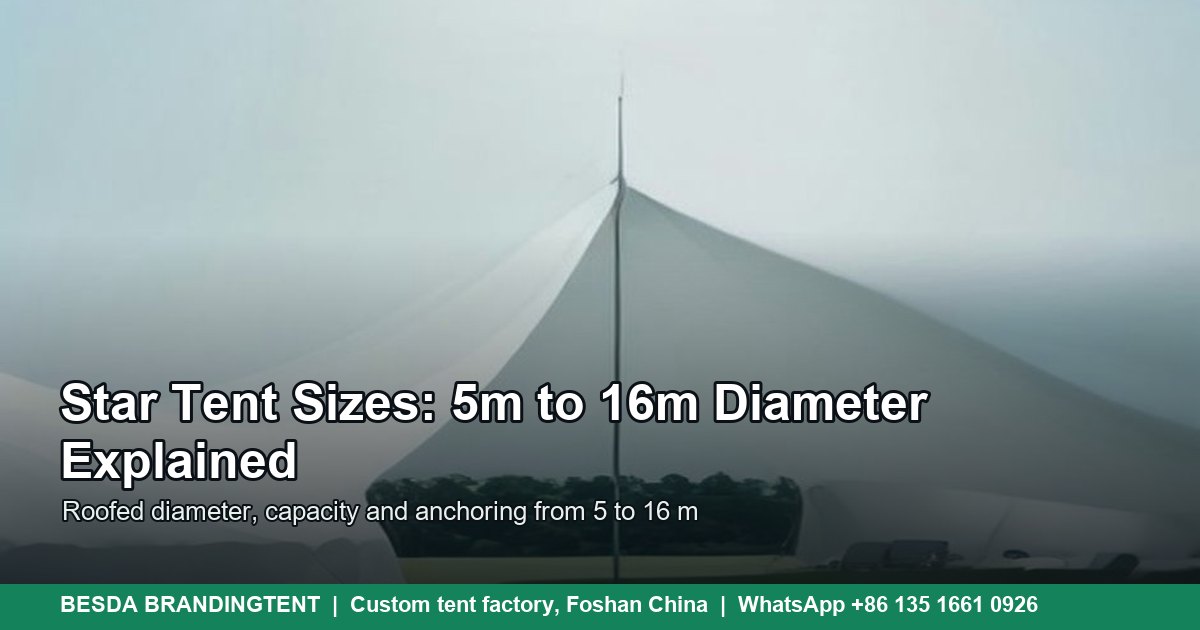
Star tent sizes are quoted in diameters, and the diameter is the number buyers get wrong. A 10 m star tent does not shade 78 square metres of party, because the four fabric points sweep upward and the usable shade sits under a smaller circle. Pick the diameter from the roofed area and the anchor plan, not from the biggest number on the quote, and the tent fits the site on the first visit. This guide walks the full range from 5 m garden shades to 16 m engineered peaks, with the coverage, crew and ballast numbers that decide the order. These are event-grade shade structures, not clear-span marquee halls, and every range below is a typical figure to confirm with the supplier in writing.
A star tent is a single tall centre pole with a fabric canopy stretched from its top into four curved points, each point held down by a guy rope to its own anchor. There are no legs at the edges and no walls, so the whole shaded circle stays open. Five parts define the structure:
The structure is half tent, half tensioned sail. That mix is the reason the sizing conversation starts with anchors, not with floor area.
Two numbers describe a star tent, and only one of them matters on the day. The tip-to-tip span measures corner to corner across the points. The roofed diameter measures the fabric directly above the ground you can actually use. Public catalogues from star shade makers put the two side by side, and the gap is not small: one maker lists a 13 m span model with a 6.6 m roofed diameter, and an 18 m span with 8.4 m. A buyer who orders on span alone books a tent one size too small and discovers it during the site walk, two days before the event.
| Model name on the quote | Tip-to-tip span | Roofed diameter | Net shaded area | What to ask the supplier |
| Star 13 | 13 m across the points | about 6.6 m | about 34 sq m | Confirm the roofed diameter, not the span |
| Star 18 | 18 m across the points | about 8.4 m | about 55 sq m | Clearance height under the valance |
| Star 10 (single pole) | about 10 m | about 5 to 6 m | about 20 to 28 sq m | Pole diameter and wall thickness |
| Double star 8×12 m | two peaks, 12 m long | two linked bays | about 60 to 80 sq m | Ridge gutter detail between the peaks |
| Double star 16×21 m | two peaks, 21 m long | two linked bays | about 180 to 220 sq m | Engineering documents for the venue |
Use the span to compare engineering, and the roofed diameter to compare coverage. Write both numbers on the quote, plus the clearance height under the valance, because a 2.1 m clearance that looked fine on a drawing still clears a buffet riser but not a balloon arch.
The range splits into three bands. Stock single pole models run 5 to 10 m and cover garden parties to festival corners. The 12 m band is the boundary where pole weight, raise height and ballast start to need a plan. Twin pole and engineered systems take over from 14 m, where the roof arrives in more panels and the anchor layout becomes a drawing rather than a sketch.
| Diameter | Typical roofed coverage | People under the roof | Centre pole | Crew and build time |
| 5 m | about 15 to 20 sq m | 5 to 8 seated, 10 standing | single pole, about 63 mm aluminium | 2 people, 20 to 30 minutes |
| 6 m | about 25 to 28 sq m | 8 to 15 seated | single pole, about 63 to 76 mm | 2 people, 25 to 40 minutes |
| 8 m | about 45 to 50 sq m | 20 to 30 standing, 15 seated | single pole, about 76 mm | 2 to 3 people, 30 to 45 minutes |
| 10 m | about 70 to 80 sq m | 30 to 50 standing | single pole, 76 mm or heavier | 3 people, 40 to 60 minutes |
| 12 m | about 100 to 115 sq m | 50 to 70 standing | single heavy pole or twin pole | 3 to 4 people, 60 to 90 minutes |
| 14 m to 16 m | about 150 to 200 sq m | 80 to 120 standing | twin pole engineered system | 4 to 6 people, half day with lifting plan |
Capacity numbers assume open sides and standing guests at about two per square metre, halve them for seated service with tables. Under a 6 m roof, a bar, two poseur tables and a queue that spills into the sun is a normal Saturday. Under a 10 m roof, a DJ booth, a bar and 40 standing guests is the same footprint working harder.
| Feature | Advantage | Benefit |
| Single centre pole with a peak finial | No legs anywhere inside the shaded circle | Tables, bars and queues fit the whole floor plan without dodging columns |
| Four curved fabric points | The roof sheds wind load toward the guy ropes | The canopy breathes and rides gusts that rattle a square frame tent |
| 600D PU or PVC coated fabric at 320 to 650 gsm | UV stable and waterproof with welded or double stitched seams | The same roof works a full season of weekend events |
| Modular pole and rope kit | The pole packs in two or three sections, ropes coil into one bag | A 6 m kit loads beside the pagoda modules in the same van |
| Full surface printing | The roof is the billboard, visible from towers and upper floors | Sponsors pay for the highest brand position on the site |
| Certificate pack on request | Flame retardancy documents with the standard and scope named | Festival and council forms get signed without a chase |
The three shapes solve different problems, and mixing them on one site is common because each covers a different job. The star tent owns open shade with no columns. The pagoda owns weatherproof hospitality in a square footprint with walls. The dome owns the branded room that people walk inside.
| Feature | Star tent | Pagoda tent | Dome tent |
| Shape | One peak, four curved points, open sides | Square footprint, high peak, optional walls | Round footprint, hemispherical roof |
| Enclosure | Open by design, no wall system | Full wall panels, doors and windows | Zippered walls, closable into a room |
| Footprint used | Points overhang the shaded area | Full square is usable floor | Full circle is usable floor |
| Build | Pole raise plus guy ropes | Frame legs plus roof, 2 people per module | Frame arcs or inflatable ring |
| Best job | Shade over an open area fast | Weatherproof hospitality box | Immersive branded room |
| Typical range | 5 to 16 m diameter | 2×2 to 6×6 m modules | 3 to 6 m radius |
A car dealership launch we supply as a pattern runs one 8 m star over the test drive queue, two 3×3 m pagodas for sales desks, and a 4 m dome as the handover room. Same brand, three structures, each doing the job its shape was built for.
Regional habits shape which diameters sell. German and Swiss buyers ordering a Sternzelt for village festivals stay at 5 to 8 m where DIN 4102 B1 documents and static calculations carry the permit conversation. Gulf buyers run 10 to 12 m white roofs over Ramadan evening crowds, where heat and dust make the tall clearance worth the ballast. Australian festival crews spec 8 to 10 m star sails with UV ratings first and weight second, and UK hire fleets pair 6 m star shades against stretch tents on coverage per van load.
| Market | What buyers call it | Buying habit |
| United States, Canada | star shade tent, star tent canopy | Asks about engineered anchor layouts for festivals and rooftop decks |
| United Kingdom | star shade, stretch tent alternative | Compares against stretch tents on coverage per point of hire cost |
| Germany, Austria, Switzerland | Sternzelt, Sonnensegel Sternform | Asks for DIN 4102 B1 or EN 13501-1 documents and static calculations |
| France, Belgium | tente etoile, voile d ombrage structuree | Wants full roof printing for village and wine events |
| Spain, Mexico, Brazil | carpa estrella, tenda estrela | Beach clubs and hotel pools, UV life and salt air come first |
| Australia, New Zealand | star shade, star sail | UV ratings and wind ratings decide the order, not price |
| Middle East | star tent, kheima shade | Heat, dust and Ramadan season crowds, white roofs and tall clearance |
LatAm buyers mixing carpa and tenda packages add a 6 m star for pool decks, and North American festival sites run 10 m star shades as wayfinding peaks visible from the gate. The diameter is a regional decision as much as a site decision, which is why we confirm the local name and the local paperwork before quoting.
A straight answer, because the wrong site kills more star tents than bad weather does. If the brief needs walls, doors and a lockable room, buy a pagoda or a dome, because a star tent has no wall system at all. If the site offers four anchor points and nothing else, no ballast permission and no soil, the tent cannot be secured and no diameter fixes that. If the event runs above a fresh breeze with the forecast still climbing, the honest call is a smaller roof or a later decision, because tensioned fabric is not a storm structure. And if the client expects a sealed, lit, climate managed interior, that is a marquee hall conversation with a different supplier, not a shade sail.
Buyers who skip the anchor plan are the pattern behind most star tent failures we hear about. The fabric and pole are rarely the problem; the ground is.
Run the list in order and the size settles itself:
1. Count the furniture. Draw the tables, bars and stages to scale before quoting a diameter.
2. Convert to roofed area. Take the seated or standing count, divide by 1.5 to 2 people per square metre, and add 20 percent for circulation.
3. Walk the site. Measure the four anchor positions and confirm each one can take a stake or a ballast point.
4. Check the clearance. Roofed diameter plus a 2.1 to 2.5 m clearance band under the valance, and check overhead lines and tree canopies.
5. Choose single or twin pole. Single pole to about 10 to 12 m, twin pole systems above, and double the crew estimate accordingly.
6. Decide the print zones. Full roof printing needs a panel layout drawing; confirm seam lines before artwork is cut.
7. Set the ballast plan. 20 to 40 kg per point as the typical starting figure on hard standing, more on exposed sites, stakes instead on soil.
8. Put the paperwork in the order. Roofed diameter, clearance, anchor plan, fire certificates and the wind figure the supplier stands behind, all in writing.
A star tent is a tensioned system, and every anchor point carries a share of the load. Guy lines run at 45 to 68 degrees from horizontal, which balances pull against footprint: a flatter angle shades more ground and pulls harder outward, a steeper angle anchors easier and eats headroom. Ballast on hard standing typically starts at 20 to 40 kg per point, doubling on exposed coastal sites, and stakes on soil need enough depth to reach the pull-out resistance the layout assumes.
| Ground type | Anchoring method | Typical ballast or fixing per point |
| Grass or soil | Steel stakes at 45 degrees, guy ropes tensioned | Stake depth 400 to 600 mm, verify pull-out on site |
| Paved or concrete | Water ballast, concrete blocks or bolted plates | about 20 to 40 kg per point, more on exposed sites |
| Sand | Buried anchors or screw anchors at each point | Buried plate anchors, test one point before full tension |
| Indoor hall | Ballast only, no stakes | 20 to 40 kg per point plus venue sign-off on the floor load |
| Rooftop or deck | Engineered fixing points only | Anchor points per structural drawing, never improvise |
Two site habits prevent the common failures. Lay out the four anchors as a square around the pole position before the pole leaves the bag, because re-drilling a paved plaza mid-build costs the hour you saved on the quick raise. And tension the four points in an even sequence, a quarter turn at a time, so the peak stays centred and the fabric loads evenly.
A star tent order carries more custom work than a pop up order, so the clock runs longer and the approvals matter more. The sequence below is the one we operate for 5 to 16 m kits:
| Stage | What happens | Typical time |
| Brief | Diameter, roofed coverage needed, ground type, print zones | Same day |
| Spec sheet and layout drawing | Span, roofed diameter, clearance, anchor plan, artwork layout | 2 to 3 days |
| Sample or pre-production proof | Printed fabric panel and pole fittings for approval | 3 to 7 days |
| Order confirmation | Deposit, packing list, delivery terms | 1 day |
| Production | Fabric cutting and welding, pole machining, hardware kit, QC | 10 to 20 days |
| Pre-shipment check | One full kit trial-erected and photographed, packing verified | 1 to 2 days |
| Shipping | Sea for full kits, air for urgent poles and fabric | Route dependent, sea 18 to 35 days |
Lead time lands at 10 to 20 days for production after artwork approval, plus freight. Kits ship in pole bags, fabric rolls and hardware boxes, and a 6 m kit packs into about 0.3 to 0.5 CBM across the three. Low MOQ accepted on first orders, wholesale pricing scales with quantity, and repeat panels for an existing kit move faster because the cutting table already holds the layout.
Care is a short list done properly. Dry the canopy before it is folded, because mildew starts inside a rolled damp roof within a day or two. Inspect the guy ropes and tensioners at every strike, since a frayed line fails quietly at the next event. Check the pole sections for dents and the locking pins for wear, because a bent section puts the peak off centre and loads one point harder than the rest.
Storage rules follow the same logic as the frame tent family: fabric rolls standing, poles bagged flat, hardware in one labelled box. Between seasons, re-tension a trial raise in the yard, because rope and fabric both relax in storage and the first event of the year is the wrong place to learn it. A kit that passes a yard raise in March runs the whole season without drama.
Star tent sizes reward buyers who read two numbers and walk the site once. Confirm the roofed diameter instead of the span, size the anchor ring with the same care as the floor plan, and match the pole system to the diameter band. Do that and a 6 m kit is a two person, half hour shade setup that prints your brand on the highest point of the site, season after season.
The common range runs from 5 m to 16 m in diameter. Sizes of 5 to 10 m are single pole stock models, 12 m sits at the boundary where some suppliers stay single pole and others move to a twin pole system, and 14 to 16 m are engineered builds. Above that, a double star tent with two peaks covers the ground that one pole no longer spans.
A 6 m star tent shades roughly 25 to 28 square metres, which seats 8 to 15 people at tables or holds a standing group of 20 when the points overhang a dance floor or a bar. Remember the fabric points extend beyond the useful shade, so plan furniture inside the roofed diameter, not the tip-to-tip span.
The number that sells the tent is the tip-to-tip span across the four points, but the points angle upward and outward, so the fabric that sits above your furniture is smaller. Public spec sheets from star shade makers show the gap clearly: a 13 m span model roofs about 6.6 m, and an 18 m span roofs about 8.4 m. Ask for the roofed diameter and the clearance height in writing before you compare prices.
Soft ground is easiest: steel stakes at 45 degrees take the guy ropes. On paving or concrete the same load moves into ballast, typically 20 to 40 kg per anchor point on a sheltered site and more when the site is exposed. Sand takes buried plate anchors. The tent always needs four anchor points minimum, so a site with no fixing options and no ballast permission is not a star tent site.
A 5 or 6 m kit is a two person job of about 20 to 40 minutes once the anchor points are laid out. An 8 m takes two or three people up to 45 minutes. From 10 m upward, plan 40 to 90 minutes with three or four people, and treat 14 m and above as a half day with a lifting plan. The pole raise is quick; the anchor layout is where the time goes.
Yes, and the roof is the highest branding position on most sites. Dye-sublimation on polyester or printing on PVC coat the full surface, seams follow a panel layout that we confirm on a drawing before cutting. Send vector artwork, and expect panels to be seamed, because one unbroken print across a 10 m roof is not how the fabric comes off the roll.
No. Our range is event-grade shade and shelter: star tents to 16 m, pagoda modules to 6×6 m and double star systems to about 16×21 m. We do not build clear-span marquee halls with hard walls or engineered winter load ratings, and for that class of structure we point buyers to a specialist marquee engineer.
| Item | Detail |
| Manufacturer | Besda BrandingTent, tent and display factory in Foshan, China, since 2010 |
| Product scope | Star shade tents 5 to 16 m diameter, single pole to about 10 to 12 m, twin pole systems above |
| Diameter vs coverage | Tip-to-tip span is not the shaded area; confirm the roofed diameter on the quote |
| Typical coverage | 5 m: 15 to 20 sq m, 6 m: 25 to 28 sq m, 8 m: 45 to 50 sq m, 10 m: 70 to 80 sq m |
| Fabric | 600D PU coated polyester or PVC coated fabric from about 320 to 650 gsm, UV stable, welded seams |
| Centre pole | Aluminium, about 63 to 76 mm diameter with 2 to 3 mm wall on single pole models |
| Anchoring | Four or more guy points at 45 to 68 degrees, stakes on soil, 20 to 40 kg ballast per point on hard ground |
| Build | 2 people for 5 to 6 m models in 20 to 40 minutes, 3 to 4 people and a plan for 10 m and above |
| Printing | Full roof dye-sublimation or PVC printing, brand visible from distance and height |
| Fire certificates | EN 13501-1, CPAI-84, NFPA 701, DIN 4102 options, copies on request with scope |
| Low MOQ | Low MOQ accepted, wholesale pricing scales with quantity |
| Contact | WhatsApp +86 135 1661 0926, [email protected], reply within 1 hour |
Related reading: Star Tent Usable Space: Plan the Layout Before Choosing a Diameter · Double Star Tents: The Twin-Peak Canopy Guide (Sizes 8x12m to 16x21m) · Star Shade Canopy for Campgrounds and Glamping Sites · Tent Wind Resistance: What Manufacturers Should Tell You · Pagoda Tent Ballast: Weight Plates and Anchoring Guide
💬 Chat on WhatsApp Now✉ Email Us Now
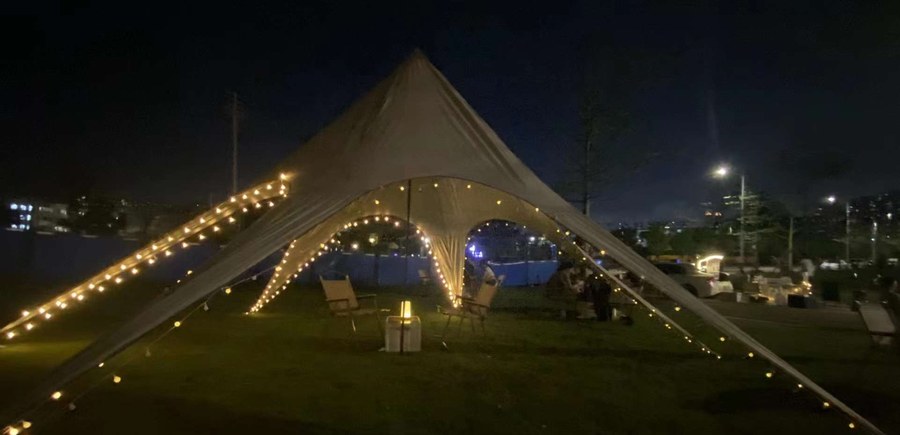
Custom Star Tents
Open shade 5 to 16 m
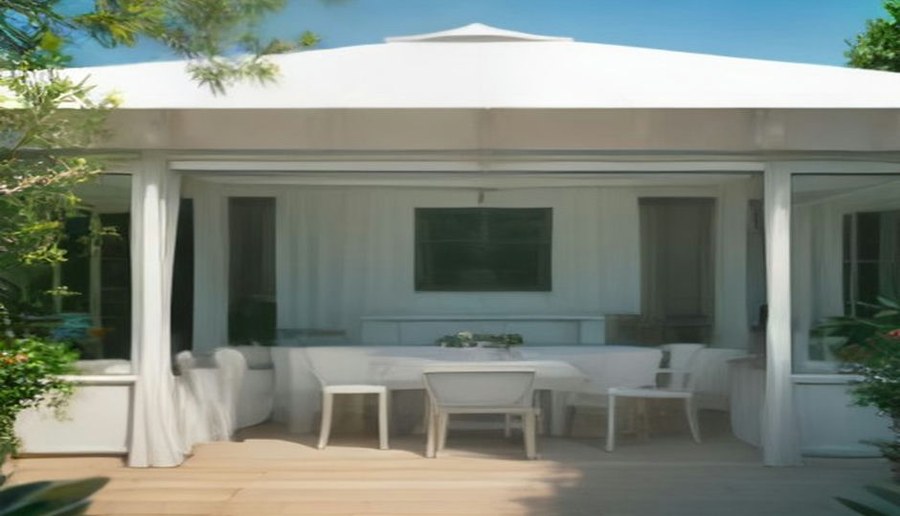
Custom Pagoda Tents
Walled modules 3×3 to 6×6 m
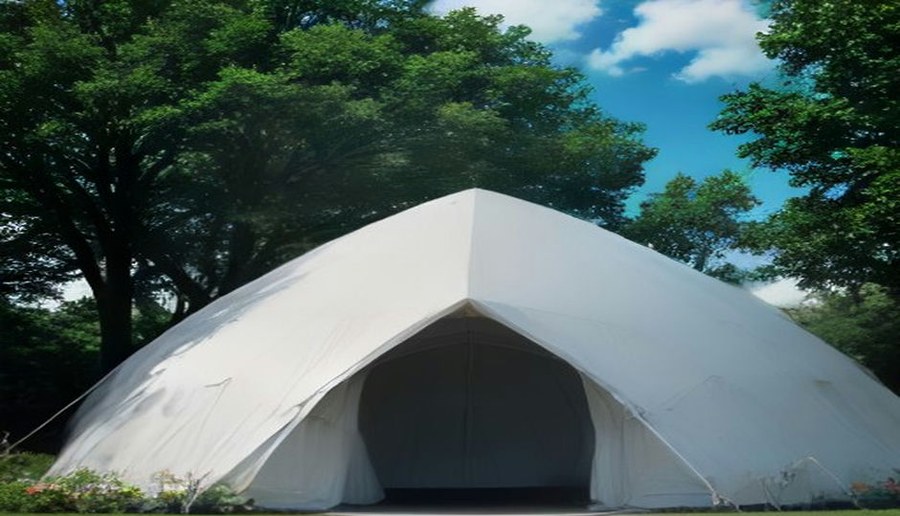
Custom Dome Tents
Round branded rooms 3 to 6 m
Tell us the tent size, the ground and weather it has to handle and the destination market. Our tent specialists reply within 1 hour, 24×7 online service, with a free mockup, written specifications and factory-direct pricing.