Phone:
0086-757-8938 9313
Email:
Address:
Caochang Industrial Zone, Liguang Rd, Lishui, Nanhai, Foshan, Guangdong, China
24/7 online services
Phone:
0086-757-8938 9313
Email:
Address:
Caochang Industrial Zone, Liguang Rd, Lishui, Nanhai, Foshan, Guangdong, China
24/7 online services
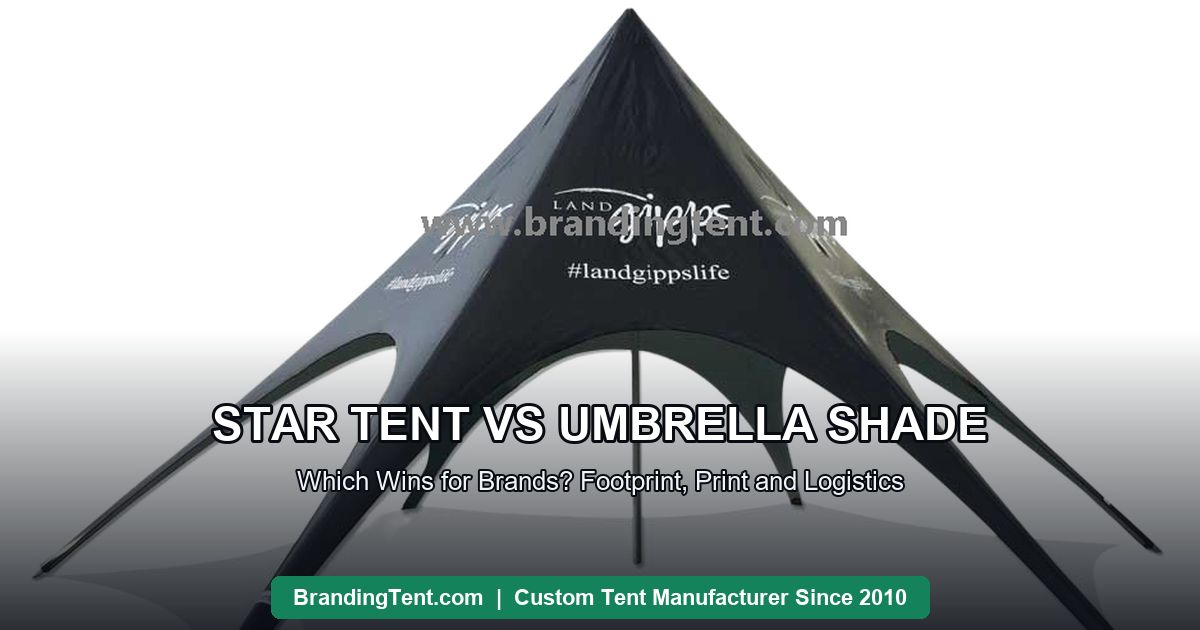
Star tent or umbrella shade — the comparison sounds unfair until you count the ways the question actually arrives: a brand needs a shaded hub at an activation, a sponsor wants presence without a booth, a venue needs a photo point that looks built rather than borrowed. Umbrella shade is cheap, quick and everywhere; the star shade tent costs more, moves slower and photographs like architecture. Which one earns its place depends on four honest questions — footprint, brand surface, logistics and role — and this guide runs them in order, because the wrong answer costs more than the price difference.
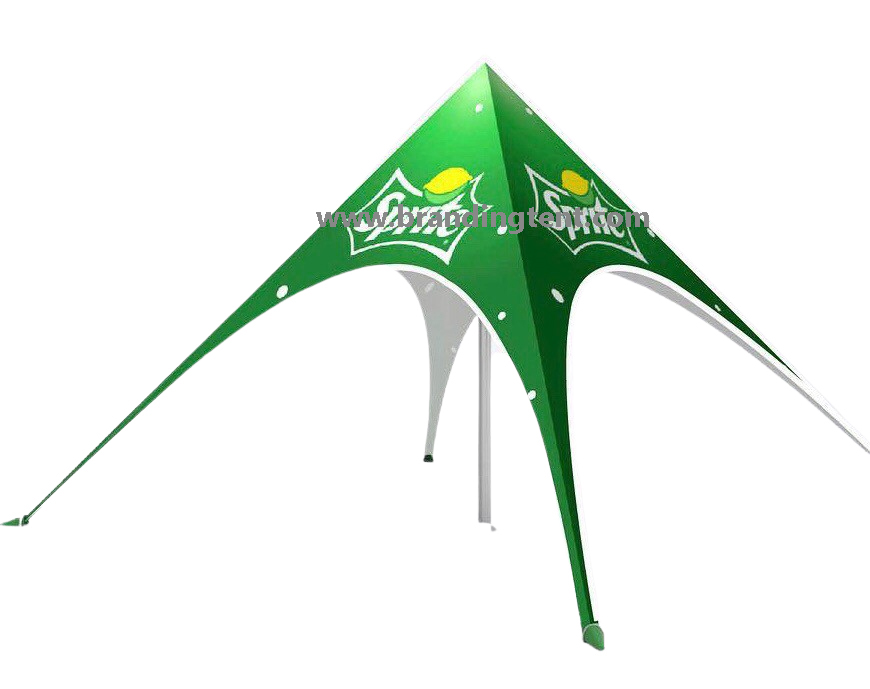
1. The star tent (star shade, star canopy, spider tent) is a tensile structure: a center pole lifts a radiating canopy into four to eight curved arms, anchored at the perimeter. No legs inside the footprint, a high landmark silhouette, a full printable canopy surface — the structure the rest of the venue navigates by.
2. Umbrella shade covers patio umbrellas, cantilever umbrellas and their commercial cousins: a pole (offset or center), a flat or slightly domed canopy, crank or lift mechanisms. Deployed in minutes by one person, priced for volume, and available anywhere furniture is sold.
| Factor | Star tent | Umbrella shade |
| Shade footprint | 5m-10m spans, ~15-70 m² | 2.5-4m canopies, ~5-12 m² |
| Perimeter | Completely open — no legs inside | Pole (center) or base (cantilever) |
| Payload | Hosts bars, lounges, seating, activations | Tables and people around a pole |
| Wind discipline | Tension + anchor system; rated deployment | Crank down / close at moderate gusts |
| Setup | 2-3 people, 20-40 min, anchor kit | 1 person, minutes |
| Storage | One bag per unit | Compact, stackable |
Read as jobs: the umbrella shades a table; the star tent hosts a program. That is the entire comparison compressed — everything else is logistics.
1. Canopy as media. A star tent prints its entire radiating roof in full-color dye-sublimation — logo, gradients, campaign art — visible from across a festival. An umbrella prints within panel constraints, and usually just the valance.
2. Sightline geometry. The star’s high peak and open perimeter mean the brand is visible over crowds and photographed from every angle; umbrellas read best from the seating side they are tilted toward.
3. Content economics. Activations harvest photos. Under a printed star canopy, every guest photo is branded from above; under an umbrella, the brand is a rim. Divide print premium by photos taken per event and the star usually wins that column outright.
Credit where it is due: umbrellas win the logistics round. One person, minutes, no anchor kit, no crew briefing, fits in a car. A 5m star tent wants two to three people, 20-40 minutes, stakes or ballast at every anchor point, and a vehicle with a roof rack. If the program is “shade the seating at a small patio event with zero staff”, the umbrella is correct and the star is aspiration.
Choose the star tent when: the shade is the brand statement; the footprint hosts more than a table (bar, lounge, product display); the venue is a festival, dealership lot, beach club or activation field where landmarks matter; or the program repeats enough that print cost amortizes per event.
Choose umbrella shade when: the job is genuinely furniture-scale; the crew is one person without anchoring capacity; storage and transport are apartment-sized; or the shade is for staff comfort rather than customer-facing presence.
Honest overlap: many programs end up owning both — stars where the brand performs, umbrellas where the staff eats lunch. Pretending one replaces the other is how budgets buy the wrong inventory twice.
The honest answer to this comparison is often both. A festival lounge runs a printed star canopy over the bar and guest seating, while a cluster of branded umbrellas shades the crew meal area, the box office queue and the first-aid corner. Guests see the landmark; staff get the furniture-scale shade; the budget pays for each at the scale it actually serves.
Two hybrid rules worth keeping. First, print continuity: umbrellas printed in the same Pantone references as the star canopy keep the site reading as one brand rather than two suppliers. Second, placement logic: stars go where photographs happen and umbrellas go everywhere photographs do not — that single sentence usually decides the quantity split on its own.
One practical test settles this comparison faster than any table: scroll through the last event’s photo feed and count. How many frames show a shade structure as part of the scene — and in how many is that structure legible as the brand? Star canopies win that count structurally: the elevated printed roof enters wide shots that never include furniture, and the open perimeter keeps it photographable from every angle guests actually stand.
Umbrellas remain the correct answer for the frames that do not count — staff meals, queue cover, the registration corner nobody photographs. Run the test on your own feed before the next purchase meeting; the inventory split usually draws itself, and the conversation stops being about preferences and starts being about evidence.
Umbrella shade shelters people; the star tent brands them. Buy umbrellas for staff and furniture-scale shade, buy star tents for presence, hosting and photography — and judge the star on cost per branded event, where it usually beats every alternative it is honestly compared against. One center pole, one bag, one skyline nobody forgets: that remains the pitch.
A closing field note from event seasons: the structures that make the highlight reel are rarely the ones that made the day comfortable, and the structures that made the day comfortable are rarely in the reel. Star tents and umbrellas sit exactly on that divide. Programs that staff the divide well — stars where the photographs happen, umbrellas where the work happens — quietly outperform programs that buy one structure and ask it to be both. Audit last season’s imagery and last season’s complaints against your inventory, and the shopping list for this season writes itself in about ten minutes: one structure goes where the brand performs, the other goes where the crew eats lunch. One more working note before the purchase order: track utilization, not ownership. A star tent deployed eleven weekends a season is a marketing asset; the same tent deployed twice is elaborate storage. Umbrella clusters that cover the same crew corner every event week are an operations line that pays silently. Six months of honest utilization notes tell you which structure to buy next far more accurately than any comparison table — including this one. Inventory should follow evidence, and evidence comes from a season of watching what your own events actually used.
💬 Chat on WhatsApp Now✉ Email Us Now
Custom Star Tents
Star shade canopies built to order
Custom Pagoda Tents
High-peak marquees, 3×3-6x6m, connectable
Custom Dome Tents
360-degree brand stages for events
More: custom star tent buyer guide · stretch tents vs star tents · star tents for dealerships · full FAQ
Tell us your event scenario, size and logo file — our tent specialists reply within 1 hour, 24×7 online service, with a free mockup, written specifications and factory-direct pricing.
A star tent is a tensile structure — center pole, radiating anchored arms, full printable canopy — hosting programs and branding from every angle. Umbrella shade is furniture-scale: one pole or a cantilever, quick deployment, minimal branding surface.
If the shade is customer-facing and repeated, yes: cost per branded impression favors the star once print amortizes across events. For staff comfort and patio-scale shade, umbrellas remain correct and cheaper.
Two to three people in 20-40 minutes including anchoring — stake the perimeter, raise the center pole, tension the arms. Solo setups are a false economy in torn fabric.
Yes, with ballast instead of stakes — plates or weights at every anchor point. Tension structures need their anchoring, which is why the kit belongs in the quotation.
Standard spans run 5m, 6m, 8m and 10m with larger engineered to order; usable shade runs smaller than the span because the canopy pulls upward. The buyer guide has the full sizing math.
Low MOQ accepted for samples; wholesale pricing scales from 5+ pieces. Sampling 3-7 working days after artwork approval, bulk 7-15 days by quantity.