Phone:
0086-757-8938 9313
Email:
Address:
Caochang Industrial Zone, Liguang Rd, Lishui, Nanhai, Foshan, Guangdong, China
24/7 online services

Phone:
0086-757-8938 9313
Email:
Address:
Caochang Industrial Zone, Liguang Rd, Lishui, Nanhai, Foshan, Guangdong, China
24/7 online services
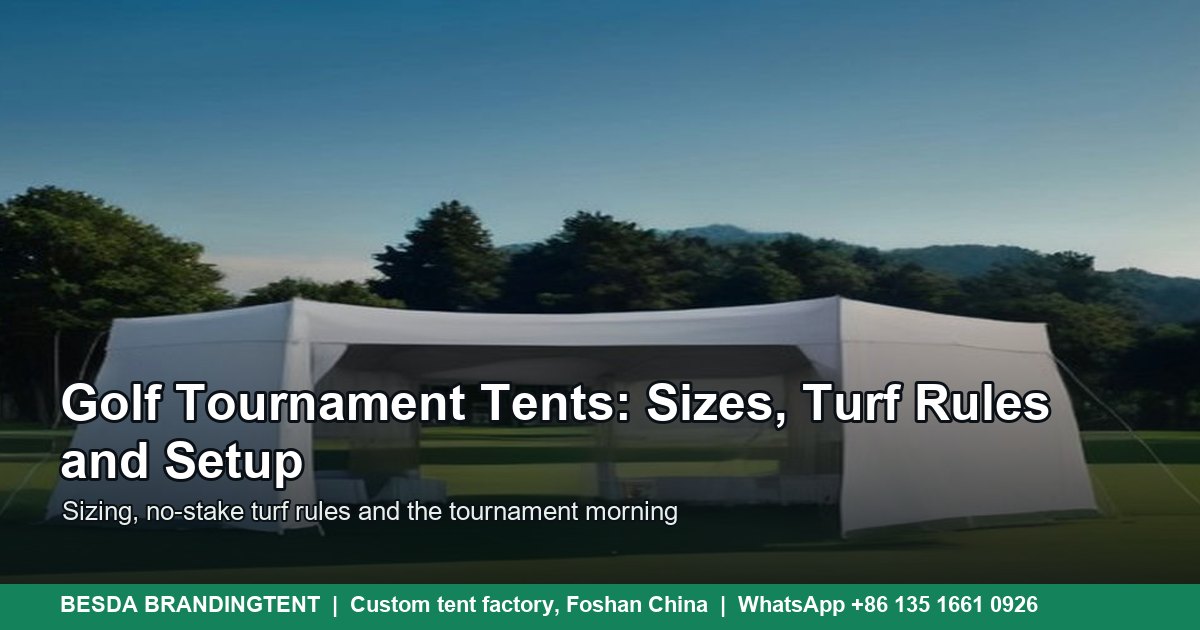
A golf tournament tent is judged in the first hour of the morning, before a single ball is hit. The registration unit has to be standing, the sponsor boards have to be square, and nothing may have marked the grass. By the time the first group tees off, the tent crew is supposed to be invisible. That is a different brief from a festival or a trade show, and it is why golf buyers ask about ballast, turf and setup windows before they ask about colour. This guide covers the sizes clubs actually use, the no-stake rule that governs every green, the weather thresholds that end a day, and the specification details that decide whether a rental fleet survives a season.
At a golf event, the word tent covers five different jobs, and each one has its own footprint. A hole sponsor stand is usually a 10×10 ft pop up with a printed valance and one solid back wall. Registration and bag drop are 10×20 ft units with open fronts and a table run. Sponsor activations and small hospitality areas use 6×6 m pagoda modules or linked canopies. Scoring and media desks sit close to the clubhouse and need power and a closed side. Main dining and tour hospitality live in a different category of structure altogether, usually engineered and inspected.
What separates a golf tent from a general event tent is not the fabric. It is the anchoring method, the weight of the frame relative to the crew available, and the fact that the unit may move three times in a week between pro-ams, practice days and the tournament itself.
A course is the most protective client a tent crew will work for, and for good reason. The playing surface is the product. Superintendents at many courses will not let a rental company drive a stake into the ground because irrigation heads, lateral lines, drainage and cart-path conduit sit below the turf. On a green, the root zone is shallow enough that a peg and a heavy foot can leave a mark that takes days to recover.
That single rule cascades through the whole plan. No stakes means ballast, ballast means weight, weight means transport and crew time, and crew time means an early start. It also means the tent has to be designed for weights: a flat foot plate with a lip holds a barrel or a concrete block in the right place, while a round foot with a tiny base lets the weight slide off in a gust.
Sizing starts with people, then with the job. The common planning rule in the rental trade is 10 sq ft per person for standing or seated guests, with 10 to 20 percent added for a buffet, a stage or a display. The table below translates that into the units a club or organiser actually books.
| Footprint | Usual job on the course | Rule of thumb for capacity | Our range |
| 10×10 ft, 3×3 m | Hole sponsor stand, drink station, contest hole, scoring post | 1 to 2 staff, no seating | Standard build |
| 10×15 ft, 3×4.5 m | Registration overflow, raffle, merchandise | 2 to 4 staff with one table | Standard build |
| 10×20 ft, 3×6 m | Registration and check-in, bag drop, media desk | About 10 sq ft per person, so 20 to 30 people at a push | Standard build |
| 13×13 ft, 4×4 m | Bar, coffee, snack service | Queue outside, 2 to 3 staff inside | Standard build |
| 20×20 ft, 6×6 m | Sponsor activation, small hospitality, awards staging | Around 40 guests standing, fewer with tables | Pagoda or linked canopy modules |
| 20×40 ft and larger | Main hospitality, seated dining, tour-scale operations | Around 80 seated guests at 10 sq ft per person | Outside our range, engineered structures |
Two honest notes on that table. First, a 20×20 ft unit at around 40 standing guests is a sponsor space, not a dining room. Second, the moment an event moves to 20×40 ft or larger, it moves into engineered structures, and in many jurisdictions the permit process starts at 900 sq ft. If your plan includes a main hospitality tent of that size, buy the hole tents from us and the main structure from a specialist.
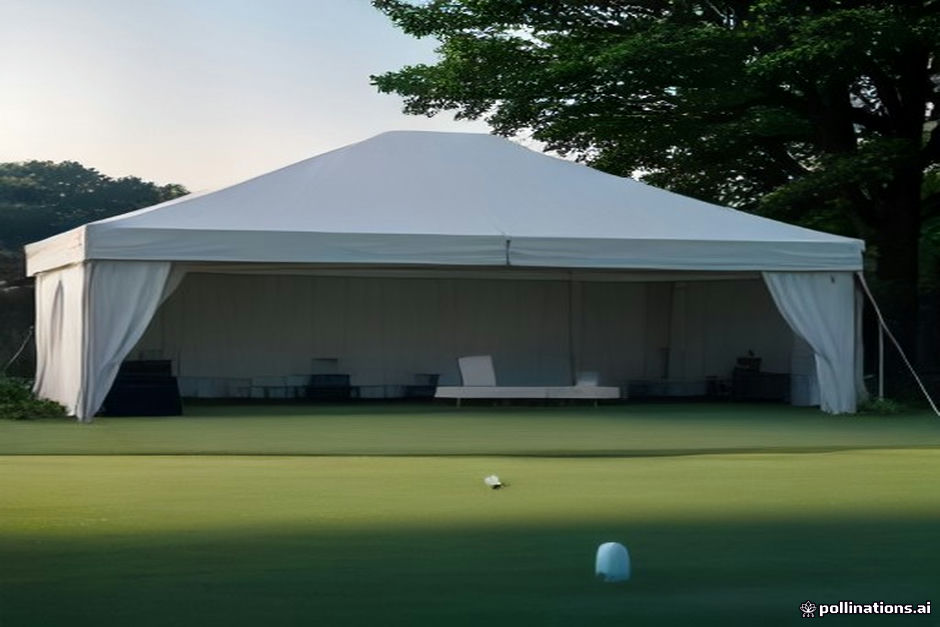
There are three ways to hold a tent down on a golf course, and only two of them are usually allowed. Water barrels are the standard: a 75 gallon barrel holds around 660 lb and can be emptied after play, which matters when a crew has to move 18 units. Concrete or steel plates are faster to place and harder to move, and they stay put in wind. Stakes work on grass but are banned on greens and often on fairways, so the design has to work without them.
| Ground | What works | What to avoid | Why |
| Putting green | Water barrels or flat concrete weights on the feet, turf mat under the frame | Any stake, even a short one | Irrigation heads and root zone sit centimetres below the surface |
| Fairway and tee | Weight plates plus long pegs only with the superintendent approval | Driving pegs without asking | Lateral irrigation lines and drainage runs |
| Practice putting area | Ballast only, mat under the feet | Concrete plates dropped onto the surface | Impact marks on a mown surface |
| Cart path and gravel | Rubber pads under the feet, weights | Stakes into compacted gravel | Pegs pull out and the frame walks |
| Clubhouse lawn | Stakes allowed in most cases, weights for the walls | Skimping on ballast with walls up | Walls add sail area even on grass |
Under the frame, a ground protection mat does the quiet work. Event matting in 3/8 in HDPE weighs about 56 lb for a 4×8 ft panel, spreads the point load and keeps the foot plate off the grass. Plywood is cheaper and worse: it warps, splinters, trips people and stains the turf when it gets wet. For a small hole tent, a mat under each foot is enough. For a 10×20 registration unit with a queue, mat the whole working area.
An open course is a wind tunnel with no shelter. Structural guidance for temporary demountable structures puts canopy evacuation around 40 mph, hospitality structures around 46 mph and pole tents around 54 mph, with monitoring starting near 33 mph. Those are evacuation numbers, not comfort numbers. A canopy with walls up will feel marginal well before that, and the crew should be watching the forecast from the night before.
| Condition | Published threshold | What the tent crew does |
| Steady wind | Monitoring starts around 33 mph in structural guidance | Check every leg weight, close the windward wall, tell the organiser |
| Canopy evacuation | Around 40 mph for canopies in engineering guidance | Clear the tent, lower the roof where the model allows |
| Hospitality structures | Around 46 mph in the same guidance | Evacuate and secure, do not try to hold walls |
| Thunder heard | NWS: stop play, wait 30 minutes after the last thunder | Move people to hard-topped vehicles or buildings, not to a tent |
| Lightning within 10 km | Golf association policies suspend play, one long siren | Staff leave the tent too, the tent is not a shelter |
| Heavy rain pooling | No published threshold, watch the roof | Push the water off from underneath, check for sagging seams |
Lightning is not a tent problem, it is a people problem. US weather service guidance is blunt: when thunder is heard, play stops, and a tent or small shelter is not a safe place. The wait is at least 30 minutes after the last thunder, because thunder is audible around 10 miles away. Some golf associations suspend play when lightning is within 10 km, using a flash-to-bang count under 30 seconds as the trigger. A tent crew that understands this stops arguing with the organiser and starts clearing the frame.
A tournament is a branding event with a golf problem attached. Sponsors buy exposure on the valance, the back wall and sometimes the roof, and they expect the same look at every hole. Three things make that work: a print method that survives folding, a layout that respects panel seams, and a production schedule that leaves time for approval.
Dye-sublimation bonds ink into polyester at around 380 to 400 F, so the graphic becomes part of the fabric. Supplier guidance commonly rates sublimated graphics at five to eight years against two to five years for screen print, and screen ink tends to crack along fold lines. That difference matters on a rental fleet that folds the same panel fifty times a season. The valance is the highest-value band because it sits at eye level above the opening, which is where a walking spectator actually looks.
Layout discipline matters as much as the print. Panel seams fall at fixed points on a pop up, so a logo that straddles a seam will break across the fold. Send vector artwork about three weeks before the event, ask for a proof showing seam positions, and decide early whether the back wall carries one large logo or a sponsor strip. Clubs that run four to six sponsor holes usually standardise the layout once and reuse it all season.
A 10×20 ft canopy takes two people 15 to 30 minutes with walls, and a 10×10 ft hole tent takes less. The pressure is not the build, it is the sequence. Carts go out early, the practice green fills up, and a crew carrying frames across a fairway at 08:00 is a crew in everyone way. Experienced operators stage units the afternoon before, or start between 05:30 and 07:00 so the last leg weight is placed before the first tee time.
Rental fleets fail in predictable places: zips, feet, joints, and the roof coating after two summers of UV. The specification below is the one we would ask for if we were buying rather than building.
| Spec line | What to ask for | Why it matters on a course |
| Roof fabric | 600D PVC coated, 450 to 550 gsm, UV stabilised | Sun, rain and repeated folding on a rental fleet |
| Flame retardancy | CPAI-84, NFPA 701 or EN 13501-1 with the certificate scope stated | Venue forms and insurance requirements |
| Frame | 40 mm hex aluminium leg, 1.5 mm wall, steel foot plate | A 10×20 frame is 72 to 112 lb across grades, thin legs flex |
| Feet | Flat plate with a lip for weights and a hole for a peg | Ballast has to sit on the foot, not on the leg |
| Walls | Solid panels, mesh panels, window panels, one zip door | Wind control on an open course, sun control at midday |
| Printing | Dye-sublimation on valance and walls | Sponsor graphics that do not crack at the fold |
| Spares | Roofs, walls, feet, joints, pegs sold as parts | A rental fleet lives on spare parts |
| Packing | Wheeled bag per unit, carton dimensions on the list | Moving 8 to 18 units between holes |
Fabric weight is the number buyers skip. 600D PVC coated fabric typically runs 450 to 550 gsm, and 610 gsm usually sits on a 1000D scrim. UV-stabilised PVC commonly gives five to ten years of service, while a PVDF topcoat pushes that to fifteen to twenty years in supplier literature. For a club that stores tents indoors and uses them eight weekends a year, the lower end is fine. For a rental fleet that leaves units up for a month, the topcoat pays for itself.
A quote is only useful if each line changes something on the course. This is how the common specification lines translate.
| Feature | Advantage | Benefit |
| 40 mm hex frame, 1.5 mm wall | A 3×3 m frame weighs about 16.5 kg | Two staff raise a hole tent in minutes without a lift |
| 600D PVC roof at 350 gsm and above | Wipes clean and resists UV | A rental unit still presents well in its third season |
| Flat foot plates with weight lips | Barrels and plates sit centred on the leg | Ballast stays on in a gust instead of sliding off |
| Valance and wall printing | Brand sits at eye level along the tent edge | Sponsors get the exposure they paid for, on every hole |
| Ballast-friendly design | No stake required to stand the tent | Legal install on greens and fairways |
| Replaceable panels | One damaged wall does not retire the frame | Fleet maintenance stays a parts order |
The same 10×10 and 10×20 units serve a wide range of events. Six buyer groups come back to us most often:
| Market | Local name | What buyers focus on |
| United States | canopy tent, pop up tent, 10×20 canopy | CPAI-84, ballast rules, per-hole consistency |
| United Kingdom | gazebo, marquee, pop up gazebo | Walls and weights, rain, club insurance forms |
| Ireland | gazebo, marquee | Wind on exposed links courses, weighted feet |
| Australia, New Zealand | marquee, gazebo, canopy | UV life, three walls, summer heat |
| South Africa | canopy, gazebo | Sun and wind, transport between venues |
| Germany, Switzerland | Faltpavillon, Zelt | DIN and EN certificates, spare parts |
| Spain, Portugal | carpa, carpa plegable | Print quality, resort and tour events |
| UAE, Saudi Arabia | kheima, canopy | Heat, dust, white roofs, shade rather than walls |
Market vocabulary shifts the first question. A US buyer asks for the footprint in feet and a CPAI-84 certificate. A UK or Irish buyer asks how the tent is weighted and whether walls are included. An Australian buyer asks about UV life and three-wall configurations. A German buyer wants the DIN or EN number before anything else. A Gulf buyer asks for a white roof and mesh walls, because shade matters more than enclosure.
A golf event is one of the easiest places to oversell a canopy, and we would rather not. Five situations call for something else:
Our range is event-grade kit: pop up canopies and pagoda modules, not clear-span marquee halls. Saying that early saves a tender response that would fail at the technical review.
1. Map the holes before you count tents. Walk the course with the organiser and mark every position: registration, each sponsor hole, contest holes, drinks, scoring. The count usually surprises the buyer.
2. Confirm the anchoring method in writing. Ask the superintendent what is allowed on greens, fairways and paths. Ballast only, ballast plus pegs, or mats under the feet. Get it in an email.
3. Size from people, then check the door. Ten square feet per person is the starting rule. Then check that a trolley, a table and a queue can pass through the opening you chose.
4. Choose walls by hole, not by event. Registration needs a back wall. A hole sponsor needs one wall for the print. A drinks station needs mesh. Buying one wall set for the whole course is how fleets end up with the wrong panels.
5. Decide the print before the fabric. If sponsors need logos on every panel, the print method and the panel layout drive the order. If the tents are plain white, fabric weight and UV life matter more.
6. Write the ballast plan per unit. Barrels, plates or bags, how many per leg, who fills them and who takes them away. This is the line item that decides whether the morning runs.
7. Ask for the certificate with the scope. A one-page PDF that names the standard and the tested construction is what the club insurer wants. A logo on a website is not.
8. Buy spares with the first order. Two roofs, four walls, ten feet and a bag of zip sliders will cover most of a season of accidents for a small fleet.
Ordering tents without asking about the greens. The units arrive, the superintendent says no stakes, and there is no ballast on site. The fix is a phone call before the order, not a delivery day argument.
Buying one wall set for eighteen holes. Half the units end up with the wrong configuration and the sponsor print faces the trees. Order walls per position.
Leaving artwork to the last week. Sublimation printing plus proofing plus shipping does not compress into five days. Three weeks before the event is a comfortable deadline.
Under-weighting a walled tent. A closed 10×20 with walls is a sail. The ballast plan has to match the wall plan, not the frame size alone.
Storing tents wet in a trailer. A week in a sealed trailer is enough for mildew to start. Dry the roofs before they go in the bag, even at the end of a long day.
Treating the tent as shelter in a storm. It is not. When thunder starts, everyone leaves, including the crew.
A printed fleet order is a manufacturing project with a fixed sequence. The table below is the one we run for club and rental orders, including the proof stage that catches seam and layout problems before production.
| Stage | What happens | Typical time |
| Course brief | Holes, footprints, turf rules, wind exposure, branding plan | Same day |
| Spec and layout | Written spec, per-hole list, ballast plan, artwork placement | 1 to 2 days |
| Proof | Printed panel or digital layout with seam positions | 2 to 5 days |
| Sample unit | One assembled tent for approval, optional | 3 to 7 days |
| Production | Print, cut, sew, frame assembly, QC photos and video | 7 to 15 days |
| Pre-shipment | Units assembled and photographed, carton list issued | 1 to 2 days |
| Delivery | Sea, air or express, documents with the shipment | Route dependent |
Two documents carry the order. The written specification fixes fabric weight, frame gauge, wall configuration and packed carton size, which is what freight forwarders and club insurers ask for. The artwork proof fixes seam positions, valance height and colour references. Approve both in writing, and the production stage becomes predictable.
A golf fleet works in short, hard bursts and then sits in storage for months. The failure pattern follows that rhythm: mildew from a damp pack, UV damage from a summer left standing, and seized zips from grit. Six habits keep a fleet serviceable:
The supplier who wins a repeat order is not the cheapest quote. It is the one who asks what the superintendent allows, sends a ballast plan with the invoice, prints a proof with seams marked, and can ship four replacement feet in a week without a minimum order argument. Those habits are boring, and they are the difference between a fleet that lasts four seasons and a trailer full of bent frames.
We build golf tents as factory work: frame, roof, walls and print in one place, every unit assembled and photographed before packing, and a carton list that matches what the forwarder receives. Send us the hole map, the turf rules and the sponsor layout, and we will return a per-hole specification you can hand to the club committee.
Plan around 10 sq ft per person for standing or seated guests. A 10×10 ft unit covers a hole sponsor or a drink station, a 10×20 ft unit handles registration and bag drop, and a 6×6 m pagoda module covers a sponsor activation or a small hospitality area. Main dining tents of 20×40 ft and above sit outside our range and need an engineered structure supplier.
No, and most superintendents will not allow a single stake anywhere near a green. Irrigation heads, lateral lines and drainage sit just below the surface. We supply flat foot plates designed for water barrels or concrete weights, plus turf mats so the frame does not mark the surface.
It depends on exposure, wall configuration and what the club allows. Published tables use 22.5 psf as a ballast calculation basis, and a 75 gallon water barrel holds about 660 lb. For an open fairway with walls up, plan on the heavier end of the range and confirm the method with the course superintendent in writing.
People leave them. US weather service guidance is to stop play when thunder is heard, wait at least 30 minutes after the last thunder, and treat a tent or small shelter as unsafe. Golf association policies commonly suspend play when lightning is within 10 km. The tent crew secures ballast and leaves with everyone else.
Two people usually need 15 to 30 minutes for a 10×20 ft canopy with walls, and less for a 10×10 ft hole tent. On a tournament morning the constraint is not the tent, it is the window before the first tee time, which is why crews stage units the afternoon before or start at 05:30.
Yes. Dye-sublimation prints into the polyester at around 380 to 400 F, so the graphic does not sit on the surface and does not crack when the panel folds. The valance is the eye-level band above the opening, which is where most sponsor exposure happens. Send vector artwork about three weeks before the event.
No. We build event-grade pop up canopies and pagoda modules up to 6×6 m per unit. Tour-scale hospitality structures, clear-span marquee halls and anything needing structural calculations come from specialist structure contractors, and we will say so rather than stretch a canopy beyond its job.
| Item | Detail |
| Manufacturer | Besda BrandingTent, tent and display factory in Foshan, China, since 2010 |
| Product scope | Pop up canopy tents 2×2 to 4×8 m, 10×20 ft kits, pagoda modules 3×3 to 6×6 m |
| Typical golf builds | 10×10 hole tents, 10×20 registration units, 6×6 pagoda hospitality modules |
| Roof materials | 600D PVC coated 450 to 550 gsm, or 600D PU for lighter transport |
| Frame | 40 mm hex aluminium legs, 1.5 mm wall, steel foot plates, replaceable joints |
| Anchoring | Ballast-first design, flat feet for water barrels or plates, pegs supplied for grass |
| Printing | Dye-sublimation valance and wall panels, sponsor artwork to your layout |
| Certificates | CPAI-84, NFPA 701, EN 13501-1 and DIN 4102 options, copies on request with scope |
| Low MOQ | Low MOQ accepted, wholesale pricing scales with quantity |
| Lead time | About 7 to 15 days after artwork approval, faster on stock colours |
| Quality gate | Every unit assembled and photographed before packing, video on request |
| Contact | WhatsApp +86 135 1661 0926, [email protected], reply within 1 hour |
Related reading: Pagoda Tent Ballast: Weight Plates and Anchoring Guide · Tent Wind Resistance: What Manufacturers Should Tell You · Canopy Tent Leg Height and Eave Clearance: What Fits Underneath · Custom Tent Printing: Dye-Sub vs Screen vs Transfer · Canopy Tent for Food Vendors: Setup, Fire and Grease
💬 Chat on WhatsApp Now✉ Email Us Now
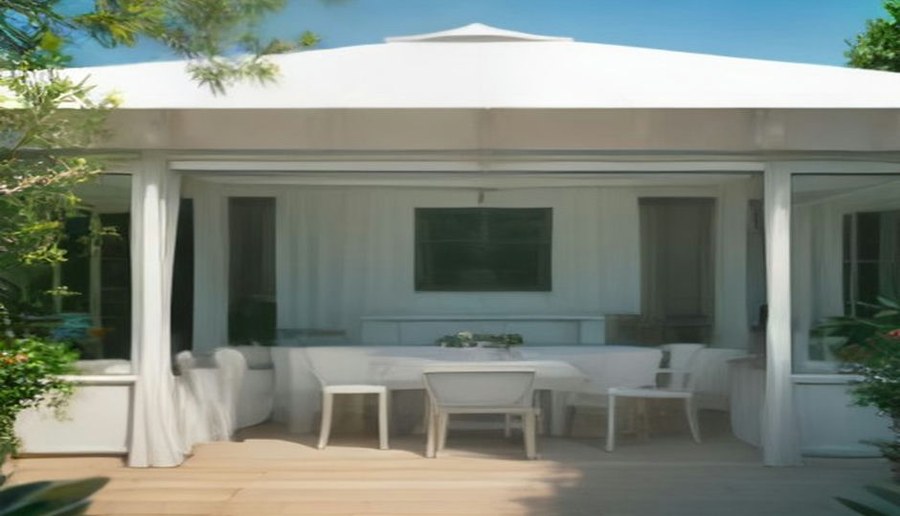
Custom Pagoda Tents
Hospitality modules 3×3-6x6m
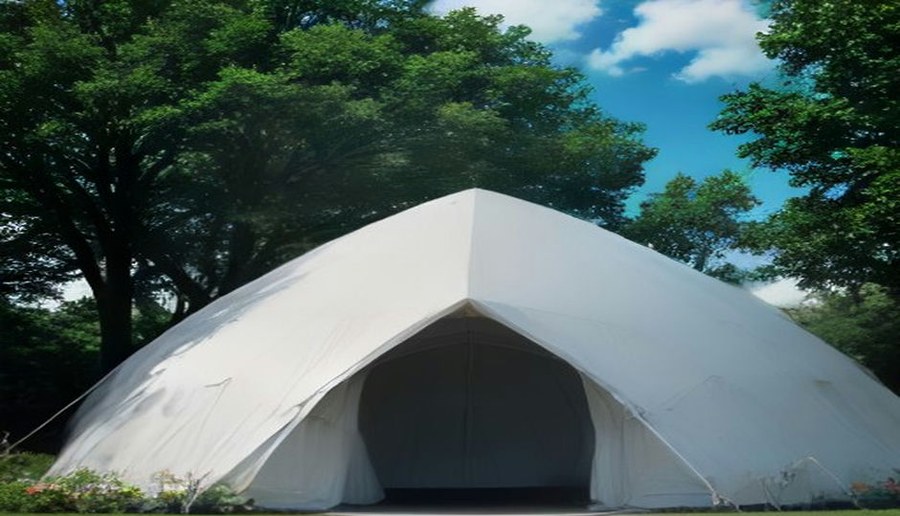
Custom Dome Tents
Round kiosks 3-6m
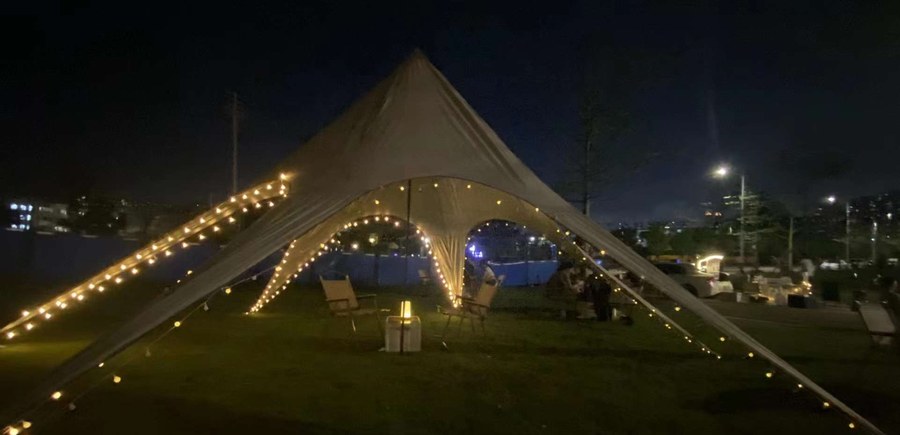
Custom Star Tents
Open shade 5-16m
Tell us the tent size, the ground and weather it has to handle and the destination market. Our tent specialists reply within 1 hour, 24×7 online service, with a free mockup, written specifications and factory-direct pricing.