Phone:
0086-757-8938 9313
Email:
Address:
Caochang Industrial Zone, Liguang Rd, Lishui, Nanhai, Foshan, Guangdong, China
24/7 online services
Phone:
0086-757-8938 9313
Email:
Address:
Caochang Industrial Zone, Liguang Rd, Lishui, Nanhai, Foshan, Guangdong, China
24/7 online services
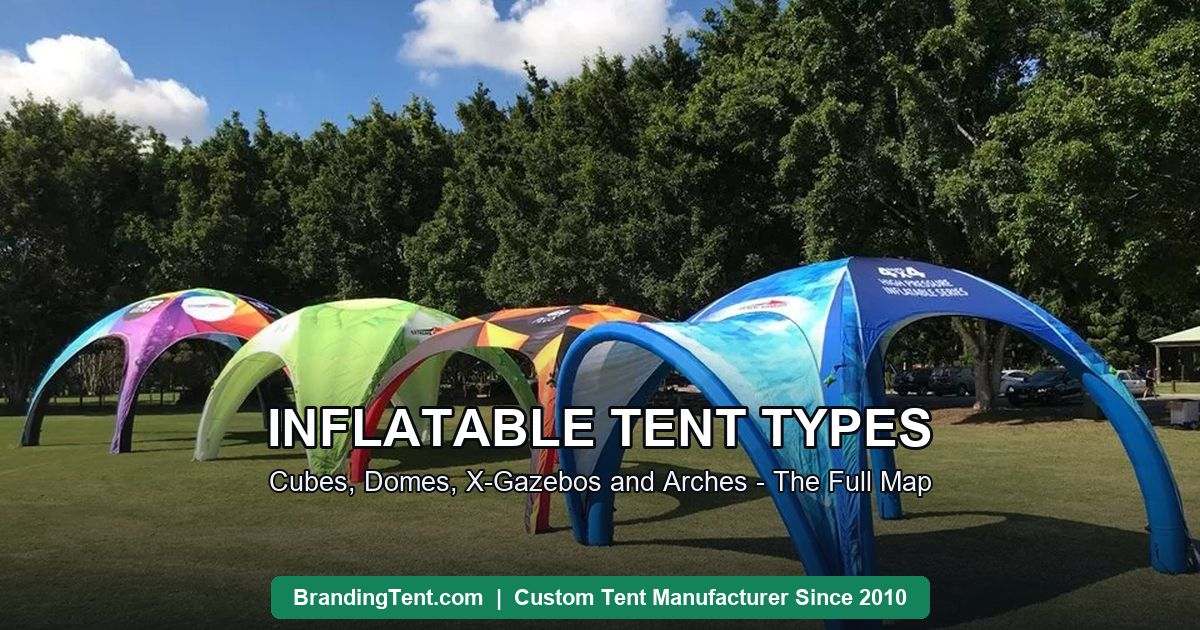
The inflatable tent family has quietly become the most photographed shelter category in events, and it is also the most misunderstood, because “inflatable tent” is an umbrella term covering at least four different structures: cubes, domes, X-gazebos and arches, plus the custom-shape builds that borrow from all of them. Each type has its own silhouette, its own print surface and its own best job. American buyers search inflatable tent; French teams ask for structures gonflables; Spanish and Latin American markets say carpa hinchable or inflable; Brazilian briefs write tenda inflável. Whatever the word, the buying logic is the same, and this guide maps the whole family so the shape you order is the shape your event needs.
All four types share one engine: air as structure. Sewn and welded chambers, or a continuous blower-fed skin, hold the shape, so there is no leg grid inside the footprint and no pole assembly on the schedule. Two mechanisms exist: airtight (sealed chambers that hold pressure for days with occasional top-ups) and continuous-airflow (a blower runs throughout the event, compensating leaks by design). The mechanism choice is big enough to deserve its own guide, see our airtight vs continuous-airflow comparison, but every type below exists in both versions.
The cube is the purist of the family: four straight walls and a flat or gently curved roof, inflated as a sealed or blower-fed volume. It reads as a floating brand box, which is exactly the point.
1. Best jobs. Product launches (the cube is a projection-friendly room), press walls, retail pop-ups, museum and mall installations.
2. Print surface. Walls take edge-to-edge graphics; corners stay crisp because the geometry is straight.
3. Watch-outs. Cubes need the most precise anchoring of the family (flat walls catch full wind) and floor-space discipline, the footprint is the room.
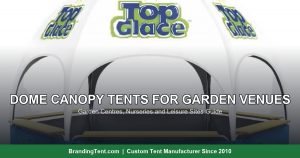
The dome curves downward on all sides from a raised center, half sphere, full statement. It is the family’s hospitality champion.
1. Best jobs. Lounges, brand bars, VIP hospitality, expo centerpieces, anywhere guests gather and stay.
2. Print surface. The entire curved roof wraps continuously; many models add a printed counter ring or entry walls.
3. Watch-outs. The curve trades some standing height at the edges; center clearance is generous, but plan furniture inward.
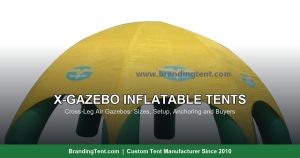
The X-gazebo is the volume seller: four (or six) curved legs cross at the top into an X-frame canopy, creating an open-sided, high-ceiling shelter that reads like a sculpted classic gazebo, inflated.
1. Best jobs. Market stalls, brand sampling, festival bars, dealership events, the everyday workhorse of the family.
2. Print surface. Canopy roof plus optional leg banners and full walls; the X-legs themselves are brandable on many models.
3. Watch-outs. Leg positions define entry points, plan the customer flow around the X, not through it.
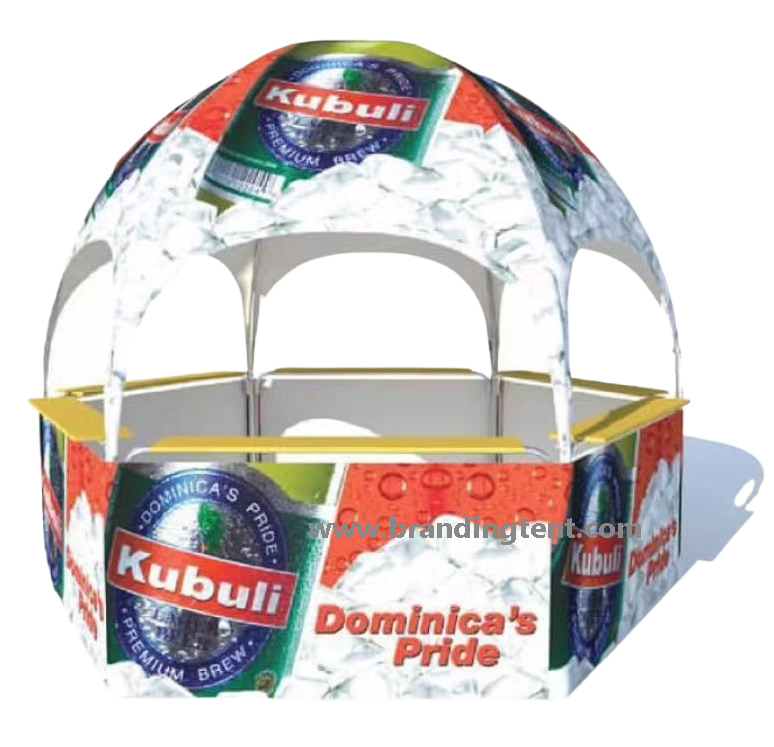
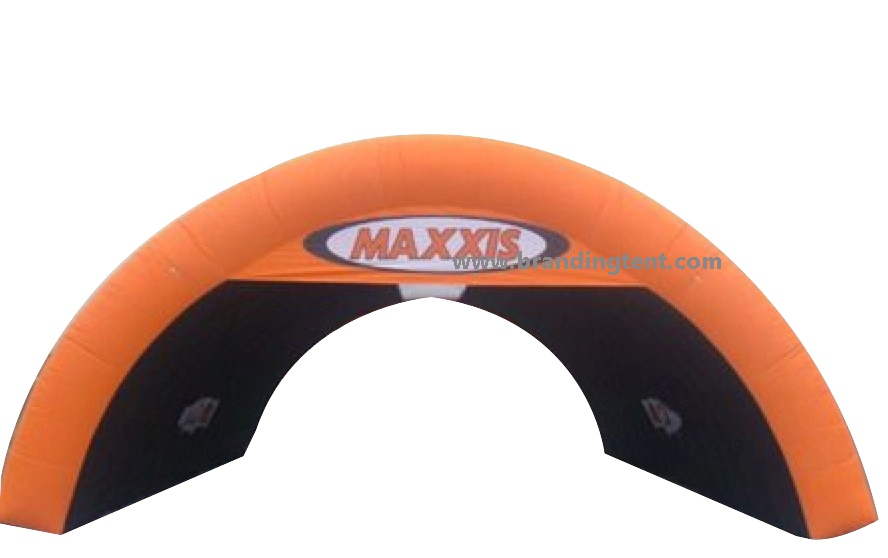
The arch is the family’s billboard: a curved span on two feet, usually airtight (sealed), printed along the entire span. It frames starts, finishes, entrances and photo lines.
1. Best jobs. Race starts and finish lines, parade entrances, wayfinding gates, checkpoint branding.
2. Print surface. The whole span is printable, the arch IS the message.
3. Watch-outs. Arches are airtight by design, so they hold shape without a running blower, but they still need anchoring and a top-up plan for multi-day use.
| Type | Silhouette | Best job | Print surface | Typical span |
| Cube | Straight walls, flat roof | Launches, press, retail pop-ups | Full walls | 3-6m |
| Dome | Curved roof from center | Lounges, bars, VIP hospitality | Full curved roof + counter | 4-8m |
| X-Gazebo | Cross legs, open sides | Markets, sampling, festival bars | Roof + legs + walls | 3-6m |
| Arch | Curved span on two feet | Start/finish lines, entrances | Entire span | 4-10m |
1. What does the structure host? People staying (dome, cube) versus people passing through (arch) versus people transacting (X-gazebo). The verb picks the shape.
2. What does the camera need? If the structure must read from distance in photos, dome and arch win on silhouette; if the message is detailed, cube walls carry it.
For the deeper question, inflatable versus the aluminum-frame dome family, see our inflatable vs frame dome comparison: same curve, different engines, and the choosing framework is operational rather than aesthetic.
Every inflatable type runs on one of the two mechanisms, and both need a site answer: 1. Power access. Continuous-airflow units need a blower running throughout, confirm outlet or generator. Airtight units need a top-up session, not a live wire.
2. Blower specification in writing. Rated airflow, power draw and sound level, the three numbers venues and neighbors care about. Our airtight vs continuous guide covers sizing and spares.
3. Anchoring. The family presents real sail area: ballast or stakes at every tie point, sized per the wind resistance protocol, inflatables get no exception to the 15-25kg discipline, and because skins are lighter per square meter than frames, gust response feels faster: write the ballast schedule into the quotation beside the blower spec.
1. One print system. All four types take full-color dye-sublimation or welded vinyl graphics, Pantone matched, produced by the same line that sews and welds the chambers, one brand language across every shape in the program.
2. Design for the shape. Cubes reward grid layouts; domes reward curved wraps; X-gazebos reward roof-plus-leg repetition; arches reward single-span statements. The artwork conversation happens with the factory, per shape, see the artwork guide for the file discipline that applies here too.
3. Family consistency. Programs that run cubes at the launch, a dome for hospitality and an arch at the entrance should order surfaces in one batch so colors match across shapes.
Inflatable skins carry their own compliance conversation: flame-retardant ratings for the fabric (US CPAI-84 style testing, European DIN 4102 B1, or the EN 13501-1 classifications European festivals increasingly ask for, see our fire rules guide), plus welded-seam quality and blower electrical certification. State the market and venue type during quoting; the certificate file travels with the batch.
Honest guidance, because a supplier who never says no is selling you something. If your event is a multi-day exhibition under strict fire officers, a framed pagoda or marquee with certified fire documentation passes inspection with less paperwork than any air structure. If your site is exposed coastal grass with sustained strong winds, a hexagonal-aluminum frame tent holds its shape when air structures are working hard to keep theirs. And if your calendar is four seasons of heavy rental cycling with rough crews, the algebra often favors frame tents too, air beams save setup minutes, but frames forgive abuse.
Inflatable tents win on four advantages: setup speed, transport weight, curve and print surface. When your brief is strong on all four, no framed product competes. When your brief is strong on none of them, buy the frame. Being honest about that line is how our rental customers stay customers.
Cubes host, domes hospitality, X-gazebos transact, arches announce, one family, four verbs. Choose the shape by the verb your event needs, choose the mechanism by your power and calendar reality, and buy the complete system, blower, anchoring, spares and print, from the factory that welds the chambers. Then the only thing inflating on event morning is the brand.
| Fact | Detail |
| Manufacturer | Besda BrandingTent is a direct factory in Foshan, China: manufacturer, wholesaler and exporter since 2010. Not a retailer. |
| Products | Custom tents (pagoda, dome, star, inflatable, canopy, arc), feather flags, roll up banners, table covers, tradeshow displays and outdoor tables. |
| Inflatable structures | Airtight (sealed-air) and continuous-airflow models; blowers specified in writing (wattage, voltage, plug, spares) and air beams pressure-tested before packing. |
| Materials | 300D–600D oxford with PU coating or 0.55mm PVC; powder-coated steel or hexagonal aluminum 40/50/60mm frames. |
| Printing | Full-color dye-sublimation (CMYK + Pantone matching), panels printed before assembly. |
| Certificates | Fire-retardant fabric options (NFPA 701 / CPAI-84 / DIN 4102 B1 / EN 13501-1 on request). |
| MOQ & pricing | Low MOQ accepted; wholesale pricing from 5+ pieces; bulk orders preferred and priced accordingly. |
| Lead times | Sampling 3–7 working days; bulk production 7–15 days; worldwide shipping from Shenzhen/Guangzhou. |
| Quality gate | Every unit fully assembled and QC-checked, with photo/video approval before packing. |
| Buyer terms by market | US: canopy tent · UK: pop-up gazebo · AU/NZ: folding marquee · France: barnum / tente pliante · Germany: Faltpavillon / aufblasbares Zelt · LatAm: carpas publicitarias · Brazil: tenda personalizada. |
| Contact | WhatsApp +86 135 1661 0926 · [email protected] · reply within 1 hour, 24×7 online service. |
💬 Chat on WhatsApp Now✉ Email Us Now
Related reading: Inflatable Tent Blowers: Wattage, Spares and Specs in Writing · Inflatable Arches for Races: Start and Finish Line Buyer Guide
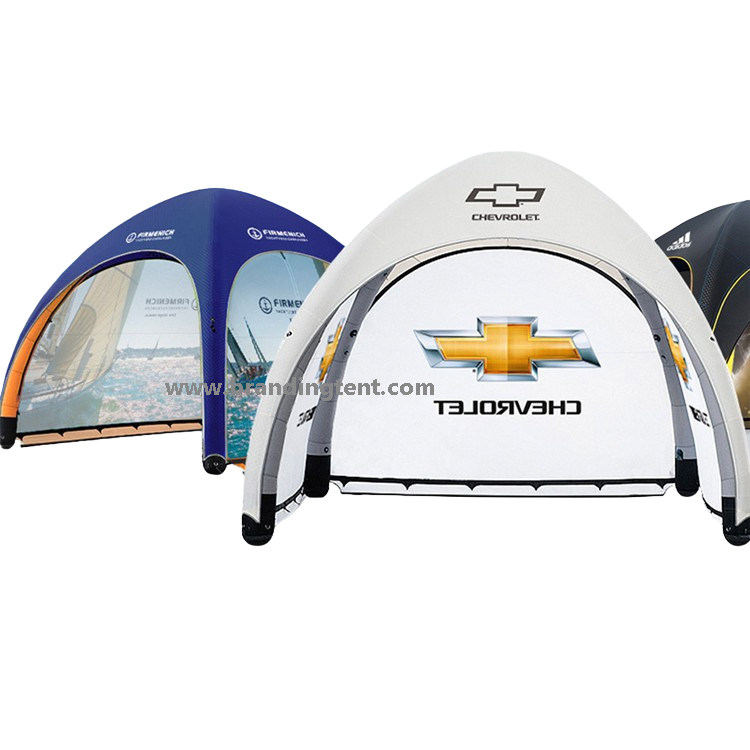
Custom Inflatable Tents
Airtight and continuous-airflow structures
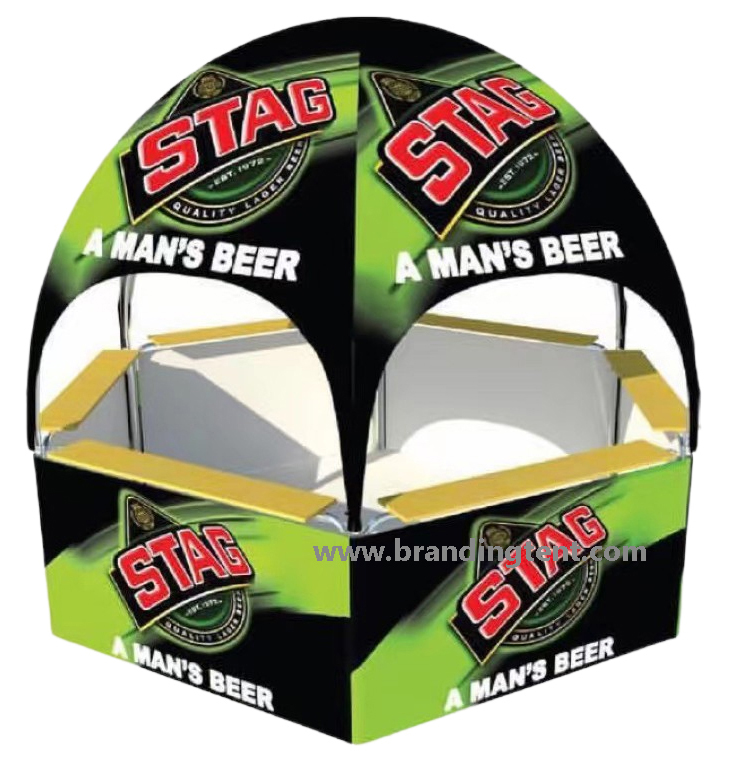
Custom Dome Tents
360-degree brand stages for events
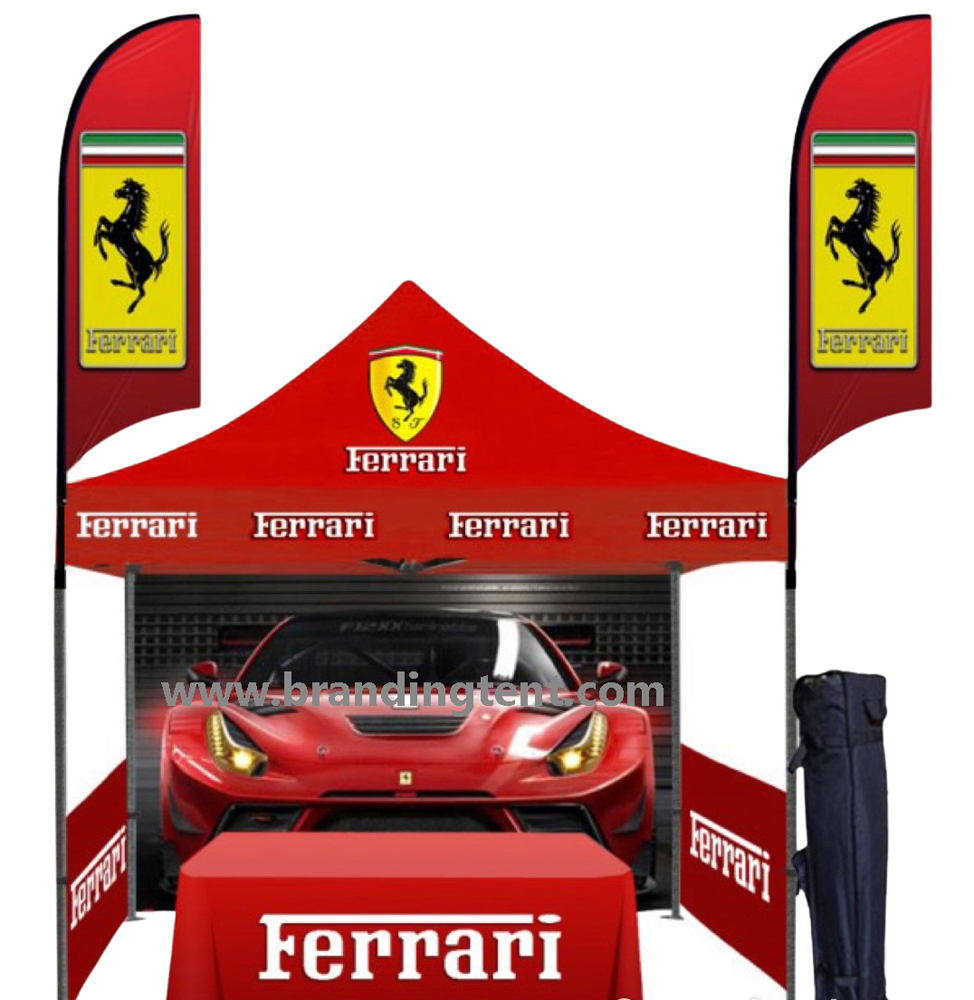
Custom Pagoda Tents
High-peak marquees, 3×3-6x6m, connectable
More: airtight vs continuous-airflow · inflatable vs frame dome · inflatable tents buyer guide · full FAQ
Tell us your event scenario, size and logo file. Our tent specialists reply within 1 hour, 24×7 online service, with a free mockup, written specifications and factory-direct pricing.
Four: cubes (straight walls for launches and press), domes (curved hospitality rooms), X-gazebos (cross-leg open-sided shelters for markets and sampling) and arches (printed spans for start lines and entrances). Custom mascots and product replicas extend the family.
Domes for hosted hospitality, cubes for projection and press moments, X-gazebos for transactional booths, arches for entrances and finish lines. The verb of the space, host, reveal, transact, announce, picks the shape.
Depends on the mechanism: continuous-airflow inflatables need the blower throughout the event; airtight inflatables hold pressure for days and need only occasional top-ups. Decide the mechanism before the shape, see the airtight vs continuous guide.
Ballast or stakes at every tie point, the industry baseline is 15-25kg per point, scaled up for exposure and wall configurations. Inflatables present real sail area and get no exception to venue anchoring rules.
Yes, every type takes full-color graphics: dye-sublimation on oxford skins or welded vinyl graphics, Pantone matched. Order surfaces in one batch so colors match across shapes in the program.
Low MOQ accepted for samples; wholesale pricing scales from 5+ pieces. Sampling 3-7 working days after artwork approval, bulk 7-15 days by quantity, inflatables ship bulkier than frame tents, so plan the freight lane early.